Winter interest plants are the ones that still give you something to look at between leaf drop and spring: coloured stems, peeling bark, berries that hang on, evergreen leaves, or flowers that open in the cold. The Royal Horticultural Society’s winter interest guide names the same five sources — “flowers, scent, berries, coloured stems or dramatic evergreen foliage” — and adds that many such plants are scented and most are shade tolerant. The thirteen below cover all five. Every zone range and size comes from the plant’s own NC State Extension profile, linked in the table, so you can check the one you are about to buy.
Most winter-interest lists stop at the names. Three things decide whether the plant actually performs in January, and they are the part this guide adds: whether it is hardy where you live (the zone table below), whether it needs something it does not come with (a male holly, an annual cut), and whether it is a plant you should be adding at all (one staple of berry lists is an invasive shrub).
The 13 plants, with their numbers
Zones are USDA hardiness zones as NC State’s Extension Gardener Plant Toolbox records them. Sizes are mature height × spread.
| Plant | Botanical name | Winter feature | Zones | Size |
|---|---|---|---|---|
| Red twig dogwood | Cornus sericea | Red stems | 2a–7b | 5–9 ft × 5–10 ft |
| Winterberry | Ilex verticillata | Red berries on bare branches | 3a–9b | 3–15 ft × 3–12 ft |
| American holly | Ilex opaca | Evergreen leaves, red berries | 5a–9b | 40–60 ft × 10–20 ft |
| Hybrid witch hazel | Hamamelis × intermedia | Late-winter flowers | 4a–9b | 15–20 ft × 8–10 ft |
| Common witch hazel | Hamamelis virginiana | Fall-into-winter flowers | 3a–9b | 15–30 ft × 15–20 ft |
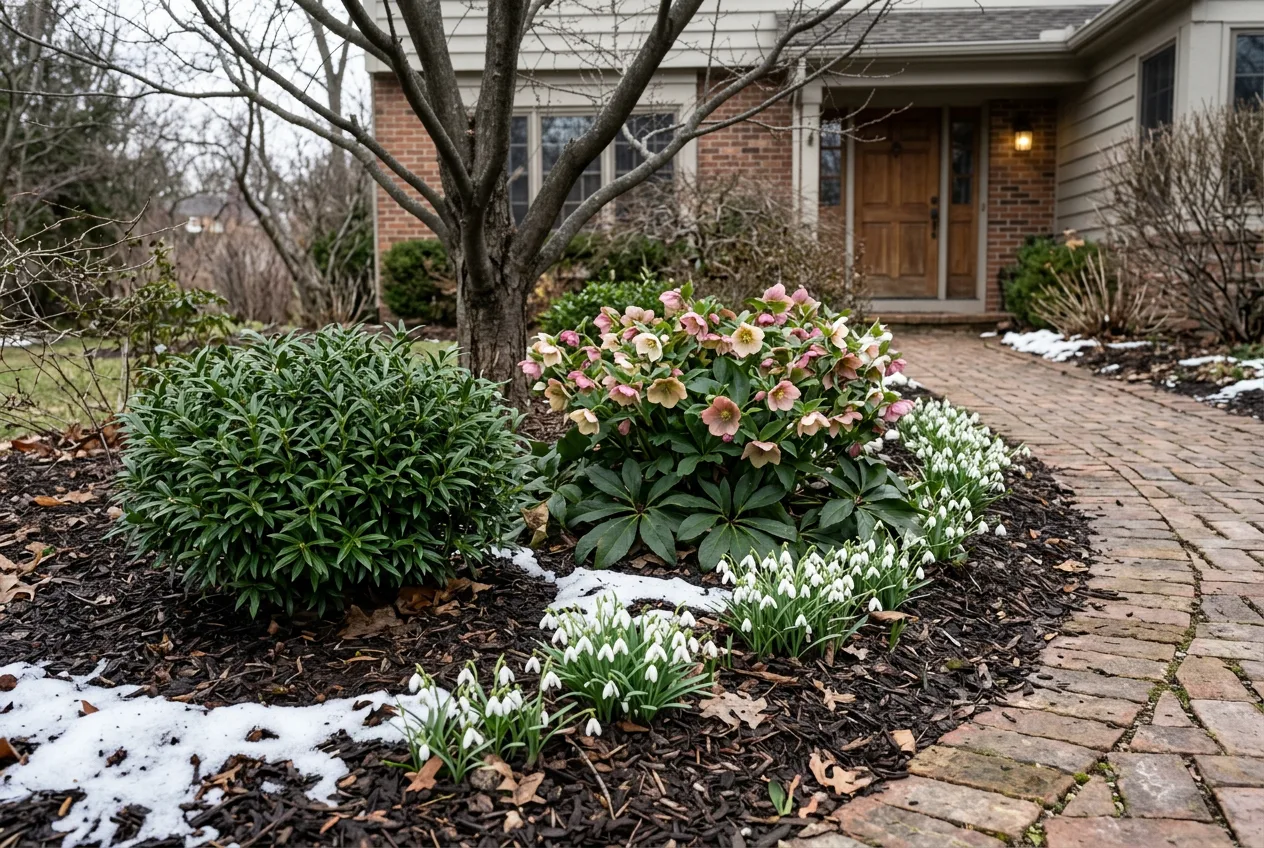
| Lenten rose | Helleborus × hybridus | Evergreen leaves, winter flowers | 4a–9b | 1–2 ft × 1–2.5 ft |
| Snowdrop | Galanthus nivalis | Late-winter flowers | 3a–9b | 4–10 in tall |
| Sweet box | Sarcococca hookeriana | Evergreen leaves, scented flowers | 5a–8b | 4–5 ft × 5–6 ft |
| Winter jasmine | Jasminum nudiflorum | Yellow flowers on bare green stems | 6a–10b | 10–15 ft × 3–6 ft |
| Paperbark maple | Acer griseum | Peeling cinnamon bark | 4a–8b | 20–30 ft × 15–25 ft |
| River birch | Betula nigra | Peeling salmon-to-brown bark | 4a–9b | 30–70 ft × 40–60 ft |
| Oakleaf hydrangea | Hydrangea quercifolia | Peeling bark, dried flower heads | 5a–9b | 4–8 ft × 4–10 ft |
| Switchgrass | Panicum virgatum | Standing tan foliage and seed heads | 5a–9b | 3–7 ft × 2–3 ft |
Seven of the thirteen are native to North America: red twig dogwood, winterberry, American holly, common witch hazel, river birch, oakleaf hydrangea and switchgrass.
Which ones grow in your zone
The same table, read the way the searches are asked — by zone. A tick means the plant’s recorded range covers the whole zone.
| Plant | Zone 4 | Zone 5 | Zone 6 | Zone 7 | Zone 8 |
|---|---|---|---|---|---|
| Red twig dogwood | ✓ | ✓ | ✓ | ✓ | — |
| Winterberry | ✓ | ✓ | ✓ | ✓ | ✓ |
| American holly | — | ✓ | ✓ | ✓ | ✓ |
| Hybrid witch hazel | ✓ | ✓ | ✓ | ✓ | ✓ |
| Common witch hazel | ✓ | ✓ | ✓ | ✓ | ✓ |
| Lenten rose | ✓ | ✓ | ✓ | ✓ | ✓ |
| Snowdrop | ✓ | ✓ | ✓ | ✓ | ✓ |
| Sweet box | — | ✓ | ✓ | ✓ | ✓ |
| Winter jasmine | — | — | ✓ | ✓ | ✓ |
| Paperbark maple | ✓ | ✓ | ✓ | ✓ | ✓ |
| River birch | ✓ | ✓ | ✓ | ✓ | ✓ |
| Oakleaf hydrangea | — | ✓ | ✓ | ✓ | ✓ |
| Switchgrass | — | ✓ | ✓ | ✓ | ✓ |
Two things in that table run against what most lists imply.
- Red twig dogwood stops at zone 7. It is the poster plant of winter interest, and NC State’s range for it ends at 7b. It grows naturally in “damp boggy areas, riparian areas, or wetland margins” across most of North America — a cold-climate shrub. If you garden in zone 8, the red-stem effect is better got from something bred for heat, or not at all.
- Zone 4 gardens lose the evergreen shrubs on this list. American holly and sweet box both start at zone 5, so in zone 4 the winter structure has to come from bark (paperbark maple, river birch), stems (dogwood), berries on a deciduous holly (winterberry) and the two witch hazels.
Zone ranges are recorded differently by different sources, so treat a plant at the very edge of its range as a gamble and ask your own state extension service before planting a large group. Our year-round planting guide covers what to put around these for the other three seasons.
Plants by what they give you in winter
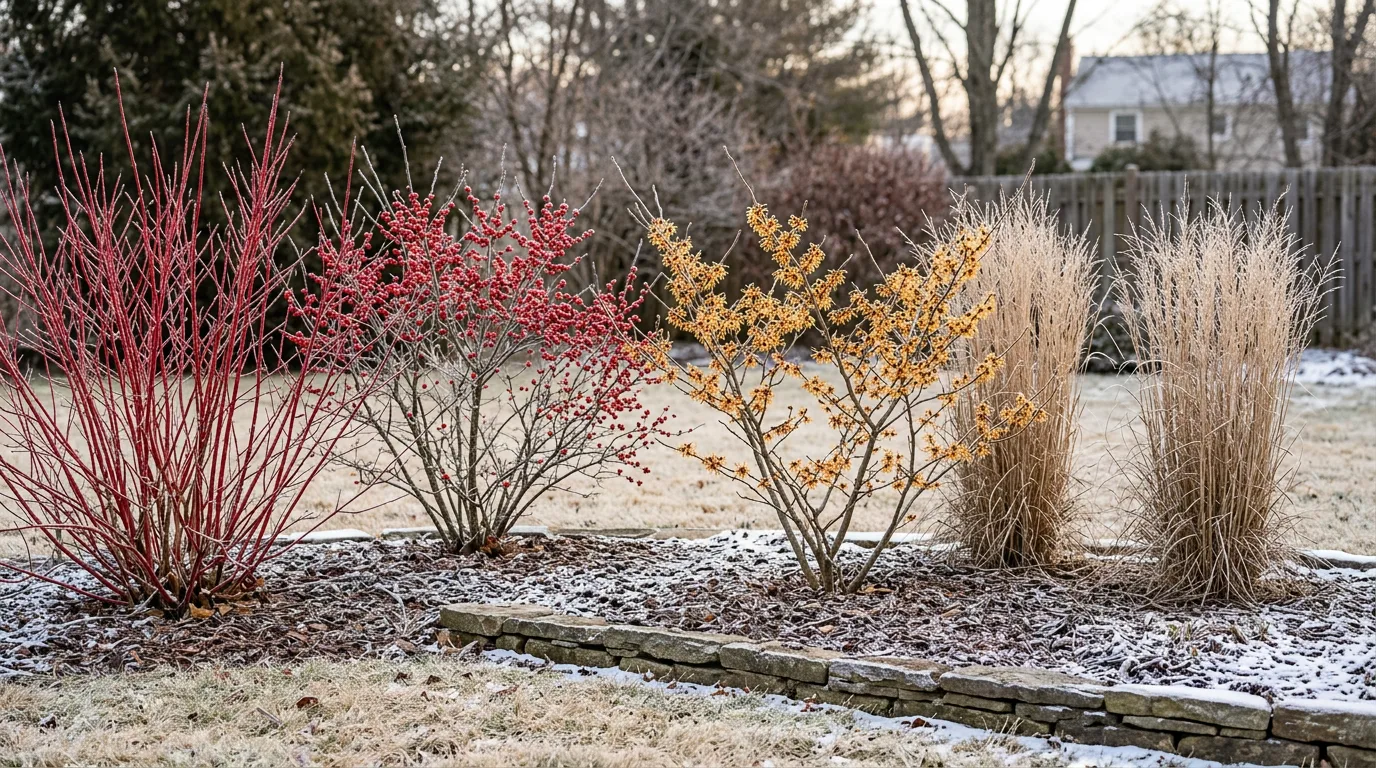
Coloured stems: red twig dogwood
NC State describes the stems as “red to dark blood-red… with horizontal branching”, and notes that “the brightest color occurs on new stem growth”. That sentence is the whole care plan: an old dogwood that is never cut turns into a brown thicket with a little red at the tips. Its instruction is to “prune the plant back in early spring to stimulate more growth” — the red you see next winter grows the summer after the cut. It also “spreads by underground stems to form a colony”, which suits a bank or a wet corner and does not suit a narrow bed. Because it likes wet ground, it is one of the best shrubs for the edge of a rain garden.
Bark: paperbark maple, river birch, oakleaf hydrangea
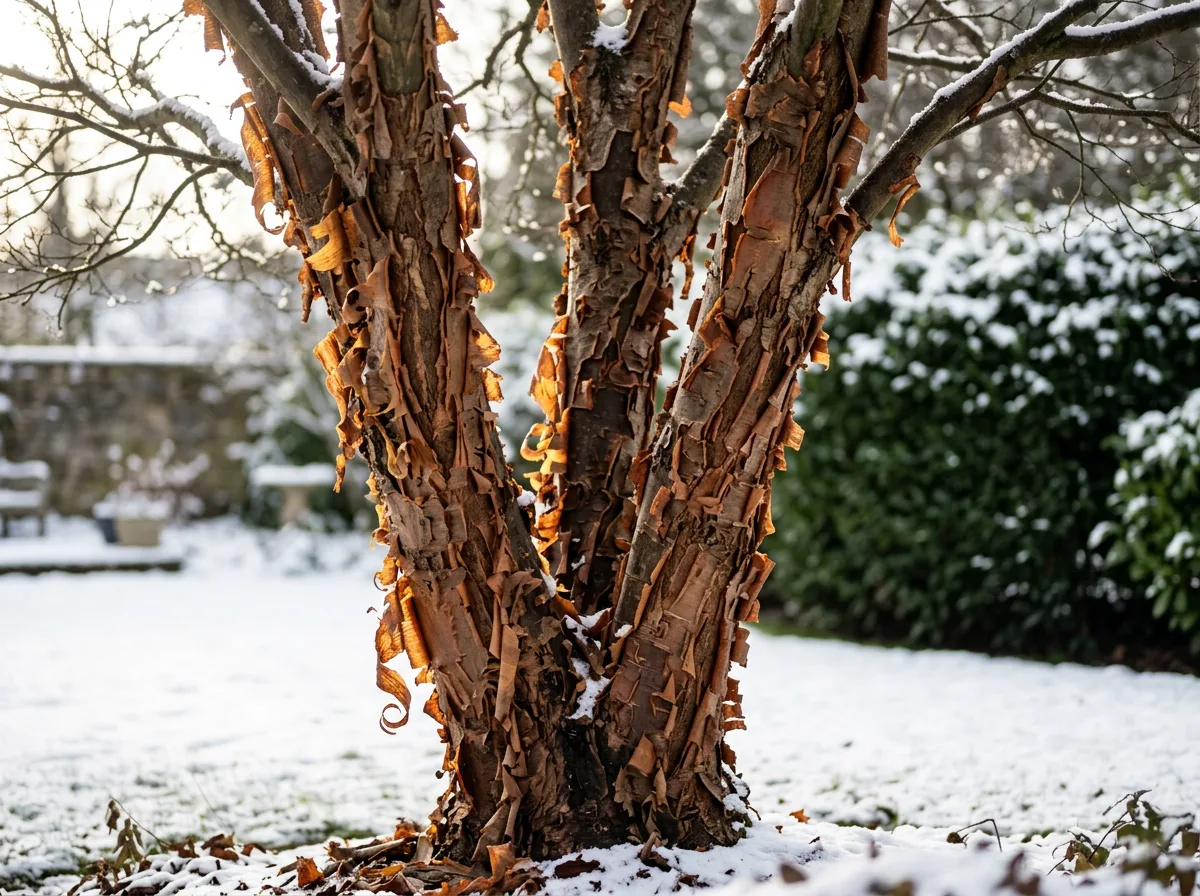
Bark is the one winter feature that does not depend on the weather, the birds or the year. Paperbark maple has “extremely ornamental peels of bark that remain on the tree instead of falling to the ground”, which is why it looks good all winter rather than leaving a mess under it, and at 20–30 ft it fits a suburban yard. River birch gives the same effect on a much bigger tree — up to 70 ft — with bark that is “salmon to rust-colored” on young trees; NC State notes it resists the bronze birch borer that kills many other birches. For a shrub-sized version, oakleaf hydrangea has exfoliating brown bark that “reveals cinnamon-colored bark underneath especially as branches age”; NC State notes the older branches have “an interesting texture when exfoliated in winter”. Leave its faded flower heads on in fall and they add a second winter feature.
Berries: winterberry and American holly
Here is the catch most lists leave out. Hollies are dioecious — male and female flowers grow on separate plants — and only the females carry berries. NC State’s instruction for winterberry is specific: “To produce berries, the plant must be properly cross-pollinated. Match blooming times with a male pollinizer like ‘Jim Dandy’ or ‘Southern Gentleman’ by planting one male (per 10 to 20 females) within 50 feet of female plants.” Buy a single winterberry with no male nearby and you may never see a berry. American holly works the same way: its profile records that it is “dioecious (male and female flowers are on separate plants)”.
Two more details are worth knowing before you buy. Winterberry “requires moist, acidic soil”, and “neutral to alkaline soils may cause chlorosis (yellowing of leaves) and even death”; American holly’s leaves “are typically yellow in alkaline soils” too. And the berries are food — winterberry’s are, in NC State’s words, “food for birds and small mammals” — so how long they last into winter depends on how hungry the local birds are. Both hollies’ berries are recorded as poisonous to people at low severity.
Winter flowers: the two witch hazels, hellebores, snowdrops, winter jasmine
Which witch hazel you buy decides when it flowers. The native common witch hazel (H. virginiana) blooms in fall into winter, with small yellow flowers; its genus name, NC State explains, refers to the plant having “both flowers and fruits at the same time”. The hybrid witch hazels (H. × intermedia, a cross of the Japanese and Chinese species) are the late-winter ones, with “spidery” flowers 1–3 inches across. Lists that just say “witch hazel” are describing one of two plants that flower months apart.
Lenten rose (Helleborus × hybridus) is an evergreen perennial that “thrives in deep shade”, flowering in winter into spring. NC State adds two cautions: it “can spread through self-seeding”, and the NC Invasive Plant Council regards all hellebores as potentially invasive, “although the threat is low”. Its leaves are poisonous if eaten. Snowdrops are the smallest plant here — 4–10 inches — blooming “late winter to early spring, when snow can be present”; all parts are poisonous. Winter jasmine’s species name, nudiflorum, means “naked flowering”: the yellow flowers open on bare green stems before any leaves. It sprawls, so it is best spilling down a wall or bank.
Evergreen leaves and scent: sweet box
Sweet box is a “shade-loving, evergreen, low shrub” whose “dark green evergreen leaves provide an attractive winter interest”, with small fragrant white flowers. NC State lists its bloom as spring; the RHS puts Sarcococca hookeriana var. digyna among its five top plants for winter interest, because in a mild garden the scent arrives at the end of winter. The RHS’s design advice applies to it directly: “plants with fragrance are best appreciated when planted by doorways or entrances in regular winter use.”
Structure: switchgrass
Grasses only give winter interest if you leave them standing. Switchgrass is a native warm-season grass, “one of the more dominant species of the tallgrass prairie”, forming “a dense columnar foliage clump” and NC State’s advice is to “prune in late winter” and, after the flowers go to seed, “leave them on the plant to provide a winter food source for birds”. Cut it in late winter rather than fall and it holds frost and snow all season. If you are choosing between grasses, our ornamental grasses guide explains which ones self-seed and which stay put.
The one to think twice about: heavenly bamboo
Heavenly bamboo (Nandina domestica) is on a great many winter-interest lists for its red berries and red-tinged evergreen leaves. NC State’s profile opens with a warning instead: “This plant is problematic, and alternatives or non-fruiting cultivars should be considered.” It records that heavenly bamboo “is listed as invasive by the NC Invasive Plant Council and is toxic if ingested by pets or children”, with cyanogenic glycosides in its fruit, leaves and stems.
NC State’s suggestions are the useful part: if you want the look, plant ‘Fire Power’ or ‘Gulf Stream’, which are sterile (non-fruiting) cultivars, so there are no berries to spread or to be eaten; if you want winter berries, plant a native shrub instead — American beautyberry, buttonbush, native viburnums or winterberry. Winterberry, with its male pollinizer, gives you the red berries without the problem. Before you buy any berrying shrub off a national list, check it with your own state’s invasive plant list, because the same plant can be harmless in one state and regulated in the next.
How to place them so you actually see them
A winter-interest plant only works if it is somewhere you look in winter. That usually means three places, and each suits different plants:
- The view from the window you use most. This is where the big effects go — a paperbark maple or river birch, a group of red twig dogwood, a winterberry with its male. Coloured stems and berries read best against something dark (an evergreen hedge, a fence, a wall) or against snow.
- The path to the door. This is where the RHS puts scented plants, and where small things such as snowdrops, hellebores and sweet box can be seen close up. All three take shade, which suits the north side of a house.
- The edge of the lawn or a bank. Switchgrass, dried oakleaf hydrangea heads and sprawling winter jasmine all fill a long view and catch frost.
If deer or rabbits visit your yard, check the woody plants against our guides to deer resistant shrubs and rabbit resistant plants: winter is exactly when bark gets gnawed, and a newly planted paperbark maple is an expensive thing to lose. For the cutting dates — dogwood in early spring, witch hazel after it flowers — see when to prune shrubs.
Placing these well is easier to judge as a picture than as a list. With Hadaa you can upload a photo of the view from your window and see a planting rendered into your own yard, checked against your hardiness zone, before you buy a single shrub.
Frequently asked questions
What does “winter interest” mean for plants? It means the plant still looks good after the growing season ends. The RHS lists the sources as “flowers, scent, berries, coloured stems or dramatic evergreen foliage”. Peeling bark and grasses left standing count too.
What are the best winter interest plants for zone 5? On NC State’s recorded ranges, every plant in this guide except winter jasmine covers zone 5: red twig dogwood, winterberry, American holly, both witch hazels, Lenten rose, snowdrop, sweet box, paperbark maple, river birch, oakleaf hydrangea and switchgrass.
What are the best winter interest plants for zone 4? Red twig dogwood, winterberry, both witch hazels, Lenten rose, snowdrop, paperbark maple and river birch. American holly, sweet box, oakleaf hydrangea and switchgrass are recorded from zone 5, and winter jasmine from zone 6.
What winter interest plants grow in shade? Lenten rose “thrives in deep shade”, sweet box is “shade-loving”, and snowdrops grow in full sun to part shade. The RHS notes that most winter-interest plants are shade tolerant, which makes the north side of a house a good place for them.
Why doesn’t my winterberry have berries? Usually because there is no male plant nearby. Only female winterberries bear fruit, and NC State recommends one male, with a matching bloom time, for every 10 to 20 females, within 50 feet of them.
Can winter interest plants grow in pots? Some can. The RHS says some winter-interest plants are “adaptable to life in containers”, which lets you move them into view for winter and out again after. The compact ones here — Lenten rose at 1–2 ft and snowdrops at under a foot — are the easiest to try.