Three of the famous companion claims for tomatoes survive contact with controlled research, and they do not survive in the form the charts state them. Marigolds suppress root-knot nematodes — but only as a dense block grown in the bed two months before the tomatoes, never as scattered interplants. Basil raises the total yield you get from a square metre by around 20%, and has no measurable effect on how a tomato tastes. And the two most-repeated warnings — keep tomatoes away from corn, keep them away from potatoes — are both correct, for reasons no chart gives. Almost everything else on the list is inherited, not tested.
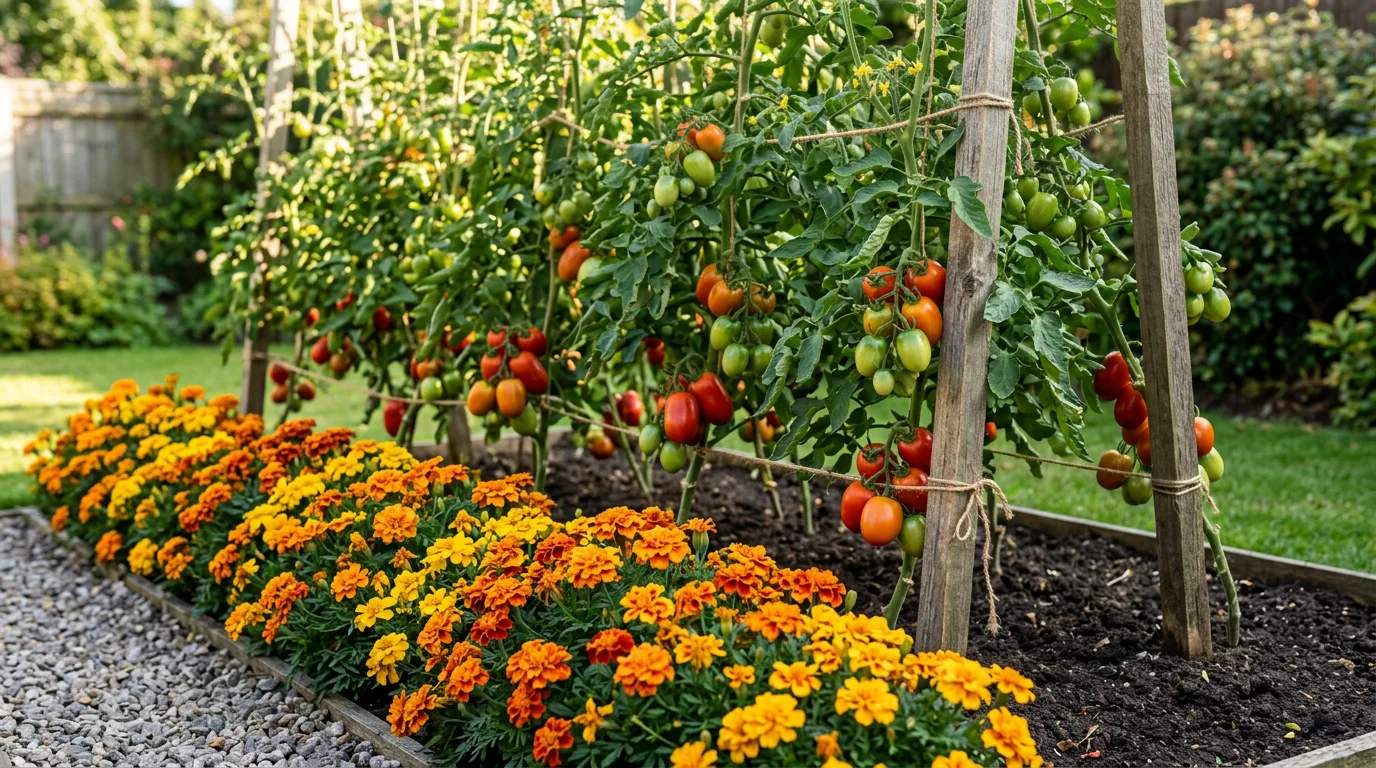
This page sorts the claims into what has been tested, what the test found, and what that means for the bed you are actually planting.
Why the charts contradict each other
Companion-planting charts are old, and they are not derived from field trials. Linda Chalker-Scott, Extension Horticulturist at Washington State University’s Puyallup Research and Extension Center, traces them to a pre-scientific habit of thinking: plants were grouped by the four elements and by signs of the zodiac, and “one of the outcomes of this categorization was the agricultural practice of planting together those species that ‘love’ each other.” Her assessment of the lists is blunt:
“There is no scientific basis, however, for any of the several lists that exist describing ‘traditional companion plants’. Like horoscopes, these lists may be fun to use, but they should not be perceived or promoted as scientifically valid any more than astrology.”
Her fact sheet is careful to separate that from the science of plant associations, which is real and well documented — and which we come back to at the end, because it is the part that will actually change your bed. But it explains why two charts you find online will tell you opposite things about the same pairing: neither is reporting a measurement.
The claims, graded
| Claim | What has actually been tested | Verdict |
|---|---|---|
| Marigolds suppress root-knot nematodes | Decades of trials; UF/IFAS reviews 14 nematode genera | Holds — as a pre-plant cover crop only |
| Marigolds reduce whitefly on tomatoes | Glasshouse trials, French marigold, 2019 | Holds in a glasshouse, via airborne limonene |
| Basil improves tomato flavour | Three years of double-blind taste panels | Fails — no consistent preference |
| Basil + tomato is a good use of ground | Relative yield indices across densities and ratios | Holds — about 20% land-use advantage |
| Aromatic herbs confuse pests generally | Insect behaviour studies on traditional aromatics | Fails — little or no disruptive effect found |
| Don’t plant corn near tomatoes | Pest identity, UC IPM | Holds — it is the same insect |
| Don’t plant potatoes near tomatoes | Shared pathogens, university plant-pathology guidance | Holds — they share both blights |
| Tomatoes “hate” brassicas | Tomato + Brussels sprout mixtures, measured | Fails as stated — no yield advantage, no reliable penalty |
| Borage deters tomato hornworm | No controlled support located | Untested |
The two “fails” matter as much as the holds. If you plant basil because you were told it sweetens the fruit, you will not notice anything, decide companion planting is nonsense, and throw out the parts that work.
Marigolds: one plant, two completely different stories
Story one — nematodes, and the spacing nobody mentions
Marigold roots release alpha-terthienyl, described in the UF/IFAS review Marigolds (Tagetes spp.) for Nematode Management as “one of the most toxic naturally occurring compounds found to date.” It inhibits nematode egg hatching, and marigold can suppress 14 genera of plant-parasitic nematodes, root-knot and lesion nematodes most of all.
Then come the conditions, and they are the whole article:
- It must be grown as a cover crop, before the tomatoes. “Marigold should be planted at least two months before the desired vegetable crop,” and “it must be planted at the same site in which the vegetable crop will be planted… otherwise no benefits can be gained from marigold root exudates.”
- Interplanting does not work. UF/IFAS answers this as a direct question and the answer is “Probably not.” Root-knot nematodes “will find and reproduce on roots of a susceptible crop or weed. So interplanting marigold and susceptible crops is very risky and may result in damage to the susceptible crops.” The caption under their own photograph is the sentence to remember: “Coleus will not be protected by marigold even though marigold is planted in close proximity.”
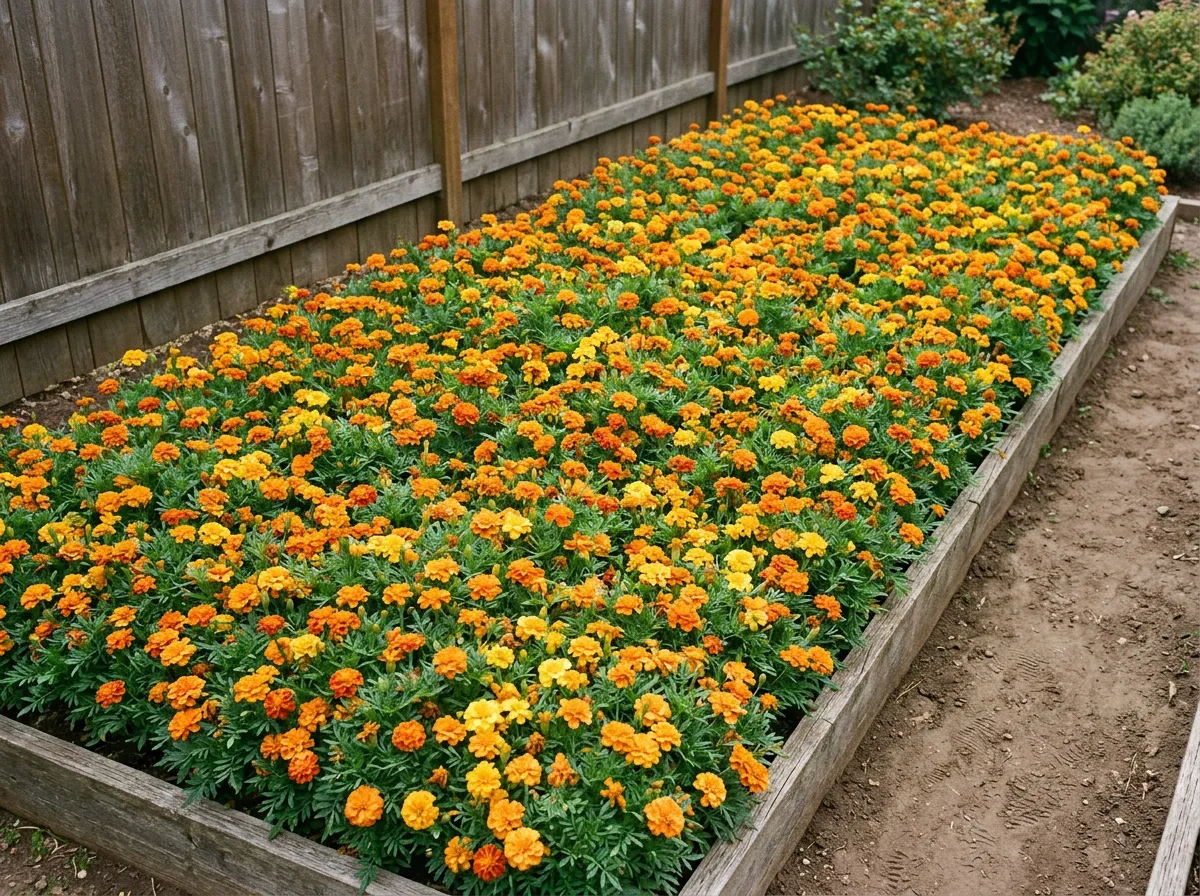
- The stand has to be dense. Row spacing and plant spacing under 7 inches, because “nematodes can reproduce on weeds and thereby nullify the effects of marigold.” At that spacing you need roughly 289 plants to cover 100 square feet.
- Variety matters, and the wrong one makes it worse. Varieties rated resistant to a given nematode suppress it; varieties rated susceptible “can increase population levels of the nematode and actually make the problem worse.” French marigolds (Tagetes patula) “appear to be most effective against the widest range of nematodes.”
- Marigold extracts and chopped-up plants do nothing. Alpha-terthienyl is inactivated by near-UV light once out of the soil, so “there is no benefit in amending a planting site with marigold extracts or homogenized plant parts.”
So a ring of six marigolds round a tomato plant is decorative. A whole bed of French marigolds grown through late summer, then hoed in as green manure before next year’s tomatoes, is a nematode treatment.
Story two — whitefly, and why it is not the same claim
Conboy and colleagues tested French marigold against glasshouse whitefly (Trialeurodes vaporariorum) on tomatoes and published the result in PLOS ONE in 2019 (open access). Intercropped marigolds did reduce whitefly numbers on the tomatoes. The agent is limonene, which made up around 24% of the volatile output from the flowers, and it works by repelling whitefly rather than killing it: laboratory assays showed behavioural avoidance, dispensers of limonene alone significantly reduced whitefly nymphs, and sharing root space without airborne contact produced no effect at all.
Two honest limits: the trials were in a glasshouse without natural enemies present, and introducing marigolds to an already heavy infestation gave “minimal reductions.” This is a preventive measure for a protected crop, not a rescue for an outdoor one.
Note what has happened here. Both findings are real, both involve marigolds and tomatoes, and they prescribe opposite planting patterns — a solid pre-plant block for nematodes, live interplanting for whitefly. A chart that says “marigolds: good for tomatoes” has compressed that into something you cannot act on.
Basil: right answer, wrong reason
Michael Bomford put the chart to a field test and gave the paper the obvious title: Do Tomatoes Love Basil but Hate Brussels Sprouts? (Journal of Sustainable Agriculture 33(4): 396–417, doi:10.1080/10440040902835001). Across a range of densities and crop ratios:
- Flavour: nothing. Double-blind taste tests over three years found no consistent preference for tomatoes grown with companions over tomatoes grown in monoculture.
- Land use: about 20%. Relative yield indices showed roughly a 20% advantage to growing tomato with basil rather than either alone — the two plants are not competing for the same light and root volume at the same time, so the bed produces more in total.
- Pests: not repeatable. An apparent reduction in some Brussels sprout pests in the first study reversed in the second once planting dates changed.
- Brassicas: no penalty found. Tomato and Brussels sprout together showed no advantage — and no evidence of the mutual loathing the charts describe.
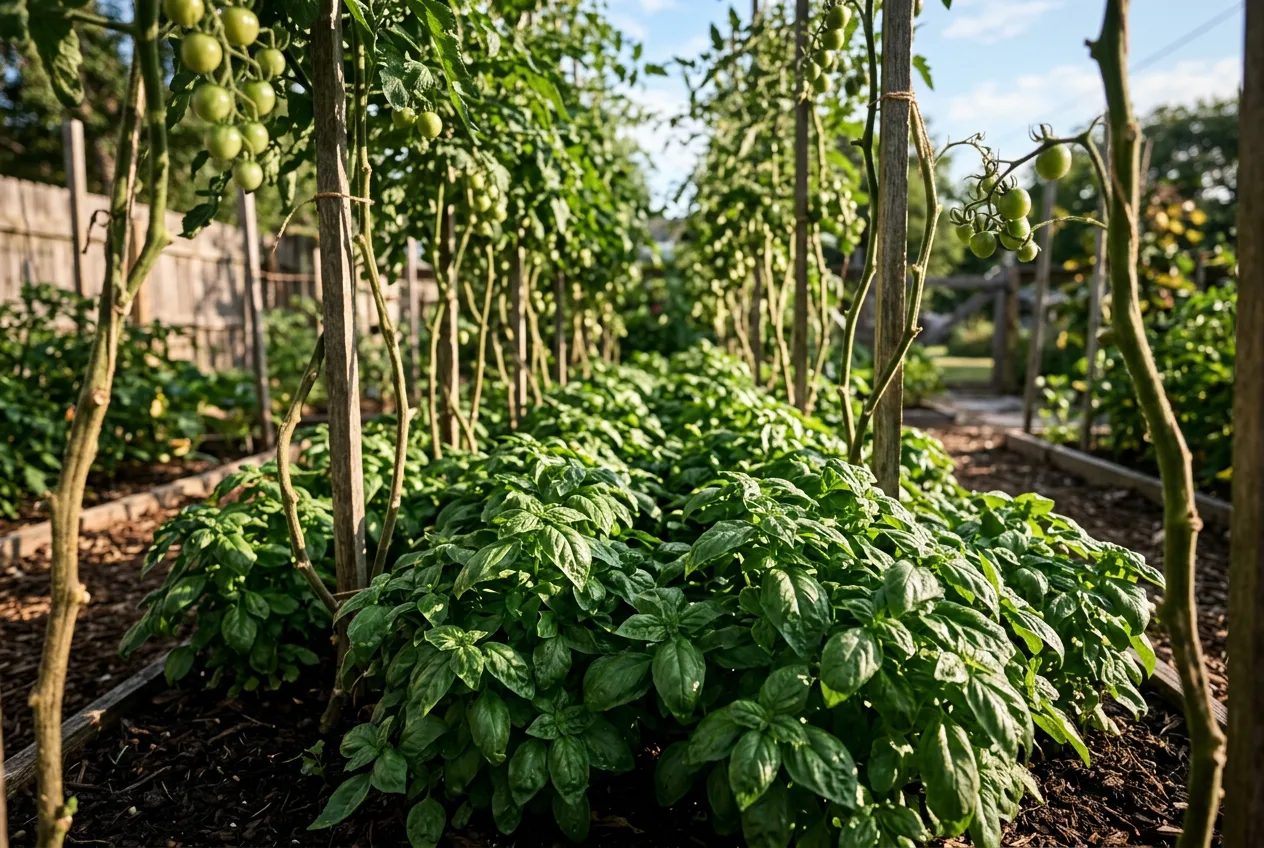
The practical reading: grow basil between your tomatoes because it is the most efficient thing you can do with the gaps, and because you want basil. Expect nothing from the fruit.
The two warnings that are real
Corn — because it is literally the same insect
The caterpillar that bores into tomato fruit and the one that ruins sweetcorn are one species. UC IPM states it plainly: tomato fruitworm, Helicoverpa (=Heliothis) zea, “is also called cotton bollworm and corn earworm.” The second name is not a coincidence of naming — it is the damage the same insect does to corn ears. Growing a block of corn beside a tomato bed is not a mysterious antipathy between two plants; it is putting a host for your tomato pest next to your tomatoes.
Potatoes — because they share two blights
Tomato and potato are both Solanum, and they share the two diseases that end tomato seasons. Early blight is caused by Alternaria solani, which UConn’s IPM programme notes “affects potato, tomato, other members of the potato family, and some mustards”; late blight is Phytophthora infestans, which “affects potato, tomato and, occasionally, eggplant and other members of the potato family.” Commercial guidance for early blight goes as far as “Do not use a field for potatoes that was used for potatoes or tomatoes the previous year. Keep this year’s field at least 225 to 450 yards away from last year’s field.”
No garden has 225 yards. The usable version is: put tomatoes and potatoes in different beds, never adjacent, and rotate the whole nightshade family — tomato, potato, pepper, aubergine — as one group on a three- to four-year cycle rather than rotating each crop separately. Peppers and aubergines belong in that group for the same reason, which is why “can I plant peppers with tomatoes?” has a boring answer: you can, they grow together happily, and you must then move the pair together next year.
What to do instead of following a chart
The mechanisms with research behind them are not plant pairings at all. They are properties of a planting:
- Diversity, for the predators. Mixed plantings “attract and retain beneficial insects, including the predator and parasitoid species” that control aphids and caterpillars for you. This is a count of species in the bed, not a specific partner for the tomato.
- Diversity, for the confusion. Several species in one area disrupt a specialist herbivore’s ability to find its host plant, “apparently through both visual and olfactory mis-cues.” Note that this is what the aromatic-herb myth is a garbled version of — and that in at least one study, traditional aromatics such as Mentha had “little or no disruptive effect on insect behavior.” The mechanism is real; the folk prescription for triggering it is not.
- Nitrogen fixers. Legumes supply nitrogen to plants and microbes in their immediate vicinity. This is the real engine of the Three Sisters, where beans fix nitrogen, corn gives the beans structure and squash shades the soil — a documented intercropping system, and the one case where a famous “companion” trio is doing exactly what it is said to do.
- Nurse plants. Taller or broader neighbours moderate the microclimate for new seedlings. For tomatoes in a hot climate this is a reason to put them where afternoon shade falls, not a reason to find the right herb.
So the planting rule that follows from the evidence is: many species, laid out so nothing shades or starves anything else, with the nightshades kept together and away from last year’s nightshades. That is a layout problem, and it is worth sketching before you buy plants — our guides to raised garden bed ideas and designing a raised bed cover bed proportions and reach, and edible garden design covers fitting the whole thing into a garden you also want to look at. If the bed has to work in autumn and winter as well, fall and winter edible gardens picks up where the tomatoes stop.
Seeing the bed before you plant it
The difficulty with laying out a mixed vegetable bed is that you are planning in July’s dimensions while standing in October’s bare soil, and a tomato row that looks airy as a sketch is a wall of foliage by August. Hadaa renders a photo of your actual plot as a planted design, with every plant checked against your USDA hardiness zone before it appears — so you can see what a basil underplanting does to the light reaching the bed behind it, or what a solid block of marigolds looks like where you were going to put the tomatoes, and decide on the strength of a picture rather than a chart.
Frequently asked questions
What should not be planted near tomatoes? Two pairings have real evidence behind them. Keep tomatoes away from sweetcorn, because the tomato fruitworm and the corn earworm are the same species, Helicoverpa zea, and corn concentrates it. Keep them away from potatoes, because both are nightshades and share early blight (Alternaria solani) and late blight (Phytophthora infestans). The remaining “enemies” on most charts — fennel, brassicas, dill — are not supported by measurement; tomato and Brussels sprout grown together have been tested and showed no reliable penalty.
Do marigolds really protect tomatoes? Yes, in two narrow ways that need opposite planting. For root-knot nematodes, marigolds work only as a dense cover crop — spacing under 7 inches, in the same ground, at least two months before the tomatoes go in — and a susceptible variety can increase nematode numbers instead. For glasshouse whitefly, live French marigolds interplanted among tomatoes reduce numbers via airborne limonene, demonstrated under glass without natural enemies present. A few marigolds dotted round an outdoor tomato plant are doing neither job.
Should I plant basil with my tomatoes? Yes, for space rather than for taste. A field study of tomato–basil mixtures measured about a 20% land-use advantage over growing either alone, and three years of double-blind taste tests found no consistent flavour difference in the tomatoes. Basil also appreciates the same watering and the same warmth, so it is an easy filler between stakes.
Can tomatoes and peppers be planted together? Yes. They are both in the nightshade family, so they grow under the same conditions and there is no interaction to avoid. The catch is on the other side of the season: because they share the same blights and the same soil-borne problems, they count as one crop for rotation. Move tomatoes, peppers, potatoes and aubergines together, on a three- to four-year cycle.
Does companion planting improve the taste of tomatoes? There is no evidence that it does. The only study to put the question to blind taste panels over multiple seasons found no consistent preference for companion-grown tomatoes. Flavour in tomatoes tracks variety, ripeness at picking, sunlight and water stress — all of which you control directly, and none of which depend on a neighbour.
Is companion planting worth doing at all? The practice is, the charts are not. Diverse plantings demonstrably attract predatory and parasitoid insects and make it harder for specialist pests to locate their host plants, nitrogen-fixing legumes feed their neighbours, and taller plants shelter seedlings. Those are the documented benefits, and you get them from planting several species sensibly spaced — not from matching a tomato to its assigned friend.