
Formal Garden Design: Symmetry, Structure, and How to Scale It to a Normal Yard
Francis Karuri
Landscape & AI Correspondent
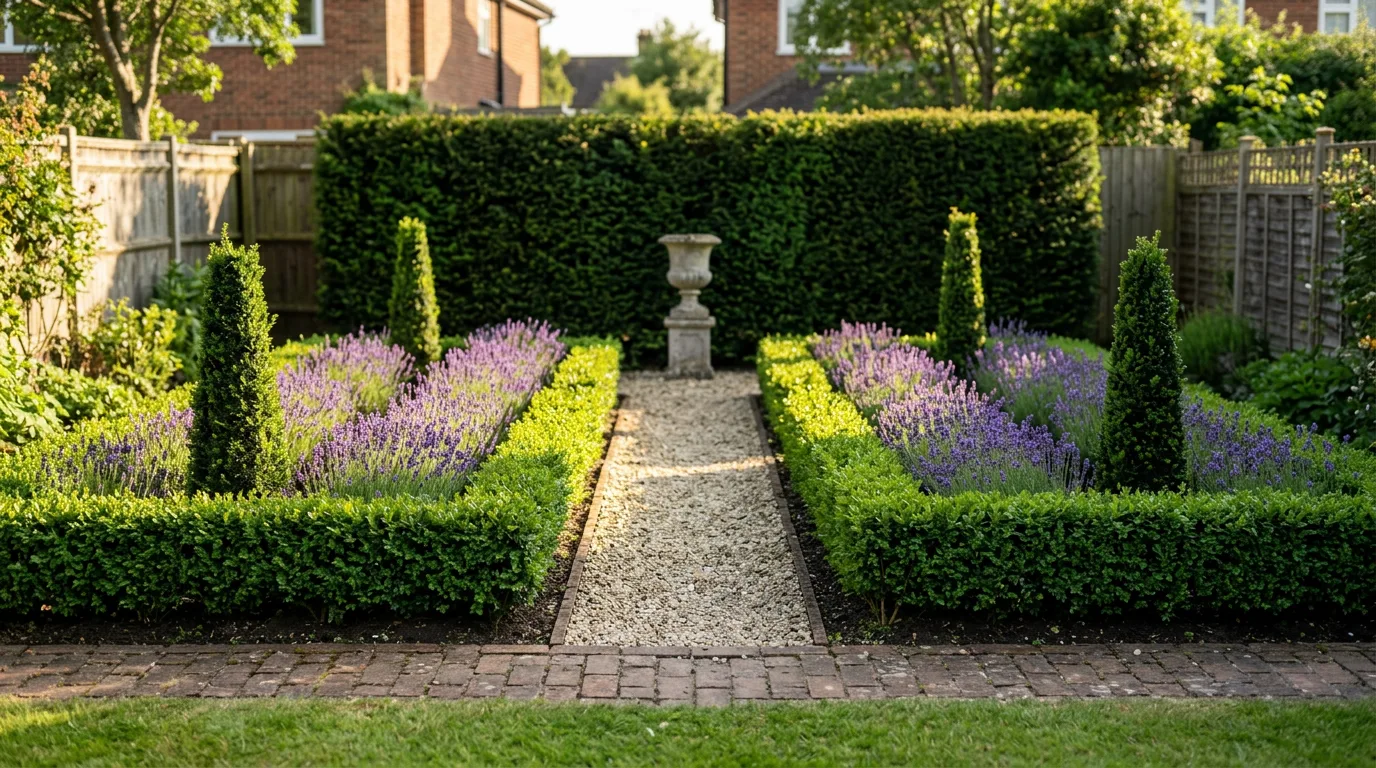
Formal garden design—axial symmetry, clipped hedges, geometric beds, focal points on sight lines—is one of the oldest and most recognizable landscape traditions. It's also one of the most misunderstood. Most people assume formal gardens require acres of land, a full-time gardener, and a baroque fountain budget. None of that is true. The principles scale down perfectly to suburban yards if you understand what makes a garden formally structured and what's just decorative excess. This guide explains how to apply formal design rules to spaces under 1,000 square feet without copying Versailles.
What Makes a Garden Formally Structured
Formal design is not a plant palette or a decorative style—it's a spatial organizing principle. The core idea is simple: human geometry imposed on plant material. Where naturalistic gardens mimic how plants grow in the wild, formal gardens announce that a person designed this space and maintains control over it.
That control shows up in six specific ways, all of which can be scaled to any yard size. These aren't decorative choices—they're the structural bones that make a garden read as formal.
The six formal design principles
- Axial symmetry: The layout mirrors on either side of a central line (the axis)
- Geometric bed shapes: Rectangles, squares, circles—never organic curves
- Clipped hedges or edges: Plants maintained in geometric forms, not allowed to grow naturally
- Focal points on axes: Sculptures, fountains, benches, or specimen plants placed at visual termini
- Repetition of plant material: The same species planted symmetrically, not a mix of different plants
- Visible maintenance: Crisp edges, clipped forms, no weeds—the garden looks actively managed
None of these principles require large scale. A 15×20 foot side yard can have axial symmetry, geometric beds, a clipped hedge, and a focal point. What changes at small scale is the level of subdivision—you use one axis instead of multiple cross-axes, simpler geometry, and fewer layers of hedging. But the underlying structure is identical.
Formal design sits at one end of the structured-garden spectrum. If you want the same discipline with looser, mass-planted beds instead of strict mirroring, see modern minimalist garden design; for the most pared-back, contemplative version of geometric restraint, Japanese Zen garden design uses asymmetry and emptiness to reach a similar sense of intention.
The Axis: The Single Line That Organizes Everything
The axis is the central organizing line of a formal garden. It's typically a path, but it can also be a sightline, a water channel, or a mown strip through planting. Everything else in the garden relates to this line through symmetry—what's on the left mirrors what's on the right.
In large estate gardens, you'll see multiple axes: a primary axis running from the house to a distant focal point, cross-axes intersecting at right angles, and secondary axes creating subdivisions. In a small yard, you use one axis. That's the entire geometry. It runs from your most common viewpoint (usually the back door or patio) to a focal point at the far end of the yard.
The axis should be 3-4 feet wide minimum if it's a walkable path. Narrower than that and it reads as a visual line but not a functional space. In very small yards (under 20 feet wide), you can use a 2-foot axis with stepping stones, but it won't have the same presence as a full-width path.
Material matters. Gravel, brick, stone pavers, and poured concrete all read as formal. Mulch does not—it looks like a maintenance path, not a design feature. If budget is limited, use compacted decomposed granite or fine pea gravel over landscape fabric. The key is crisp edges and a uniform surface.
Symmetry: Not Just Mirrored Plants, But Mirrored Geometry
Formal symmetry means everything on one side of the axis has a mirror-image counterpart on the other side. Not similar—identical. Same bed shape, same dimensions, same plant species, same number of specimens. This is not naturalistic balance (where different elements have similar visual weight). This is mathematical mirroring.
The symmetry applies to geometry first, plants second. If you have a 4×8 foot rectangular bed on the left side of the axis, you need an identical 4×8 foot bed in the same position on the right. If that bed contains five boxwood spheres, the mirrored bed needs five boxwood spheres in the same arrangement. If one side has a bench, the other side needs a bench in the symmetrical position—or a visually equivalent focal point.
Where beginners fail: trying to fake symmetry with "close enough" mirroring. A 4×8 bed on the left and a 5×7 bed on the right breaks the formality completely. A dwarf boxwood on one side and a different shrub trimmed to the same shape on the other side reads as sloppy, not symmetrical. Formal design has no tolerance for approximation—either commit to exact mirroring or choose a different design style.
What to mirror in small yards
- Bed shapes and positions: Same size, same distance from axis, same geometric form
- Hedge heights: If one side has a 2-foot boxwood hedge, the other side does too
- Specimen placement: Topiaries, standards, or clipped shrubs in identical positions
- Hardscape elements: Benches, pots, stepping stones—anything structural
Hedges and Clipped Edges: The Visual Signature of Control
Clipped hedges are the single strongest signal that a garden is formal. A low boxwood hedge edging a geometric bed announces human control in a way no other plant treatment does. The hedge doesn't need to be elaborate—a 12-inch-tall box edging is enough—but it must be clipped to a clean geometric line.
Hedges do three things: they define bed edges, they create internal subdivision, and they add year-round structure. In a small formal garden, use hedges to outline the main planting beds on either side of the axis. In winter, when perennials die back, the hedge structure holds the design.
Best hedge plants for small-scale formal gardens: a blight-resistant box such as Buxus microphylla 'Winter Gem' or B. sinica var. insularis 'Franklin's Gem' (slow-growing, stays compact — and see the hedge section below before buying any box at all), germander (tough, Mediterranean, aromatic), lavender (informal texture but formal clipping), and Euonymus japonicus 'Microphyllus' (tiny leaves, tight clipping). Avoid fast growers like privet or laurel unless you're willing to clip monthly—they outgrow small-scale proportions quickly.
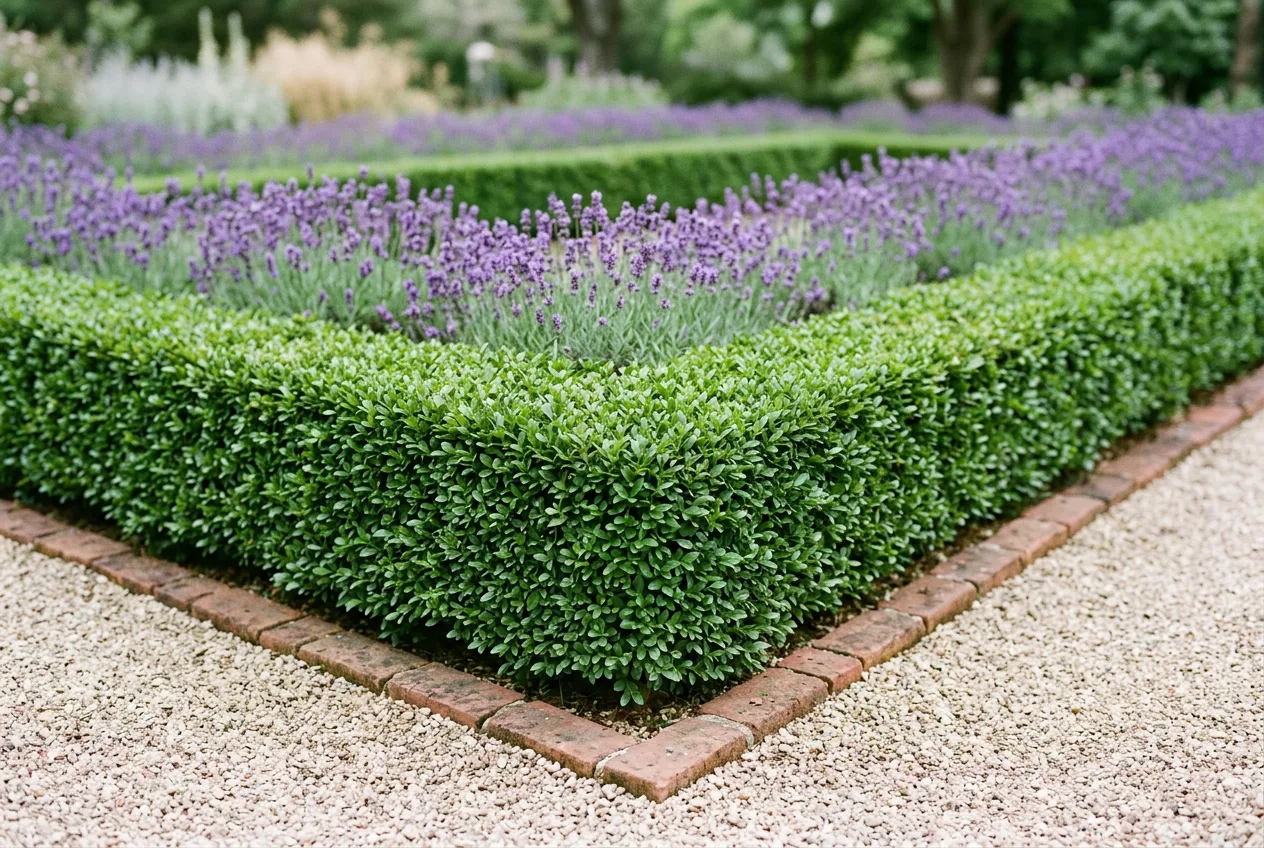
Clipping frequency: Boxwood needs clipping 2-3 times per growing season (late spring, mid-summer, early fall). Lavender needs once annually (after flowering). Germander needs 2-3 clips. Privet needs monthly if you're using it as a low hedge. The maintenance is rhythmic and predictable—unlike staking, deadheading, or dividing perennials, which are reactive and irregular.
The Hedge Problem Every Formal Garden Guide Skips
Almost every formal garden article — including an earlier version of this one — tells you to edge the beds with dwarf box. That advice is now backwards. The dwarf box of English parterres is Buxus sempervirens 'Suffruticosa', and Virginia Tech's Boxwood Blight Task Force lists it in its table of cultivars very susceptible to boxwood blight. The same document opens by stating that “No boxwood are currently immune to boxwood blight” — so the choice is between degrees of resistance, not between safe and unsafe.
Two separate problems arrived within a few years of each other. Boxwood blight (Calonectria pseudonaviculata) defoliates a clipped hedge from the base up and survives in fallen leaf litter. Box tree moth (Cydalima perspectalis) is an invasive caterpillar that strips foliage outright, and it is under active federal quarantine in the United States. Cornell's New York State IPM programme now recommends planting alternatives rather than box, citing pests “both of which require regular spray treatments”. A formal garden is the one style where the hedge is not decoration — it is the design — so this is a structural risk, not a plant-health footnote.
Check your county before you buy
USDA APHIS expanded the box tree moth quarantine four times in 2026 alone. Within a quarantined area, movement of boxwood nursery stock is restricted:
- • Virginia — Clarke and Frederick Counties and the City of Winchester (Federal Order DA-2026-11, 31 March 2026)
- • Ohio — Ashtabula, Clark, Cuyahoga, Lake, Lorain, Lucas and Preble Counties (DA-2026-23, 4 August 2026)
- • Maryland and Pennsylvania — Allegany, Frederick, Garrett and Washington Counties (MD) and Franklin County (PA) (DA-2026-24, 4 August 2026)
- • New Jersey — Cape May County (DA-2026-30, 21 August 2026)
The list grows; check APHIS's current quarantine notices rather than this page before ordering forty plants.
What to plant instead, by what you actually want
| If you want… | Plant | Why |
|---|---|---|
| True box, lowest risk | Buxus microphylla 'Winter Gem' or 'Wintergreen'; B. sinica var. insularis 'Franklin's Gem' | All three sit in Virginia Tech's blight-resistant/tolerant table. Still box, still clips to a hard line. |
| The box look, no box | Ilex glabra 'Gem Box' (inkberry holly) | Cornell's first-named alternative. Small oval leaves read as box at hedge distance; immune to both box pests. |
| Hard clipping, topiary | Taxus baccata (yew) or Cephalotaxus harringtonia (plum yew) | Yew is the estate gardener's default for a reason: it tolerates cutting into old wood, which box does not. |
| A tight evergreen ball | Chamaecyparis obtusa 'Nana' (dwarf Hinoki cypress) | Also on Cornell's list. Holds a globe form with very little clipping. |
| Never plant | B. sempervirens 'Suffruticosa', 'Justin Brouwers', 'American', 'Arborescens' | All four appear in Virginia Tech's very-susceptible table. 'Suffruticosa' is the traditional parterre edging, which is why so many historic gardens have lost theirs. |
The resistance ratings above come from trials summarised by the Virginia Tech task force, drawn from Ganci's 2014 North Carolina State thesis on host resistance in Buxus. Resistant is not immune: the task force is explicit that infected resistant cultivars still carry the fungus, showing “only very few minor or barely noticeable symptoms”. Practically, that means a resistant hedge survives an outbreak that would kill 'Suffruticosa', but it can still pass blight to a neighbour's box.
Two habits matter as much as the cultivar. Clear and bin fallen leaves from under the hedge rather than composting them, because the pathogen overwinters in litter. And buy from one nursery in one delivery — mixing sources is the commonest way blight arrives in a new garden. If the formality you want is the geometry rather than the greenery, the stone or steel bed edging described below carries the same visual argument with none of this risk.
Focal Points: Where the Axis Terminates
Every axis needs a visual terminus—a focal point that draws the eye and signals the end of the compositional sequence. In grand gardens this is a fountain, a sculpture, or a pavilion. In suburban yards it's a bench, a large pot, a specimen tree, a wall-mounted plaque, or a clipped shrub standard.
The focal point sits on the axis, centered. It should be visible from your main viewing position (the patio or back door) and scaled to the space. A 12-inch pot reads as decor, not a focal point. A 24-inch pot planted with a clipped bay laurel standard reads as architecture. Size and formality matter—the focal point needs presence.
If your yard is very small (under 20 feet deep), the focal point might be a wall feature: a mounted mirror, a decorative grill, a piece of carved stone. The axis runs to the wall, and the wall-mounted element terminates the sightline. This works particularly well in urban courtyards where the boundary wall is close.
Focal point options by budget
- Low budget: Large terracotta pot with clipped rosemary, DIY obelisk, painted wall feature
- Mid budget: Cast stone urn, clipped bay laurel standard, metal arbor, formal bench
- High budget: Custom sculpture, wall fountain, specimen tree (trained espalier or pollarded form)
What to Plant Inside the Geometric Beds
The beds themselves are geometric—rectangles, squares, or simple curves. What you plant inside can be either tightly controlled (more formal) or looser and more naturalistic (still formal in structure, but softer in texture). Both approaches work. The key is consistency: if one bed is planted with clipped specimens, all beds should be. If one bed is planted with loose perennials, all beds should be.
Formal planting (tight control): Roses clipped to uniform height, repeated blocks of the same perennial (e.g., rows of lavender or catmint), clipped topiary specimens, or seasonal annuals planted in geometric patterns. This is the most traditionally formal approach and requires the most maintenance.
Semi-formal planting (structured looseness): Repeat the same perennial species in each symmetrical bed but let them grow naturally without clipping. Use drifts of 3-5 plants per species. Keep the palette limited (3-5 species total) so repetition creates rhythm. This approach pairs formal structure with naturalistic texture—it's easier to maintain and still reads as designed.
Planting palette for small formal gardens
- Structural evergreens: Boxwood, bay laurel (in pots), rosemary, euonymus, yew
- Repeat-blooming perennials: Lavender, catmint, salvia, roses (floribunda or hybrid tea)
- Spring bulbs: Tulips, alliums, daffodils—planted in geometric rows or blocks
- Seasonal annuals: Begonias, impatiens, dusty miller—swapped seasonally for consistent color
How to Scale Formal Design to Suburban Yard Dimensions
The mistake most people make is trying to fit an estate garden layout into a small space. That doesn't work—you end up with a miniature version that feels cramped and overwrought. Instead, simplify the geometry while preserving the principles. Here's how to translate formal design to a 20×30 foot backyard.
Use one axis, not multiple. A single 4-foot-wide path runs from the back door to a focal point at the far fence. No cross-axes, no subdivisions. This one line is your entire organizing structure.
Limit bed depth to 3-4 feet. In large gardens, planting beds can be 10+ feet deep with multiple layers. In small yards, beds should be no more than 4 feet deep (reachable from both sides for maintenance) and run parallel to the axis. Two symmetrical beds flanking the central path is the entire planting scheme.
Choose compact hedge plants. Use a compact blight-resistant box at 12-18 inches tall — 'Winter Gem' or 'Franklin's Gem' — rather than the traditional 'Suffruticosa' dwarf box. Use germander or lavender instead of privet or laurel. The hedge should frame the beds without dominating them. In very small yards, you can edge beds with stone or metal instead of living hedges—it still reads as formal if the edge is geometric.
Reduce plant variety. In an estate garden you might use 15-20 species. In a small formal yard, use 3-5 species total, repeated symmetrically. The repetition is what creates rhythm, not the diversity.
Using AI to Test Formal Layouts Before Building
Formal garden design is unforgiving—if the symmetry is off by 6 inches, or the proportions don't balance, it reads as sloppy instead of structured. Testing layouts before you commit to construction is essential, and AI landscape design tools make that process instant. You can sketch an axis, place symmetrical beds, and generate a photorealistic render showing exactly how the proportions will read from your viewing position.
Hadaa is particularly useful for formal design because it handles geometric precision well. Upload a photo of your current yard, then use the sketch tool to draw the axis, outline bed shapes, and place focal points. The AI generates a render showing the formal structure at full maturity—hedges at final height, beds fully planted, proportions locked in. If the axis feels too wide or too narrow, or the beds feel cramped, you see it before you dig.
This is critical for symmetry testing. Small asymmetries—a bed that's 6 inches deeper on one side, a hedge that's slightly taller—destroy the formal effect. AI rendering lets you verify that mirrored elements are actually mirrored, not just close enough. You can test multiple axis widths, bed depths, and hedge heights in an afternoon, then build the version that actually works at your scale.
How to use AI for formal garden design
- Start with accurate yard dimensions: Measure your space and upload a photo from your primary viewing angle
- Sketch the axis first: Draw a straight path from foreground to focal point—test 3-4 widths
- Add symmetrical beds: Draw one bed, duplicate it on the opposite side—check visual balance in render
- Place the focal point: Position on the axis at the far end—render to verify it terminates the sightline
- Test hedge heights: Generate versions with low (12"), medium (24"), and tall (36") hedges to find proportion
Why this matters for formal design specifically
Formal gardens live or die on proportion and symmetry. A 6-inch error in bed depth breaks the mirror effect. An axis that's too narrow disappears. AI lets you test and fix these issues before construction, when changes cost nothing instead of hundreds of dollars and hours of labor.
Design your formal garden →For more on applying design principles systematically, see AI landscape design trends 2026, which covers the shift toward geometric structure in residential landscapes. If you're working with a challenging site, AI hillside garden design explains how to terrace slopes for formal layouts.
Frequently Asked Questions
Can you create a formal garden in a small suburban yard?
What are the core principles of formal garden design?
Do formal gardens require a lot of maintenance?
What plants work best in small-scale formal gardens?
How wide should the central axis be in a small formal garden?
Can a formal garden work on a sloped yard?
What's the difference between formal and symmetrical?
How do you add seasonal color to a formal garden without losing structure?
Test Your Layout
Design Your Formal Garden Before You Build
Test axis placement, bed proportions, and symmetry in photorealistic renders. Fix proportion errors before construction, when they cost nothing.


