
Driveway Landscaping Ideas That Boost Curb Appeal from the Street
Dennis Mutahi
Landscape Design Writer
Driveway landscaping is the planting, edging and lighting along the edges of your drive — and the one rule that decides most of it is not aesthetic. Where your driveway meets the street, almost every US city caps how tall anything may grow: 30 inches in League City, Texas, 36 inches in La Mesa, California, measured inside a clear-vision triangle struck from the driveway itself. Plants, walls, fences and parked cars all count. So the design question is not “what looks good beside a driveway” but what is allowed in the first 15–25 feet, and what you can do everywhere behind it. This guide covers that limit with the codes quoted, then the borders, materials, plants, lighting and budgets for the rest of the drive.
The 30-Inch Rule at Your Own Driveway
Most driveway landscaping advice talks about “preserving sightlines” without ever giving the number. There is a number, it is written into zoning codes rather than building codes, and it applies to the triangle where your own driveway meets the street — not just to street corners. Inside that triangle, planting is capped at roughly knee height.
What three codes actually say
| Jurisdiction | Triangle at a driveway | Max height |
|---|---|---|
| La Mesa, CA | 15 ft along each edge of pavement from the juncture | 36 in |
| League City, TX | 25 ft from the intersecting rights-of-way, struck from the driveway centreline | 30 in |
| Fairfax County, VA | 30 ft | 42 in |
Sources: City of La Mesa, “Sight Distances at Corners & Driveways” (Zoning Ordinance §24.05.030N); League City UDC Art. 4 §4.4.1.
Read those three together and the useful finding is that the height is roughly standard and the triangle is not. Thirty to forty-two inches covers the common cases, but the distance it reaches back from the pavement runs from 15 to 30 feet, so a guide quoting one pair of numbers is wrong for most readers. Look up your own city’s “clear vision triangle”, “sight distance triangle” or “visibility triangle” before you buy anything for the street end of the drive.
The part almost nobody mentions: it is a volume, not a line
La Mesa requires the clear space to extend upward to seven feet above grade, leaving a four-foot band of open air above the 36-inch limit, because “low hanging or cascading landscape materials, structural projections, and non-permanent features” block a driver’s view just as effectively as a hedge. That catches two things people plant on purpose: a small ornamental tree near the apron whose canopy has not lifted past head height yet, and trailing groundcover allowed to spill over the driveway edge. The code also counts parked vehicles as obstructions, which is worth knowing before you design a gravel parking bay into the triangle.
Two further limits sit on the same strip of ground, and they are separate permissions. First, the land between the sidewalk and the kerb — the parkway, verge or tree lawn — is usually public right-of-way that you maintain but do not own, and many cities publish an approved plant list for it. The same 30-inch figure recurs in the public realm: Chicago’s design standards for landscaped street medians require a 30-inch maximum height from the top of the plants to the pavement surface within sight-triangle areas, with plant material chosen from the City of Chicago Roadway Plant List (CDOT Street and Site Plan Design Standards). Your own verge is not a median, but it is public land, so the rule that governs it is the city’s rather than yours. Second, being exempt from a building permit does not make planting legal: the 2021 International Residential Code states that its own exemptions “shall not be deemed to grant authorization for any work to be done… in violation of… any other laws or ordinances of this jurisdiction.” Permit-exempt and compliant are different things.
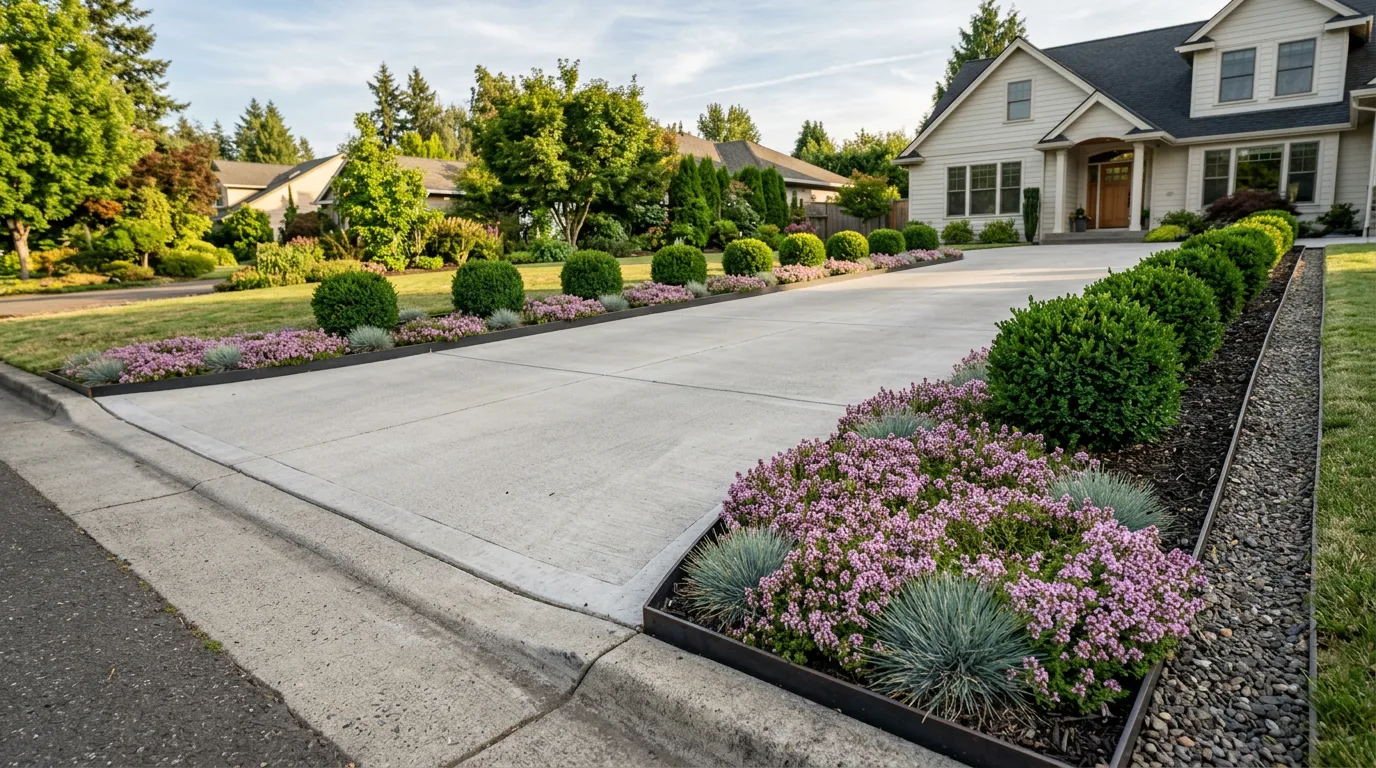
Practically, this gives the driveway border a shape rather than a style: keep everything inside the triangle at or below knee height and let it rise only once you are past it. The hero image above is that rule drawn — ankle-high matting at the street end, clipped shapes further up the drive. Every planting plan further down this page assumes it.
Two neighbouring limits are covered elsewhere, because they are set by different rules. This page is the driveway triangle — what you may plant where your own drive meets the street. For how tall a fence or wall may be across the front of the property, which is a front-setback question with a separate and much more variable answer, see front yard fence ideas. For replacing the lawn either side of the drive, see no-grass front yard ideas, and for the approach as a whole, front yard curb appeal.
Why Driveway Borders Matter
From the street, your driveway is one of the largest continuous surfaces visible. An unlandscaped driveway edge reads as unfinished—the visual equivalent of framing a painting but leaving the corners exposed. A defined border does three things simultaneously: it reduces the perceived width of the driveway (which can dominate narrow lots), it creates a transition zone between hardscape and lawn or foundation planting, and it reinforces your home's architectural style through plant selection and edging materials.
Driveway landscaping also solves practical problems. It prevents mulch, gravel, and soil from washing onto paving. It guides foot traffic away from vehicles. It softens the visual impact of parked cars. And when planned with your home's facade in mind, it extends the design language of your front entry all the way to the street.
The best driveway borders feel intentional but not fussy. They work within the constraints of your site—width, slope, sun exposure, and existing materials—and they hold up under the specific stresses of the driveway zone: vehicle overhang, reflected heat, salt or de-icer exposure, and occasional tire encroachment.
Before choosing plants or hardscape, measure your available width and note where the functional driveway edge ends and plantable space begins. A 10-foot-wide driveway with a 2-foot grass strip offers very different design possibilities than a 12-foot drive with a 5-foot border. Your material constraints—whether you're working with concrete, asphalt, gravel, or pavers—will also shape your edging strategy.
If you're still planning your driveway design and want to see how different border treatments will look from the street, Hadaa's AI landscape visualizer lets you upload a photo of your property and preview planting schemes, edging materials, and lighting configurations before you break ground.
Narrow Driveway Borders (2–3 Feet)
Narrow borders are the most common scenario in suburban and urban lots, where driveways run close to property lines or adjacent to narrow lawn strips. With only 2–3 feet of width, you're working in a zone that can't accommodate large shrubs or layered planting, but it's more than enough space for a clean, low-maintenance edge treatment that defines the driveway without cluttering it.
Design Strategies for Tight Borders
- Single-layer groundcover strips — Mass-plant one low-growing species (mondo grass, creeping thyme, blue fescue) in a continuous ribbon. Uniformity reads as intentional design, not leftover space.
- Hardscape-only edges — Install 12–18 inches of decorative gravel or river rock against the driveway, contained by steel or aluminum edging. Add a single accent boulder every 15–20 feet for visual rhythm.
- Integrated lighting strips — Embed low-voltage LED path lights into the border at 8-foot intervals. The fixtures themselves become design elements, especially when paired with minimal planting.
- Vertical accents at key points — Use narrow columnar evergreens (Sky Pencil holly, Slender Hinoki cypress) at the driveway entrance or garage corners. These add height without width, marking transitions without blocking sightlines.
Best Plants for Narrow Borders
Choose plants that mature at 12–18 inches tall and spread slowly. Avoid anything that sends runners into the driveway or requires annual shearing to stay in bounds. These species tolerate heat reflection, occasional salt exposure, and the compacted soil common along driveway edges:
- Mondo grass (Ophiopogon japonicus) — Evergreen, 6–10 inches, forms dense mats, tolerates shade, never needs mowing.
- Creeping thyme (Thymus serpyllum) — 2–4 inches, fragrant when stepped on, fills gaps between pavers, blooms lavender in summer.
- Blue fescue (Festuca glauca) — Clumping grass, 8–12 inches, blue-gray foliage, drought-tolerant once established.
- Lilyturf (Liriope muscari) — 12–18 inches, evergreen, purple flower spikes in late summer, extremely low maintenance.
- Ice plant (Delosperma cooperi) — Succulent groundcover, 4–6 inches, bright magenta flowers, ideal for hot, dry exposures.
Plant groundcovers at 12-inch spacing for faster coverage or 18-inch spacing if budget is tight—they'll fill in within one season. Apply a 2–3 inch layer of mulch between plants to suppress weeds while they establish. For narrow borders, fine-textured mulch (shredded hardwood, mini pine bark) reads as more refined than chunky nuggets.
Wide Driveway Borders (4–6+ Feet)
Wide borders offer room for layered, dimensional planting that can integrate with your home's foundation beds and create a cohesive front-yard composition. With 4+ feet of width, you can incorporate perennials, ornamental grasses, small shrubs, and even espaliered trees along fence lines or walls. The challenge shifts from "what fits?" to "how do I create visual rhythm across 50+ linear feet without making it look busy?"
Layered Planting for Depth
Structure wide borders in horizontal bands that echo the driveway's linear geometry:
- Front edge (0–18 inches from paving) — Low, uniform groundcover or clumping perennials. This is the "frame" that defines the driveway's edge.
- Middle layer (18–36 inches) — Taller perennials, ornamental grasses, or compact shrubs. Use repetition here—plant in drifts of 3–5 of the same species every 10–15 feet.
- Back layer (36+ inches) — Upright shrubs, small trees, or taller grasses. These anchor the composition and screen fences, utility boxes, or neighboring properties.
Repeating Accent Plants
Long driveway borders need a visual anchor—a single species that repeats at regular intervals to create rhythm. This could be a compact evergreen like dwarf boxwood at 15-foot intervals, a sterile ornamental grass cultivar every 12 feet, or a flowering perennial like daylilies in groups of three every 20 feet. Specify the cultivar rather than the grass: “fountain grass” covers both Cenchrus (formerly Pennisetum) alopecuroides, which North Carolina State University records as weedy, with seed that “breaks open after a hard freeze and naturalizes readily”, and Pennisetum setaceum, rated Moderate on the California Invasive Plant Council inventory. The repetition reads as structure; the infill planting provides variety.
For modern or minimalist homes, consider a single-species mass planting across the entire border—50 feet of Karl Foerster feather reed grass or a continuous ribbon of lavender. This approach emphasizes form and texture over color variety and requires far less maintenance than a mixed border.
Wide Border Plant Recommendations
- Karl Foerster feather reed grass (Calamagrostis) — 4–5 feet, upright columnar form, tan seed heads hold through winter, extremely low maintenance.
- Daylilies (Hemerocallis) — 18–30 inches depending on cultivar, blooms for 4–6 weeks, tolerates neglect, hundreds of color options.
- Catmint (Nepeta) — 18–24 inches, lavender-blue flowers all summer, attracts pollinators, shear once after first bloom for rebloom.
- A sterile fountain grass cultivar — 'Praline', 'Cayenne' or 'Etouffee' — compact, arching form, bottlebrush flowers in late summer, golden fall color. NC State lists these as sterile; the two dwarf cultivars most often sold for borders, 'Hameln' and 'Little Bunny', both “can self-seed aggressively”, which is the wrong trait beside a drive you will be weeding by hand. Note the species reaches 2–6 ft, so keep any of them outside the clear-vision triangle.
- Boxwood (Buxus 'Green Gem' or 'Green Velvet') — 24–36 inches, evergreen, classic formal look, works for traditional and modern styles.
- Russian sage (Perovskia atriplicifolia) — 36–48 inches, silvery foliage, airy purple flowers, drought-tolerant, deer-resistant.
When planning wide borders, think about seasonal interest. Choose at least two plants that bloom at different times (early summer daylilies, late summer grasses) and one evergreen for winter structure. This ensures the border looks purposeful year-round, not just during peak growing season.
Straight vs Curved Driveway Strategies
Driveway geometry dictates border strategy. Straight driveways benefit from strong linear repetition and clean edging materials that emphasize the parallel lines. Curved driveways need design moves that work with—not against—the arc, using the curve as an opportunity to vary planting depth and create visual anchors at key points.
Straight Driveways
Straight driveways read as formal and structured. Enhance this by using consistent planting intervals and materials that reinforce the geometry. Install edging in continuous straight runs—no interruptions or jogs. If you're using accent plants, space them at exact intervals (every 10 feet, every 15 feet) rather than clustering them organically.
For a modern look, border one or both sides with a continuous band of a single low-growing species—lavender, boxwood, or ornamental grass. For traditional homes, alternate groups of three perennials with 2-foot gaps filled with mulch, creating a rhythmic "plant–gap–plant" pattern that reads clearly from the street.
Curved Driveways
Curves introduce opportunities for varied planting depth. The outside of a curve naturally has more space than the inside—use this to your advantage. Widen the border on outer curves and plant taller accent shrubs or grasses here; narrow the border on inner curves and keep planting low to preserve sightlines.
Lighting along curves should be closer together than on straight runs—every 6–8 feet instead of 10—to visually trace the arc at night. Use flexible metal edging to create smooth, continuous curves; rigid materials like brick or stone require cutting and create faceted lines that fight the curve.
One common mistake: planting the same species at uniform intervals along a curve. This creates a rigid, geometric pattern that clashes with the organic line. Instead, vary planting density—cluster more plants on outer curves, space them farther apart on inner curves. This mirrors natural landscape patterns and makes the curve feel intentional rather than accidental.
If you're designing a curved driveway from scratch and want to preview how different border widths and planting schemes will look from multiple angles, Hadaa's visualization tools let you test variations before committing to a layout.
Material-Specific Solutions
Your driveway's surface material shapes your edging options and plant selection. Concrete, asphalt, gravel, and pavers each present different challenges—heat retention, edge definition, maintenance access—and each pairs better with certain border treatments than others.
Concrete Driveways
Concrete is the cleanest surface to edge because it has a defined, unchanging boundary. The best edging materials for concrete are steel or aluminum landscape edging (thin, strong, bends smoothly for curves) or poured concrete curbing (permanent, seamless, ideal for large-scale projects). Avoid plastic edging—it looks cheap against concrete and becomes brittle in freeze-thaw cycles.
Concrete reflects significant heat in summer. Choose heat-tolerant plants: lavender, sedum, hardy ice plant (Delosperma cooperi), ornamental grasses, and Mediterranean herbs. If your driveway runs east-west and gets full sun, add a 4-inch layer of mulch or gravel to insulate plant roots from reflected heat.
Asphalt Driveways
Asphalt edges are less crisp than concrete and can crumble over time, especially at the margins. Install edging 2–3 inches away from the asphalt edge (not flush against it) to leave room for resurfacing or patching. Steel or aluminum edging works well here; avoid stone or brick edging that requires a mortared footer—you'll need to dig it out when the driveway is resealed.
Asphalt gets hotter than concrete and can leach petroleum residue into adjacent soil during the first few years. Choose plants with deep root systems that aren't in direct contact with the surface: a sterile fountain grass cultivar (see above), Russian sage, daylilies, and switchgrass. Avoid shallow-rooted groundcovers directly against the asphalt edge.
Gravel Driveways
Gravel driveways have no fixed edge—the gravel migrates into planting beds and vice versa. Edging is essential here, and it must be tall enough to contain the gravel (minimum 4 inches above grade). Steel or aluminum edging with a 6-inch depth works well; stone or brick edging needs to be mortared to a footer or the gravel will wash underneath.
Because gravel is permeable and doesn't generate the same heat as solid paving, you have more flexibility with plant selection. Gravel driveways pair well with cottage-garden or naturalistic planting styles—catmint, lavender, ornamental grasses, and self-seeding perennials that can tolerate a few stray stones.
Paver Driveways
Paver edges are clean and modular, which gives you the option to integrate planting directly into the paving pattern—remove pavers at intervals and plant low-growing groundcovers (thyme, Corsican mint, blue star creeper) in the voids. This works best for driveways with light traffic; high-traffic areas need full paver coverage for stability.
For traditional paver borders, match your edging material to the paver color and style. If you're using tumbled brick pavers, edge with soldier-course brick. If you're using bluestone or granite pavers, edge with cut stone in the same material. This creates visual continuity and makes the driveway feel like a single designed element rather than paving plus afterthought planting.
Plant Selection for Driveway Borders
Driveway borders are high-stress zones. Plants here face reflected heat, compacted soil, salt or de-icer exposure, occasional vehicle overhang, and—if the border is narrow—limited root space. The best performers are tough, low-maintenance species that look good year-round and don't require staking, deadheading, or frequent division.
Low-Growing Groundcovers (Under 12 Inches)
Use these for the front edge of any driveway border or as the primary planting in narrow (2–3 foot) strips:
- Creeping Jenny (Lysimachia nummularia) — Bright chartreuse foliage, 2–4 inches, spreads fast, tolerates light foot traffic.
- Ajuga (Ajuga reptans) — 4–6 inches, purple or bronze foliage, blue flower spikes in spring, spreads quickly.
- Sedum (Sedum acre, Sedum spurium) — Succulent groundcover, 3–6 inches, yellow or pink flowers, extremely drought-tolerant.
- Dwarf mondo grass (Ophiopogon japonicus 'Nana') — 3–4 inches, evergreen, dense clumps, ideal for formal edges.
Edge-Definition Perennials (12–24 Inches)
These plants create a defined border without blocking sightlines. Use them as the primary layer in 3–4 foot borders or as the middle layer in wider designs:
- Lavender (Lavandula angustifolia) — 18–24 inches, silvery evergreen foliage, purple flowers, extremely fragrant, drought-tolerant.
- Coreopsis (Coreopsis verticillata) — 12–18 inches, yellow flowers all summer, threadlike foliage, no deadheading required.
- Dianthus (Dianthus gratianopolitanus) — 6–12 inches, blue-gray foliage, pink or white flowers, clove-scented, deer-resistant.
- Hardy geranium (Geranium sanguineum) — 12–18 inches, pink or magenta flowers, fall foliage color, tolerates part shade.
Seasonal Color Accents
For driveways where you want seasonal impact, add one or two accent plants that deliver concentrated color at a specific time of year. Plant these in groups of three or five at key visual nodes—the driveway entrance, garage corners, or at 15-foot intervals along long runs. Good choices: black-eyed Susans (late summer), salvia (all summer), asters (fall), spring bulbs in pockets between evergreens.
Avoid high-maintenance annuals unless you're committed to replacing them seasonally. Driveway borders are visible from the street, which means dead or shabby plants are highly conspicuous. Stick with perennials and evergreens that look good 10 months of the year rather than spectacular for two months and ragged for the rest.
When selecting plants, consider your maintenance capacity. A single-species border (all lavender, all boxwood, all Karl Foerster grass) requires minimal ongoing work—one annual shearing or trim. A mixed border with five different perennials requires staggered pruning, selective deadheading, and occasional dividing. Both approaches can look excellent; choose the one that matches your time and interest.
Hardscape Accents: Edging, Lighting, and Decorative Elements
Hardscape elements do the structural work of a driveway border. Edging defines the boundary and contains materials. Lighting extends curb appeal into evening hours and improves safety. Decorative accents—boulders, decorative gravel, art pieces—add visual interest without maintenance. When chosen to match your home's style, hardscape anchors the planting and gives the border a finished look even in winter when plants are dormant.
Edging Materials
Edging is the single most important hardscape element in a driveway border. It prevents mulch and soil from washing onto paving, creates a mowing edge, and gives the border a crisp, intentional appearance. Choose based on your driveway material, border width, and aesthetic:
- Steel or aluminum landscape edging — Most versatile. Thin profile (¼ inch), bends smoothly for curves, available in 4, 6, or 8-inch heights. Install flush with the driveway surface for a clean edge. Cost: $3–6 per linear foot.
- Brick or stone edging — Traditional look, works best for straight runs or gentle curves. Requires a 4-inch gravel footer and mortar for stability. Adds 6–8 inches of width. Cost: $8–15 per linear foot installed.
- Poured concrete curbing — Permanent, seamless, ideal for large-scale projects. Must be installed professionally with a curbing machine. Cost: $6–10 per linear foot.
- Plastic edging — Cheap, flexible, easy to install—but visible, brittle in cold climates, and looks low-quality. Use only for temporary borders or hidden edges. Cost: $1–2 per linear foot.
Lighting
Driveway lighting serves dual purposes: it improves safety after dark and extends the visual impact of your landscaping into evening hours. Low-voltage LED systems are the standard—they're energy-efficient, safe to install, and offer adjustable brightness. Place fixtures every 8–10 feet along one or both sides of the drive, positioned 12–18 inches from the paved edge.
Use downward-facing or shielded fixtures to reduce glare and avoid light trespass onto neighboring properties. For accent lighting, add small spotlights at the base of specimen plants, trees, or decorative boulders—these create depth and draw the eye to focal points. Solar path lights are an option for borders under 50 feet, but their light output is weaker and inconsistent in winter or cloudy climates.
- Low-voltage LED path lights — $15–30 per fixture, plus $200–400 for transformer and cable. Dimmable, long lifespan, minimal energy cost.
- Solar stake lights — $10–20 per fixture, no wiring required. Best for driveways under 50 feet in sunny locations.
- Spotlights and uplights — $25–50 per fixture. Use sparingly—one or two accent lights per 50 feet is enough.
Decorative Accents
Use accents sparingly and purposefully. One well-placed boulder or sculptural element at the driveway entrance has more impact than a scattering of smaller pieces along the length. Good accent options: large (24+ inch) boulders set into planting beds, decorative gravel in contrasting colors (black or white river rock against tan mulch), low garden walls or seat walls at entry points, or metal or stone address markers integrated into the border.
Avoid: too many accent materials (stone, brick, gravel, mulch, and pavers all in one border reads as chaotic), decorative elements that require maintenance (water features, planters that need seasonal replanting), and anything that will interfere with snow removal or vehicle clearance.
Budget Tiers for Driveway Borders
Driveway border costs vary widely depending on length, width, edging material, and plant choices. The breakdowns below assume a 50-linear-foot border on one side of the driveway—adjust proportionally for longer runs or borders on both sides. All prices include materials; add 30–50% if hiring labor.
$500 Budget: Essential Border
This tier covers the minimum to define the edge and add basic planting—enough to make the driveway look intentional rather than unfinished. Focus on a single groundcover species, basic edging, and mulch. Skip lighting and decorative accents at this level.
- Steel or aluminum edging: 50 linear feet at $3.50/ft = $175
- 15 groundcover plants: Ajuga, creeping Jenny, or mondo grass in quart pots at $6 each = $90
- 3 cubic yards mulch: Shredded hardwood at $40/yard = $120
- Solar path lights: 4-pack at $80 = $80
- Remaining: $35 for stakes, edging connectors, landscape fabric
Result: A clean, defined edge with uniform groundcover planting and basic lighting. Plants spaced 18 inches apart will fill in within one season.
$2,000 Budget: Layered Border
This tier adds depth with multiple plant layers, better lighting, and optional hardscape accents. You can incorporate perennials, ornamental grasses, and a few evergreen shrubs for year-round structure.
- Steel edging: 50 linear feet at $4/ft = $200
- 20 groundcovers: Lilyturf or blue fescue at $8 each = $160
- 12 perennials: Daylilies, catmint, or coreopsis in gallon pots at $15 each = $180
- 5 ornamental grasses: Sterile dwarf fountain grass cultivars at $25 each = $125
- 3 evergreen shrubs: Boxwood or dwarf spruce in 3-gallon pots at $40 each = $120
- 4 cubic yards mulch: Premium dyed hardwood at $50/yard = $200
- Low-voltage lighting kit: 6 LED path lights, transformer, 50 ft cable = $400
- 2 accent boulders: 24–30 inch fieldstone at $150 each = $300
- Remaining: $315 for soil amendments, fertilizer, stakes, connectors
Result: A three-layer border with low groundcovers in front, mid-height perennials in the middle, and ornamental grasses or evergreens at the back. Professional-quality lighting and two focal-point boulders add structure and evening visibility.
$5,000+ Budget: Full Design
At this level you can hire a landscape designer, install premium edging materials, incorporate mature plants for instant impact, and add architectural hardscape elements—low walls, seat walls, integrated address features. This tier also covers both sides of the driveway, extends lighting to include accent spots, and allows for specimen trees or large multi-stem shrubs.
- Poured concrete curbing or stone edging: 100 linear feet (both sides) at $8/ft = $800
- 40 perennials and groundcovers: Mix of sizes and species = $600
- 15 ornamental grasses: Karl Foerster feather reed grass and sterile fountain grass cultivars in 2–3 gallon pots = $450
- 8 evergreen shrubs: Boxwood, dwarf conifers, or hollies in 5-gallon pots = $480
- 3 specimen trees: Columnar hornbeam, Japanese maple, or serviceberry in 7-gallon pots = $600
- 8 cubic yards premium mulch or decorative stone: $500
- Low-voltage lighting system: 12 path lights, 4 spotlights, transformer, 150 ft cable = $900
- Hardscape accents: Decorative boulders, low seat wall, or integrated address feature = $800
- Design consultation: $500–1,000 for professional layout and plant selection
- Remaining: $400–900 for soil prep, amendments, irrigation, labor assistance
Result: A complete, cohesive design that feels integrated with your home's architecture and front yard. Mature plants provide instant structure and curb appeal. Hardscape elements create focal points and year-round interest. Lighting system highlights key features and ensures safe navigation after dark.
Before committing to a budget tier, consider phasing the project: install edging and lighting infrastructure in year one, add plants in year two, and layer in hardscape accents as budget allows. This spreads costs and gives you time to observe how early plantings perform before filling in the entire border.
Frequently Asked Questions
Is there a height limit on planting beside a driveway?
What plants work best along a narrow driveway?
How do I landscape a driveway edge on a budget?
Should I use gravel or mulch for driveway borders?
How wide should a driveway planting strip be?
What's the best edging material for a concrete driveway?
How do I landscape a curved driveway?
Can I plant trees along my driveway?
How can I add lighting to my driveway landscaping?
Start designing
Preview Your Driveway Border Before You Plant
Upload a photo of your driveway and see how different edging materials, plant combinations, and lighting configurations will look from the street—before you buy a single plant or break ground.


