
Mediterranean Garden Design: Sun-Drenched Style for Dry Climates
Winnie Astrid
Garden Design Editor
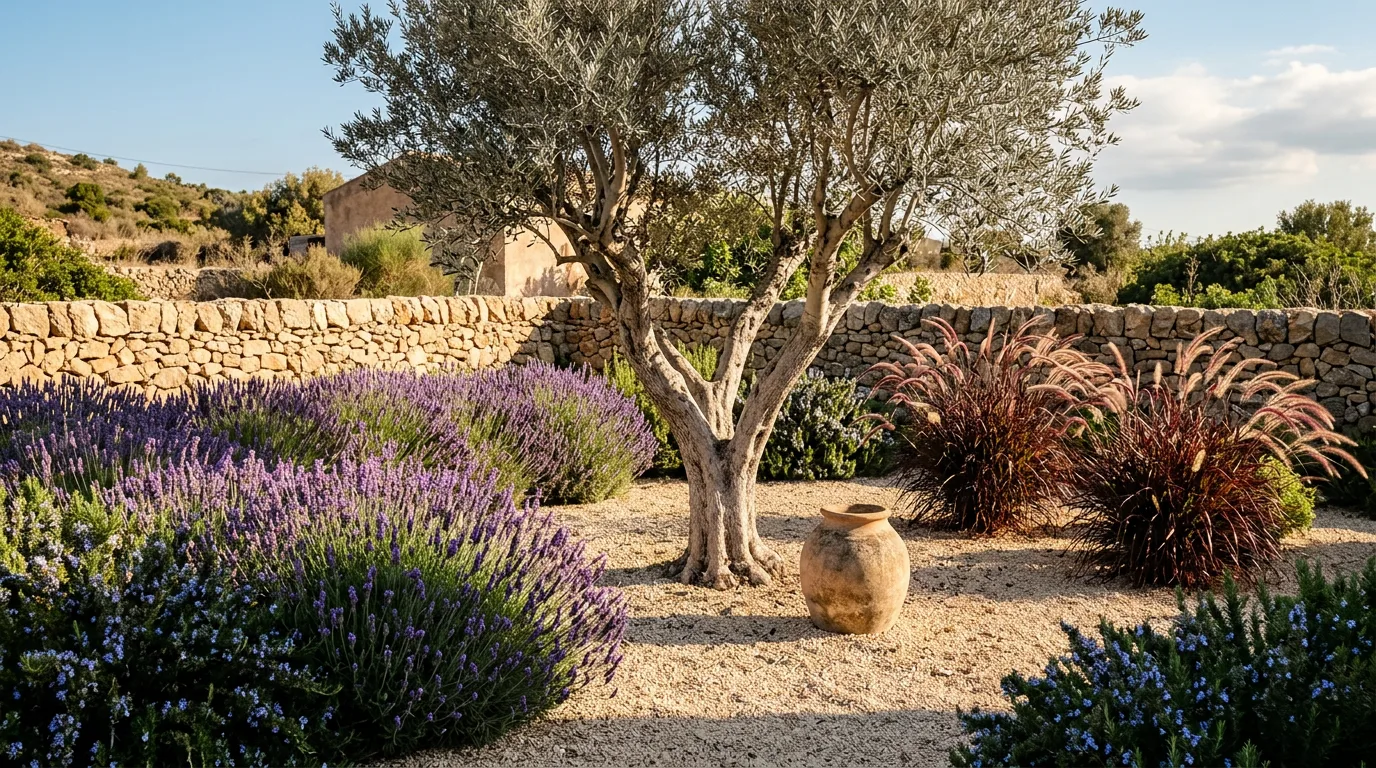
Mediterranean garden design is gravel and stone instead of lawn, a few sculptural trees, and massed grey-leaved shrubs that bloom in heat rather than despite it. It thrives where lawns struggle. But before you plant the look, check one thing most style guides never mention: the two most recognisably Mediterranean plants of all — the fruiting olive tree and green fountain grass — are prohibited outright in Southern Nevada, one for allergenic pollen and one as a noxious weed, and approved substitutes for both are named in the same regional plant list. Below is the style done properly, with the plant restrictions stated up front, then the materials, the three planting tiers, irrigation, costs and a full conversion walkthrough.
Why Mediterranean Gardens Work in Dry Climates
Mediterranean climate zones—the actual ones around the Mediterranean Sea, plus California, parts of Australia, Chile, and South Africa—share a specific pattern: hot, dry summers and mild, wet winters. Gardens designed for this climate don't just tolerate drought; they're optimized for it.
The core principle: work with water scarcity, not against it. Traditional American lawns demand consistent moisture year-round. Mediterranean plants evolved to store water during wet winters and coast through bone-dry summers with minimal intervention.
The visual payoff is immediate. While your neighbor's lawn turns brown in July, your garden looks its best—lavender in full bloom, gravel paths warm underfoot, herbs releasing fragrance in the heat. This is landscaping that improves as conditions worsen.
What makes this style climate-appropriate:
- Deep-rooted plants — access water below the surface rather than demanding frequent shallow irrigation
- Hardscape dominance — patios, gravel, stone retain heat and reduce planted area that requires water
- Mulch and ground cover — protect soil from evaporation and regulate temperature
- Shade structures — pergolas and arbors reduce plant stress and create usable outdoor rooms
Essential Mediterranean Design Elements
Hardscape Materials
Mediterranean gardens are hardscape-first. The ground plane is gravel, decomposed granite, or warm-toned pavers—never turf. This isn't minimalism; it's practicality meeting aesthetics.
Material palette: terracotta pavers, natural stone in ochre and cream tones, decomposed granite in warm beige, gravel with a slight pink or gold cast. Avoid grey concrete, black mulch, and anything that reads as modern industrial.
Plant Layers
Mediterranean gardens layer in three tiers: structural trees (olive, citrus), mid-height shrubs (lavender, rosemary), and low groundcovers (creeping thyme, succulents). Each tier has a job.
Trees provide vertical structure and shade. Olives are the iconic choice—sculptural, slow-growing, drought-tolerant once established. Citrus adds fragrance and seasonal interest. Avoid fast-growing trees that demand water.
Shrubs define spaces and add seasonal color. Lavender borders pathways, rosemary grows into hedges, bougainvillea climbs walls. These plants bloom in heat, not despite it.
Groundcovers suppress weeds and soften hardscape. Creeping thyme between pavers, succulents in planters, ornamental grasses for movement. Keep it low and let hardscape dominate.
Outdoor Living Spaces
Mediterranean gardens blur the line between indoor and outdoor. Patios aren't afterthoughts—they're the primary destination. Design them as rooms: defined edges, overhead structure, seating arranged for conversation.
Pergolas and shade sails make spaces usable in peak sun. Vine-covered pergolas (grapes, wisteria, bougainvillea) add fragrance and dappled light. Retractable shade sails offer flexibility.
Focal points anchor the space. A wall fountain, a fire pit, a clay chimenea—one strong element that draws the eye and invites gathering. Keep furniture simple: wrought iron or teak, cushions in warm earth tones.
Color Palette
Mediterranean gardens lean into warm, sun-faded tones. Think aged terracotta, sun-bleached stone, silvery foliage. Accent colors are restrained: deep blue ceramic pots, ochre walls, sage green shutters.
Avoid: bright white (too stark), dark grey (too modern), vivid tropical colors (wrong climate zone). The palette should feel warm at noon and golden at dusk.
Plant Selection for Mediterranean Gardens
Mediterranean plants share common traits: silver or grey-green foliage (reflects heat), thick or waxy leaves (reduce water loss), deep root systems, and aromatic oils (deter pests and reduce moisture loss). Here's what to plant where.
Check the prohibited list first
The Southern Nevada Regional Plant List — the document Clark County, Las Vegas and the regional water authority all work from — carries a short Prohibited Plants page of species “listed on the State of Nevada’s noxious weed list or banned by the Clark County Department of Environment and Sustainability for their allergenic properties, therefore they are no longer being sold or allowed to be planted in Southern Nevada.” Two of the three entries are Mediterranean-garden staples:
- Fruiting olive tree (Olea europaea) — banned for pollen. Approved substitute on the same list: the fruitless cultivars 'Swan Hill' and 'Wilsonii'.
- Green or crimson fountain grass (Pennisetum setaceum) — a noxious weed. It is also rated Moderate on the California Invasive Plant Council inventory, which notes that “the red cultivar is sterile and not considered invasive”; the sterile purple fountain grass (Pennisetum × advena 'Rubrum') is on the approved Southern Nevada list.
- Oleander (Nerium oleander) is not prohibited, but the same list flags it toxic in all parts. Worth knowing before it goes in beside a play area.
None of this makes the style unavailable — in every case the approved plant gives the same effect. It does mean the shopping list is a local question, so find your own city or county’s approved and prohibited plant lists before you order. For the wider dry-climate palette see desert landscape design, drought-tolerant plants by region and gravel landscaping.
Sources: Southern Nevada Regional Plant List, June 2026 (Prohibited Plants, p. iii); Cal-IPC, Pennisetum setaceum profile.
Structural Trees
- Olive (Olea europaea) — slow-growing, sculptural, silver foliage. Check your jurisdiction before buying one. The fruiting species is on the prohibited list for Southern Nevada, where such plants are “no longer being sold or allowed to be planted” on allergenic-pollen grounds, and similar pollen ordinances exist elsewhere in the desert Southwest. The low-pollen fruitless cultivars 'Swan Hill' and 'Wilsonii' are approved on that same list, reaching about 25 ft by 20 ft — they give the identical silver, sculptural effect with no fruit drop and no paving stains, which is usually what you wanted anyway
- Citrus (Lemon, Orange) — fragrant blooms, edible fruit; needs protection below 28°F
- Italian Cypress — vertical accent, defines edges, no fruit drop or leaf litter
- Pomegranate — orange-red blooms, edible fruit, tolerates heat and poor soil
Mid-Height Shrubs
- Lavender — purple blooms, fragrant, attracts pollinators; prune after flowering to maintain shape
- Rosemary — evergreen herb, blue flowers, edible; grows into a hedge if left unpruned
- Bougainvillea — vibrant bracts, climbs or sprawls, thorny; needs training and frost protection
- Oleander — evergreen, drought-tolerant, blooms summer to fall; all parts toxic—avoid if you have pets
Groundcovers and Accents
- Creeping Thyme — fills gaps between pavers, aromatic when stepped on, low water needs
- Succulents (Agave, Echeveria) — architectural form, zero maintenance once established
- Fountain Grass — soft texture, movement in breeze, tan seed heads add winter interest
- Sage (Salvia) — multiple varieties, long bloom period, hummingbird magnet
Irrigation Strategy for Mediterranean Gardens
Mediterranean gardens need water—but far less than traditional landscaping, and on a completely different schedule. The goal is deep, infrequent watering that encourages plants to develop extensive root systems.
Drip irrigation beats spray systems. Drip lines deliver water directly to root zones with minimal evaporation. Install emitters at each plant's base, run zones separately for different water needs (trees vs. shrubs), and set timers for early morning watering.
Watering frequency by season:
- Establishment year — twice weekly, deep watering; reduce to weekly after 3 months
- Hot summer months — once or twice weekly for most plants; succulents and established trees may need none
- Cool season — monthly or rely on rainfall; Mediterranean plants are adapted to wet winters
Pro Tip
Install a rain sensor on your irrigation controller. Mediterranean gardens should get zero supplemental water during and immediately after rain—overwatering is more damaging than underwatering for these plants.
What a Mediterranean Garden Costs
Mediterranean gardens front-load costs in hardscape and irrigation infrastructure, then deliver long-term savings through reduced water use and minimal maintenance. Here's the realistic breakdown for a 1,000 sq ft backyard conversion.
Installation Costs
- Lawn removal and grading — $1,500–$3,000 depending on method (sheet mulching vs. sod removal)
- Hardscape (decomposed granite or gravel) — $2–$4 per sq ft installed; pavers run $8–$15/sq ft
- Drip irrigation system — $1,500–$2,500 for 1,000 sq ft with timer and zones
- Plants — $2,000–$4,000 for a mix of trees, shrubs, and groundcovers
- Pergola or shade structure — $3,000–$8,000 depending on size and material
Total: $10,000–$20,000 for a complete transformation. DIY can cut costs by 40% if you're comfortable with hardscape installation.
Ongoing Costs
- Water bills — expect 50–70% reduction compared to lawn; savings vary by region
- Maintenance — seasonal pruning, annual mulch refresh, drip line checks; $500–$1,000/year if hiring out
- Plant replacement — minimal; Mediterranean plants are long-lived once established
Mediterranean Garden on a Budget or in a Small Yard
You don't need a sprawling estate or a five-figure budget to capture the style. Mediterranean gardens scale down beautifully—a courtyard, a side yard, or even a balcony can read as authentically sun-drenched if you keep the material palette tight and let a few strong plants carry the space.
Small-yard strategy: commit even harder to hardscape. In a compact space, gravel or decomposed granite plus a handful of terracotta pots reads as intentional and restful. Cluster planting in containers you can rearrange, use a single specimen tree (a potted olive or dwarf citrus) as the focal point, and run a vertical element—a wall of climbing rosemary or a bougainvillea on a trellis—to draw the eye up rather than out.
Affordable Drought-Tolerant Plants to Start With
These are inexpensive, widely available, and fill in fast—the backbone of a low-cost Mediterranean planting. For a deeper species list, see our full guide to Mediterranean garden plants.
- Lavender (Lavandula) — cheap in small pots, spreads quickly, and one plant scents an entire seating area
- Rosemary (Salvia rosmarinus) — edible, evergreen, and easy to propagate from cuttings for free additional plants
- Rock rose (Cistus) — fast-growing shrub with papery pink or white blooms; thrives in poor soil with no supplemental water once established
- Jerusalem sage (Phlomis fruticosa) — whorls of soft yellow flowers on grey-green foliage; tough, deer-resistant, and low cost
- Santolina (cotton lavender) — silvery mounding foliage that clips into low edging; an inexpensive stand-in for pricier structural shrubs
- Agave and hardy succulents — nearly free once you split offsets from a single mother plant; add architectural form for zero ongoing cost
Where to save: buy plants in 1-gallon rather than 5-gallon sizes (they establish just as well and cost a third as much), source decomposed granite by the bulk yard instead of by the bag, and phase the build over two seasons so you spread the cost. A gravel-forward layout is itself a budget move—see our gravel landscaping ideas for low-cost ground-plane options.
Where not to skimp: soil prep and drip irrigation. Both are cheap relative to the plants they protect, and both are what let a low-budget garden survive its first dry summer.
Design Walkthrough: Converting a Standard Backyard
Here's how to approach a typical 30' × 40' suburban backyard with existing lawn and minimal features. This assumes full sun and a mild-winter climate (USDA zones 8-10).
Step 1: Define Outdoor Rooms
Mediterranean gardens are structured around use. Divide the space into: a main patio (dining/seating), a secondary zone (fire pit or lounge), and planted borders.
Main patio: 12' × 16' minimum for table and chairs, placed closest to the house. Use pavers or stamped concrete in a warm tone. Add a pergola for afternoon shade.
Secondary zone: gravel pad 8' × 10' for fire pit seating or outdoor kitchen prep. Surround with low seating walls (18" height) in stacked stone.
Step 2: Pathways and Circulation
Connect zones with 3–4' wide pathways in decomposed granite. Curve paths gently to create discovery—straight lines feel institutional. Border paths with lavender or low grasses to soften edges.
Stepping stones work for secondary paths through planted areas. Use irregular flagstone 18–24" across, spaced 4–6" apart, with creeping thyme filling gaps.
Step 3: Plant Placement
One or two specimen trees as focal points—olive in the main sightline from the house, citrus near the patio for fragrance. Plant in amended soil with a 4' diameter basin for deep watering.
Shrubs in clusters of 3–5 along the perimeter and between zones. Mass lavender (same variety for cohesion), alternate with rosemary for height variation. Avoid single-specimen dot planting—it reads as unfinished.
Groundcovers in the remaining gaps. Use succulents in terracotta pots as portable accents you can rearrange seasonally.
Step 4: Focal Points and Details
Add one strong focal element per zone. Options: a wall-mounted fountain (recirculating, low water use), a clay chimenea, a large ceramic pot (24"+ diameter) planted with agave or citrus.
Lighting: warm-white LED path lights (3000K), uplights at the base of trees, string lights on the pergola. Avoid cool-toned or RGB lighting—it clashes with the warm material palette.
Common Mistakes to Avoid
Overwatering During Establishment
New plants need consistent water, but "consistent" doesn't mean daily. Overwatering rots roots and encourages shallow root development. Water deeply twice a week for the first season, then taper off. Let the soil dry between waterings.
Mixing Too Many Styles
Mediterranean style is warm, earthy, and plant-forward. Mixing in modern minimalism (grey concrete, steel planters) or tropical elements (banana plants, bright colors) creates visual confusion. Pick one direction and commit.
Skipping Mulch
Exposed soil in Mediterranean gardens loses moisture fast and gets colonized by weeds. Apply 2–3" of mulch (shredded bark or decorative rock) around plants. Refresh annually. Mulch is maintenance insurance.
Ignoring Frost Tolerance
Not all Mediterranean plants tolerate freezes. Citrus, bougainvillea, and some succulents need protection below 28°F. If you're in zone 7 or colder, substitute cold-hardy alternatives: hardy rosemary, Russian sage, ornamental grasses.
Using AI to Design Your Mediterranean Garden
Mediterranean gardens have specific material and plant requirements that generic design tools often miss. Hadaa is built specifically for landscape design and understands regional plant palettes, hardscape pacing, and climate-appropriate layouts.
How it works: upload a photo of your current yard, specify Mediterranean style, and the AI generates photorealistic renders showing gravel pathways, appropriate plant selections, and shade structures in context. You can iterate on plant placement, adjust hardscape materials, and test different pergola designs before committing to installation.
This is especially useful for Mediterranean conversions because the style depends on getting proportions right—too much hardscape reads as barren, too much planting defeats the drought-tolerance goal. Visualizing the final result prevents expensive course corrections mid-install.
Start Designing
See your yard transformed into a Mediterranean garden—upload a photo and get a photorealistic render in minutes.
Try Hadaa →Frequently Asked Questions
What defines Mediterranean garden style?
Is Mediterranean landscaping expensive?
What plants work best in Mediterranean gardens?
Can Mediterranean style work in cold climates?
How much water does a Mediterranean garden need?
What hardscape materials are most authentic?
How do I design a Mediterranean patio?
Can I mix Mediterranean style with modern design?
Can you create a Mediterranean garden in a small yard?
What are the most affordable Mediterranean plants?
Design Your Mediterranean Garden
Turn Your Yard Into a Sun-Drenched Retreat
Upload a photo of your yard and get a photorealistic Mediterranean garden design—complete with drought-tolerant plants, warm hardscape, and outdoor living spaces.


