
Backyard Privacy Ideas: Fences, Plants, Pergolas & Screens That Actually Work
Francis Karuri
Landscape & AI Correspondent
Compare privacy fences, living screens, and structural solutions rated 1–10 for effectiveness. Includes HOA-friendly options, cost breakdowns, and AI sight line testing so you know what will actually block your specific problem vantage points before you build.
Quick Answer
- For immediate privacy: Solid fencing (wood, composite, vinyl) delivers instant results at $25–60/linear foot.
- For natural aesthetics: Mature evergreen screens provide 9/10 privacy in 3–5 years at $40–150 per tree.
- For HOA restrictions: Lattice with climbing vines or metal screens offer compliant alternatives at $15–50/linear foot.
- For maximum effectiveness: Layer all three — a 6-foot fence with climbing roses and strategic trees creates 10/10 privacy at $40–80/linear foot.
- How high you may go: in England and Wales, 2m without planning permission — 1m beside a vehicular highway. In the US there is no national limit, only local zoning. Either way, an evergreen hedge over 2m is the one method with a law of its own. The numbers, with sources.
Privacy Assessment: What Are You Actually Blocking?
Backyard privacy is not one problem. Before choosing a solution, assess what you are screening:
Visual sight lines. Identify where neighbors, street traffic, or overlooking windows have direct views into your yard. Stand at the problem vantage point and note what you can see — dining areas, pools, patios, bedroom windows. Privacy solutions must block these specific angles, not just fill space.
Noise intrusion. Sound does not respect property lines. Solid barriers (masonry walls, dense fencing, thick evergreen hedges) reduce noise by 5–10 decibels. Lattice and open screens do almost nothing for sound. If traffic or neighbor noise is the primary concern, specify a continuous, dense barrier.
Wind buffering. Wind reduces outdoor comfort and damages plants. Solid fences create turbulence on the lee side. Semi-permeable screens (slatted fences, mixed hedge plantings) slow wind without creating downdrafts. If you live in a high-wind area, avoid solid barriers over 6 feet — they act as sails and fail structurally.
Property line disputes. Confirm your property boundaries before installing any structure. Fences built on the wrong side of the line must be removed at your expense. Survey markers are legally definitive; neighbor agreements are not unless recorded as easements.
Fence Solutions: Materials, Heights, and HOA Constraints
Fencing delivers instant privacy. The trade-off is cost, maintenance, and regulatory compliance.
Solid Wood Fencing
Cedar, redwood, and pressure-treated pine are standard. Cedar and redwood resist rot naturally and age to a silver-gray patina. Board-on-board designs eliminate gaps; shadowbox patterns allow slight airflow but reduce privacy to 8/10.
Height regulations: Most jurisdictions allow 6 feet in rear yards without permits. Front yards are typically restricted to 3–4 feet. HOAs frequently mandate uniform colors and prohibit chain-link or unfinished surfaces.
Lifespan: Cedar and redwood last 15–20 years with minimal maintenance. Treated pine lasts 10–15 years if stained every 2–3 years.
Composite and Vinyl Fencing
Composite (wood fiber + plastic) and vinyl fencing eliminate rot and never require painting. Colors remain stable for 20+ years. Composite feels more substantial than vinyl and resists wind deflection better.
Trade-offs: Higher upfront cost, less natural appearance, and limited repair options — damaged panels must be replaced entirely. Vinyl becomes brittle in extreme cold.
Horizontal Slat Fencing
Modern horizontal designs use 1x6 or 1x8 boards with 0.5–1 inch gaps. Tight spacing (0.5") delivers near-total privacy; wider gaps (1") allow light and air but reduce privacy to 7/10. This style is HOA-friendly in contemporary neighborhoods and ages better visually than vertical pickets.
Masonry and Block Walls
Concrete block, stucco-finished walls, and natural stone provide permanent, maintenance-free privacy and the best noise reduction. Masonry requires engineered footings and is regulated as a structure in most jurisdictions — permits and inspections are mandatory. Ideal for high-wind areas, steep slopes, and properties where long-term permanence justifies the cost.
How High Are You Allowed to Build It?
Almost every privacy guide answers this with "about six feet, check locally", which is not an answer. There are in fact three hard numbers worth knowing, and the surprising one is that the hedge — the method everyone assumes is the unregulated choice — is the only one with a statute written specifically about it.
Three numbers, with their sources
2 metres — a fence, wall or gate, England and Wales
Permitted development allows you to put up a boundary of up to 2m without planning permission, dropping to 1m if it is next to a highway used by vehicles (or that highway's footpath), which catches most front boundaries. It does not apply to a listed building or its curtilage, to a boundary shared with a neighbouring listed building, or where an Article 4 direction or a planning condition has removed the right. And if an existing boundary is already taller than those figures, you may not increase its height. (Planning Portal)
2 metres — an evergreen hedge, England and Wales, and this one is enforceable against you
Part 8 of the Anti-social Behaviour Act 2003 defines a "high hedge" at section 66 as so much of a barrier to light or access as "is formed wholly or predominantly by a line of two or more evergreens" and "rises to a height of more than two metres above ground level". Under section 65 a neighbouring owner or occupier can complain to the council that the height of that hedge is adversely affecting their reasonable enjoyment of their own property — and the council can serve a remedial notice requiring you to cut it down and keep it down. It applies wherever the hedge stands on your land, so planting well inside your boundary is no defence. Three details matter: it needs two or more evergreens, so a single tree is outside it entirely; a deciduous hedge is outside it; and the Act itself excludes a line of evergreens where "the existence of gaps significantly affects its overall effect as such a barrier" above 2m. The complainant must show they have exhausted other routes first and pay the council's fee.
48 inches — a pool or spa barrier, United States
There is no national US fence-height code; height is local zoning, and the familiar 6ft rear / 3–4ft front pattern is a convention, not a rule. The one national figure is the pool barrier: the International Swimming Pool and Spa Code, adopted into the IRC, requires the top of the barrier to be not less than 48 inches (1,219mm) above grade measured on the side facing away from the pool, with the gap between grade and the bottom of the barrier no more than 2 inches over a non-solid surface such as grass or gravel. If your privacy fence is also your pool barrier, it has to clear that before it is a design decision at all.
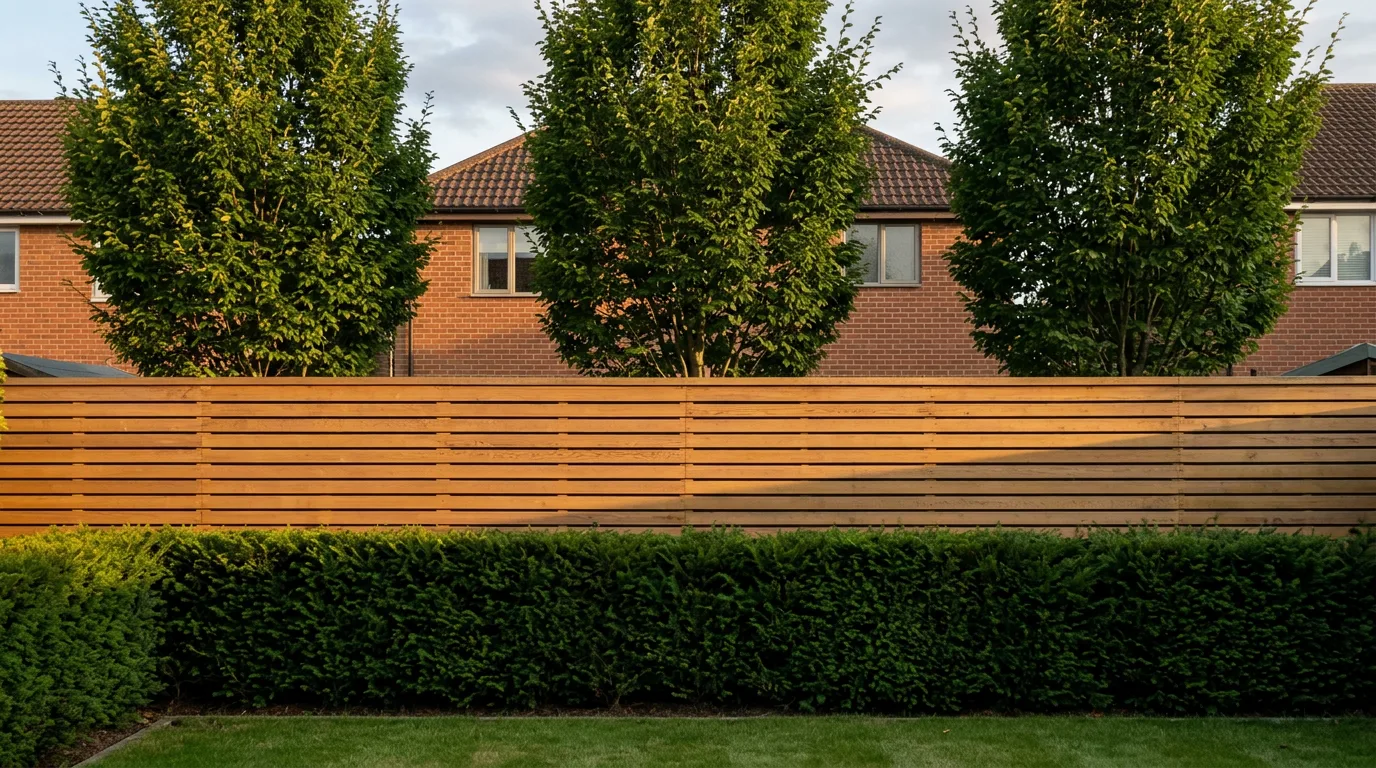
What this changes about the layered strategy. The recommendation further down this page — fence, then evergreens set back inside it, then understorey shrubs — is still the most effective arrangement, and the reason is now sharper rather than softer. In England and Wales a 2m fence is permitted development; the trees behind it are what actually block an overlooking upstairs window, and a line of two or more evergreens taken above 2m is precisely what a neighbour can act on. So keep the tall layer as individual specimen trees with visible gaps between them rather than a continuous clipped evergreen wall. That is outside the Act's own definition on two counts, it screens the window just as well, and it is also the better-looking solution — a 6m conifer hedge along a suburban boundary is the thing neighbours complain about, and a trio of multi-stem birch or hornbeam standing in front of it is not.
Nothing here is legal advice, and both countries layer local rules on top: councils and HOAs can be stricter than the national position, and a restrictive covenant on your deeds binds you regardless of what planning permits. Check the deeds and the local authority before ordering materials — the expensive mistake is a boundary built and then required to come down. The property-line point in the assessment section above is the other half of this: survey markers are definitive, neighbour agreements are not.
Living Screens: Fast-Growing Plants and Evergreen Hedges
Plant-based privacy takes time but creates natural, layered screening that improves with age. The primary variables are growth rate, evergreen vs. deciduous foliage, and climate suitability.
Evergreen Privacy Trees
Thuja Green Giant: Fastest evergreen screen, grows 3–5 feet per year, reaches 20–30 feet. Space 5–6 feet apart. Hardy zones 5–9.
Leyland Cypress: Grows 3–4 feet per year, reaches 30–40 feet. Susceptible to bagworms and canker disease in humid climates. Hardy zones 6–10.
Skip Laurel: Broadleaf evergreen, grows 2 feet per year, tolerates shade better than conifers. Hardy zones 6–9.
Eastern Red Cedar: Native to eastern US, extremely drought-tolerant, grows 1–2 feet per year. Hardy zones 2–9.
Fast-Growing Deciduous Screens
Hybrid Willow: Fastest deciduous screen, grows 6–10 feet per year. Root systems are aggressive — plant at least 20 feet from foundations and septic systems. Hardy zones 4–9.
Deciduous screens provide 8/10 privacy in summer, 2/10 in winter. Combine with evergreen understory plantings for year-round coverage.
Bamboo and Ornamental Grasses
Clumping bamboo (Fargesia): Non-invasive, grows 2–3 feet per year, reaches 10–15 feet. Hardy zones 5–9. Clumping varieties do not spread via underground runners.
Running bamboo: Fast-growing but invasive without root barriers — install 30-inch-deep HDPE barriers or avoid entirely. Many HOAs prohibit running bamboo.
Miscanthus (Maiden Grass): Deciduous, grows 4–6 feet tall, non-invasive, drought-tolerant. Hardy zones 5–9.
Structural Screens: Lattice, Metal, Glass, and Pergolas
Structural screens provide instant privacy without the mass of solid fencing. They work best layered with plantings or as standalone features in small spaces.
Lattice Panels with Climbing Vines
Wood or vinyl lattice panels mounted on posts provide immediate partial screening. Add fast-growing vines (clematis, climbing hydrangea, evergreen climbing roses) for full coverage in 1–2 years. Carolina Jessamine is evergreen in zones 7–10 but all parts are toxic — avoid if children or pets frequent the area.
Metal Privacy Screens
Laser-cut steel, aluminum, or corten panels in geometric or organic patterns. Panels are 4x8 or 4x6 feet, mounted on posts or frames. Metal screens allow light and air while blocking direct sight lines. Corten develops a rust patina that stabilizes after 6–12 months.
HOA advantage: Metal screens read as art installations rather than privacy barriers and often pass review in neighborhoods that restrict solid fencing.
Pergolas with Integrated Screening
Pergolas with lattice side panels, fabric curtains, or climbing vines create semi-enclosed outdoor rooms. Retractable fabric panels allow seasonal adjustment. For more pergola design ideas, see Backyard Pergola Ideas.
Layered Privacy Strategy: Combining Methods for 10/10 Results
The most effective privacy systems layer multiple methods to address sight lines, noise, and aesthetics simultaneously. A 6-foot fence provides instant coverage. Evergreen trees planted 5 feet inside the fence mature into a secondary screen at 10–15 feet. Ornamental understory shrubs fill gaps and soften the hardscape.
Example layered design (per linear foot):
- 6-foot horizontal slat cedar fence on property line: $35–45
- Thuja Green Giant trees at 6-foot spacing: $8–15
- Skip Laurel understory shrubs at 4-foot spacing: $6–10
- Total: $49–70 per linear foot
This configuration delivers 9/10 privacy immediately, 10/10 within 3 years, and improves aesthetically for 20+ years. The fence blocks ground-level sight lines and noise. Trees block overlooking windows. Shrubs eliminate gaps and add seasonal interest.
HOA compliance: Fences meeting HOA standards (6 feet, natural or approved colors) combined with landscaping are typically approved. If fencing is prohibited, layer evergreen screens with metal or lattice panels.
Cost Comparison: Privacy Solutions by Budget
| Privacy Method | Rating | Time | Cost/Linear Ft |
|---|---|---|---|
| Chain-Link + Slats | 6/10 | Instant | $15–25 |
| Lattice + Vines | 7/10 | 1–2 years | $15–30 |
| Solid Wood Fence (Cedar) | 9/10 | Instant | $25–45 |
| Evergreen Hedge (Thuja) | 9/10 | 3–5 years | $12–20 (trees) |
| Composite/Vinyl Fence | 9/10 | Instant | $40–60 |
| Metal Privacy Screens | 8/10 | Instant | $50–120 |
| Masonry/Block Wall | 10/10 | Instant | $60–120 |
| Layered (Fence + Trees + Shrubs) | 10/10 | Immediate → 3–5 yr | $40–80 |
Installation costs not included unless specified. DIY installation reduces costs by 30–50% for fencing and lattice.
AI Visualization for Privacy Planning
The hardest part of privacy planning is visualizing how a solution will actually block sight lines from specific vantage points. Hadaa’s Change Viewpoint engine tests privacy configurations from neighbor perspectives before you commit to materials.
Testing fence heights: Generate views at 4-foot, 6-foot, and 8-foot fence heights from the neighbor’s elevation. This reveals whether a standard 6-foot fence is sufficient or if you need additional screening for raised decks or second-story windows.
Layering visualization: Test combinations — fence alone, fence + trees at 5 years mature height, fence + trees + shrubs. Compare privacy ratings and aesthetics side by side. This prevents over-building or under-building.
Growth timeline simulation: See what your evergreen hedge will look like at 1 year, 3 years, and 5 years. This manages expectations and helps decide whether to start with larger (more expensive) stock or plant smaller trees and wait.
Frequently Asked Questions
What is the fastest way to get backyard privacy?
How tall can I build a privacy fence without a permit?
What is the best evergreen tree for a fast privacy screen?
Are there HOA-friendly privacy solutions that do not look like fences?
How much does it cost to install a privacy fence for a typical backyard?
How long does it take for a privacy hedge to fill in?
Can I combine a fence with plants for better privacy?
What is the best low-maintenance privacy solution?
AI Sight Line Testing
Test privacy solutions from your neighbor’s vantage point.
Stop guessing whether a fence height or tree placement will actually block sight lines. Upload your yard photo, specify the problem vantage point, and compare privacy configurations side by side before you build.


