
No-Grass Front Yard Ideas That Look Better Than a Lawn
Dennis Mutahi
Landscape Design Writer
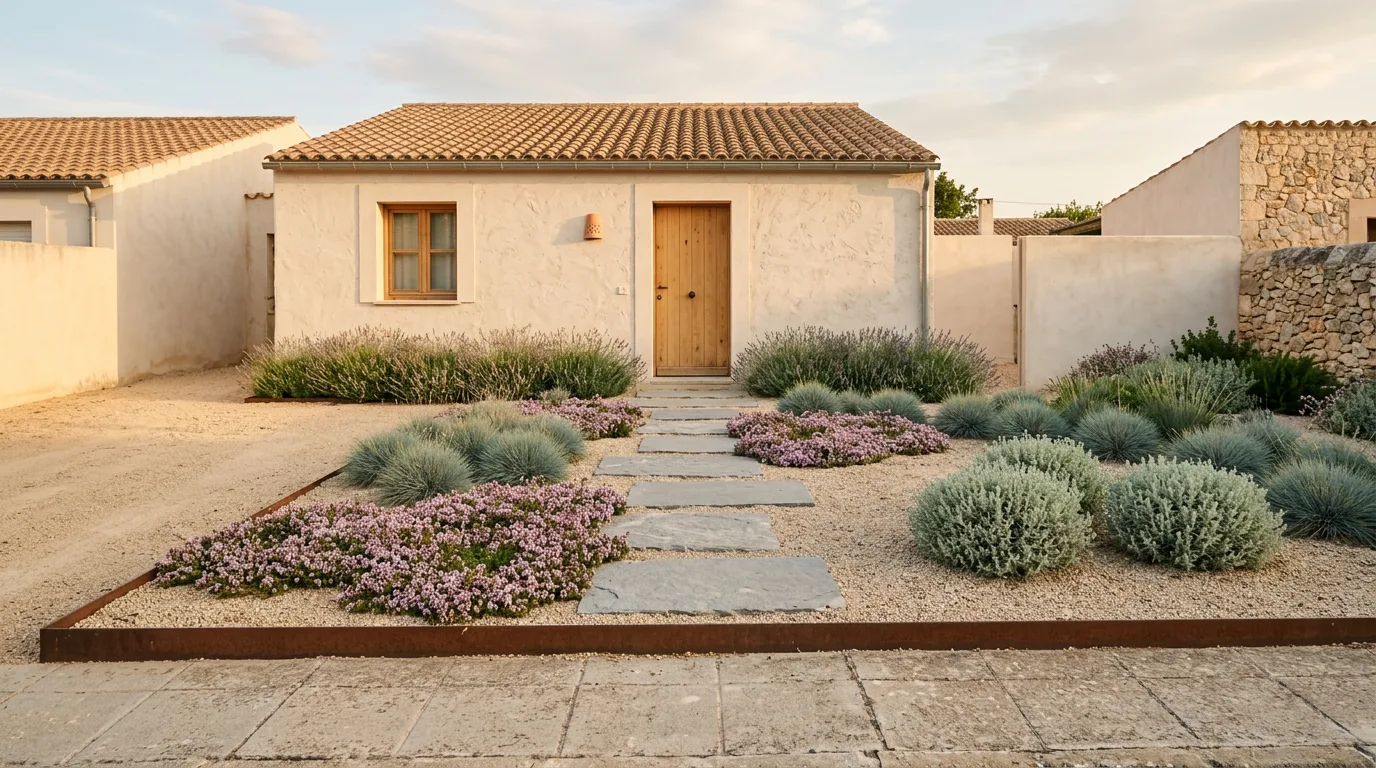
A lawn's thirst is easy to work out and larger than most people assume: EPA WaterSense puts a landscape's requirement at one inch of water a week, including rainfall, and an inch over a square foot is 0.62 gallons — so a 1,500 sq ft front lawn wants about 935 gallons a week, or roughly 24,000 gallons across a 26-week season, less whatever the sky provides. On top of that it demands weekly mowing from spring through fall, and offers little visual interest beyond its brief peak green weeks. The best no-grass front yards don't just eliminate maintenance—they transform a utilitarian surface into a designed landscape with texture, seasonal change, and genuine curb appeal. This guide shows you exactly how gravel, groundcover, native meadows, and hardscape alternatives perform in real front yards, with specific costs, timelines, and design principles that prevent the "patchwork" look that sinks most grass-removal projects. This page is about the front yard specifically; if you are converting the whole plot, or want the rebate rules and the quantities to quote from first, start with landscaping without grass: real costs and rebate rules.
Why Go Grass-Free: Water, Time, and Aesthetics
The case for removing grass isn't just environmental—it's economic and aesthetic. A 1,500 sq ft front lawn costs $800–$1,200 annually in water, fertilizer, mowing labor, and equipment maintenance in most US regions. That lawn also demands 30–40 hours of active labor per season: mowing, edging, aerating, overseeding, weeding.
Water savings: Grass lawns account for 30–60% of residential water use in suburban areas. Replacing turf with drought-tolerant groundcover cuts front yard irrigation by 50–70%; gravel or hardscape eliminates it almost entirely. In California and the Southwest, municipal rebates often cover 50–80% of grass-removal costs—making the upfront investment net-neutral or profitable.
Maintenance reduction: A well-designed no-grass yard requires 2–4 hours of seasonal maintenance (spring cleanup, occasional weeding, annual mulch refresh) versus 30–40 hours for grass. The time saved compounds year over year; the aesthetic advantage grows as plants mature and hardscape weathers.
Visual transformation: Grass is a monoculture—one species, one texture, one shade of green for most of the year, brown for the rest. No-grass designs introduce layers: vertical grasses, spreading groundcovers, sculptural succulents, seasonal color from perennials. A thoughtfully composed no-grass yard reads as "designed landscape" where grass reads as "default surface."
Real-world costs
- Professional grass removal — $2–$4 per sq ft (includes grading, fabric, initial planting)
- DIY grass removal — $0.50–$1.50 per sq ft (rental equipment, materials, your labor)
- Municipal rebates — $1–$3 per sq ft in drought-affected regions
Before choosing a grass alternative, visualize how each option will look in your specific front yard context. Hadaa's AI-powered landscape design tool lets you upload a photo of your front yard and preview gravel, groundcover, or hardscape designs in seconds—helping you commit to a direction with confidence before breaking ground.
Gravel and Rock Landscapes: Structure and Permanence
Gravel and crushed rock offer the fastest visual transformation and lowest ongoing maintenance of any grass alternative. Installed correctly, a gravel yard needs no irrigation, no mowing, and minimal weeding. The challenge is avoiding the "parking lot" aesthetic—gravel must be composed with plants, boulders, or hardscape accents to read as intentional landscape rather than neglected surface.
Types of gravel: Pea gravel (smooth, rounded) is comfortable underfoot and drains well but migrates easily—best contained within defined borders. Decomposed granite (crushed stone that compacts) stays in place, creates clean pathways, and reads as refined in modern or Mediterranean designs. River rock (2–4 inch rounded stones) anchors large open areas and contrasts well with fine-textured plants but is difficult to walk on—use for non-traffic zones only.
Installation: Professional gravel installation costs $3–$6 per sq ft depending on site preparation needs. Remove existing sod, grade for drainage, install commercial landscape fabric (4 oz minimum), then lay 2–3 inches of gravel. Edges must be contained with steel, stone, or concrete borders; uncontained gravel migrates onto sidewalks and into planting beds within one season.
Design strategy: Combine gravel with plant islands—groupings of 3–5 drought-tolerant perennials or grasses spaced throughout the gravel field. Cut through landscape fabric to plant; use drip irrigation for the first season. This breaks visual monotony and signals "designed landscape" rather than "abandoned lot." Place accent boulders (100–500 lb) as focal points near entry or at grade changes.
Cost comparison
Gravel works best in warm, dry climates where it complements regional architecture. In wet climates, it can look stark and drain poorly—consider mixed hardscape with generous planting instead.
Groundcover Plants: Living Carpets That Replace Turf
Groundcovers offer the closest visual approximation to grass—a continuous, textured surface—without the mowing, watering, or fertilizing. The tradeoff: groundcovers take 1–2 full growing seasons to fill in, require weed management during establishment, and tolerate only light foot traffic compared to turf.
Cool-climate options: Creeping thyme (Thymus serpyllum) forms a dense mat under 3 inches tall, tolerates light foot traffic, blooms purple in summer, and smells aromatic when stepped on. Requires full sun, good drainage, and minimal water once established. Plant 6–12 inches apart; expect full coverage in 1–2 seasons. Cost: $3–5 per sq ft installed.
Warm-climate options: Dymondia margaretae (silver carpet) is drought-tolerant, evergreen, handles moderate foot traffic, and stays under 2 inches tall. Thrives in coastal California and Mediterranean climates. Plant 8–12 inches apart; fills in within 1–2 seasons. Cost: $4–6 per sq ft installed. Kurapia (Lippia nodiflora cultivar) is the highest-traffic groundcover short of grass, spreads aggressively, and requires 50% less water than turf—but needs annual mowing to maintain appearance.
Shade-tolerant options: Ajuga reptans (bugleweed) tolerates full to partial shade, forms dense rosettes of purple or bronze foliage, blooms blue in spring. Spreads moderately; plant 6–10 inches apart. Cost: $3–4 per sq ft installed. Pachysandra terminalis (Japanese spurge) is evergreen, thrives in deep shade, grows 6–12 inches tall, and requires almost no maintenance once established—but takes 2–3 seasons to fill in.
Installation strategy: Remove grass, amend soil with compost, install drip irrigation on a seasonal timer. Plant groundcover plugs at the recommended spacing in a staggered grid. Mulch bare soil with 1–2 inches of fine bark to suppress weeds during fill-in. Hand-weed monthly in year one; by year two, dense coverage eliminates most weed pressure.
Groundcover comparison
| Species | Height | Traffic | Water | Fill time |
|---|---|---|---|---|
| Creeping thyme | 2–3" | Light | Low | 1 season |
| Dymondia | 1–2" | Moderate | Very low | 1–2 seasons |
| Kurapia | 2–3" | High | Moderate | 1 season |
| Ajuga | 4–6" | None | Moderate | 1–2 seasons |
| Pachysandra | 6–12" | None | Moderate | 2–3 seasons |
Groundcovers are the best choice for homeowners who want the visual continuity of grass without the maintenance burden. They work particularly well in low-maintenance front yard designs where weekly mowing is impractical.
Native Meadow and Wildflower Gardens
A native meadow front yard is the highest-biodiversity, lowest-input grass alternative—but it demands the most patience and accepts the least control. Meadows look "weedy" for the first 1–2 years as perennials establish root systems; by year three, they become self-sustaining ecosystems that require one annual mowing and zero irrigation. They work best for homeowners comfortable with an informal, naturalistic aesthetic.
Species selection: Choose a regionally appropriate native seed mix from a specialist supplier (Prairie Moon Nursery, Larner Seeds). Generic "wildflower" mixes from big-box stores contain non-native annuals that bloom once and die—leaving bare dirt. Native perennials take 2–3 years to mature but persist indefinitely, self-seed, and provide habitat for pollinators and birds.
Site preparation: Remove existing vegetation, till to 4–6 inches, grade for drainage. For best results, solarize the site for one full summer (clear plastic sheeting kills weed seeds). Sow seed in fall (for spring germination) or early spring (for summer establishment). Water lightly for the first 6–8 weeks; after that, rainfall alone sustains the meadow in most climates.
Maintenance: Mow once per year in late winter (cut to 4–6 inches, remove clippings). This prevents woody plant invasion, recycles nutrients, and stimulates fresh spring growth. Spot-treat invasive weeds (thistle, bindweed) by hand in year one and two; by year three, established natives outcompete most weeds.
Design considerations: Edge the meadow with a 12–18 inch mowed border or stone boundary so it reads as "intentional" rather than "abandoned." Plant taller species (coneflower, Joe Pye weed, ornamental grasses) toward the back or center; shorter species (black-eyed Susan, aster, sedge) at the edges. This creates depth and prevents the "wall of vegetation" look.
Meadow timeline & costs
- Seed cost — $0.50–$2 per sq ft (native mix from specialist supplier)
- Site prep (DIY) — $200–$500 for rental equipment, compost, tools
- Year 1 — Sparse coverage, visible bare soil, requires weeding and light watering
- Year 2 — 50–70% coverage, first significant bloom, reduced weed pressure
- Year 3+ — Full coverage, peak bloom, self-sustaining with annual mowing only
Native meadows are ideal for large front yards (1,000+ sq ft) where the scale supports a naturalistic composition. For smaller yards or more formal contexts, consider a mixed approach—meadow in the background, structured hardscape or groundcover near the entry.
Mixed Hardscape Solutions: Pavers, Patios, and Decomposed Granite
Hardscape-dominant front yards replace grass with durable, permanent surfaces—concrete pavers, flagstone, decomposed granite, or poured concrete—interspersed with planting zones. This approach delivers the most architectural presence, works well in urban contexts, and requires the least ongoing maintenance of any grass alternative. The upfront cost is the highest, but the lifespan is measured in decades, not seasons.
Paver systems: Interlocking concrete or natural stone pavers create clean, geometric ground planes that define entries, walkways, and sitting areas. Install on a compacted gravel base with polymeric sand joints (prevents weed growth). Cost: $10–$18 per sq ft installed for concrete pavers, $15–$25 per sq ft for natural stone. Best for modern or Mediterranean styles where strong geometry complements architecture.
Decomposed granite courts: DG is crushed granite that compacts into a firm, permeable surface—softer underfoot than pavers, more stable than loose gravel. Install over compacted base with stabilizer additive for durability. Cost: $4–$7 per sq ft installed. Works well in drought-prone regions and pairs beautifully with succulents, ornamental grasses, and modern architecture.
Permeable paver systems: Grid pavers (concrete or plastic) allow grass or groundcover to grow through openings—combining the load-bearing strength of hardscape with the visual softness of planting. Useful for driveways, overflow parking, or high-traffic front yard zones. Cost: $8–$12 per sq ft installed. Requires irrigation and occasional mowing/trimming of planted joints.
Design strategy: Use hardscape for circulation (entry walk, pathways, sitting areas) and plant the remaining space with low-water shrubs, grasses, or groundcover. This creates functional clarity—you walk here, plants grow there—while avoiding the visual monotony of continuous paving. Limit hardscape to 40–60% of total front yard area; more reads as commercial, less loses the maintenance advantage.
Hardscape cost & lifespan
Hardscape solutions work particularly well for front yards focused on curb appeal—they deliver immediate visual impact and hold their appearance without seasonal fluctuation.
Succulent and Xeriscaping Options
Xeriscaping—landscaping with drought-adapted plants—is the most resilient no-grass option for hot, dry climates. Properly designed xeric landscapes use 10–20% of the water a grass lawn demands, look lush and intentional year-round, and improve visually as plants mature. The aesthetic is sculptural and textural rather than green and uniform.
Succulent species: Agave (century plant, octopus agave) provides architectural form and requires zero supplemental water once established. Plant in full sun, well-draining soil; space 3–5 feet apart. Yucca (beaked yucca, banana yucca) offers vertical structure and year-round evergreen foliage. Sedum and ice plant spread as groundcovers, bloom prolifically, and tolerate neglect. Cost: $15–$50 per plant depending on size.
Native grasses: Ornamental grasses (Mexican feather grass, blue grama, deer grass) provide movement, texture, and seasonal color while requiring minimal water. Plant in masses of 5–10 for visual impact. Cut back once annually in late winter. Cost: $8–$20 per plant in 1-gallon containers.
Design principles: Group plants by water need—high-water-use species near the house or entry, low-water species at the perimeter. Mulch all planting beds with 2–3 inches of gravel or decomposed granite to retain soil moisture and suppress weeds. Use drip irrigation on a seasonal timer for the first two years; after establishment, most xeric plants survive on rainfall alone in their native climates.
Regional adaptation: Xeriscaping works best in USDA zones 7–10 with annual rainfall under 20 inches. In wetter climates, ensure excellent drainage (amend soil with sand or gravel, plant on berms) to prevent root rot. In freezing climates, choose cold-hardy succulents (sedum, sempervivum, delosperma) and native grasses over tender agave and aloe.
Xeriscape plant palette by region
Southwest (AZ, NM, S. CA)
Agave, yucca, prickly pear, ocotillo, Mexican feather grass, desert marigold
Mediterranean (CA coast, Pacific NW)
Lavender, rosemary, santolina, rockrose, sedum, ornamental grasses, native sages
Temperate/Cold (zones 4–6)
Sedum, sempervivum, delosperma, native prairie grasses, coneflower, yarrow
Xeriscaping combines the water savings of gravel with the visual richness of planting—making it the most sustainable and aesthetically compelling choice for arid and semi-arid climates.
Design Principles for Cohesive No-Grass Yards
The visual failure mode of most no-grass front yards is "patchwork"—disconnected plants, arbitrary material changes, no clear structure. A successful grass-free design has visual logic: defined edges, consistent materials, intentional repetition, and a clear hierarchy between circulation, planting, and open space.
Define edges aggressively: Use steel, stone, or concrete edging to separate hardscape from planting, gravel from groundcover, lawn replacement from sidewalk. Crisp edges signal "designed landscape" and prevent material migration. Avoid plastic edging—it degrades in sunlight and looks cheap within one season.
Limit your material palette: Choose one hardscape material (pavers or DG, not both), one gravel type, and 5–7 plant species repeated throughout. More variety reads as chaos. Repetition creates rhythm and makes the design feel intentional.
Create focal points: Every front yard needs a visual anchor—a large specimen plant, a grouping of boulders, a sculptural container, or an architectural element. Place the focal point at the entry or at the intersection of primary sightlines. This gives the eye somewhere to land and organizes the rest of the composition around it.
Layer by height: Place tallest elements (shrubs, grasses, specimen plants) at the back or center; mid-height plants in the middle; groundcovers and hardscape at the front. This creates visual depth and prevents the "flat" look that makes many grass-free yards feel unfinished.
Balance mass and void: Not every square foot needs a plant. Open areas of gravel, decomposed granite, or hardscape give the eye rest and make planted areas feel deliberate. Aim for 40–60% planting, 40–60% open ground or hardscape. More planting reads as overgrown; less reads as barren.
Match style to architecture: Modern homes pair well with geometric hardscape, ornamental grasses, and sculptural succulents. Traditional homes look better with curved edges, flowering perennials, and natural stone. Mediterranean and ranch styles suit decomposed granite, lavender, and olive trees. Forcing a style mismatch between house and landscape creates visual tension.
Common design mistakes
- Too many materials — Three types of gravel, four paving materials, ten plant species. Simplify ruthlessly.
- No defined edges — Gravel migrating onto sidewalks, plants bleeding into pathways. Install borders first.
- Underplanting — Vast expanses of bare gravel with isolated lonely plants. Group plants in clusters of 3–5.
- Ignoring scale — Huge boulders in a tiny yard, or tiny plants in a large open space. Match element size to site scale.
- No focal point — Uniform texture throughout with nothing to anchor the composition. Add one strong element.
Before committing to a no-grass design, test your concept visually. Hadaa's AI visualization tool lets you upload a photo of your current front yard and see how gravel, groundcover, or hardscape designs will look in your specific context—helping you avoid the most common design mistakes before installation begins.
Frequently Asked Questions
How much water does a no-grass front yard save?
What is the cheapest grass alternative for a front yard?
Do no-grass yards increase home value?
What groundcover looks like grass but doesn't need mowing?
Can I mix gravel with plants in a front yard?
How do I prevent weeds in a no-grass front yard?
What looks best in a sunny, dry front yard with no irrigation?
How long does a groundcover lawn replacement take to fill in?
Ready to design your no-grass front yard?
Visualize Your Grass-Free Front Yard in Seconds
Upload a photo of your current front yard and see how gravel, groundcover, or hardscape designs will look in your specific space—before you commit to installation.


