There is no single right month to prune a shrub, because three independent clocks decide the answer and they do not agree. The first is the flower-bud clock: a shrub that sets next year’s buds last summer loses its flowers to a winter cut, and a shrub that flowers on this year’s growth does not. The second is the disease clock, and it is the one almost every pruning calendar gets wrong — for oaks and elms the trigger is a temperature, not a date. Wisconsin Horticulture Extension states it plainly: “Oaks and elms should not be pruned once the temperature hits 50°F as the beetles that carry oak wilt and Dutch elm disease fungi become active at that temperature.” The third is the wound clock: a cut made in late spring closes slowly and stays open to pathogens for longer.
Read all three and most of the confusion disappears. Read only the calendar and you will eventually shear the flower buds off a lilac, or open an oak in June.
Clock one: which wood holds the buds
Every timing rule for a flowering shrub reduces to one question — was the flower bud made last year or will it be made this year?
Shrubs that bloom in spring carry buds formed the previous summer. Wisconsin Horticulture describes them as producing buds on “one-year-old wood (wood produced the preceding summer)”, and gives the rule: “prune AFTER they have flowered in spring, but before the next year’s flower buds are set.” Cut one in February and the flowers are in the bin.
Shrubs that bloom in summer make their buds on growth that has not happened yet, so they can be cut hard while dormant. The same source lists them as pruned “when they are dormant or in early spring before budbreak.”
| Clock-one group | Buds made | Prune | Examples named by Wisconsin Horticulture |
|---|---|---|---|
| Spring flowering | Previous summer, on one-year-old wood | Straight after the flowers fade | Lilac, forsythia, viburnum, honeysuckle, chokeberry, mock orange, weigela |
| Summer flowering | This spring, on new growth | Dormant season or early spring before budbreak | Hydrangea, roses, Japanese spirea, rose-of-Sharon, potentilla, smokebush |
The practical version: if it flowers before roughly midsummer, prune it when the flowers finish. If it flowers after, prune it before it starts growing.
Hydrangeas are four plants, not one
“Hydrangea” sits in the summer-flowering row above, and that is where most ruined hydrangeas come from — because the genus splits across both clock-one groups. UGA Extension separates them by species:
| Species | Wood | Timing (UGA Extension) |
|---|---|---|
| Smooth hydrangea, H. arborescens | New, spring growth | “prune H. arborescens in late winter” — cutting “to 6-12 inches above the ground stimulates vigorous regrowth” |
| Panicle hydrangea, H. paniculata | New spring growth | “prune H. paniculata in late winter before spring growth begins”, lightly |
| Bigleaf hydrangea, H. macrophylla | Old wood | “prune H. macrophylla immediately after flowers fade” |
| Oakleaf hydrangea, H. quercifolia | Old wood | “prune H. quercifolia immediately after flowers fade” — lightly, “leaving plenty of stem length” |
Reblooming bigleaf cultivars flower on both old and new wood, which buys you a second chance rather than a free pass: UGA notes they can be pruned after the blooms fade, or in late winter if a hard freeze has already taken the old-wood buds.
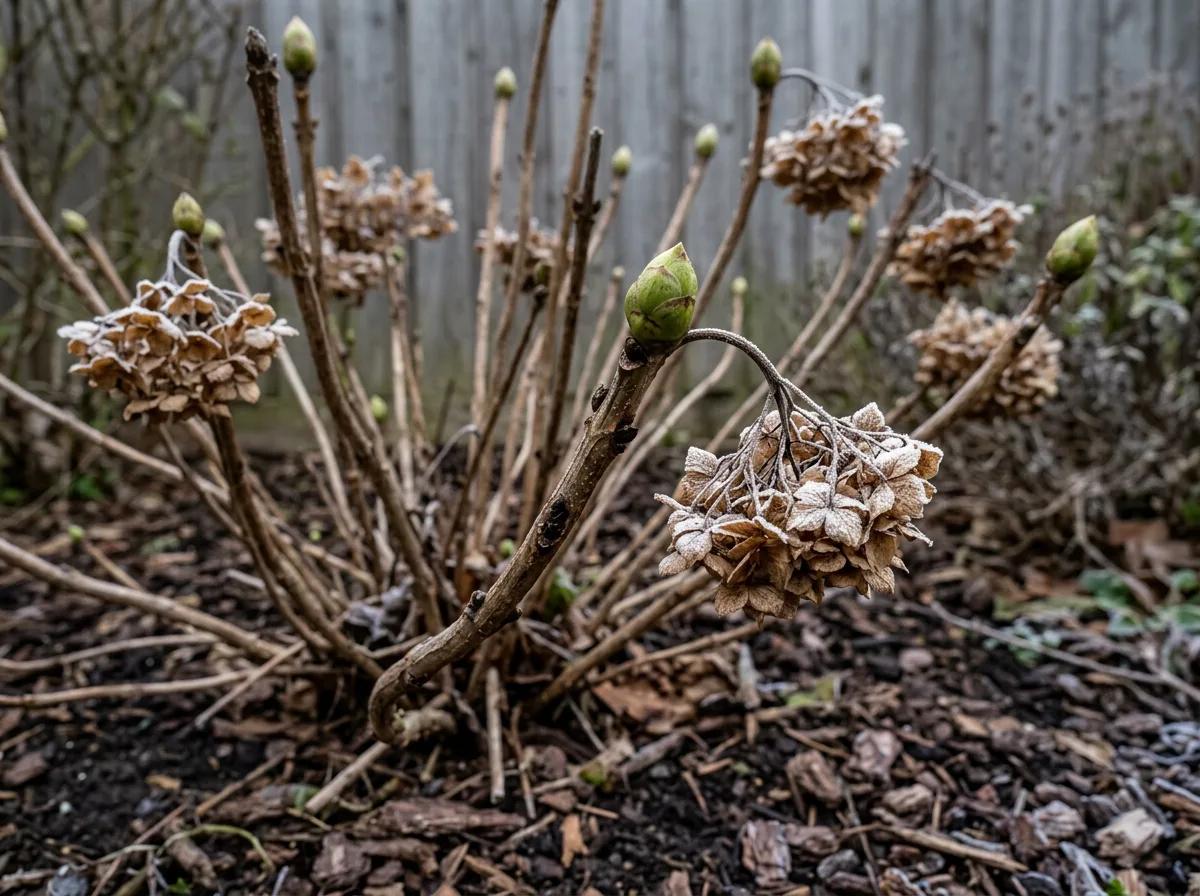
So the two hydrangeas you cut to the ground in February are arborescens and paniculata. The two you leave alone until the flowers brown are macrophylla and quercifolia — and the fat green buds already sitting on those bare stems in winter are the reason.
Clock two: the 50°F beetle threshold
This is the clock that makes a pruning calendar unsafe, and it applies to the two genera most likely to be standing over your shrubs — oak and elm.
Oak wilt is moved by beetles that are drawn to the smell of a fresh wound. Wisconsin Horticulture’s figure for how fast is the one worth remembering: “Sap beetles can visit wounded oaks within 10 minutes of wound formation.” The bark beetles involved are named as Pseudopityophthorus minutissimus and Pseudopityophthorus pruinosus. The red oak group is the group that dies — Wisconsin describes red oaks as most susceptible and able to die in under a month, while white oak group species “usually have less severe symptoms and rarely die in a single season.”
Dutch elm disease works the same way with a different vector: two species of elm bark beetle, one native and one European.
Because both vectors switch on with warmth, the extension rule is written as a temperature. Again from Wisconsin Horticulture: oaks and elms “should only be pruned if the temperature is going to be reliably below 40°F and preferably lower for several days before, during and after pruning.”
What the state agencies publish as dates
Agencies translate that threshold into a calendar window for their own latitude, which is why the published dates differ:
| Agency | Window to avoid |
|---|---|
| Minnesota DNR | April through July |
| Michigan DNR | April 15 to July 15 |
| Wisconsin Horticulture Extension | Everything outside the dormant season — “Prune oak trees only during the dormant season when sap and bark beetles are not active” |
Treat those as local readings of the same rule rather than as competing facts. Two states a few hundred miles apart publish windows that differ by a fortnight, and Wisconsin declines to give a date at all — which is the honest version, because the beetles answer to the thermometer. If you garden further south, your own window opens and closes earlier than Minnesota’s; if you are further north, later. Check your own forecast against 50°F rather than copying a date from a blog written for somebody else’s latitude.
The exception that proves the rule. Pruning paint is not recommended on any normal cut — Wisconsin Horticulture says wound treatments “are not recommended. These compounds slow down wound closure and promote decay.” The single exception is an oak wounded in the growing season, where the point is not healing but getting a barrier over the scent before the beetle arrives. That is the only situation in ordinary garden pruning where a sealant is the right answer.
If you are pruning elms and have to make more than one cut, disinfect between them. Wisconsin Horticulture’s instruction is to treat tools “for at least 30 seconds with a 10% bleach solution or (preferably due to its less corrosive properties) 70% alcohol”, and to make cuts “six feet below any area showing symptoms.”
Clock three: how fast the wound closes
The third clock is why “late fall to winter” is the default answer for woody plants that have no flower-bud constraint. Wisconsin Horticulture’s guidance for deciduous trees is that “Most deciduous trees should be pruned in late fall to winter”, when the branch structure is visible and disease organisms are dormant; late spring and summer are avoided because pathogens are active and wounds close more slowly.
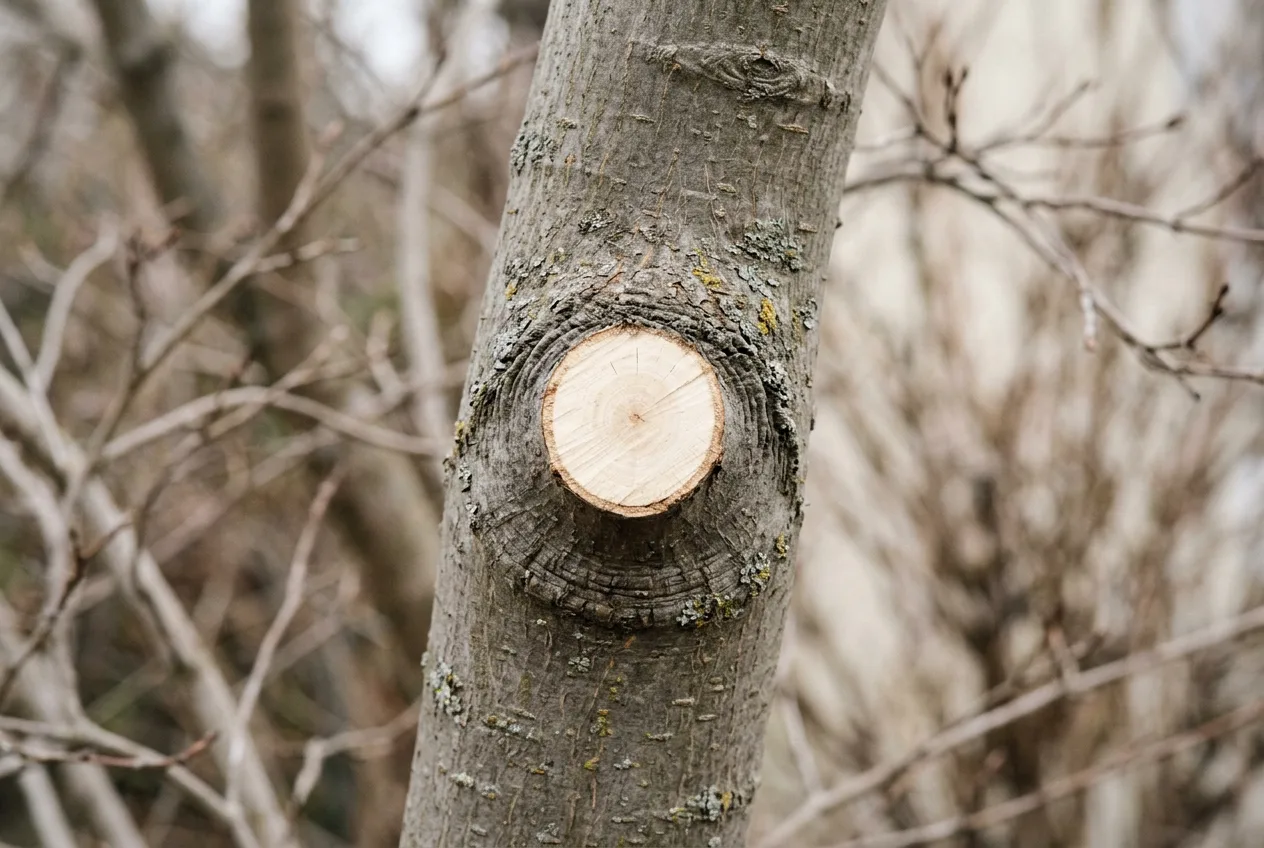
Where you make the cut matters as much as when. The final cut goes “next to the tree’s trunk outside of the branch collar” — and explicitly not flush: “Do not cut the branch flush with the tree’s trunk.” A flush cut removes the collar tissue that closes the wound; a long stub leaves dead wood the plant cannot seal around. For a limb heavy enough to tear, the three-cut method is an undercut 12–18 inches out, a second cut from above to drop the weight, then the final cut outside the collar.
How much, not just when
Two numbers do most of the work.
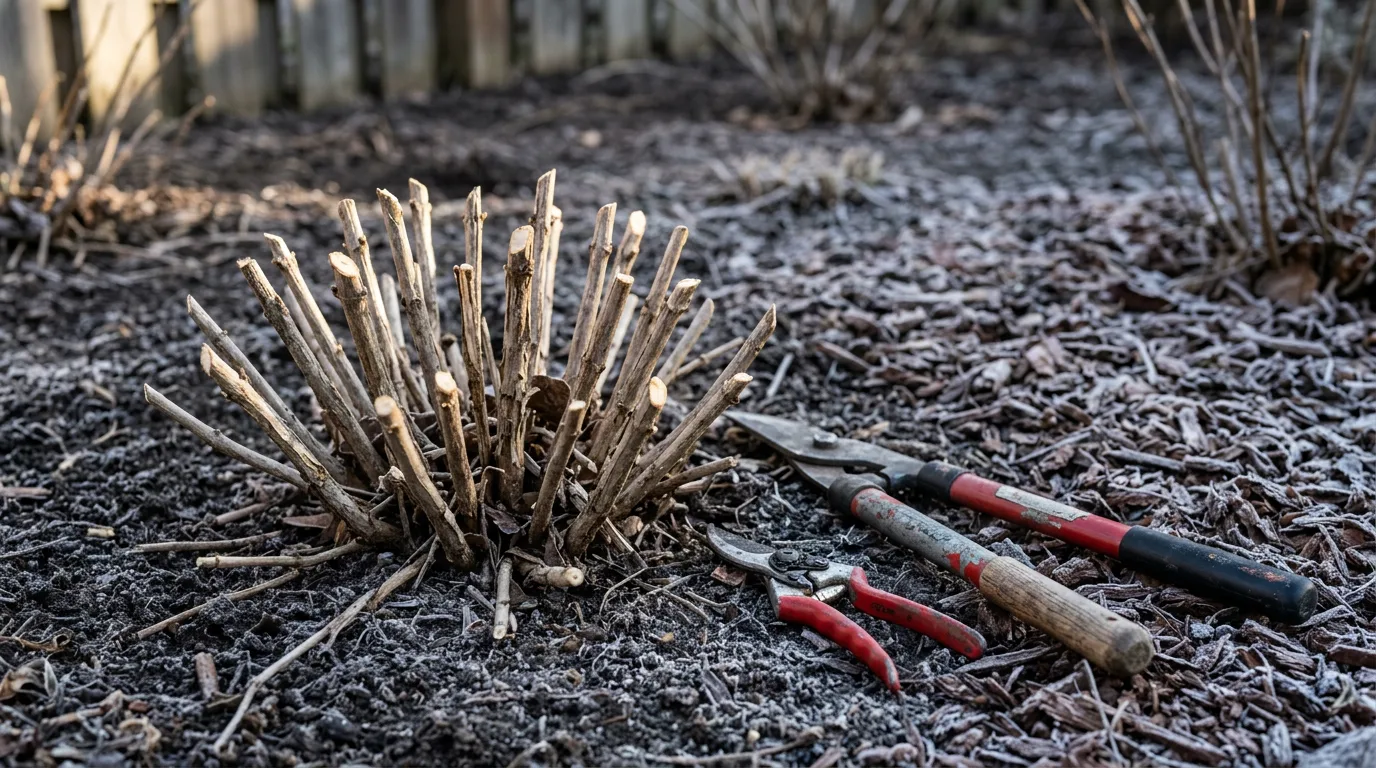
The one-third rule. Wisconsin Horticulture: “Remove only 1∕3 of the largest branches at one time.” On an overgrown shrub this turns a single brutal year into a three-year renewal, taking the oldest stems out at the base each winter so there is always mature wood flowering while the young wood comes up.
Rejuvenation, for the shrubs that take it. Some shrubs can be cut to almost nothing: “Cut the entire shrub back to a height of four to 10 inches from the ground when the shrubs are dormant.” Wisconsin names butterfly bush, ‘Annabelle’ hydrangea, potentilla and Japanese spirea as suitable. That is the same instruction UGA gives for smooth hydrangea, from the other direction.
And the shrubs that take neither. Broad-leaved evergreens must not be “sheared or cut back into older, non-leafy areas as these plants lack latent buds” — Wisconsin names rhododendron, evergreen holly and Oregon grapeholly. Cut a rhododendron back into bare wood and nothing grows back there, ever. This is the single most expensive pruning mistake in a mature front garden, because the plants it ruins are usually the oldest and largest things in it, and the kind of specimen shrub worth choosing carefully in the first place.
A related trap: Wisconsin flags red-twig dogwood, shrub willow, double-flowering almond and purple-leaf sandcherry as prone to canker and fire blight, and recommends annual thinning plus careful tool disinfection on those rather than occasional heavy cuts.
The month you are actually standing in
| If it is | Do | Leave |
|---|---|---|
| Late autumn to midwinter | Deciduous trees and summer-flowering shrubs; oaks and elms, once nights are reliably below 40°F | Spring bloomers — their buds are already made |
| Late winter, before budbreak | Cut H. arborescens and H. paniculata back; rejuvenate butterfly bush, potentilla, Japanese spirea; take out one third of the oldest stems on anything overgrown | Lilac, forsythia, viburnum, mock orange, weigela |
| Spring, once it is past 50°F | Spring bloomers, as soon as the flowers fade | Oaks and elms — this is the window the DNRs name |
| Early to midsummer | Light shaping; hedges; H. macrophylla and H. quercifolia as their flowers brown | Hard cuts on anything — wounds close slowly |
| Late summer to early autumn | Little. Late cuts push soft growth into the first frost | Almost everything; wait for dormancy |
Hedges are the one category that runs on a different schedule entirely, because a hedge is maintained for density rather than flowers — if you are shaping a screening hedge, you are trimming to a profile through the growing season, not making structural cuts once a year.
The woody half of a seasonal job
Pruning shrubs is one half of putting a garden to bed; the other half is herbaceous — stems, seedheads and fallen leaves — and the rules there are nearly the opposite, because what you leave standing over winter is habitat. Our fall garden cleanup checklist covers that side, including the disease exceptions that force a cut, and preparing a garden for winter covers the rest of the sequence. If your shrubs are mainly there to keep deer off the rest of the border, the species that are rarely damaged are also, usefully, the ones that recover best from a hard renewal cut.
When you are deciding what a bed should look like in three years rather than next spring, it helps to see it. Hadaa renders a photograph of your garden as a finished design, so you can test a shrub at full size — and a renewal cut takes it back to a quarter of that — before you commit three winters to it.
FAQ
Can I prune shrubs in the fall? For summer-flowering shrubs and most deciduous trees, late autumn into winter is the recommended window — Wisconsin Horticulture puts it at “late fall to winter”. What is best avoided is late summer to early autumn, when a cut pushes soft new growth that the first frost then kills.
Is it ever too cold to prune? For oaks and elms, cold is the point: the extension rule is to prune only when temperatures are “reliably below 40°F and preferably lower for several days before, during and after pruning.” For everything else, very hard frost makes wood brittle, so work on a mild dormant day rather than the coldest one.
Why did my hydrangea not flower after I pruned it? Almost certainly it is a bigleaf or oakleaf hydrangea, which flower on old wood, and it was cut in winter or early spring. The buds for this summer were already on those stems. Identify the species first, then use the UGA table above.
Do I need to paint pruning cuts? No — wound dressings “slow down wound closure and promote decay”. The one exception is an oak wounded during the growing season, where paint applied immediately is a barrier against the beetles that carry oak wilt.
How much can I take off an overgrown shrub in one go? Remove no more than one third of the largest branches in a year, unless the species is one that tolerates rejuvenation to four to ten inches — butterfly bush, ‘Annabelle’ hydrangea, potentilla and Japanese spirea among them. Never cut a rhododendron or an evergreen holly back into bare, non-leafy wood: those plants lack the latent buds to regrow from it.
Sources: Wisconsin Horticulture Extension on pruning deciduous shrubs, pruning deciduous trees, oak wilt, Dutch elm disease and the end of the spring dormant pruning season · UGA Extension Forsyth County on identifying hydrangeas before pruning · Minnesota DNR and Michigan DNR on oak pruning windows. Checked 2 October 2026.