
Japanese Zen Garden Design: Create Calm in Any Backyard
Francis Karuri
Landscape & AI Correspondent
Zen garden design is often reduced to raked gravel, a few stones, and the vague instruction to "create calm." This misses the actual mechanics. Real zen landscaping follows specific spatial rules — asymmetric composition, emptiness as a structural element, borrowed scenery, restraint in materials and color. These rules translate to any backyard, in any climate, at any scale. The result is a space that feels contemplative and deliberate, not because it's Japanese in aesthetic, but because zen landscaping applies principles that strip away visual noise and foreground composition over decoration.
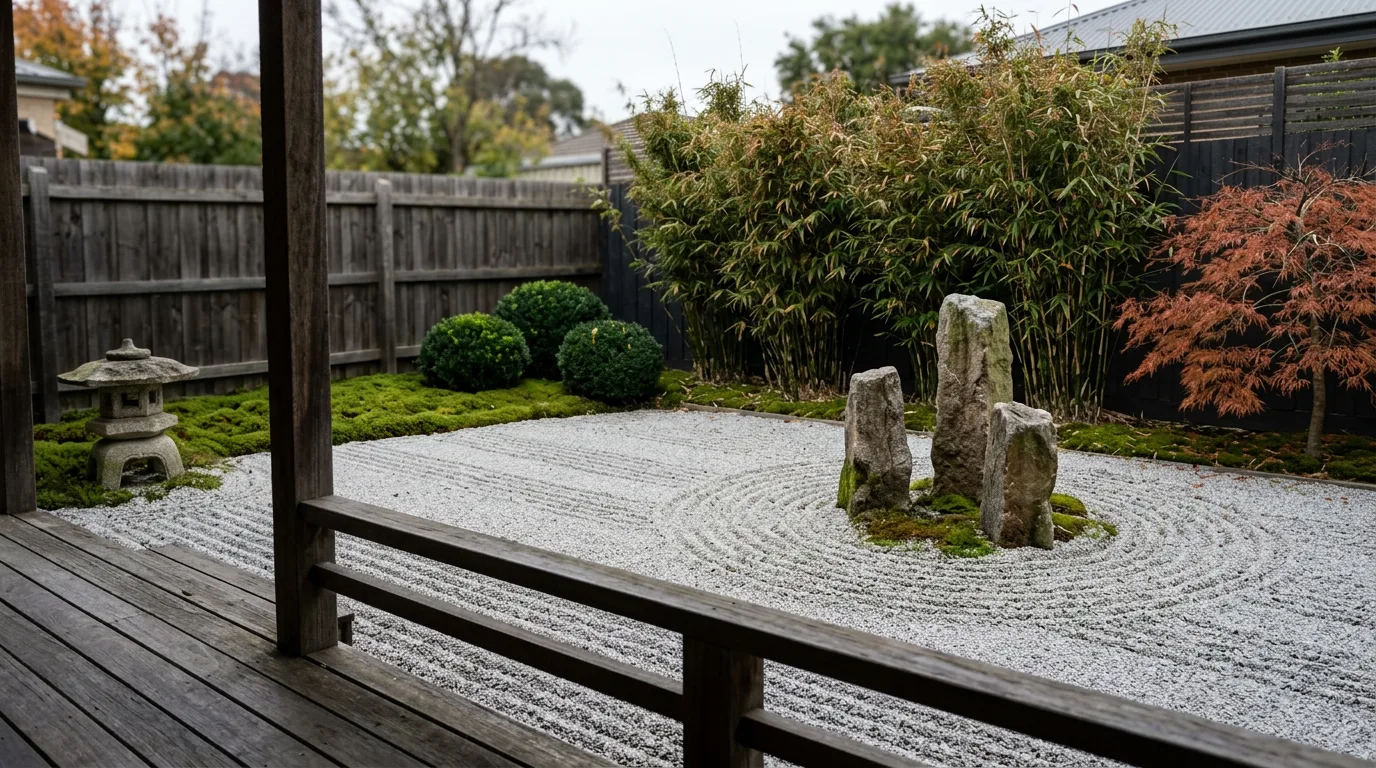
The Core Principles of Zen Garden Design
Zen gardens (karesansui, or "dry landscape") emerged in medieval Japan as contemplative spaces for Buddhist monks. Unlike stroll gardens or tea gardens, which invited movement and social ritual, Zen gardens were designed to be viewed from a single fixed position — typically a temple veranda. This constraint forced a different design logic: every element had to justify its position within the frame, and emptiness became as important as the objects placed within it.
The principles that govern traditional Zen gardens are not stylistic preferences but structural rules derived from centuries of refinement. They work in any cultural context because they address fundamental perceptual mechanics — how the eye moves through space, how asymmetry creates tension and resolution, how emptiness amplifies the presence of objects.
Asymmetry (fukinsei)
Zen composition avoids symmetry, centering, and predictable spacing. Stone groupings use odd numbers (3, 5, 7), never even. Elements are positioned off-center and at irregular intervals. This asymmetry creates visual tension that keeps the eye moving rather than settling into complacency.
In practice: if placing three stones, position them in a scalene triangle, not an equilateral one. If dividing the garden into zones, use a 60/40 or 70/30 split, not 50/50. Asymmetry does not mean randomness — every placement is intentional, but the logic is dynamic rather than static.
Simplicity and restraint (kanso)
Zen gardens use the minimum number of elements required to establish the composition. A traditional Zen garden might contain fewer than ten objects total: a stone grouping, a single tree, a lantern, and the gravel field itself. Every additional element dilutes the clarity of the composition.
This restraint applies to materials, color, and form. The palette is limited to stone, gravel, moss, and evergreens — all neutral or muted. Flowering plants, bright colors, and ornamental objects are excluded not for cultural reasons but because they compete for attention.
Natural irregularity (shizen)
Zen gardens appear natural rather than designed, but this is not the same as being unplanned. Stones are selected and positioned to look as though they emerged from the landscape organically. Gravel raking patterns echo water ripples or flowing streams. Plants are pruned to enhance their natural form, not forced into geometric shapes.
The goal is to create a space that feels timeless and inevitable — as though it has always existed in this configuration and will continue unchanged. Anything that reads as artificial, decorative, or imposed breaks this effect.
Borrowed scenery (shakkei)
Traditional Zen gardens frame distant views — a mountain, a tree line, a temple roof — as part of the composition. This technique, shakkei, integrates the surrounding landscape into the garden without physically controlling it.
In suburban contexts, borrowed scenery might be a neighbor's mature tree, a distant hillside, or even a section of sky framed by fencing. The principle is the same: the garden is not an isolated enclosure but a curated view that extends beyond its physical boundaries.
The Purpose of a Zen Garden
The purpose of a Zen garden is contemplation, not recreation. Where most gardens are made to be walked through, planted in, and used, a Zen garden (karesansui) is made to be looked at — a fixed composition that supports stillness of attention. It originated in medieval Japanese Zen Buddhism as an aid to meditation: monks would view and rake the gravel as a focusing practice, the repetitive motion and the unchanging arrangement quieting the mind. That is the core function the form was designed around.
In a modern backyard, the purpose translates directly even without the religious context. A Zen garden gives you a deliberately empty, low-stimulus space — a visual counterweight to a busy home and a busy screen-filled life. The restraint is the point: by removing color, clutter, and seasonal change, the design holds your attention on a small number of carefully placed elements and on the emptiness between them. This is what separates true zen landscaping from a generic "Japanese-themed" corner with a lantern and some pebbles.
What the garden is for
- Contemplation — a fixed view that rewards sustained looking rather than activity
- A meditative ritual — raking the gravel is a calming, repeatable practice, not just maintenance
- Symbolic landscape — gravel reads as water, stones as mountains or islands; the garden abstracts nature rather than copying it
- Calm and low maintenance — a restful, low-stimulus space that stays consistent year-round
How Asymmetry Creates Balance
The most common mistake in Western interpretations of Zen gardens is attempting to balance the composition symmetrically. Symmetry feels stable and resolved, which is precisely what Zen design avoids. Asymmetry creates dynamic balance — the composition feels stable despite lacking mirror symmetry.
Achieving this requires understanding visual weight. A large stone positioned near the edge of the composition can balance several smaller stones grouped on the opposite side. A vertical element (a tree, a lantern) can balance a horizontal expanse (a raked gravel field). The composition holds together through tension rather than equivalence.
Practical guidelines for asymmetric composition
- Use odd-numbered groupings — three stones, five plants, seven gravel lines. Even numbers create symmetry by default.
- Position the focal point off-center — place the primary stone grouping at the one-third or two-thirds mark, not the midpoint.
- Vary spacing — elements should not be evenly distributed. Cluster some close together, leave others isolated.
- Balance mass with void — a dense stone grouping on one side can be balanced by a large expanse of empty gravel on the other.
Test your composition
Stand at the intended viewing position (typically where you'll sit or enter the space). Close your eyes, open them, and note where your gaze lands first. If it hits the center of the frame, the composition is too symmetrical. A well-balanced asymmetric composition draws the eye off-center, then guides it through the space in a deliberate sequence.
Emptiness as a Structural Element
In most garden styles, empty space is what remains after placing plants, hardscape, and features. In Zen design, emptiness is the primary element. The raked gravel field is not background — it is the composition. Stones, plants, and objects are placed within it to define its boundaries and amplify its presence.
This inverts the typical design process. Rather than starting with a list of elements to include (a bench, a tree, a path), start with the void. Define the empty space first — its shape, its proportion, its texture — then introduce the minimum number of objects required to frame and activate it.
How to use emptiness effectively
Scale the void to the space
In a small backyard (10×15 feet), a single uninterrupted gravel field with one stone grouping at the edge can feel expansive. In a larger space, the void can be subdivided by subtle grade changes, stone borders, or planting islands — but each subdivision should itself feel spacious, not crowded.
Vary the texture of emptiness
Raked gravel creates one kind of emptiness; a moss bed creates another. The former reads as active and dynamic (the raking pattern implies movement), the latter as still and soft. Both are valid. Choose based on the feeling you want: gravel for clarity and sharpness, moss for quietness and age.
Use objects to define, not fill, the void
A stone placed in the center of a gravel field does not fill the space — it makes you aware of the space around it. A single tree at the edge of a moss bed frames the emptiness and gives it scale. Every object you add should make the void more present, not less.
Materials and Elements in Zen Garden Design
Gravel and sand
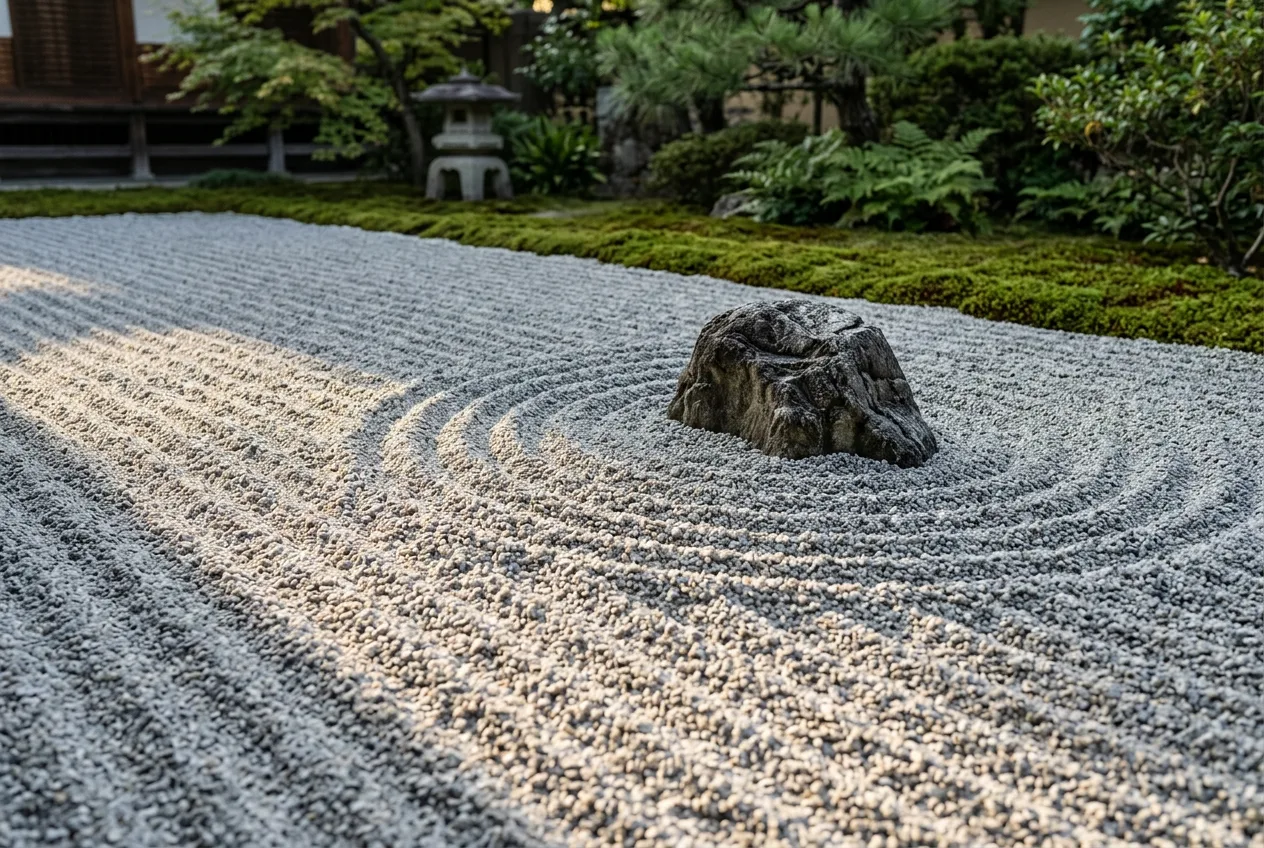
Gravel or sand forms the primary surface in most Zen gardens. It represents water symbolically — raked in patterns that echo ripples, waves, or flowing streams. Use crushed granite, pea gravel, or decomposed granite in neutral tones (gray, tan, white). Avoid brightly colored or highly polished materials.
Depth: 2-3 inches of gravel over landscape fabric or a compacted base to suppress weeds. Rake weekly to maintain the pattern and remove debris.
Alternative: In humid climates or shaded areas, moss can replace gravel as the primary ground plane. Moss requires no raking but needs consistent moisture and shade to establish.
Stones
Stones are the structural bones of the composition. In traditional Zen gardens, stones are selected individually for their shape, color, and texture, then grouped in odd numbers (most commonly three or five). Each stone within a grouping plays a role: the tallest is the "guardian," the next tallest is the "attendant," and smaller stones complete the composition.
Selection: Choose stones with weathered, natural surfaces — avoid cut or polished stone. Position stones partially buried to mimic how they would sit in a natural landscape, not placed on top of the gravel like decorations.
Grouping logic: Stones should relate to each other as a composition, not as isolated individuals. Orient them at angles that create implied lines of sight between them. Avoid placing stones in straight rows or evenly spaced intervals.
Water (real or symbolic)
Traditional Zen gardens often exclude water entirely, relying on raked gravel as a symbolic substitute. When water is included, it should be still or slow-moving — a small pond, a stone basin (tsukubai), or a narrow stream. Avoid fountains, waterfalls, or moving water features that create sound or visual activity.
For North American climates, a still reflecting pool or a stone basin fed by a slow drip is more sustainable and easier to maintain than a recirculating pond.
Lanterns and ornaments
Stone lanterns (tōrō), water basins, and bamboo fences are traditional elements but should be used sparingly. A single lantern positioned at a compositional focal point is effective; multiple ornaments scattered throughout the garden fragment the composition.
If including ornamental elements, choose weathered stone or cast concrete over brightly colored ceramics or polished metal. The goal is to reinforce the garden's sense of age and naturalism, not to decorate it.
Materials and Maintenance at a Glance
| Material | Role | Spec | Maintenance |
|---|---|---|---|
| Gravel / sand | Primary surface, symbolic water | Crushed granite or pea gravel, 2–3 in over fabric | Rake weekly; replenish every 3–5 years |
| Stones | Structural focal groupings | Weathered, odd-numbered, partially buried | Effectively none once set |
| Moss | Soft ground plane (humid/shade) | Established in shade with consistent moisture | Mist in dry spells; remove debris gently |
| Water basin (tsukubai) | Still or slow-moving accent | Stone basin, slow drip — no fountains | Clear debris; check water level seasonally |
| Evergreens | Backdrop and accents | Restrained forms: maple, boxwood, clumping bamboo | Prune to natural form 1–2× per year |
| Stone lantern (tōrō) | Single ornamental focal point | Weathered stone or cast concrete, used sparingly | Effectively none |
How Much Gravel You Actually Need
The question every zen garden guide skips, and the one the merchant will ask you first. Gravel is sold by the cubic yard or the ton, not by the square foot, so measure the raked area and convert it. At the 2–3 inch depth in the table above, the arithmetic is cubic yards = area in square feet × depth in feet ÷ 27, which is × 0.167 ÷ 27 at 2 inches and × 0.25 ÷ 27 at 3 inches.
| Raked area | Gravel at 2 in | Gravel at 3 in | Typical stone groupings |
|---|---|---|---|
| 100 sq ft (a 10 × 10 courtyard) | 0.62 cu yd | 0.93 cu yd | One grouping of 3 |
| 200 sq ft (a side yard) | 1.23 cu yd | 1.85 cu yd | One of 3, one of 5 |
| 400 sq ft (a garden corner) | 2.47 cu yd | 3.70 cu yd | Two or three groupings |
| 800 sq ft (a small whole garden) | 4.94 cu yd | 7.41 cu yd | Three groupings, plus empty ground |
Three things the numbers do not show. Order about 10% over — gravel settles into the fabric and into the ground under the stones, and a second delivery of a different batch will not match the first in colour. Choose an angular crushed gravel rather than a rounded pea gravel: angular particles lock together and hold a rake line, while rounded ones slump back and the pattern disappears within a day. And size matters more than colour — roughly 3 to 6 mm holds a crisp furrow, while anything much coarser will not take the rake at all.
The stones are the opposite problem: they are bought individually, they are heavy, and the composition depends on their proportions, so buy them in person rather than by the pallet. Budget for them to be set with roughly a third of their height buried, which means a stone that reads as two feet tall in the finished garden has to arrive nearer three.
Building a Zen Garden Plant Palette
Zen gardens prioritize evergreens with restrained forms and muted colors. The planting is minimal — often fewer than five plant species in the entire garden. Flowering plants, bright foliage, and seasonal color changes are avoided because they introduce visual noise and temporal instability.
In North American climates, the traditional Japanese plant palette (Japanese maple, black pine, bamboo, azalea) can be adapted or substituted with native or regionally appropriate alternatives that maintain the same visual restraint.
Recommended plants by region
Cool temperate (Pacific Northwest, Northeast)
- Japanese maple (Acer palmatum) — refined branching, restrained habit, minimal fall color in cultivars like 'Sango Kaku'
- Boxwood (Buxus) — evergreen, dense form, prunes cleanly into natural shapes
- Bamboo (Fargesia species) — clumping (non-invasive), vertical form, year-round green
- Ferns and moss — soft texture, shade-tolerant, low maintenance
Hot, humid (Southeast)
- Podocarpus — evergreen conifer, upright habit, heat-tolerant
- Southern live oak (small specimens) — evergreen, sculptural branching, native
- Mondo grass (Ophiopogon japonicus) — low groundcover, dark green, forms dense mat
- Clumping bamboo (Bambusa multiplex) — non-invasive, heat-tolerant, vertical structure
Arid (Southwest)
- Japanese yew (Podocarpus macrophyllus) — drought-tolerant once established, evergreen, upright habit
- Desert willow (Chilopsis linearis) — native, airy form, minimal water
- Agave or yucca — sculptural, architectural, drought-adapted (use sparingly as focal points)
- Blue fescue (Festuca glauca) — low, mounding grass, blue-gray foliage, minimal water
Pruning philosophy
Prune to enhance natural form, not to impose geometric shapes. Remove crossing branches, thin crowded growth, and shape the canopy to follow the plant's inherent structure. The result should look like a refined version of the plant's wild form, not a sculpted object.
Layout Strategies for Small and Suburban Spaces
Zen gardens scale effectively because the principles are spatial, not dimensional. A 10×15-foot corner of a suburban backyard can hold a complete Zen composition — a raked gravel bed, a three-stone grouping, and a backdrop of bamboo or evergreen shrubs. The key is restraint: fewer elements, more space between them.
Courtyard or side yard
A narrow side yard (6-8 feet wide) is an ideal location for a Zen garden. Install a gravel bed along the length of the space, position a single stone grouping near one end, and plant evergreens or bamboo along the back fence as a visual backdrop. The linearity of the space naturally creates the asymmetry and directional flow that Zen composition requires.
View the garden from a fixed point — a window, a bench, or the entry threshold — so the composition is framed and read as a unified scene rather than experienced as a path through space.
Corner of a larger backyard
Carve out a 10×15-foot or 12×20-foot zone in one corner of the yard. Define the boundary with a low stone wall, a bamboo screen, or a hedge to separate the Zen space from the rest of the yard. Within the enclosure, create a gravel field, a stone grouping, and minimal planting. Add a simple bench or stepping stones to establish the viewing position.
This zoned approach lets you preserve functional lawn or patio space elsewhere while dedicating a single area to contemplative design.
Front yard alternative to lawn
Replace a turf-dominated front yard with a Zen-inspired composition: a gravel bed edged in stone, asymmetric stone groupings, and evergreen shrubs or a single tree. This approach eliminates high-maintenance lawn, conserves water, and creates a distinctive entry experience.
Keep sightlines clear to the front door. Position taller elements (trees, bamboo) at the edges of the space, and use low stones or groundcovers near the entry path.
Maintenance Requirements
Zen gardens require consistent but minimal maintenance. The primary task is raking the gravel to refresh the pattern and remove debris — typically a 10-15 minute weekly ritual. Planting is sparse and focused on evergreens, so seasonal upkeep is limited to occasional pruning and weed removal.
Weekly and seasonal tasks
- Rake gravel weekly to refresh the pattern and remove fallen leaves or debris
- Remove weeds as they appear (landscape fabric beneath gravel minimizes this)
- Prune evergreens once or twice per year to maintain natural form
- Replenish gravel every 3-5 years as it compacts or migrates
- Moss care (if used): mist during dry periods, remove debris gently
Time commitment
A Zen garden requires approximately 30-60 minutes per month once established — mostly spent raking and occasional pruning. This is among the lowest maintenance burdens of any garden style.
Visualizing Your Zen Garden Before You Build
The difficulty in planning a Zen garden is that the composition is spatial — it depends on proportion, balance, and sightlines that are hard to evaluate from a two-dimensional plan or a mental sketch. Most homeowners either place too many elements (fragmenting the composition) or fail to establish a clear focal point (leaving the space feeling incomplete).
Hadaa generates photorealistic renders from a photo of your yard, showing exactly how a Zen garden composition will look in your specific space. You see the gravel field, stone groupings, and planting at the correct scale and proportion before you purchase materials or hire a contractor.
How AI rendering works for Zen garden design
Upload a photo of the space you want to convert — a side yard, a backyard corner, or a front yard. Specify Zen or minimalist as your style preference. Hadaa's Garden Autopilot generates multiple design variations, each showing:
- Asymmetric stone groupings positioned at compositionally correct intervals
- Gravel or moss fields with appropriate scale and texture
- Minimal planting that reinforces the composition without overwhelming it
- Multiple viewpoints so you see the design from every angle, not just one static perspective
After you select a render, Hadaa generates a contractor-ready blueprint and a material list. For Zen gardens, this includes gravel specifications (type, depth, quantity), stone counts and sizes, and a plant list with USDA zone verification. You hand this to a landscaper or execute it yourself with full confidence that the proportions and materials will work in your space.
Why this matters
Zen gardens fail when the composition is unbalanced or the scale is wrong — too many stones, too little gravel, plants that overpower the emptiness. AI rendering shows you the finished composition at the correct scale before you commit to materials, so you build with confidence rather than hope.
Frequently Asked Questions
What are the core principles of Japanese Zen garden design?
Can I create a Zen garden in a small suburban backyard?
Do I need a water feature in a Zen garden?
What plants work in a Zen garden in North America?
How do I maintain a gravel or sand Zen garden?
What's the difference between a Zen garden and a Japanese garden?
How much does it cost to build a Zen garden?
Can I adapt Zen garden design to a modern aesthetic?
Related reading
- Modern Minimalist Garden Design: Less Lawn, More Impact
- Formal Garden Design: Symmetry, Structure & How to Scale It
- Best AI Landscape Design Apps in 2026: 12 Tools Tested, Ranked, and Compared
- How AI Landscape Design Works: From Photo to Photorealistic Render in Minutes
- AI Backyard Design: Upload a Photo and Get 22 Photorealistic Renders
See Your Design Before You Build
Visualize Your Zen Garden in Minutes
Upload a photo of your yard. Get photorealistic renders showing asymmetric composition, stone placement, and gravel fields at the correct scale.


