
Desert Landscape Design: Beautiful Xeriscaping That Doesn't Look Like a Parking Lot
Dennis Mutahi
Landscape Design Writer
The biggest objection to desert landscaping is that it looks barren—acres of beige gravel, a lone cactus, zero color. That's bad xeriscaping, not desert design. Done right, desert landscapes deliver vibrant color, textured layers, sculptural focal points, and year-round visual interest while using 70% less water than traditional lawns. Here's how to design one that reads as lush, not lunar.
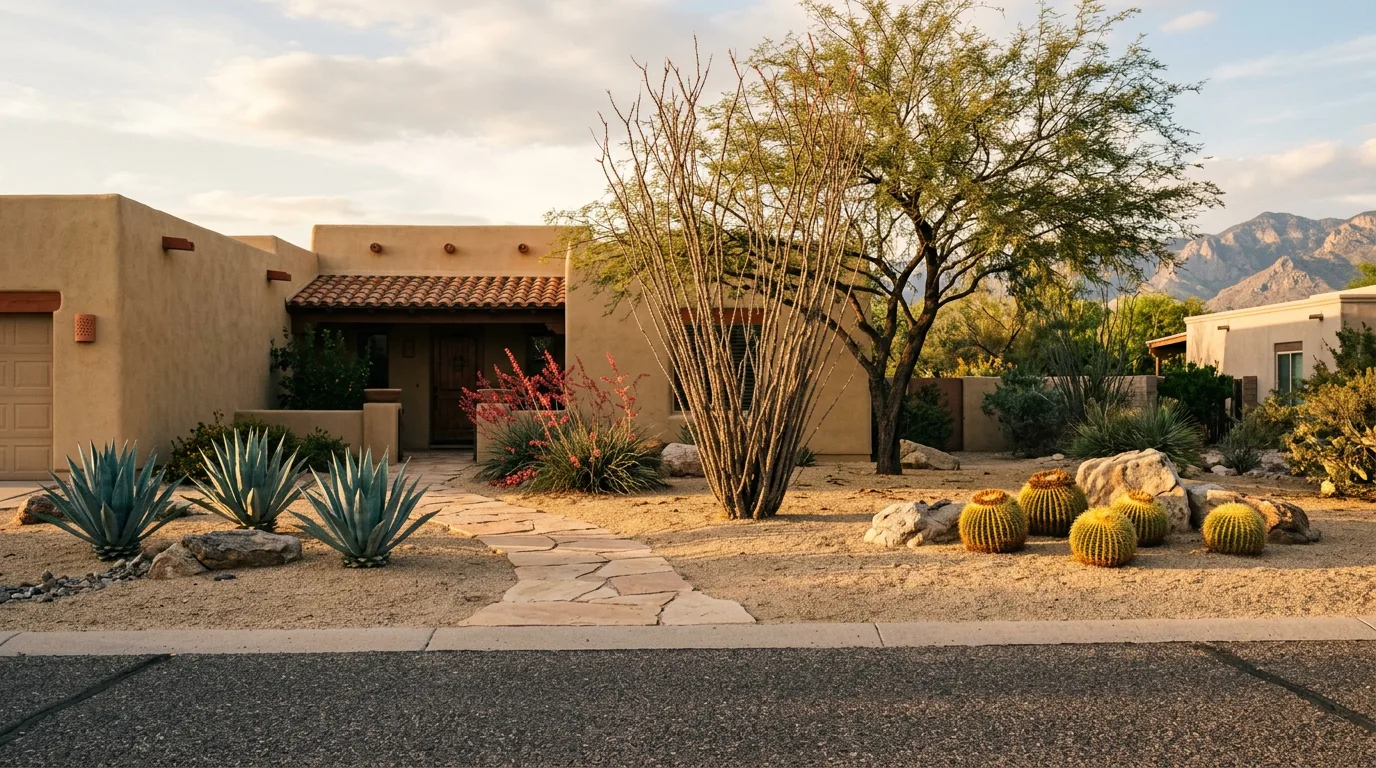
Why Desert Landscapes Look Barren (And How to Fix It)
Most desert landscapes fail because they prioritize water savings over design. The result: endless gravel fields punctuated by randomly spaced cacti that look like afterthoughts. The gravel is builder-grade grey. There's no height variation, no color, no visual structure. It reads as unfinished, not intentional.
The fix: treat desert landscaping as a design problem first, a water-conservation problem second. Start with composition—focal points, layered heights, color contrast, defined spaces—then select plants and materials that deliver the design while meeting water goals.
Problem: Monochromatic Gravel
Builder-grade grey gravel makes everything look like a commercial parking lot. It's cheap, neutral, and visually dead.
Solution: use gravel in warm tones—rust, terracotta, tan, ochre—that complement desert plant colors. Mix textures: ¾" decorative rock in patios, ⅜" crushed granite in pathways, 2-3" boulders as accents.
Problem: Dot-Planted Cacti
Single cacti spaced evenly across a gravel field read as landscaping by checklist, not design.
Solution: group plants in clusters of 3-5, vary heights within each cluster, and leave intentional empty space between groups. Think of plantings as compositions, not inventory.
Problem: No Vertical Elements
Flat landscapes feel unfinished. Without height variation, there's no visual interest from any angle.
Solution: add tall structural plants (ocotillo, saguaro, palo verde trees), stack boulders for height, or install vertical elements like ramadas or metal sculptures as focal points.
Problem: Zero Seasonal Color
Evergreen succulents and gravel deliver year-round consistency, but also year-round monotony.
Solution: include blooming desert natives (penstemon, desert marigold, brittlebush) that add seasonal color bursts. Even brief blooms change the entire character of the space.
Core Principles of Desert Landscape Design
Layer Heights for Visual Depth
Desert landscapes need three height tiers: groundcovers and low succulents (under 12"), mid-height shrubs and grasses (1-4'), and tall structural elements (trees, ocotillo, or architectural features above 6').
Why this works: layered heights create sightlines that change as you move through the space. From the house, you see the tall elements first; as you walk closer, mid-height and groundcover plantings reveal themselves. This is what separates designed landscapes from gravel lots.
Use Boulders as Focal Points
Boulders are the sculptural anchors of desert landscapes. Place 1-3 large boulders (300+ lbs) as focal points, partially bury them for a natural look, and cluster plants around them rather than scattering them randomly.
Material selection: choose boulders native to your region—sandstone, granite, basalt. Avoid decorative river rock that looks imported. Boulders should feel like they've always been there, not like they were dropped by a crane last week.
Embrace Color Through Plants and Materials
Desert landscapes achieve color through blooming plants (purple penstemon, yellow brittlebush, magenta bougainvillea), colorful foliage (red yucca, blue agave), and warm-toned materials (rust gravel, terracotta pavers, oxidized steel accents).
The palette: warm earth tones (ochre, rust, sand) as base layers, punctuated by vibrant desert blooms. Avoid cool greys, black mulch, or anything that reads as industrial.
If you want that warmth with more clipped structure and less cactus, Mediterranean garden design works in the same heat and on the same water budget, using silver-leaved shrubs and gravel in place of succulents. Check the plant list for your county first — the fruiting olive and green fountain grass that define the look are prohibited in Southern Nevada, and that page names the approved substitutes.
Define Spaces With Hardscape and Edging
Desert landscapes blur into formless gravel fields without clear spatial definition. Use pathways (flagstone, decomposed granite), patios (pavers or stamped concrete), and edging (steel, natural stone) to create legible zones.
Functional zones: main patio adjacent to the house, pathways connecting spaces, planted beds with defined edges, open gravel areas as breathing room. Every zone should have a clear purpose.
Plan for Shade and Outdoor Living
Desert landscapes are unusable without shade. Include ramadas (Southwestern-style pergolas), shade sails, or plant palo verde or mesquite trees for dappled shade. Position shade structures over patios and seating areas.
Microclimate design: shade structures create cooler zones where you can grow more diverse plants (ferns, hostas) in an otherwise hot landscape. Strategic shading makes desert gardens livable, not just viewable.
Which Desert Are You In? (This Decides the Plant List)
Almost every desert landscaping article treats “the desert” as one place. North America has four, they are not interchangeable, and the difference is not academic — it is the difference between a plant that lives and a plant that dies in its first February.
The clearest example is the one everybody puts on a mood board. The saguaro grows, in the words of the National Park Service, “only in the Sonoran Desert… found, naturally, in no other environment”, limited by freezing temperatures and by altitude — generally sea level to about 4,000 feet. Plant one in Las Vegas or Albuquerque because you saw it in a Phoenix garden and you have bought a slow, expensive failure.
What separates the four deserts is when the rain arrives, not just how much falls. Moving west to east from the Mojave to the Chihuahuan, the ratio of winter to summer rain drops. The Sonoran is the odd one out: it gets both, in two distinct seasons, which is why it supports two flowering seasons a year and a far richer palette than its neighbours. Design for the wrong rainfall pattern and your irrigation schedule fights the plants all year.
| Desert | Where | Rain pattern | Design consequence |
|---|---|---|---|
| Sonoran | Phoenix, Tucson, Yuma, Palm Springs' eastern edge | Bimodal — gentle winter rains and violent summer monsoon storms | The richest palette of the four. Two bloom seasons, columnar cacti (saguaro, organ pipe), palo verde, ocotillo, brittlebush. Plan for monsoon runoff: this is the one desert where drainage design matters as much as irrigation. |
| Mojave | Las Vegas, Barstow, Victorville, Death Valley | Winter-dominant, dry summers, cold nights | No saguaro, no matter what the Las Vegas nursery says. Joshua tree, creosote, Mojave yucca, desert willow, blackbrush. Sparser natural spacing, so composition has to do more work — group and layer, or it reads as scrub. |
| Chihuahuan | El Paso, Las Cruces, Alpine, southern New Mexico | Summer monsoon rain, little or no winter rain | Agave, sotol, yucca, cenizo (Texas sage), damianita, ocotillo. Higher elevation means real freezes; choose cold-hardy agaves and expect a genuinely dormant winter look. Plant in early summer to catch the monsoon, not in spring. |
| Great Basin / high desert | Reno, Bend, Boise, much of northern Nevada and Utah | Cold-limited — the growing season is short regardless of when rain falls | The one that breaks “desert” expectations. Almost no succulents or cacti survive here; the natural vegetation is low small-leafed shrubs. Sagebrush, rabbitbrush, bitterbrush, native bunchgrasses. Design it as a cold steppe garden, not a Southwest one. |
Rainfall pattern and desert type by region follow the Arizona-Sonora Desert Museum and the National Park Service's Sonoran Desert Network climate summary.
Then check the zone on top
Desert type tells you the rainfall pattern; the USDA hardiness zone tells you what survives the coldest night. They do not move together. Phoenix sits in zone 9b–10a, Las Vegas around 9a, El Paso 8a–8b, Albuquerque 7b, Reno 7a, Bend 6b — a spread of roughly 20 °F in minimum winter temperature across gardens that all look like “desert” in photographs.
Both filters have to pass before a plant goes on the plan. That two-step check is exactly what our zone-by-zone planting guide exist for, and it is what Hadaa's biological engine runs automatically on every design it generates.
Plant Selection for Desert Landscapes
Choose plants native to your desert region—Sonoran, Mojave, Chihuahuan, or Great Basin. Native plants are adapted to local rainfall patterns, soil types, and temperature extremes. They also support local pollinators and wildlife.
General rule: prioritize plants with year-round structure (agave, yucca, cacti) as the backbone, then add seasonal bloomers for color bursts. Avoid tropical plants (palm trees, bird of paradise) that demand excessive water and look out of place.
Structural Plants (Evergreen, Architectural Form)
- Agave — rosette form, blue-grey or green foliage; slow-growing, dramatic focal point
- Ocotillo — vertical branching canes, red blooms in spring; iconic Sonoran Desert plant
- Barrel Cactus — spherical form, yellow blooms; slow-growing, drought-tolerant
- Red Yucca — grass-like foliage, red flower spikes; hummingbird magnet
Desert Trees (Shade and Structure)
- Palo Verde — green bark, yellow blooms, dappled shade; Arizona state tree
- Mesquite — drought-tolerant, nitrogen-fixing, feathery foliage; edible pods
- Ironwood — dense, slow-growing, purple-pink blooms; provides dense shade
- Desert Willow — orchid-like blooms, fast-growing, attracts hummingbirds
Seasonal Bloomers (Color Accents)
- Penstemon — tubular flowers in red, pink, purple; blooms spring through summer
- Desert Marigold — yellow daisy-like blooms, long flowering season, reseeds
- Brittlebush — yellow blooms, silvery foliage, mounding form; blooms late winter through spring
- Fairy Duster — red puffball blooms, attracts butterflies, blooms year-round in warm climates
Groundcovers and Low Fillers
- Sedum (Desert varieties) — low, spreading, succulent foliage; zero maintenance once established
- Desert Zinnia — small yellow flowers, low-growing, reseeds freely
- Native Grasses — blue grama, deer grass, or sideoats grama; movement and texture
- Gravel mulch — not a plant, but the primary groundcover; use ¾" decorative rock in warm tones
Hardscape and Material Choices
Material selection defines whether a desert landscape feels warm and intentional or barren and industrial. Choose warm-toned materials that complement desert plants and mimic the natural environment.
Gravel and Loose Fill
Decorative rock (¾" to 1" diameter) — rust, terracotta, tan, ochre tones. Use as primary groundcover over landscape fabric. Avoid grey or black gravel.
Decomposed granite — compacted pathways in warm beige or tan; natural look, drains well.
Crushed granite (⅜") — finer texture for high-traffic areas; compacts tighter than decorative rock.
Paving Materials
Flagstone — irregular natural stone in warm tones (sandstone, rust); use for pathways and patio insets.
Stamped concrete — textured to mimic stone or tile, in earth tones; cost-effective for large patios.
Natural stone pavers — travertine, sandstone, or limestone; avoid polished finishes (too slippery in heat).
Structural Elements
Ramadas — Southwestern-style open pergolas with vigas (round beams) and latillas (cross-pieces); natural wood or stained pine.
Oxidized steel accents — planters, edging, or decorative panels; rust patina adds warmth.
Stacked stone walls — low retaining walls or borders in native stone; avoid stucco (reads as commercial).
Boulders
Use 1-3 large boulders (300-1000 lbs) as focal points. Choose native stone—sandstone, granite, basalt—in warm tones. Partially bury boulders (⅓ underground) for a natural look. Cluster plants around boulders rather than placing them in isolation.
Irrigation Strategy for Desert Landscapes
Desert plants need water during establishment, but far less than traditional lawns once mature. The goal is deep, infrequent watering that encourages deep root development.
Drip irrigation is mandatory. Install emitters at each plant's root zone, run separate zones for different water needs (trees vs. succulents), and set timers for early morning watering to minimize evaporation.
Watering Schedule by Phase
- Establishment (Year 1-2) — twice weekly deep watering; reduce frequency as plants establish
- Mature plants (Year 3+) — monthly deep watering during hot season; many desert natives need zero supplemental water after establishment
- Monsoon season — turn off irrigation entirely; rely on natural rainfall
Water Savings
Established desert landscapes use 70-80% less water than traditional lawns. In Phoenix, AZ, that translates to savings of $1,200-$1,800 annually on water bills for a typical 2,000 sq ft yard.
Layout Walkthrough: Transforming a Standard Desert Yard
Here's how to approach a typical 30' × 40' desert backyard, currently lawn or builder-grade gravel. This assumes full sun and arid climate (Phoenix, Tucson, Las Vegas, Albuquerque).
Step 1: Define Primary Patio and Shade Structure
Place a 12' × 16' patio adjacent to the house using flagstone or stamped concrete. Add a ramada or shade sail (10' × 12' minimum) for afternoon shade. This is your primary destination—furnish it with weather-resistant seating.
Step 2: Place 1-2 Large Boulders as Focal Points
Position one large boulder (500+ lbs) in the main sightline from the house, partially buried. Use a second boulder to define the edge of a seating area or pathway. These anchor the composition.
Step 3: Plant Structural Elements
One or two trees for vertical structure—palo verde or mesquite near the patio for shade, ocotillo at the perimeter for height.
Mid-height clusters of 3-5 agave, yucca, or barrel cactus. Group near boulders or along pathways, leaving open gravel space between clusters.
Step 4: Add Seasonal Bloomers
Plant drifts of penstemon, brittlebush, or desert marigold in beds along the perimeter or flanking pathways. Use 5-7 plants per species in a single mass—never single specimens scattered randomly.
Step 5: Install Pathways
Decomposed granite pathways (3-4' wide) connecting patio to side yard or secondary zones. Use flagstone stepping stones through planted areas. Edge pathways with steel edging or low stacked stone.
Step 6: Apply Gravel Groundcover
Spread ¾" decorative rock in warm tones (rust, tan, ochre) over landscape fabric in all open areas. Use 3-4" depth for weed suppression. Gravel is the canvas—plantings and boulders are the composition.
What a Desert Landscape Costs
Desert landscaping costs more upfront than maintaining a lawn, but delivers long-term savings through reduced water use and minimal maintenance. Here's the realistic breakdown for a 1,000 sq ft backyard.
Installation Costs
- Lawn removal and grading — $1,500–$2,500
- Gravel and base prep — $2,000–$4,000 (landscape fabric, base rock, decorative gravel)
- Boulders — $500–$1,500 for 1-3 large boulders with delivery and placement
- Plants — $2,000–$4,000 for native trees, succulents, and bloomers
- Drip irrigation — $1,500–$2,500 with timer and zones
- Ramada or shade structure — $3,000–$6,000 depending on size and materials
Total: $10,000–$20,000 for a professional install. DIY can reduce costs by 30-40% if you handle grading and planting.
Ongoing Costs
- Water bills — 70-80% reduction vs. traditional lawns; $1,200–$1,800 annual savings in Phoenix
- Maintenance — minimal pruning, seasonal cleanup; $200–$500/year if hiring out
- Gravel refresh — top up gravel every 3-5 years; $200–$400
What Your Water Utility Will Pay You to Do This
Most desert landscaping articles end the cost conversation at the installed price. In the Southwest that is only half of it, because several water authorities will pay a meaningful share of the bill to get a lawn out of the ground — and the rules attached to the money quietly dictate the design.
Three things are worth knowing before you draw anything. Every one of these programmes requires approval before work starts; several set a minimum living plant coverage, which rules out the gravel-desert look this article warns against anyway; and rates change, in both directions.
Southern Nevada (Las Vegas, Henderson, North Las Vegas)
The Southern Nevada Water Authority's Water Smart Landscapes rebate pays $5 per square foot of grass removed and replaced with desert landscaping, up to the first 10,000 square feet converted, and $2.50 per square foot after that, per property per fiscal year. Las Vegas Valley Water District customers get a further $2 per square foot on top, taking it to $7. Two conditions shape the design: plants must cover at least 50 percent of the converted area at maturity, and a drip system with a filter and pressure regulator is required. You must have a pre-conversion site visit before you remove the lawn — starting early disqualifies the project outright.
SNWA Water Smart LandscapesSouthern California (Metropolitan Water District service area)
SoCal Water$mart's residential turf replacement rebate is $2.00 per square foot, up to 5,000 square feet of converted yard per year. The design conditions are more prescriptive than Nevada's: three plants per 100 square feet of area transformed, no hardscape inside the converted area except permeable hardscape, a stormwater retention feature in every project, and conversion of overhead spray to drip, micro-spray or hand watering. Funds are reserved by application before work starts, then you have 180 days to finish.
SoCal Water$mart turf replacementTucson — check before you count on it
This is the one to verify rather than assume, and it is why “check your local rebate” is not good enough advice. Tucson Water's turf removal rebate at $5 per square foot sits under its Commercial & Multifamily customer rebates. Its residential rebate page lists high-efficiency toilets, high-efficiency clothes washers, rainwater harvesting and grey water systems — and no turf removal. If you are a Tucson homeowner budgeting a conversion around a turf rebate you read about in a listicle, confirm with Tucson Water first.
Tucson Water residential rebatesThe design consequence
Read those conditions together and the rebate is not neutral about what you build. Fifty percent living coverage at maturity in Nevada, three plants per hundred square feet in Southern California, permeable surfaces only, drip throughout: a gravel field with six cacti in it does not qualify for the money, and a properly layered planting does. The programme is paying for the good version of this style, which is a useful thing to know before the first quote arrives.
Using AI to Design Your Desert Landscape
Desert landscaping requires precise plant placement, material selection, and spatial composition to avoid the "parking lot" look. Hadaa generates photorealistic renders that respect desert design principles: layered heights, boulder focal points, warm material palettes, and native plant selections.
How it works: upload a photo of your current yard, specify desert or xeriscape style, and the AI generates layout options showing gravel groundcover, clustered plantings, boulder placements, and shade structures. You can adjust plant species, test different gravel colors, and visualize seasonal bloom patterns before installation.
This is especially useful for desert landscapes because mistakes—dot-planted cacti, grey gravel, no height variation—are expensive to correct and immediately visible.
Start Designing
See your yard transformed into a vibrant desert landscape—upload a photo and get a photorealistic render showing native plants, warm materials, and sculptural focal points.
Try Hadaa →Frequently Asked Questions
Can I plant a saguaro in my desert landscape?
Is desert landscaping the same everywhere in the Southwest?
Will my water utility pay me to remove my lawn?
What is xeriscaping?
Does desert landscaping look barren?
What plants work in desert landscapes?
How much does desert landscaping cost?
Do I need irrigation for desert plants?
What colors work in desert landscaping?
Can desert landscaping work in cold climates?
How do I add shade to a desert landscape?
Design Your Desert Landscape
Beautiful Xeriscaping That Looks Lush, Not Barren
Upload a photo of your yard and get a photorealistic desert landscape design—complete with native plants, warm gravel, sculptural boulders, and vibrant seasonal color.


