
Wildflower Garden Design: How to Make a Meadow Look Intentional, Not Abandoned
Winnie Astrid
Garden Design Editor
Wildflower meadows are ecologically brilliant and maintenance-light, but they come with one serious design challenge: the line between "intentional naturalistic planting" and "someone gave up mowing" is thinner than most gardeners expect. The plants themselves don't signal intent—the structure around them does. This guide explains the specific design moves that make a wildflower garden look curated instead of abandoned, and why those moves work even in small suburban yards.
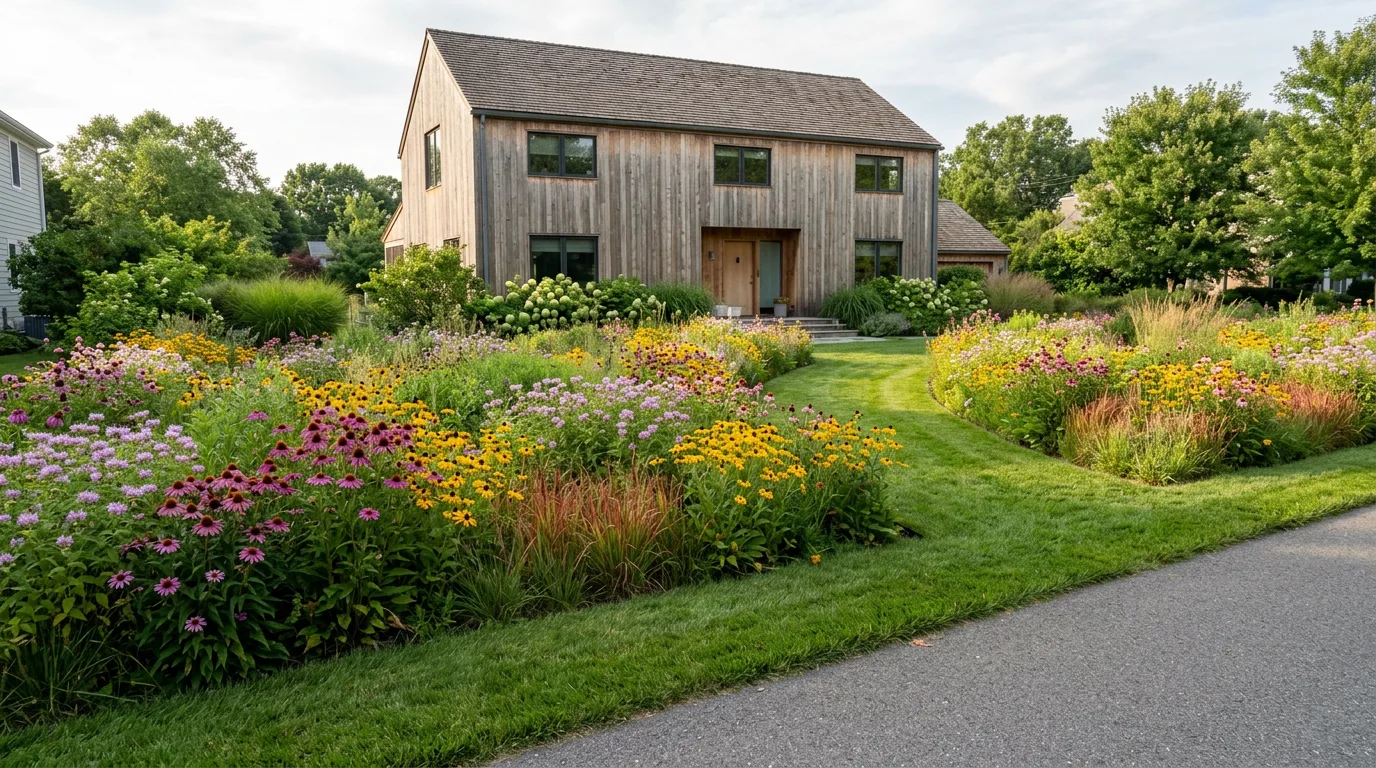
Why Wildflower Gardens Look Abandoned (And What Actually Signals Neglect)
The cultural default for residential landscapes is short grass, clipped edges, and visible human intervention. A wildflower meadow violates all three. It's tall, textured, and designed to look like it grew without help. That's the ecological goal—but it's also why neighbors and HOAs read them as neglect.
The problem isn't the wildflowers. It's the absence of design cues that separate "this is a choice" from "this is what happens when you stop caring." Those cues are structural, not botanical. A meadow full of rare native species still looks abandoned if it has no edges, no paths, and no focal points. A meadow planted with three common species looks intentional if those structural elements are present.
Understanding this distinction is the entire design challenge. You're not trying to make the meadow look manicured—you're trying to make it look framed, bounded, and deliberately placed.
What neighbors actually see
- No edges: The meadow blurs into adjacent lawns or property lines without visual transition
- No paths: There's no way to enter or move through the space—it reads as inaccessible
- No focal point: The eye has nowhere to land—no bench, sculpture, tree, or destination
- Inconsistent maintenance: Paths mowed irregularly, or edges creeping into lawns
Mown Paths Are the Single Most Important Design Element
Paths do two things simultaneously: they make the meadow usable, and they prove it's deliberate. A meadow without paths is just tall plants. A meadow with consistent mown paths is a designed landscape you can walk through.
The path pattern matters. Straight paths read as formal and efficient. Curved paths feel naturalistic and exploratory. Geometric patterns (figure-eights, concentric circles) feel playful and contemporary. The choice depends on your garden's context, but the presence of any path pattern is more important than which pattern you pick.
Path width signals whether the space is meant to be entered or just viewed. A 2-foot path is a sightline—it says "look, don't walk." A 3-4 foot path is an invitation to move through the space. A 6-foot path accommodates two people side-by-side and reads as a primary circulation route.
Path maintenance is the ongoing signal that this is intentional. Paths need to be mowed weekly during the growing season. Irregular mowing—where paths are sometimes distinct and sometimes overgrown—destroys the visual cue that separates design from neglect. Set the path pattern once, then maintain it consistently. That consistency is what your neighbors and your own visual system use to understand the space.
Edges Define Where the Design Stops and the Rest of the World Starts
A wildflower meadow without a defined edge looks like it's spreading. That's biologically accurate—many meadow plants self-seed aggressively—but it reads as loss of control. Edges are the visual frame that says "this is contained."
The simplest edge is a mown border: a 12-18 inch strip of short grass between the meadow and the property line, fence, or adjacent lawn. This creates contrast and prevents the meadow from visually bleeding into spaces where it doesn't belong. Mow this border at the same interval as your paths—it's part of the same structural system.
For a more architectural edge, use a low hedge (boxwood, lavender, or native shrub), a stone border, or a maintained perennial bed as a transition zone. These create a middle layer between the wildness of the meadow and the formality of a lawn or hardscape. The transition makes the meadow feel intentional by embedding it in a designed context.
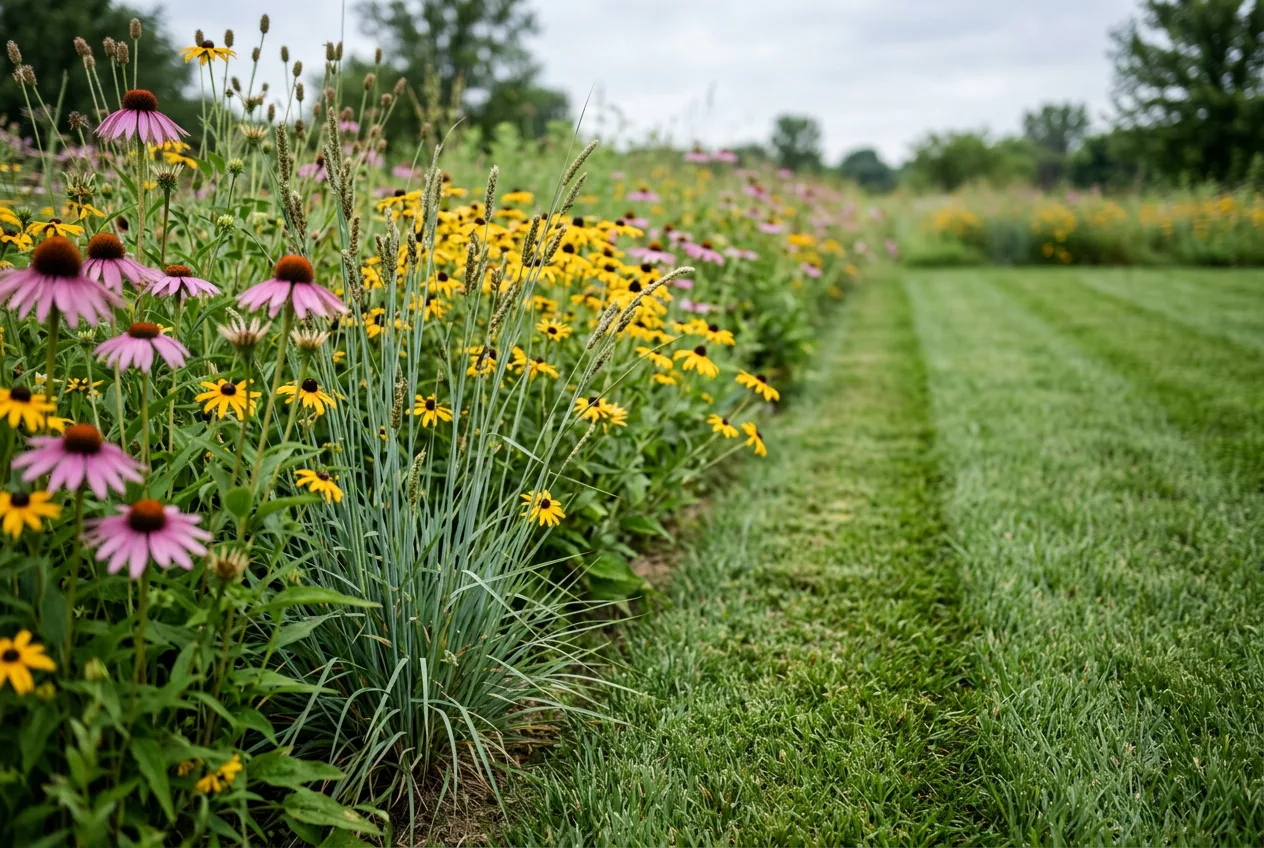
Edge strategies by context
- Front yard: Use a formal hedge or low fence—neighbors need to see clear intentionality
- Backyard: Mown borders are sufficient; add a patio or deck as a hard edge on one side
- Side yard: Straight mown paths + fence-line border; keep height under 3 feet near property lines
- Rural setting: Edges can be softer—use drifts of taller shrubs or a ha-ha (sunken fence)
A Focal Point Gives the Meadow a Destination
A meadow without a focal point is just a field. A focal point—a bench, a specimen tree, a sculpture, a birdbath—turns the meadow into a place you go to. It signals that someone designed this space for use, not just planted it and walked away.
The focal point should sit at the terminus of a path or at a visual sightline from the house. Place it deliberately, then mow a circular clearing around it so it's surrounded by a frame of short grass with the meadow beyond. This layering—lawn, clearing, focal point, meadow—creates depth and reinforces the sense of intentional design.
The best focal points are functional: a bench you actually sit on, a fire pit you gather around, a raised bed for vegetables. Decorative elements (sculptures, obelisks, large pots) work too, but they need to be substantial enough to hold visual weight against the meadow. A small garden gnome disappears. A 6-foot steel obelisk does not.
How You Plant Matters More Than What You Plant
Random scattering creates visual noise. Drifts create rhythm. Plant wildflowers in drifts of 5-15 plants per species, then repeat those drifts across the meadow. This mimics how plants naturally colonize in the wild—they cluster, not scatter—and it gives the human eye patterns to follow.
Limit your palette. A meadow with 30 species in tiny quantities looks chaotic. A meadow with 6-8 species in bold drifts looks intentional. Choose 3-5 species for early season, 3-5 for mid-season, and 2-3 for late season so you have continuous color without overwhelming complexity.
Height variation creates structure within the planting. Use tall species (4-6 feet) as a backdrop, mid-height species (2-3 feet) as the visual core, and short species (6-12 inches) along path edges and in foreground drifts. This layering prevents the meadow from reading as a uniform mass and adds depth even when plants aren't in bloom.
Planting ratios for structure
- 60% mid-height species: The visual core—this is what people see from a distance
- 25% tall species: Backdrop and vertical interest—plant behind mid-height drifts
- 15% short species: Path edges and foreground—these frame the taller layers
Vigorous is not the same as illegal, and the two get confused. Black-eyed Susan (Rudbeckia hirta) is a North American native that self-seeds freely: in a 600-square-foot front yard it will blur your drift structure within two seasons, which is an aesthetic problem you fix by editing. Queen Anne's lace (Daucus carota) and oxeye daisy (Leucanthemum vulgare) are a different category. Both are European introductions, both are listed Class C noxious weeds in Washington State and on that state's quarantine list, under which it is "prohibited to transport, buy, sell, offer for sale, or distribute… seed packets of seed, flower seed blends, or wildflower mixes of quarantined species into or within the state." A packet that is a harmless cottage-garden flower in one state cannot legally be sold in another, and plenty of generic "wildflower mix" tins contain both.
Check the species list against your own state or county before you buy a mix, not after. Penn State Extension publishes a do-not-plant table for meadows and prairies that names bull thistle, Canada thistle, nodding thistle, crown vetch, dame's rocket, purple loosestrife and Queen Anne's lace — with the three thistles marked as Pennsylvania noxious-list species whose "planting… is not permitted" at all. Design-wise the rule is simpler: choose clump-formers (coneflowers, asters, salvias) over spreaders, or accept that you will spend time editing. Legally, the rule is that a common name on a tin tells you nothing — look the Latin name up on your state's noxious weed list.
Consistent Maintenance Is What Separates Design from Neglect
Wildflower gardens aren't no-maintenance—they're different-maintenance. The work shifts from weekly mowing the entire lawn to weekly mowing just the paths and edges, plus annual cut-back. But that maintenance must be visible and consistent. A meadow with crisp edges and clean paths reads as designed. The same meadow with shaggy edges and overgrown paths reads as abandoned, even if the wildflowers themselves are thriving.
Year one is not like the years after it, and this is where most front-yard meadows are abandoned. A perennial meadow "usually requires two or three years to establish properly," says Penn State Extension: the plants spend the first season putting everything into roots, so there is very little to see above ground and a great deal of weed. The first-year regime is therefore the opposite of the mature one — repeated mowing, not none. Penn State: "During the first year, while your plants are small, you will need to mow several times to control weeds. Mow the first time before the weeds reach 8 inches in height. Mow to a height just above the level of the desired plants (about 4 inches). Mow often enough to prevent weeds from growing taller than 8 inches or from developing seed heads." Stop at the end of the growing season to let the young plants overwinter, then cut whatever is left to the ground in the second spring. From year two on it is the single annual cut "late in winter or early in spring before the next year's growth begins." Plan the structure — paths, edges, focal point — for a space that will look sparse for a full season, because those are the only things signalling intent while the planting is still underground.
And the signal is sometimes a legal one. Penn State notes that "'weed' ordinances occasionally can lead to controversy over natural landscaping. These laws, which are usually set by county or local governments, restrict the height or type of plants" grown on a property. A mown border, mown paths and a visibly maintained edge are the evidence that this is a planting rather than an abandonment — which is worth having before a complaint, not after. Check your municipal code for a maximum vegetation height and any cultivated-plantings exemption before you convert a front yard.
The annual cut-back is your chance to reset the visual signal. In late winter (February-March in most climates), mow or scythe the entire meadow down to 4-6 inches. This clears dead stems, prevents thatch buildup, and creates a temporary moment of high visibility—neighbors can see you're actively managing the space. As the meadow regrows, the cut paths and edges maintain that signal through the growing season.
Maintenance schedule
- Year one only: Mow the whole area several times, cutting to about 4 inches before weeds reach 8 inches — then stop at the end of the season (Penn State Extension)
- Weekly (April-October): Mow paths and perimeter edges—this is your primary visual maintenance
- Monthly (growing season): Spot-weed aggressive invasives—remove before they set seed
- Annually (late winter): Cut entire meadow to 4-6 inches, rake or remove thatch if excessive
- As needed (every 2-3 years): Re-seed thin patches or add new species to maintain diversity
Using AI to Visualize Meadow Structure Before You Plant
The hardest part of wildflower garden design is visualizing what the structure will look like before the plants fill in. Traditional landscape plans show plant positions from above, which doesn't help you understand how paths, edges, and focal points will read from eye level. This is where AI landscape design tools become genuinely useful—they let you test path patterns, edge treatments, and focal point placements as rendered views before you commit to planting.
Hadaa is built specifically for this kind of structural experimentation. Upload a photo of your existing lawn, then use the sketch tool to draw in path patterns and planting zones. The AI generates a photorealistic render showing how the meadow will look at full height with your chosen structure. You can test multiple path layouts, edge treatments, and focal point positions in minutes—something that would take weeks with traditional mockups.
This matters because structural mistakes are expensive to fix once plants are established. Realizing your paths are too narrow, or that you need a focal point, or that the edge treatment doesn't read clearly—these insights are much cheaper when they happen at the design stage than after two years of growth.
How to use AI for meadow design
- Start with your current space: Upload a photo of your lawn from the angle you'll most often view it (usually from the house or patio)
- Sketch the structure first: Draw path patterns, edges, and focal point locations—test 3-4 variations
- Specify planting zones: Indicate tall backdrop areas, mid-height core zones, and low-edge bands
- Generate seasonal views: Render the same structure in early, mid, and late season to see year-round appearance
- Export the final design: Use the render as a reference photo when you're mowing paths or placing focal points
Why this works for meadows specifically
Meadow design is about structure, not plant selection. You need to see how paths and edges will read at full height before you plant. AI tools let you test that structure visually—and change it instantly—until you find the layout that signals intentionality to your eye and your neighbors'.
Try Hadaa →For more on how AI landscape design handles naturalistic plantings, see how AI landscape design works. If you're designing a meadow specifically to support pollinators, AI plant recommendations explains how to specify native species and bloom season coverage in your prompts.
Frequently Asked Questions
How do you make a wildflower meadow look intentional instead of neglected?
What's the best way to create paths through a wildflower garden?
Should I plant wildflowers in drifts or scatter them randomly?
How do you edge a wildflower meadow?
What mistakes make wildflower gardens look messy?
Can you have a formal wildflower garden?
How tall should a wildflower meadow be before it looks abandoned?
Do wildflower gardens need maintenance?
Design Your Meadow
Test Path Patterns and Structure Before You Plant
Upload your lawn photo and experiment with meadow layouts in minutes. See exactly how paths, edges, and focal points will look at full height.


