The nursery tag on a Japanese maple tells you almost nothing about where it belongs in your yard. It says the species — Acer palmatum — and maybe a cultivar name. It does not say that the species itself ranges from a 40-50 ft tree in the wild down to named cultivars that top out under 8 ft, that a weeping form spreads wider than it grows tall, or that the “specimen tree by the patio” photo in every landscaping gallery assumes you already picked the right size for the spot.
Three decisions actually determine whether a Japanese maple becomes the best thing in your yard or something you’re pruning away from the walkway in five years: which size class fits the space, how much sun the spot gets, and what goes underneath it. Here’s how to make all three with real numbers instead of a photo.
Start with mature size, not the pot size
A Japanese maple you buy in a 15-gallon pot tells you nothing about its ceiling. According to NC State Extension’s plant database, the species as a whole runs 15-25 ft tall and 10-25 ft wide at maturity. The Missouri Botanical Garden’s Plant Finder gives the same range — 10-25 ft each direction — and adds that it can “infrequently” reach 40 ft. Clemson Cooperative Extension is blunter about the species in the wild: 40-50 ft.
Named cultivars are where the range actually matters, because breeders have spent a century narrowing it:
| Cultivar | Mature size | Habit | Source |
|---|---|---|---|
| Bloodgood | 15-20 ft tall | Upright, round-headed; deep reddish-purple holds color all summer | Clemson |
| Burgundy Lace | 10 ft tall, 12 ft wide | Large shrub form, branches droop to the ground | Clemson |
| Crimson Queen | 8-10 ft tall | Dwarf, cascading/weeping, dissected foliage | Clemson, NC State |
| Waterfall | 10 ft tall, 12 ft wide | Weeping, green leaves, gold-and-red fall color | Clemson |
| Inaba Shidare | 8-10 ft tall | Small weeping tree, red-purple color holds through summer | Clemson |
| Germain’s Gyration | 6-8 ft tall, 8-12 ft wide | Spreading mound of twisting branches | NC State |
| Sharp’s Pygmy | Truly dwarf | Slow, dense, tiny leaves | NC State |
| Sango-kaku | Species-range size | Upright; grown for coral-colored winter bark, not just foliage | NC State |
The pattern: “dwarf” on a Japanese maple tag usually means 6-10 ft, not the 2-3 ft a dwarf shrub implies. If you’re working with a bed under 6 ft wide, look specifically for the cultivars above labeled dwarf or weeping, not the species default. A full-size upright like Bloodgood against a narrow foundation bed will outgrow it within a decade. The same width sets how far a maple belongs from a neighbor’s boundary: half the mature spread is the working rule.
Where it actually goes
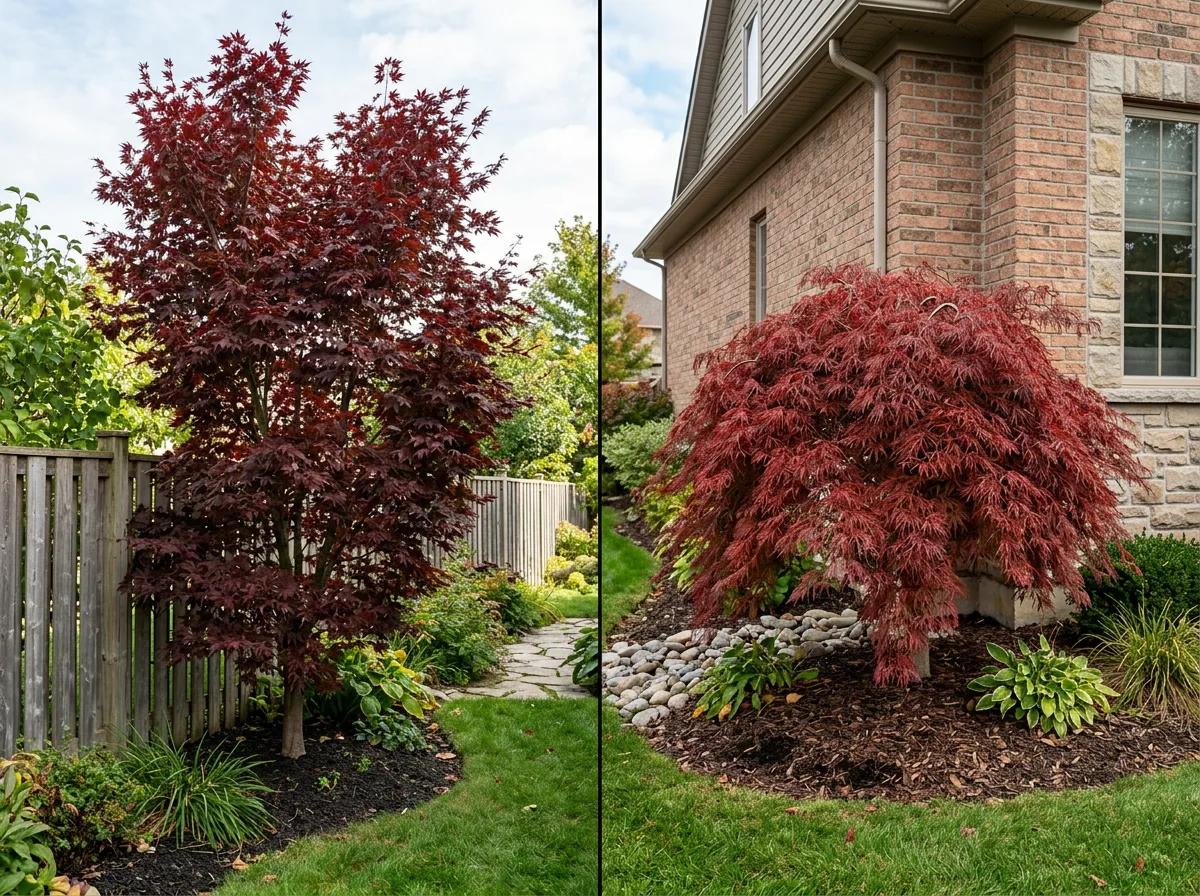
Clemson’s guidance splits placement by habit, and it’s the most useful sizing rule either extension source gives: plant upright, taller selections where you can “limb up” the canopy — prune the lowest branches as the tree matures to clear a walkway or patio edge — and plant low, spreading, weeping selections only where there’s room for the branches to droop all the way to the ground, since that’s how they’re built to grow. A Crimson Queen or Waterfall planted tight against a path will need the thing that makes it distinctive — branches that touch the ground — cut off within a few years.
Both Clemson and the Missouri Botanical Garden flag the same two siting risks:
- Wind and late frost. New leaves emerge early in spring and are frost-sensitive; a site “protected from high winds and late spring frosts” matters more for Japanese maples than for most ornamental trees.
- Afternoon sun in hot climates. MBG notes it can take full sun in the northern end of its range but “prefers some part afternoon shade” further south, and new foliage “may scorch in full sun locations in hot summer areas, particularly if soils are not kept consistently moist.” Clemson says the same: dappled shade is the safe default, with too much shade the tradeoff being slower growth and greener (less purple) leaf color.
A reasonable compromise for most yards: morning sun, afternoon shade — the east side of a house, or under the high, thin canopy of a larger shade tree. That’s also the spot where the next section’s companions do their best work, and it’s the same part-shade math our shade garden design guide works through in more depth if you’re planning the whole bed, not just the tree.
Soil and water
Both sources agree closely: evenly moist, slightly acidic, well-drained soil high in organic matter. Clemson specifies 3-4 inches of mulch beneath the canopy and warns against ever letting water stand around the roots — root rot is on both extensions’ disease lists. MBG adds that the species is not drought-tolerant and that mulch does double duty, holding moisture and keeping roots cool. If your site is hot and dry with no irrigation plan, both sources point the same direction: it’s the wrong tree before it’s the wrong variety.
What to plant underneath it
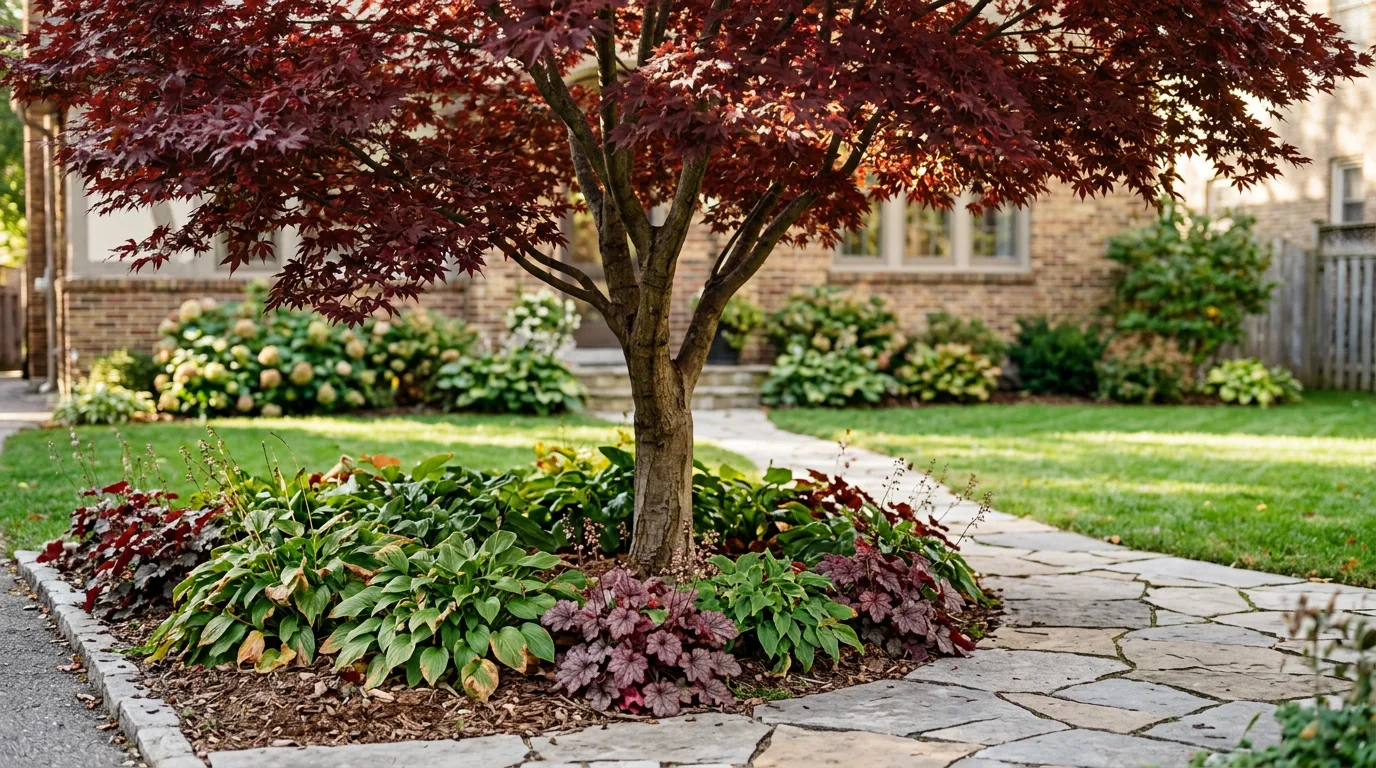
A Japanese maple’s canopy creates exactly the dappled, root-competed shade that stops most groundcovers. University of Vermont Extension’s guide to planting under trees names the plants that actually work there: hosta, lady’s mantle (Alchemilla mollis), fringed bleeding heart (Dicentra eximia), foamflower (Tiarella), and coral bells (Heuchera) — chosen specifically because they’re shade-tolerant, reasonably drought-tolerant once established, and shallow-rooted enough not to compete hard with the tree’s own roots. The guide also suggests spring bulbs (snowdrops, grape hyacinth, squill), which bloom and go dormant before the maple’s canopy fully fills in.
Clemson’s shade plant list adds three more genuinely shade-adapted options worth pairing with a Japanese maple specifically for texture contrast against its finely cut foliage: ferns, astilbe, and Japanese forest grass (Hakonechloa macra) — the last one in particular echoes the maple’s own arching, cascading form at ground level.
Skip anything that wants consistently dry soil or full sun under there; it will struggle in the maple’s moisture and light conditions regardless of how shade-tolerant its tag claims it is.
One thing most guides don’t mention
NC State Extension flags something worth knowing before you plant one near a woodland edge: Acer palmatum “self-seeds easily so can spread and become weedy in the landscape,” and the Mid-Atlantic Invasive Plant Council lists it as invasive in Virginia and Washington, D.C. It’s not a reason to avoid the species — it’s rarely a problem in a maintained bed where seedlings get weeded or mowed — but if your property backs onto a natural area in the mid-Atlantic, it’s worth deadheading seed clusters or choosing a cultivar known to set less seed.
On the upside, both NC State and the broader deer-resistance literature list it as only mildly attractive to deer — if deer pressure is the reason you’re hesitant about a specimen tree, see our deer resistant shrubs guide for what else is safe near it.
Putting it together by yard size
Small yard or foundation bed (under 8 ft to spare): a true dwarf — Sharp’s Pygmy, Germain’s Gyration, or Kiyohime — in morning sun, underplanted with heuchera or a low hosta.
Patio or walkway specimen, or a front-entry accent for curb appeal: an upright, taller selection like Bloodgood, limbed up as it matures so the canopy clears foot traffic, rather than a weeping form that needs its branches left to reach the ground.
Open bed or woodland margin with room to spread: a weeping cultivar — Crimson Queen, Waterfall, or Orangeola — left to droop naturally, underplanted with ferns and astilbe.
Winter interest in a spot seen from indoors: Sango-kaku for the coral bark, which reads as strongly in January as the foliage does in October.
If you’re not sure how a specific cultivar’s mature spread will actually read against your house and the beds around it, Hadaa turns a photo of your yard into a zone-checked design before you commit a decade of growth to the wrong spot — see our planting guide walkthrough for how. That’s especially useful for a tree whose whole appeal depends on getting the size and the siting right the first time, since a mistake here isn’t cheap to undo.
FAQ
How far should a Japanese maple be planted from a house? Neither Clemson nor NC State state an exact distance, but the practical rule from their siting guidance is to plant by mature spread, not current size: give an upright cultivar like Bloodgood (15-20 ft wide eventually) enough room that its widest branches won’t be rubbing siding or gutters in 15 years, and plant a weeping form only where its branches can reach all the way to the ground without being cut back from a path.
What’s the best Japanese maple for a small yard? Look for cultivars Clemson and NC State both describe as dwarf — Sharp’s Pygmy, Germain’s Gyration (6-8 ft tall, 8-12 ft wide), Kiyohime, or Oto hime — rather than the species default, which runs 15-25 ft.
Do Japanese maples need full sun or shade? Dappled or part shade is the safe default per both extensions, with afternoon shade recommended in hot-summer regions to prevent leaf scorch. Full sun is workable in cooler, northern parts of its range if soil moisture is kept consistent.
What can I plant under a Japanese maple? Hosta, coral bells (heuchera), astilbe, ferns, foamflower, and Japanese forest grass are the extension-recommended options — all shade-tolerant, shallow-rooted, and tolerant of the dry shade a maple’s canopy creates.
Are Japanese maples invasive? NC State Extension notes the species self-seeds readily and is listed as invasive in Virginia and Washington, D.C. by the Mid-Atlantic Invasive Plant Council. It’s not a widespread problem in a maintained garden bed, but worth knowing if your property adjoins a natural area in that region.