
Does Landscaping Really Increase Home Value? What the Data Actually Shows
Winnie Astrid
Garden Design Editor
The claim that landscaping adds 20% to home value is everywhere, and there is no dataset behind it. This article uses the three records that do exist — NAR's 2023 cost-recovery survey of eleven defined outdoor projects, a seven-state study of what buyers think a landscape is worth, and a USDA Forest Service study of 3,479 recorded sales — to give you cost recovery by project, what each figure is actually measuring, and the one place where enjoyment and resale value pull in opposite directions.
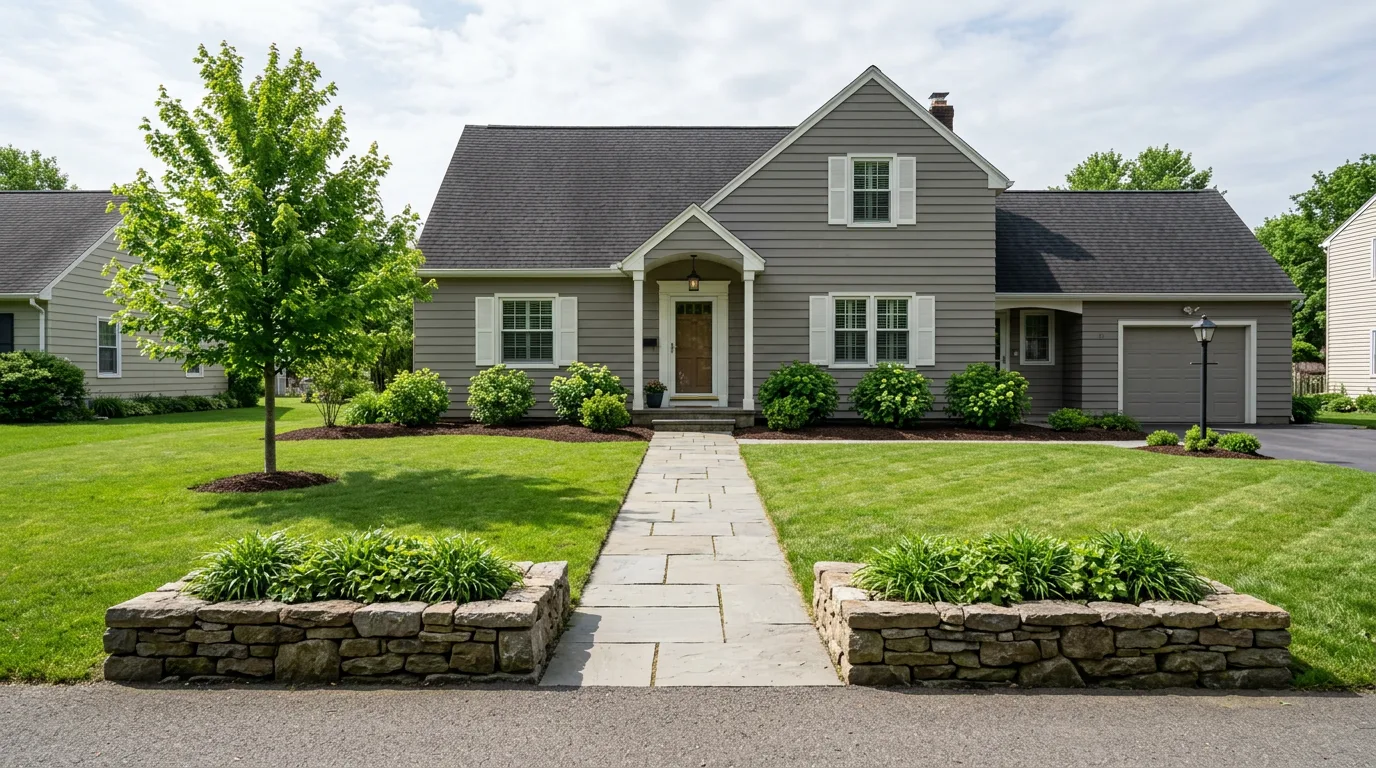
Quick answer — cost recovery, project by project
- Standard lawn care service: 217% cost recovery — the highest of the eleven projects NAR measures, on a $415 spend
- New patio: 95% — and it beats a new wood deck (89%), which a great many ROI guides print the other way round
- Outdoor kitchen: 100% cost recovery, and the lowest Joy Score of all eleven projects
- In-ground pool: 56% — joint-lowest recovery, joint-highest Joy Score (10/10)
- Cost recovery and enjoyment run almost exactly opposite in NAR's own two tables
- The "20% claim": a marketing figure with no dataset behind it — no survey or sales study measures a whole-garden percentage
Where the "20% Value Increase" Claim Comes From (and Why It's Misleading)
The 20% landscaping ROI figure circulates widely in real estate and home improvement marketing, and the striking thing about it is that no study produces it. The research that is usually gestured at measures something narrower: how much more a photograph of a well-landscaped house front is judged to be worth (5–11%, Behe et al. 2005), or what one specific project recovers against one specific cost (NAR and NALP, eleven projects). Neither produces a percentage for "landscaping" as a whole, because neither asks that question. A whole-garden percentage is a repetition artefact, not a finding.
The original research was limited in scope, applied to specific markets and price points, and measured buyer perception of value (how much more buyers were willing to offer) rather than appraised value. The distinction matters: appraised value is what a home is worth according to comparable sales data; buyer willingness to pay is a psychological number influenced by presentation and first impressions.
What the research actually shows is more nuanced and more useful: specific landscaping investments generate specific, measurable returns — and the variation between them is enormous. Lawn care returns nearly three times its cost. An outdoor kitchen returns roughly 60 cents per dollar. A pool in a cold climate may return nothing or less.
The honest summary
- Landscaping does increase home value — but the return is project-specific, market-specific, and condition-specific
- The high-ROI work is often the least glamorous: lawn care, maintenance, curb appeal basics
- Feature additions mostly return less than maintenance — but not uniformly: an outdoor kitchen at NALP's $15,000 specification recovers 100%, while a pool recovers 56%
- Every published percentage is tied to a project at a stated size; change the size or the material and the number no longer applies
What NAR's Remodeling Impact Report Actually Shows
The 2023 Remodeling Impact Report: Outdoor Features is the only US dataset that does both halves of the sum. The National Association of Landscape Professionals (NALP) costs eleven specific projects at a specific size; the National Association of Realtors then asks its members what each one recovers at resale. Every percentage below is a dollar value divided by a dollar cost, for one defined job — not an estimate for a category.
That distinction is the whole article. "A patio returns 95%" is not a fact about patios. It is a fact about an 18-by-16-foot concrete paver patio, dry set over compacted gravel and sand, with paving material at $7 to $10 per square foot, costing $10,500 and recovering $10,000. Double the size, or specify natural flagstone, and you have left the dataset.
It is also widely mis-attributed. The report is NAR with NALP — not ASLA — and it is a different survey from Remodeling magazine's Cost vs. Value report, which uses different projects and different costs. Blending the two is how the "50–300%" range in circulation gets built.
| Project (as NALP defined and costed it) | Cost | Value recovered | Cost recovery | Joy Score |
|---|---|---|---|---|
| Standard lawn care service Six seasonal applications, 5,000 sq ft |
$415 | $900 | 217% | 9.4 |
| Landscape maintenance Mulch, mow 2,835 sq ft, prune, 60 plants |
$4,800 | $5,000 | 104% | 9.6 |
| Overall landscape upgrade 3×30 ft flagstone walk, 2 planters, 5 shrubs, 1 tree |
$9,000 | $9,000 | 100% | 9.7 |
| Outdoor kitchen As specified by NALP |
$15,000 | $15,000 | 100% | 9.0 |
| New patio 18×16 ft concrete pavers, dry set |
$10,500 | $10,000 | 95% | 9.9 |
| New wood deck 14×18 ft cedar, open-riser stairs |
$16,900 | $15,000 | 89% | 9.8 |
| Tree care 3 fertiliser applications, pruning, one 30 ft removal |
$2,875 | $2,500 | 87% | 9.3 |
| Irrigation system installation 5,000 sq ft lawn, no boring |
$6,000 | $5,000 | 83% | 9.4 |
| Landscape lighting 600W transformer, 20 LED fittings |
$6,800 | $4,000 | 59% | 10 |
| Fire feature Dry-stacked stone kit, gas burner, 10 ft flagstone patio |
$9,000 | $5,000 | 56% | 9.7 |
| In-ground pool addition 18×36 ft gunite, 3–7 ft depth |
$90,000 | $50,000 | 56% | 10 |
Source: 2023 NAR Remodeling Impact Report: Outdoor Features, pp. 6–7 and the per-project pages. Costs are NALP's estimates for the described project; value recovered is what NAR's members put it at. Joy Score is the homeowner's own 1–10 rating from the same report. National figures — regional variation is significant.
Two things in that table are worth more than the headline order. The first is that a patio beats a deck — 95% against 89% — which a great many ROI articles print backwards. The patio costs $10,500 and recovers $10,000; the deck costs $16,900 and recovers $15,000. Both lose money; the patio loses less of it, on a smaller stake.
The second is the column almost nobody reproduces. NAR publishes a Joy Score beside the cost recovery — what the homeowners who did the project say about living with it — and the two rankings run close to opposite:
- The two highest Joy Scores (in-ground pool and landscape lighting, both 10/10) carry the two lowest cost recoveries, 56% and 59%.
- The highest cost recovery by a distance (standard lawn care, 217%) scores 9.4, near the bottom of the joy table.
- The lowest Joy Score of all eleven projects is the outdoor kitchen, 9.0 — and it recovers 100% of its $15,000.
So the familiar advice — buy maintenance for resale, features for yourself — is only half supported. Maintenance does pay back best. But the feature most often sold as a resale investment, the outdoor kitchen, recovers its cost in full and is the project its owners rate lowest; and the two projects owners love most are the two that give back least. If you are choosing between a pool and an outdoor kitchen, this dataset says they are opposite bets, not similar ones.
How Curb Appeal Affects Sale Price and Time-on-Market
Curb appeal operates through a different mechanism than appraised value. Rather than adding a discrete dollar amount to the appraisal, curb appeal shapes buyer psychology before they enter the house — influencing how generously they evaluate everything inside and how motivated they are to make a competitive offer.
The 5–11% figure everyone quotes is real, and it does not say what it is usually used to say. It comes from Behe et al. (2005) in the Journal of Environmental Horticulture (23(3):127–133): 1,323 volunteers across seven states were shown sixteen photographs of the same house front, landscaped to different standards, and asked what the home was worth. Perceived value rose 5–11% for a good landscape. That is an opinion about a photograph, not a recorded sale price — which makes it a good predictor of how a listing performs and a poor basis for a budget.
Inside that study there is a finding more useful than the range itself. The three variables were plant type, plant size and design sophistication, and their importance ran in that order, increasing: how the planting was arranged mattered more than how big it was, which mattered more than what it was. The smallest plants actively lowered perceived value, by 2.3%; the largest raised it 2.8%. Layout is the cheapest of the three to get right and the one that moves the number most.
What drives curb appeal value
- Lawn condition: The single most visible curb appeal signal. Green, edged, weed-free lawns consistently appear in "what made you choose this home" buyer surveys.
- Foundation planting scale: Shrubs and plantings proportional to the house — not overgrown, not bare — signal maintenance and care.
- Defined edges: Clean lawn-to-bed transitions communicate intentionality and maintenance more strongly than plant species or volume.
- Entry clarity: A clear, well-defined path to the front door reads as welcoming and well-maintained — critical for both in-person viewings and listing photos.
Do Trees and Plants Add Appraised Value?
Trees carry the only landscaping premium in this article that was measured on recorded sale prices rather than on opinions or on agent surveys, which makes it the most load-bearing number here.
Donovan and Butry (2010), a USDA Forest Service study published in Landscape and Urban Planning, visited 3,479 single-family homes — every home sold in Portland, Oregon over a ten-month period — and fitted a hedonic price model to the sales. Street trees added $8,870 to sale price, which the authors note is 3.0% of the median, and reduced time on market by 1.7 days.
The part that matters for a budget is where the money lands. One street tree added $12,828 to the combined value of every house within 100 feet — more than it added to the house that owns it. The paper's own conclusion is that if street trees are left to individual homeowners there will be too few of them, because most of the benefit goes to the neighbours. The flip side is the useful bit: your street's existing trees are already in your sale price, and they cost you nothing.
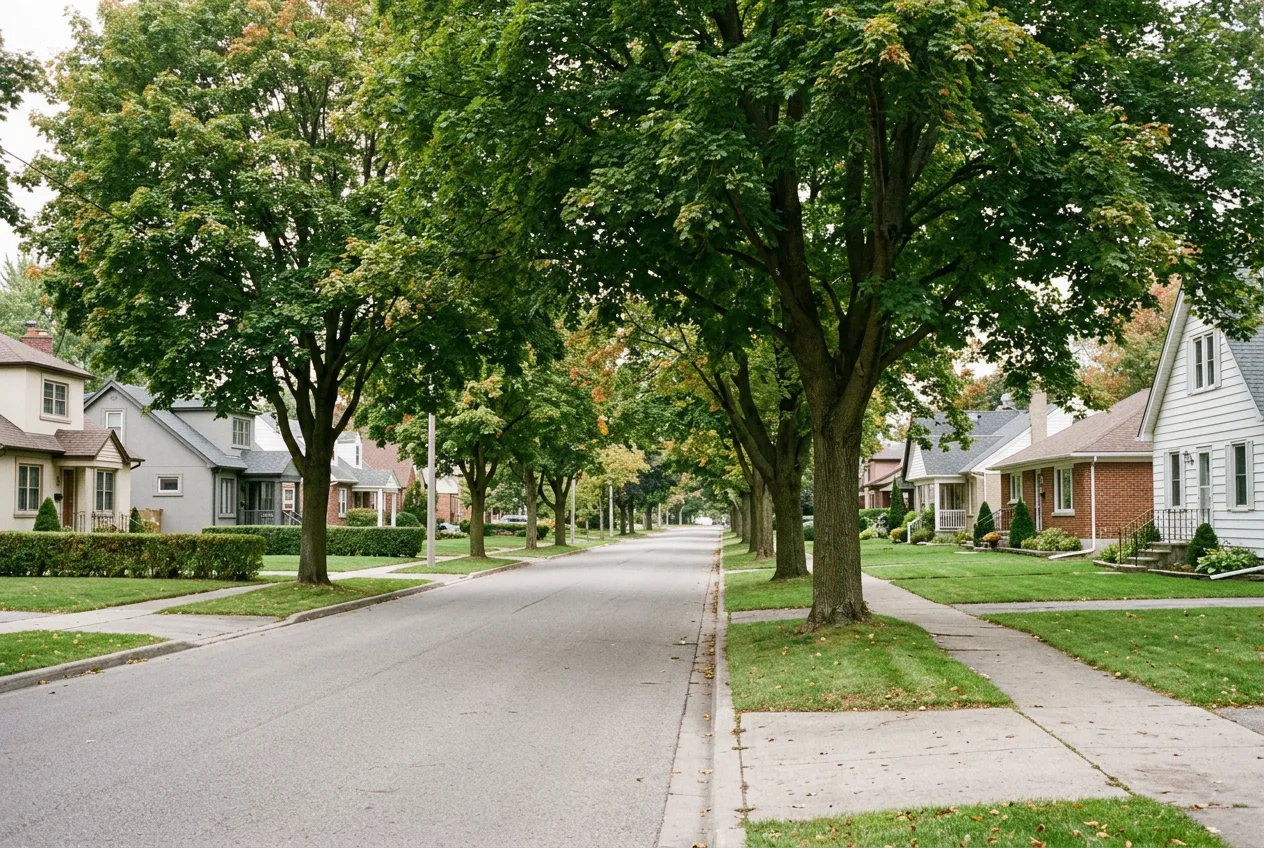
Tree value by type and context
Mature shade trees: the measured figure is $8,870 per street tree, 3.0% of Portland's median sale price, in the Donovan and Butry sample. Nothing in that study separates oak from maple, so a per-species premium is not something the evidence supports. The energy case is real but smaller than usually claimed: the US Department of Energy credits shading an air-conditioning unit with up to 10% better efficiency, and notes that air directly under a tree can be 25°F cooler than air over a nearby blacktop car park. It also warns on timing: a 6–8 ft deciduous tree shades windows in its first year, but a slow-growing tree may need ten years to shade a roof.
Ornamental trees (Japanese maple, crape myrtle, dogwood): Visual value only — these are landscape assets, not significant appraised value contributors on their own. Their value is in making the surrounding planting scheme read as complete and considered.
Street trees (public land or verge): $8,870 to the house they front and $12,828 spread across the houses within 100 feet, per Donovan and Butry. Note the direction of the asymmetry before you plant one for yourself — and note that it works in your favour on a street that is already planted.
Overgrown or structurally problematic trees: These actively reduce appraised value by signalling maintenance deferred and by creating buyer concern about root damage, debris, and future removal costs. A $500 arborist visit to assess and prune aging trees before sale is a high-return investment.
Pools and Outdoor Kitchens: The Real ROI Numbers
These two get bracketed together in almost every ROI article, and in NAR's data they are opposites. One recovers 56% of its cost and is the best-loved project in the report; the other recovers 100% and is the least-loved. Deciding between them on a single "feature additions don't pay" rule gets it wrong whichever way you go.
Swimming pool
NAR/NALP project: 18×36 ft gunite pool, 3–7 ft depth, standard filtration, 3 ft concrete surround
Cost: $90,000 · Recovered: $50,000
Cost recovery: 56% — joint-lowest of the eleven projects
Joy Score: 10/10 — joint-highest of the eleven projects
Key consideration
The 56% is a national figure; NAR does not publish it by climate, so treat any warm-market percentage you see (including ones we used to print here) as an estimate rather than a measurement. What the report does support: in markets where buyers expect a pool, not having one is the cost.
Outdoor kitchen
NAR/NALP project: outdoor kitchen as specified in the report
Cost: $15,000 · Recovered: $15,000
Cost recovery: 100% — full recovery, fourth of eleven
Joy Score: 9.0/10 — the lowest of all eleven projects
Key consideration
This is the reversal in the dataset. The outdoor kitchen is the feature usually described as a poor resale bet, and at NALP's $15,000 specification it recovers every dollar — while being the project owners rate lowest to live with. The caution is scope, not category: $15,000 is the measured job, and an $80,000 build on a $350,000 house is outside the data entirely.
Landscaping That Does Not Add Home Value (or Actively Reduces It)
Not all landscaping investment is value-neutral or positive. Some improvements actively narrow your buyer pool, create perceived maintenance obligations, or signal a highly personalised taste that doesn't translate to broad appeal. Understanding what to avoid is as important as knowing what to invest in.
Landscaping to approach cautiously
- Highly personalised themes: Elaborate topiary, themed garden areas, strong colour schemes. Buyers pay for neutrality, not personality. What you love, the market may penalise.
- Ornamental water features: Ponds, fountains, and streams signal ongoing maintenance and potential liability to many buyers. The aesthetic value is offset by buyer concern.
- Oversized decking: Replacing lawn with hardscape reduces the perceived green space of the property. Buyers consistently prefer a balance of lawn, planting, and hard surface — not wall-to-wall paving.
- High-maintenance tropical plantings in cool climates: Any planting scheme that visibly requires expert attention or specialist care creates a perceived obligation for the next owner. Native and adapted species consistently outperform tropicals on resale in markets outside their natural climate zone.
- Mature plantings too close to foundations or structures: A beautiful mature shrub pressing against the house foundation signals deferred maintenance and potential moisture or root damage. Buyers and inspectors notice this.
How a Cohesive Design Multiplies the Value of Any Landscape Investment
Individual landscaping elements — a new walkway, a planted border, fresh mulch — add value in isolation. But the same elements, designed as a cohesive whole that relates to the architecture of the house, consistently generate stronger buyer response than the sum of their parts.
This is the one piece of received wisdom on the page that the research actually supports, and it supports it in order. In Behe et al.'s seven-state study the three variables tested were plant type, plant size and design sophistication, and their influence on perceived home value increased in exactly that sequence — arrangement beat size, size beat species. A $5,000 planting scheme that reads as intentional and proportional will out-perform a $10,000 collection of specimen plants that reads as uncoordinated, and that is a measured result rather than a designer's preference.
AI design tools have made high-quality landscape design accessible at every budget level. With Hadaa, you can generate photorealistic renders of your garden or front yard from a photo — testing design options, plant combinations, and hardscape choices before committing to installation. The render doubles as a contractor brief that ensures what gets built matches what you visualised.
For homeowners preparing to sell, a rendered design also gives agents and stagers a "before/after" visual that can be included in listing materials — showing buyers not just the current state but the finished potential of the space.
The design multiplier
Research from NAR consistently shows that "well-landscaped" properties — rated highly on cohesion and design quality, not just plant volume — receive the highest buyer perception scores. Cohesive design is a multiplier on the underlying investment, not just an aesthetic preference. The return comes from design quality, not just landscape spend.
See also: how Hadaa's AI landscape design tool helps homeowners visualise and plan outdoor improvements before the first contractor quote.
Frequently Asked Questions
Does landscaping really increase home value?
What landscaping has the highest return on investment?
Does landscaping affect appraisal value?
How much does curb appeal affect home sale price?
Do trees add value to a property?
Does a pool increase or decrease home value?
Does landscaping affect how quickly a home sells?
What landscaping projects do NOT add home value?
Design for value
See exactly what your yard could look like — before spending a dollar.
Upload a photo of your garden and generate photorealistic renders of design options that maximise curb appeal and resale value. The design step that most homeowners skip.


