
Modern Front Yard Landscaping Ideas: Modern, Contemporary and Minimalist
Francis Karuri
Landscape & AI Correspondent
Modern, contemporary and minimalist are three different things, and picking the wrong word is why so many front yards miss. Modern is a dated movement — mid-century modernism, with flat planes, structural honesty and hard geometry. Contemporary means current practice, which in 2026 is softer: looser planting, permeable surfaces, drought-adapted and native species. Minimalist is not a period at all but a reduction strategy, and it can be applied to either. A front yard that reads as "modern" is usually minimalist geometry; one that reads as "contemporary" usually is not. This guide covers all three, with design rules, materials and plant lists — and one warning no other modern-front-yard guide gives you: the two clipped evergreens the whole minimalist look is built on are the two under a blight and a federal quarantine.
What Defines Modern Front Yard Design
Modern landscaping is not about stark emptiness. It is about deliberate composition. The principles below apply across all three styles — minimalist, organic, and industrial — and distinguish modern design from both traditional cottage gardens and generic builder-grade plantings.
- Geometry over ornamentation — lines, angles, and repeated forms create visual interest. Curves appear only when they reinforce the architecture, never as decorative flourishes.
- Limited material palette — modern yards use three materials maximum. More than that reads as indecision, not abundance.
- Repetition as rhythm — plant the same species in multiples of three or five, spaced evenly. Avoid the collector's approach of one-of-everything.
- Negative space as a design element — empty zones are not voids to fill. They frame focal points and give compositions breathing room.
- Architectural plants over blooms — form trumps flower. Choose plants for structure, leaf shape, and year-round presence, not seasonal color bursts.
- Crisp edges — no blurred transitions between lawn and bed, no plants spilling onto hardscape. Every boundary is intentional and maintained.
If your current yard has curved flowerbeds, mixed-species groupings, and decorative edging, that is traditional design. Modern design strips away the embellishment and asks each element to justify itself structurally. The result feels calm, composed, and permanent.
Tools like Hadaa let you upload a photo of your front yard and preview how these principles apply to your specific layout before you commit to a single plant or paver.
Modern Minimalist: Clean Lines, Limited Palette
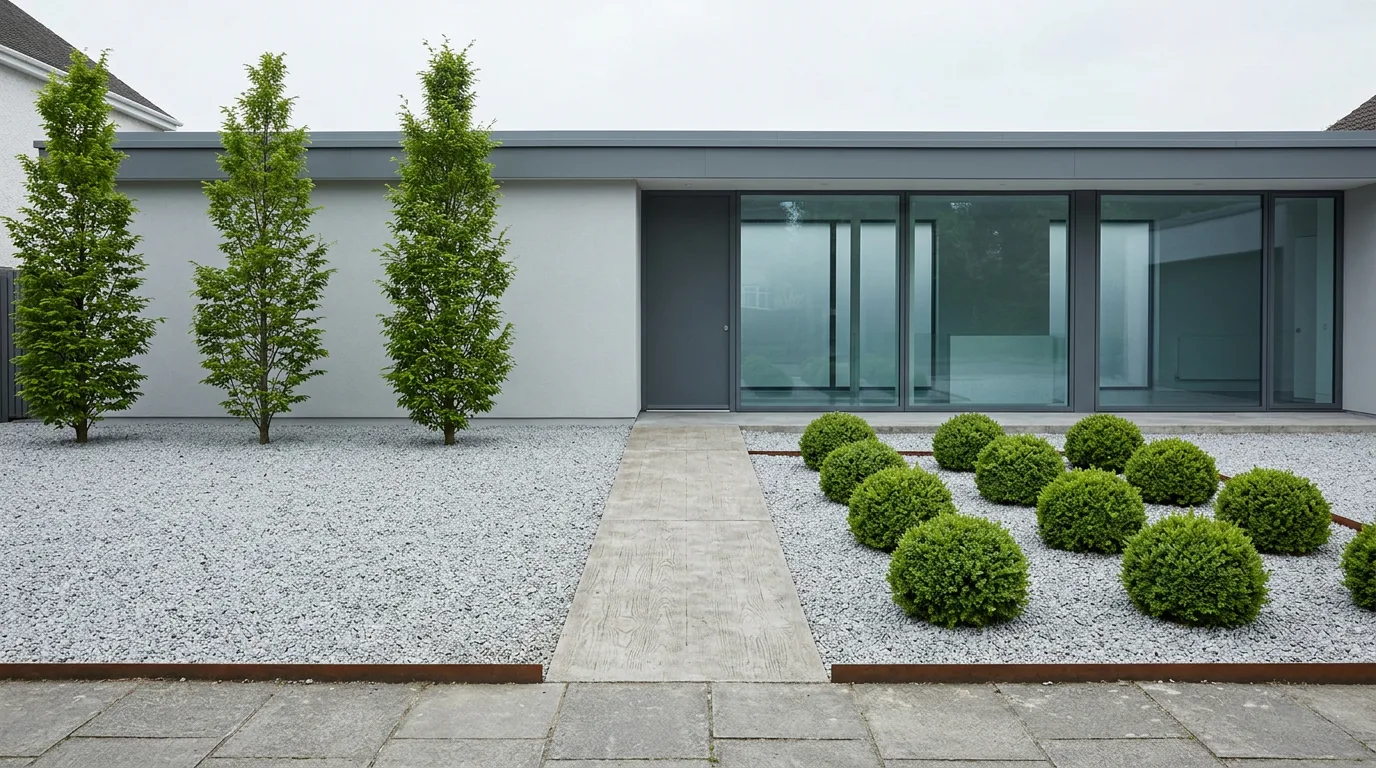
Minimalist modern is the most restrained expression of the style. It uses the fewest materials, the tightest plant palette, and the strictest adherence to geometry. The goal is visual calm through reduction.
Core Design Rules
- One or two plant species, maximum — often just a single grass (Miscanthus) or one clipped evergreen repeated across the yard. This is the style’s strength and its single point of failure: read the blight and quarantine note under plant selection before you commit a whole front yard to one species.
- Hardscape dominates — concrete, cut pavers, or poured aggregate make up 60–70% of the visible surface. Lawn is often absent or reduced to a single rectangular panel.
- Gravel or groundcover instead of mulch — organic mulch reads as rustic. Use decomposed granite, pea gravel, or a low groundcover like thyme.
- Monochromatic color scheme — gray, black, white hardscape with green-only planting. No seasonal color, no variegation.
- Square or rectangular planters — no rounded pots, no decorative urns. Use steel, concrete, or fiber cement in neutral tones.
This style works best on smaller lots where visual complexity would feel chaotic. It demands maintenance discipline — one overgrown shrub or weedy bed edge destroys the composition. If you are not prepared to edge monthly and prune on schedule, choose a softer style.
For a more detailed exploration of how minimalist principles create curb appeal, see our guide to front yard curb appeal ideas.
Modern Organic: Natural Materials, Softer Edges
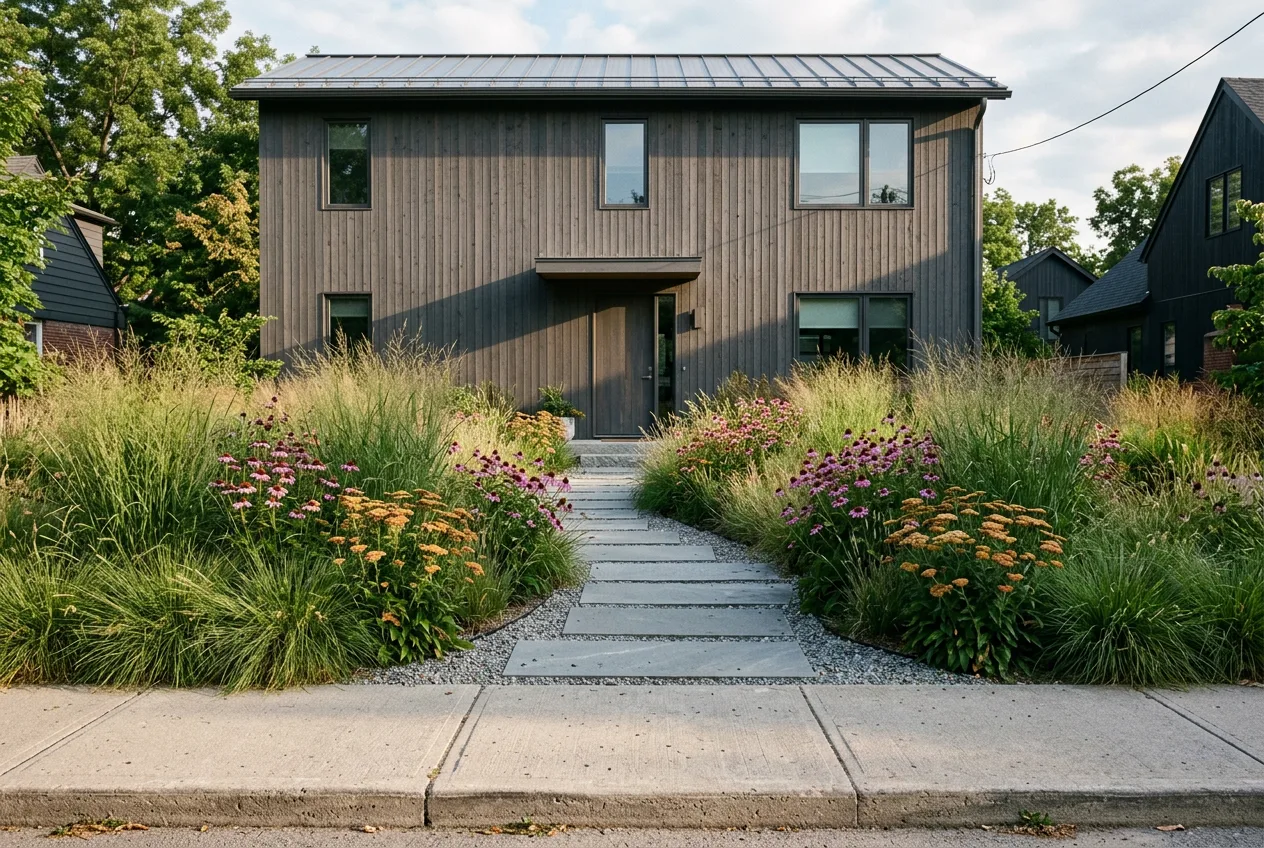
Modern organic retains the clean lines and intentional structure of minimalist design but introduces warmth through natural materials and a wider plant palette. This is the style that blends most comfortably into established neighborhoods while still reading as distinctly contemporary.
Core Design Rules
- Natural stone over concrete — use flagstone, limestone, or bluestone for pathways. Leave irregular edges rather than cutting everything to perfect rectangles.
- Wood accents — horizontal cedar fencing, timber edging, or a wooden planter box add warmth without compromising the modern structure.
- Native grasses and perennials — introduce movement and seasonal change with species like Calamagrostis, Echinacea, or Salvia. Keep to three or four species, planted in drifts.
- Softer edges between zones — grasses can spill slightly onto gravel or pavers. The boundary is still defined, but not militant.
- Earthtone palette — warm grays, browns, greens, with muted rust or gold accents from blooms or foliage.
This approach reduces maintenance compared to minimalist designs — native plants are more forgiving of inconsistent watering and pruning. The composition still relies on intentional structure, but it reads as grounded rather than austere.
If you are designing for water efficiency and regional climate, our low-maintenance front yard landscaping ideas guide covers drought-tolerant plant pairings that work within an organic modern framework.
Modern Industrial: Metal, Concrete, Bold Contrast
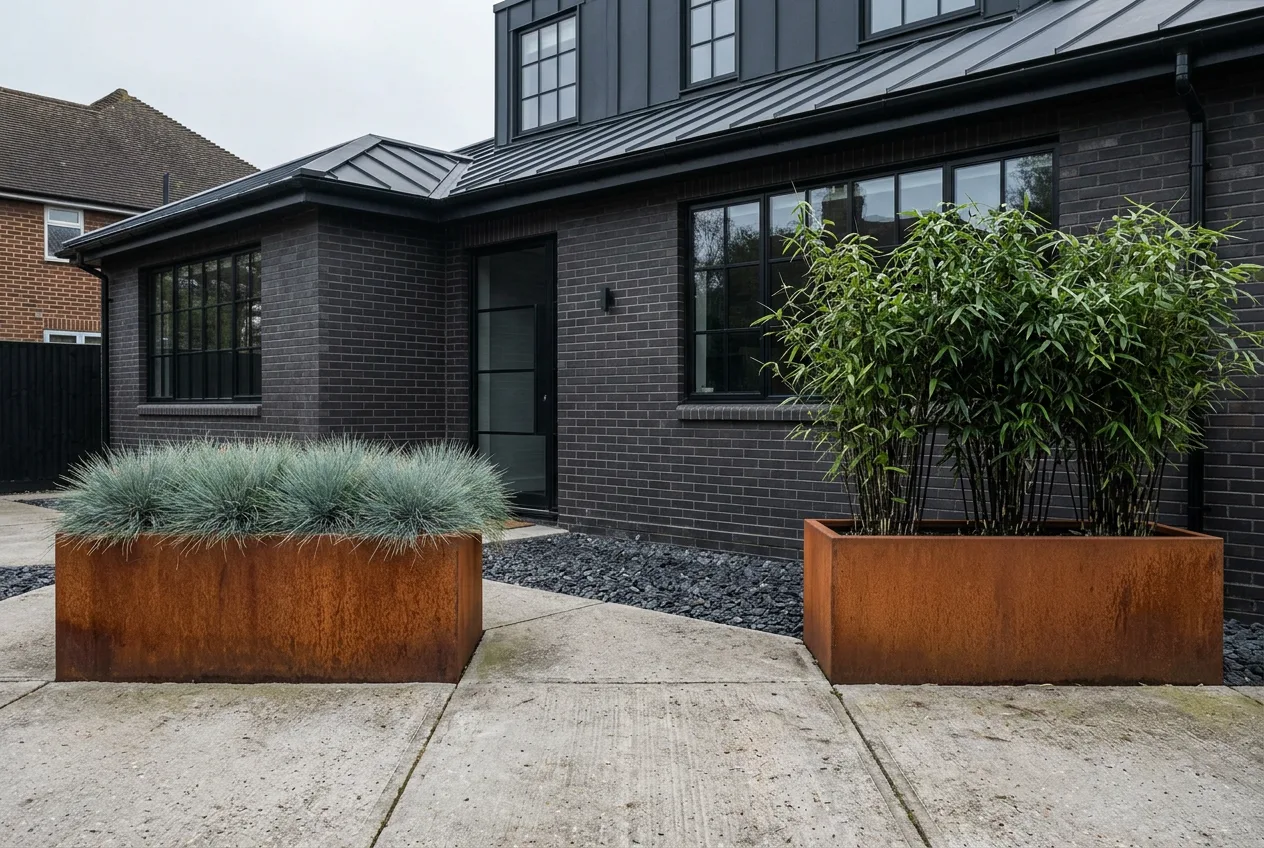
Industrial modern leans into hard materials, high contrast, and utilitarian forms. It is the most dramatic of the three styles and works best on contemporary architecture where the landscaping can echo the building's material language.
Core Design Rules
- Corten steel, galvanized metal, or powder-coated steel elements — use as edging, planters, or retaining walls. The rust patina on corten adds warmth without softness.
- Exposed aggregate or polished concrete — large poured panels with control joints create bold geometric divisions.
- High-contrast planting — dark foliage (black mondo grass, dark-leafed heuchera) against light hardscape, or bright chartreuse grasses against charcoal pavers.
- Angular, oversized planters — large cubic or rectangular containers in metal or fiber-reinforced concrete.
- Minimal lawn or none — grass competes with the material drama. Replace with gravel, pavers, or groundcover.
This style demands confidence. Industrial modern is unforgiving — a poorly executed detail (cheap metal edging instead of corten, thin concrete that cracks) undermines the entire composition. If budget or material availability is limited, organic modern is a safer choice.
The industrial palette overlaps with some AI landscape design styles available in visualization tools, particularly brutalist and mid-century modern presets.
Plant Selection for Modern Designs
Modern landscaping privileges plants with strong architectural form, consistent shape, and year-round presence. Avoid anything that blooms prolifically, grows unpredictably, or demands frequent deadheading. The list below is organized by function, not aesthetic preference.
Ornamental Grasses
Grasses provide movement and vertical structure without requiring pruning. Choose clumping varieties, not spreading ones.
- Miscanthus sinensis — tall, upright, consistent form. Varieties like 'Morning Light' or 'Gracillimus' stay narrow.
- Calamagrostis × acutiflora 'Karl Foerster' — columnar, early bloomer, holds structure through winter.
- Panicum virgatum — native switchgrass, airy texture, good for organic modern schemes.
- Festuca glauca (blue fescue) — low, mounding, blue-gray foliage. Use in multiples for groundcover effect.
Evergreen Shrubs
- Buxus (boxwood) — the traditional choice for minimalist hedges, and now the riskiest one. Requires frequent shearing to maintain geometry. Choose the species and cultivar, not just "boxwood" — see the blight and quarantine note below.
- Taxus (yew) — columnar varieties work as vertical accents. More drought-tolerant than boxwood.
- Ilex crenata (Japanese holly) — naturally compact, and genuinely safer than boxwood against box blight. But not a plant with "better disease resistance": it has a different disease, and a bad one. See below.
Correction & the clipped-green problem
An earlier version of this page called boxwood "the standard for minimalist hedges" and offered Japanese holly as the alternative "with better disease resistance." The first is no longer safe advice and the second is misleading. Both named plants have a serious problem, and because a minimalist front yard's entire grammar is one clipped evergreen form, repeated, a disease that takes out that one species takes out the whole design at once. That is the real risk in this style, and it is worth more than any amount of advice about geometry.
Boxwood: blight, and a federal quarantine. Virginia Tech's Boxwood Blight Task Force is blunt about it — "No boxwood are currently immune to boxwood blight" — and its very-susceptible table is dominated by Buxus sempervirens: 'Suffruticosa', 'Justin Brouwers', 'American', 'Halifax American', 'Fineline', 'Black American', 'Arborescens', 'Aurea Pendula' and 'Latifolia Maculata'. Almost everything on its resistant list is a different species — B. microphylla ('Winter Gem', 'Green Beauty', 'Wintergreen', 'Golden Dream', 'Northern Emerald', 'Wedding Ring') or B. sinica var. insularis ('Nana', 'Franklin's Gem', 'Wee Willie') — plus B. harlandii 'Richard'. Separately, box tree moth is under an active USDA APHIS federal quarantine confirmed in Delaware, Kentucky, Maryland, Massachusetts, Michigan, Ohio, Pennsylvania, Virginia and West Virginia, expanded as recently as October 2026 (federal order DA-2026-43), which restricts interstate movement of boxwood plants and every boxwood clipping, cutting and piece of debris. If you live in one of those states, buying and replacing boxwood is not a routine purchase any more.
Japanese holly: black root rot. Virginia Cooperative Extension's publication 450-606, Black Root Rot of Holly (Hansen, Bush and Rodriguez Salamanca) describes the disease, caused by the soilborne fungus Berkeleyomyces basicola (formerly Thielaviopsis basicola), as "a serious and extremely common problem on Japanese holly (Ilex crenata)." Fungicides are not curative: by the time you can see symptoms, significant root loss has already happened. The hollies that are resistant are other species — I. aquifolium and I. cornuta are highly resistant, I. vomitoria and I. opaca moderately so.
So what do you actually plant? Three honest options, in order of how little they change the look. Keep the boxwood look, change the species: a B. microphylla or B. sinica var. insularis cultivar off Virginia Tech's resistant table reads identically at four paces, and is the lowest-risk way to get the clipped mound. Keep the form, change the genus: Taxus (already on the list above, and more drought-tolerant), Ilex vomitoria or I. crenata's resistant cousins, Osmanthus, or a dwarf Pittosporum in mild climates. Change the strategy: stop relying on one repeated species at all. A minimalist planting that alternates two or three unrelated evergreens of the same size and tone still reads as rigorous, and survives losing one of them — which, given a blight with no immune cultivar and a quarantine that keeps expanding, is a design decision rather than a horticultural one.
The same problem, in a different idiom, is covered in our formal garden design guide — formal planting leans on clipped box even harder than minimalist planting does, and the cultivar tables there are the same Virginia Tech ones.
Architectural Accent Plants
- Agave and Yucca — bold sculptural forms for warm climates. Use sparingly as focal points.
- Phormium (New Zealand flax) — spiky foliage in burgundy, bronze, or variegated forms. Works in industrial schemes.
- Bamboo (clumping varieties only) — provides vertical screening. Never plant running bamboo unless contained in a planter.
Trees
- Carpinus betulus 'Fastigiata' (hornbeam) — columnar, formal, urban-tolerant.
- Cupressus sempervirens (Italian cypress) — narrow evergreen, Mediterranean aesthetic.
- Ginkgo biloba 'Princeton Sentry' — narrow deciduous form, golden fall color, minimal litter.
In all cases, choose mature sizes that fit the space at full growth. Modern design does not accommodate overgrown plants spilling beyond their intended zones. If you need help visualizing plant maturity and spacing, Hadaa's AI tool generates layouts based on your yard dimensions and selected species.
Color Palette and Material Guide
Material choice defines the sub-style more than plant selection does. The wrong material undermines the entire composition; the right material makes even simple plantings read as deliberate.
Hardscape Materials
- Poured concrete — best for large unbroken surfaces. Use control joints to define geometry. Broom finish for traction, smooth trowel for minimalist aesthetics.
- Cut pavers (bluestone, limestone) — uniform size, tight joints. Avoid tumbled or distressed finishes.
- Decomposed granite or pea gravel — stabilized DG for pathways, gravel for planting beds. Colors: gray, tan, or buff.
- Corten steel — pre-weathered or allowed to rust naturally. Use as edging, planters, or retaining walls. Avoid painted steel; the coating never ages well.
- Cedar or Ipe (tropical hardwood) — horizontal fencing, planter boxes. Allow to weather naturally to silver-gray.
Color Palette Rules
Limit your palette to three colors maximum, drawn from these categories:
- Neutral base — light gray, charcoal, white, or warm beige for the majority of hardscape.
- Green tones — monochromatic planting in varying shades of green. Avoid variegated foliage unless the entire scheme is based on it.
- One accent — rust (from corten), black (from steel or dark foliage), or a single bloom color (white or deep burgundy).
Do not mix warm and cool tones within the hardscape. If your pavers are warm gray, your gravel should also be warm-toned. Multicolor river rock, red mulch, and brightly painted elements have no place in modern design.
Common Mistakes to Avoid
Modern design is unforgiving. Traditional landscaping hides errors behind abundance; modern landscaping exposes them. The mistakes below are not subjective — they break the compositional rules that define the style.
- Mixing too many materials — brick pavers next to flagstone next to concrete reads as indecision. Three materials is the hard limit; two is better.
- Planting in odd numbers without spacing discipline — three shrubs do not automatically create rhythm if they are unevenly spaced or different sizes. Repetition requires consistency.
- Using curves where angles are more appropriate — if your house and lot lines are rectangular, curving paths and beds fight the geometry. Curves belong in organic modern only when they echo a natural feature (a slope, a tree canopy).
- Using mulch in minimalist designs — shredded bark belongs in woodland gardens. Use gravel, groundcover, or bare soil if you must.
- Adding decorative elements with no structural role — garden statues, birdbaths, ornamental edging. If it does not define a boundary, provide seating, or hold a plant, remove it.
- Ignoring maintenance requirements — a minimalist hedge that grows unevenly destroys the composition faster than a naturalistic planting. If you cannot commit to monthly edging and pruning, organic modern is a safer choice.
- Overplanting — negative space is not a failure. A yard with three perfectly placed elements reads as more intentional than one with ten competing focal points.
If you are unsure whether your design holds together, photograph it in black and white. The composition should be legible without color. If it looks chaotic in monochrome, the design is broken.
Frequently Asked Questions
What makes a front yard design modern?
What's the difference between modern minimalist and modern organic landscaping?
What plants work best in modern front yard designs?
How do I choose a color palette for a modern front yard?
Can I create a modern front yard on a budget?
What are the biggest mistakes in modern front yard landscaping?
How can AI help me design a modern front yard?
Do modern front yards work in traditional neighborhoods?
Ready to visualize your modern front yard
See your design before you build it
Upload a photo of your front yard and preview minimalist, organic, and industrial modern styles in seconds. No guesswork, no expensive mockups — just instant professional visualizations.


