
Front Yard Fence Ideas: 30+ Styles, Costs, and Design Rules
The definitive front yard fence guide organized by function—privacy, boundary, and decorative styles—and by the six design families every fence belongs to. 30+ specific fence designs with material costs, HOA compliance rules, setback requirements, gate design rules, and plant pairings for every style.
Winnie Astrid
Garden Design Editor
Quick Answer
- Privacy (6ft+): Solid board-on-board wood, vinyl privacy panels, composite horizontal slat—full screening for high-traffic streets.
- Boundary (3-4ft): White picket, split rail, wire livestock, metal grid—defines property line without blocking sightlines.
- Decorative (2-4ft): Wrought iron, aluminum ornamental, low boxed wire, hedge-and-fence hybrid—architectural accent with high curb appeal.
- Best ROI: Classic white picket ($18-28/linear foot) and aluminum ornamental ($20-35/linear foot) deliver highest curb appeal per dollar.
- Check your height before your style: front-yard limits are set by zoning, not by the permit rule, and they are low — 40 in in Phoenix, 3 ft 6 in in Los Angeles and Portland, 4 ft in Seattle, 6 ft in Austin. The 2021 IRC lets you build a 7 ft fence with no building permit at all, which is why so many front fences go up legally permitted and still have to come down. The five-city table and how to check yours.
Quick Answer: Fence Style by Home Type
- Victorian / heritage: White timber picket with pointed or spear tops—painted, 3–4 ft.
- Craftsman / bungalow: Low cedar post-and-rail with stone-capped posts—natural stain, 2.5–3.5 ft.
- Modern / contemporary: Horizontal steel or aluminum flat rail—powder-coated black or grey, 3–4 ft.
- Traditional brick: Wrought-iron or estate-rail aluminum with brick pillars—3.5–4 ft.
- Maximum privacy (where permitted): Horizontal timber board—5–6 ft, grey stain.
Types of Front Yard Fences
Every front yard fence belongs to one of six design families, grouped below by the function they serve — privacy, boundary marking, or decorative accent. Jump to any type for full styles, costs, and photos.
Close-board timber, louvered board, or masonry panels, 5–6 ft — full screening from the street.
Classic picket, estate & wrought iron, and post-and-rail — 3–4 ft, defines the property line without enclosing it.
Modern horizontal slat and masonry & mixed-material — 2–4 ft, architectural accent over function.
Classic picket, estate & wrought iron, modern horizontal, privacy, natural & rural, masonry & mixed material.
Function-First Framework: Choose by Purpose, Then Style
Most front yard fence guides organize by material (wood, vinyl, metal) or style (modern, traditional, cottage). This forces you to evaluate 30+ options without a decision filter. You end up choosing based on aesthetics alone—then discovering your beautiful choice doesn't solve your actual problem.
The right framework: start with function, narrow by constraints, then choose style.
The Three Functional Categories
Privacy Fences (6ft+)
Purpose: Full visual screening from street, sidewalk, or neighboring properties.
Typical height: 6-8 feet (above the front-yard limit in most cities — check first)
Best for: High-traffic streets, small front yards with close setbacks, homes where the front yard functions as primary outdoor living space.
Privacy fences trade curb appeal openness for functional screening. Use them only when the need is genuine—a 6-foot solid fence on a quiet residential street signals fortress mentality, not design intention.
Boundary Fences (3-4ft)
Purpose: Define property line, contain pets/children, discourage shortcuts across lawn.
Typical height: 3-4 feet (within the front-yard limit in most cities, but over it in Phoenix)
Best for: Corner lots, homes with sidewalk frontage, pet containment without blocking sightlines.
Boundary fences are the default choice for most front yards. They provide functional definition without the visual weight or regulatory complexity of privacy fencing.
Decorative Fences (2-4ft)
Purpose: Architectural accent, foundation planting frame, low visual barrier to define garden beds.
Typical height: 2-4 feet (purely aesthetic, minimal functional barrier)
Best for: Cottage gardens, Victorian homes, perennial borders, formal entry sequences.
Decorative fences are curb appeal tools first, functional barriers second. Choose them when the goal is to add architectural interest, not to solve a containment or privacy problem.
The decision filter:
- Need to block street noise or visual intrusion? Privacy fence.
- Need to contain pets or define property line without blocking views? Boundary fence.
- Want architectural accent or frame for foundation planting? Decorative fence.
The Six Fence Design Families (Pick One, Eliminate the Rest)
The function filter above tells you how tall and how solid your fence should be. The design family tells you what it should look like. Every front yard fence style belongs to one of six families—and identifying which family matches your home's architecture is the fastest way to eliminate 80% of the options before you start comparing prices.
Match the family to your home's era and dominant exterior material. A horizontal slat fence on a Victorian cottage reads as a period mismatch; a white picket on a 2015 contemporary build reads the same way in reverse.
Family 1 — Classic Picket
Vertical pickets with pointed, dog-ear, spear, or finial tops, 3–4 ft, painted or vinyl. The most recognizable residential boundary marker. A genuine design asset on Victorian, cottage, Cape Cod, and colonial homes; a mismatch on contemporary builds.
Family 2 — Estate & Wrought Iron
Three- and four-rail metal fencing with spear tops, in powder-coated aluminum or true wrought iron. Pairs with brick gate pillars on traditional, Georgian, and colonial homes. Aluminum delivers the wrought-iron look with zero maintenance.
Family 3 — Modern Horizontal
Horizontal cedar, composite, or steel boards on steel posts. Board spacing controls privacy (1-inch gaps semi-private, 2-inch open). The defining language of contemporary and mid-century homes; a poor fit for heritage architecture.
Family 4 — Privacy Fencing
Close-board vertical or horizontal timber, louvered board, or masonry panels, 5–6 ft where regulations permit. Full screening from street and neighbors. The top profile (flat, angled, scalloped) is the main design variable; a grey or charcoal stain avoids the raw-pine look.
Family 5 — Natural & Rural
Post-and-rail split timber, woven wattle hurdle, dry-stone wall, or low box hedge with stone edging. Defines a boundary without enclosing it—ideal for craftsman, farmhouse, and rural-facing properties. Natural cedar weathers to silver-grey with zero maintenance.
Family 6 — Masonry & Mixed Material
Brick or rendered masonry pillars with metal or timber infill panels, or full masonry knee-walls. The highest-cost, highest-permanence category—it reads as permanent infrastructure rather than a temporary boundary. Best on period and Georgian homes where the fence will outlast the next two owners.
Privacy Fences: 10 Styles for Full Screening (6ft+)
Privacy fences are functional tools first, design elements second. The goal: maximum visual screening at a reasonable cost. The constraint: in most cities a full-height privacy fence is simply not allowed across the front of the lot — the zoning limit inside the front setback is 40 in in Phoenix, 3 ft 6 in in Los Angeles and Portland, 4 ft in Seattle. Austin is the exception at 6 ft. Confirm your own figure with the planning counter before you price anything on this list.
1. Board-on-Board Wood Privacy Fence
Vertical boards alternated on both sides of horizontal rails create a solid visual barrier with no sightline gaps. Cedar and redwood resist rot naturally; pressure-treated pine requires regular staining.
Best for: Traditional homes, neighborhoods with wood fence precedent, homeowners willing to invest in maintenance.
Verdict
The classic privacy fence. Higher upfront cost than panels, but board-on-board construction eliminates the "good side / bad side" problem—both faces look intentional. Expect to restain every 2-3 years to prevent graying.
2. Solid Vinyl Privacy Panels
Interlocking vinyl panels create a solid barrier with no maintenance requirement. White, tan, and gray are standard colors. Higher-end products offer woodgrain textures that mimic painted wood from a distance.
Best for: HOAs with strict maintenance requirements, homeowners prioritizing zero upkeep, modern or suburban home styles.
Verdict
Highest upfront cost, lowest lifetime cost. Vinyl privacy fencing pays back the premium through eliminated maintenance. The aesthetic reads as suburban—not a fit for historic or rustic homes.
3. Horizontal Slat Composite Fence
$35-55/linear ft • 6 ft • Modern aesthetic with wood-alternative material
Horizontal boards in dark gray, charcoal, or walnut composite. Contemporary look, 20-25 year lifespan, minimal maintenance. Best for modern or mid-century homes.
4. Shadowbox Wood Fence
$22-35/linear ft • 6 ft • Semi-private with decorative pattern
Alternating boards on each side create a shadowbox effect—solid from straight-on, partial visibility at angles. Softer look than solid board-on-board.
5. Lattice-Top Privacy Fence
$28-42/linear ft • 6-7 ft (5 ft solid + 1-2 ft lattice) • Decorative top softens height
Solid lower section for privacy, diagonal lattice upper section for light penetration and visual softening. Supports climbing vines (clematis, jasmine).
6. Vertical Slat Metal Privacy Fence
$40-65/linear ft • 6-8 ft • Contemporary metal alternative to wood
Powder-coated aluminum or steel slats in black, bronze, or charcoal. No maintenance, 25-30 year lifespan. High-end aesthetic for modern homes.
7. Living Fence (Hedge as Privacy Screen)
$15-30/linear ft (plants + installation) • 6-8 ft mature height • Evergreen screening
Arborvitae, Leyland cypress, or holly planted 2-3 feet apart. Takes 3-5 years to mature but creates softer, more natural screening than built fences. Requires annual shaping.
8. Corrugated Metal Privacy Fence
$30-50/linear ft • 6-8 ft • Industrial-modern aesthetic
Corten steel or galvanized metal panels with vertical ribbing. Rust-resistant, zero maintenance. Works best in contemporary, industrial, or desert-modern settings.
9. Stucco or Masonry Wall
$50-100/linear ft • 6 ft typical • Permanent, architectural screening
Concrete block or poured concrete with stucco finish. Highest upfront cost, longest lifespan (50+ years), highest curb appeal impact. Mediterranean, Spanish, or Southwestern styles.
10. Bamboo Roll Privacy Screen
$8-18/linear ft (DIY material only) • 6 ft • Temporary or rental solution
Natural bamboo poles wired together, attached to wood or metal frame. Tropical aesthetic, 5-8 year lifespan. Low-cost temporary privacy before permanent fence installation.
Boundary Fences: 12 Styles for Property Definition (3-4ft)
Boundary fences are the workhorse category for front yards. They define property lines, contain pets, and discourage shortcuts across lawns—all without blocking sightlines or triggering permit requirements. Most municipalities allow a 3-4 foot fence at the front property line without a building permit, but “permit-free” is not the same as unrestricted: the zoning limit inside the front setback is as low as 40 in in Phoenix and 3 ft 6 in in Los Angeles and Portland, and vision clearance overrides both.
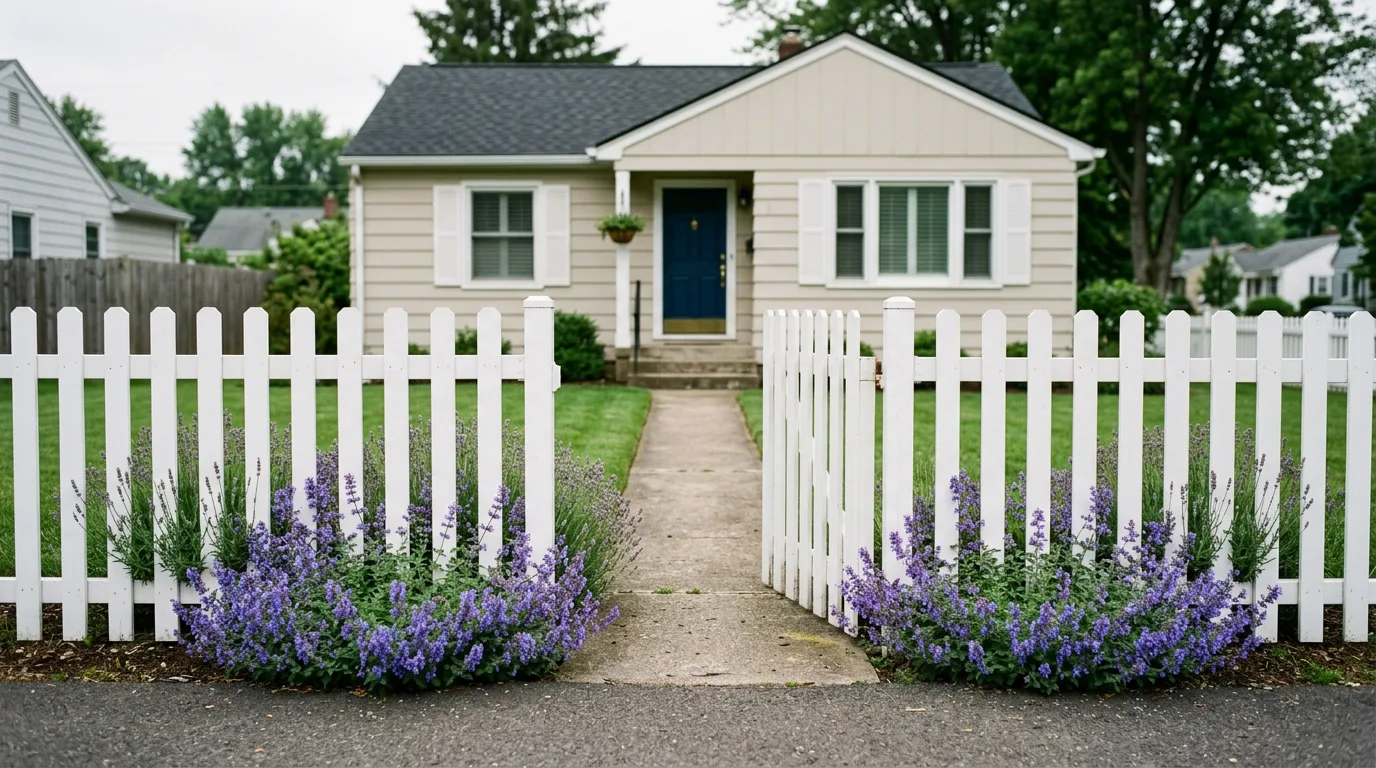
11. Classic White Picket Fence
Vertical pickets with pointed or rounded tops, typically 3-4 inches wide with 2-3 inch gaps. The archetypal front yard fence. Works with cottage, colonial, craftsman, and traditional home styles.
Material choice: Vinyl requires zero maintenance but reads as suburban; painted wood requires maintenance but delivers higher perceived craftsmanship.
Verdict
The highest ROI boundary fence for traditional homes. White picket fencing delivers instant curb appeal recognition and broad buyer appeal. Choose vinyl for zero maintenance or wood for authentic craftsmanship—both work.
Visualize Picket Fence Styles →12. Black Aluminum Picket Fence
$22-38/linear ft • 3-4 ft • Modern take on classic picket
Powder-coated aluminum pickets in matte black or bronze. Zero maintenance, 25-30 year lifespan. Contemporary alternative to white wood picket.
13. Split Rail Wood Fence
$12-22/linear ft • 3-4 ft • Rustic, open boundary
Horizontal logs in 2-3 rail configuration. Defines boundary without blocking views. Works best for ranch, farmhouse, or rural properties with large front yards.
14. Wire Livestock Fence
$8-15/linear ft • 3-4 ft • Minimal visual impact, pet containment
Welded wire mesh on wood or metal posts. Nearly invisible from a distance. Best for large front yards where visual openness is priority but pet containment is required.
15. Horizontal Board Fence
$20-35/linear ft • 3-4 ft • Contemporary sightline fence
2-3 horizontal boards with 4-6 inch gaps. Modern aesthetic, defines boundary without blocking views. Works with mid-century, contemporary, or minimalist homes.
16. Chain Link Fence (Vinyl-Coated)
$10-18/linear ft • 3-4 ft • Budget pet containment
Diamond mesh with black or green vinyl coating. Functional, low-cost, low curb appeal. Use only where budget is the primary constraint.
17. Welded Wire Grid Fence (Modern)
$25-40/linear ft • 3-4 ft • Contemporary metal grid
Rigid welded wire panels with 2x4 inch or 4x4 inch grid in black powder-coat finish. Clean, modern look. Pair with ornamental grasses or perennial borders.
18. Post-and-Rail with Wire Mesh
$15-25/linear ft • 3-4 ft • Rustic with pet containment
Split rail posts with welded wire backing. Keeps the open, rustic aesthetic of split rail while containing small dogs. Best for farmhouse or cottage styles.
19. Vertical Cable Rail Fence
$30-50/linear ft • 3-4 ft • High-end modern boundary
Stainless steel cables tensioned between metal or wood posts. Nearly transparent, contemporary aesthetic. Highest cost in the boundary category but delivers modern luxury signal.
20. Bamboo Panel Fence
$18-30/linear ft • 3-4 ft • Tropical or Asian-inspired boundary
Natural bamboo poles in tight vertical arrangement. Tropical aesthetic, 8-12 year lifespan. Works in coastal, Zen garden, or tropical-modern settings.
21. Stone or Concrete Block Wall (Low)
$40-80/linear ft • 2-3 ft • Permanent architectural boundary
Dry-stacked stone, mortared stone, or concrete block with cap. Permanent, high-end aesthetic. Best for Mediterranean, craftsman, or estate-style homes.
22. Living Willow Fence
$15-28/linear ft • 3-4 ft mature height • Woven living boundary
Willow branches woven between stakes, take root and create living fence. Requires annual weaving and shaping. Cottage or English garden aesthetic. 10-15 year lifespan.
Decorative Fences: 8 Styles for Architectural Accent (2-4ft)
Decorative fences are curb appeal tools first, functional barriers second. They frame foundation plantings, define garden beds, and add architectural interest without blocking views or creating visual weight. Use them when the goal is aesthetic enhancement, not privacy or pet containment.
23. Wrought Iron Ornamental Fence
$35-60/linear ft • 2-4 ft • Classic estate aesthetic
Hand-forged or cast iron with decorative finials, scrollwork, or geometric patterns. Highest curb appeal impact in the decorative category. Requires rust prevention maintenance every 3-5 years.
24. Aluminum Ornamental Fence (Maintenance-Free)
$25-45/linear ft • 2-4 ft • Modern alternative to wrought iron
Powder-coated aluminum with ornamental design mimicking wrought iron. Zero maintenance, rust-proof, 25-30 year lifespan. Best value in decorative fencing.
25. Low Boxed Wire Fence (Hog Wire)
$15-28/linear ft • 2-3 ft • Farmhouse-modern hybrid
Welded wire panels in wood frame. Defines garden beds without blocking views of foundation planting. Works with farmhouse, transitional, or modern cottage styles.
26. Cast Stone or Concrete Balustrade
$50-90/linear ft • 2-3 ft • Formal estate style
Traditional baluster design in precast concrete. Mediterranean, Victorian, or formal garden aesthetic. Permanent installation, highest perceived value in decorative category.
27. Laser-Cut Metal Panels (Decorative)
$40-70/linear ft • 2-4 ft • Contemporary art fence
Powder-coated steel or aluminum with custom laser-cut patterns (geometric, botanical, abstract). High-end contemporary homes. Doubles as garden art.
28. Low Hedge with Metal Edging
$12-25/linear ft • 2-3 ft mature height • Living decorative boundary
Boxwood, dwarf yaupon holly, or lonicera hedge clipped to formal shape with steel or aluminum edging at base. Formal garden aesthetic, requires quarterly shaping.
29. Victorian Gothic Picket Fence
$25-40/linear ft • 3-4 ft • Ornate heritage style
Decorative pickets with scalloped top rail, finials, or Gothic arch gates. Painted in heritage colors (black, forest green, burgundy). Victorian, Queen Anne, or Gothic Revival homes only.
30. Stacked Stone Garden Wall
$35-65/linear ft • 2-3 ft • Natural stone accent
Dry-stacked flagstone or fieldstone. Creates raised planting bed behind wall for foundation shrubs. Craftsman, cottage, or mountain home styles. Permanent, 50+ year lifespan.
Material Comparison: Wood, Vinyl, Metal, Composite
| Material | Lifespan | Maintenance | Cost Range | Best For |
|---|---|---|---|---|
| Wood (Cedar/Redwood) | 15-25 years | Stain/seal every 2-3 years | $18-40/linear ft | Traditional homes, natural aesthetic |
| Wood (Pressure-Treated Pine) | 10-20 years | Paint/stain every 2-3 years | $12-30/linear ft | Budget-conscious, willing to maintain |
| Vinyl | 25-30 years | None (hose off annually) | $20-50/linear ft | Zero maintenance priority, suburban aesthetic |
| Aluminum | 25-30 years | None (rust-proof) | $22-50/linear ft | Modern aesthetic, ornamental designs |
| Wrought Iron | 50+ years | Rust prevention every 3-5 years | $35-70/linear ft | Estate or Victorian homes, decorative accent |
| Composite | 20-25 years | Minimal (hose off annually) | $30-60/linear ft | Contemporary homes, wood-look without maintenance |
| Chain Link | 15-25 years | None | $8-18/linear ft | Budget pet containment (low curb appeal) |
| Masonry (Stone/Stucco) | 50+ years | None | $40-100/linear ft | Permanent architectural statement, high-end homes |
The material decision filter:
- Budget priority: Chain link, wire livestock, or pressure-treated wood split rail.
- Zero maintenance priority: Vinyl, aluminum, or composite.
- Natural aesthetic priority: Cedar, redwood, or stone (accept the maintenance requirement).
- Contemporary aesthetic priority: Composite horizontal slat, aluminum grid, or cable rail.
- Highest curb appeal ROI: Classic white picket (vinyl or wood) or aluminum ornamental.
Cost Breakdown by Fence Type
Fence costs are quoted per linear foot installed. A typical front yard fence runs 60-150 linear feet depending on lot size and setback. Labor accounts for 40-60% of total cost.
This page prices the fence. If the fence is one line in a larger budget, our landscaping cost guide covers the whole project — including the other code thresholds, like the 4 ft retaining wall and the 200 sq ft deck, where the price steps rather than slides.
Front Yard Fence Cost Estimator
Small front yard (60 linear feet):
- Budget option (chain link, wire): $480-$1,080
- Mid-range option (vinyl picket, split rail): $1,200-$2,400
- Premium option (aluminum ornamental, cedar board-on-board): $2,100-$3,600
Average front yard (100 linear feet):
- Budget option: $800-$1,800
- Mid-range option: $2,000-$4,000
- Premium option: $3,500-$6,000
Large front yard (150 linear feet):
- Budget option: $1,200-$2,700
- Mid-range option: $3,000-$6,000
- Premium option: $5,250-$9,000
Cost factors not included above:
- • Gates add $200-$800 depending on width and hardware
- • Permit fees: $50-$300 (required for fences over 4 feet in most jurisdictions)
- • Removal of existing fence: $3-$8/linear foot
- • Grading or leveling sloped ground: $500-$2,000
- • Custom paint colors or stain: add 15-25% to wood fence cost
The lifetime cost calculation:
Vinyl and aluminum cost 20-40% more upfront than wood, but zero maintenance over 25 years makes them the lowest lifetime cost option. Wood requires $200-$500 in staining/sealing every 2-3 years. Over a 20-year period, a $2,400 wood fence costs $4,400-$6,400 total; a $3,200 vinyl fence costs $3,200 total.
Before committing to material choice, visualize fence styles in your actual front yard to confirm the aesthetic reads as intended. A vinyl fence that looks fine in isolation may read as suburban against your home's architecture.
Front Yard Fence Design Rules: Setback, HOA, and Proportions
Front yard fences are the most regulated landscape element. Height limits, setback requirements, and HOA restrictions vary by municipality and neighborhood. Always verify local rules before purchasing materials.
Zoning and Setback Requirements
Two separate rules govern a front yard fence, and conflating them is the single most expensive mistake on this page. One is the building permit threshold, which is generous. The other is the zoning height limit for the front setback, which is far stricter — and in two of the five cities below it is less than half the permit threshold.
The International Residential Code exempts from a building permit “fences not over 7 feet (2134 mm) high” (2021 IRC R105.2). The same section then says, in its own words, that this is not permission to build: “Exemption from permit requirements of this code shall not be deemed to grant authorization for any work to be done in any manner in violation of the provisions of this code or any other laws or ordinances of this jurisdiction.” The zoning code is one of those other ordinances, and it is the one that sets your height.
| City | Max height in the front setback | Side & rear | Building permit needed above |
|---|---|---|---|
| Phoenix, AZ | 40 in (fences); 3 ft for a freestanding wall | 6 ft | — |
| Los Angeles, CA (R zones) | 3 ft 6 in | 6–8 ft | — |
| Portland, OR | 3 ft 6 in (many zones) | 8 ft | 7 ft timber / 4 ft masonry |
| Seattle, WA | 4 ft | 6 ft (+2 ft of arbour or trellis) | 8 ft |
| Austin, TX | 6 ft — no front-yard reduction | 6 ft (7–8 ft with a grade change or neighbour consent) | 6 ft along the public right-of-way |
Read that table twice. In Portland you may build a 7 ft timber fence without a building permit, and your front setback limit is 3 ft 6 in: “In many zones, fence height is limited to three and one-half feet (3 ½') where constructed in the front building setbacks.” In Seattle the permit threshold is 8 ft and the front limit is 4 ft: “We limit the height of the fence to 4 feet when it is located in a front or street side setback.” A homeowner who reads only the permit rule and puts up a 6 ft board fence across the front of a Portland lot is 2 ft 6 in over, has broken no permit rule, and will still be told to cut it down.
The spread between cities is the other thing worth noticing. Phoenix is the tightest: “Fences in a required front-yard setback shall be limited to a height of forty (40) inches” — so the 4 ft picket that is legal in Seattle is four inches too tall in Phoenix, and a masonry wall in the same position is capped lower again at three feet. Austin is the loosest: “A solid fence constructed along a property line may not be more than 6 feet high, measured from the natural grade up” — with no separate front-yard reduction at all, which makes a full-height privacy fence across an Austin front garden ordinary rather than exceptional. There is no national default here, and any guide that gives you one number is guessing.
The Corner and the Driveway: Vision Clearance
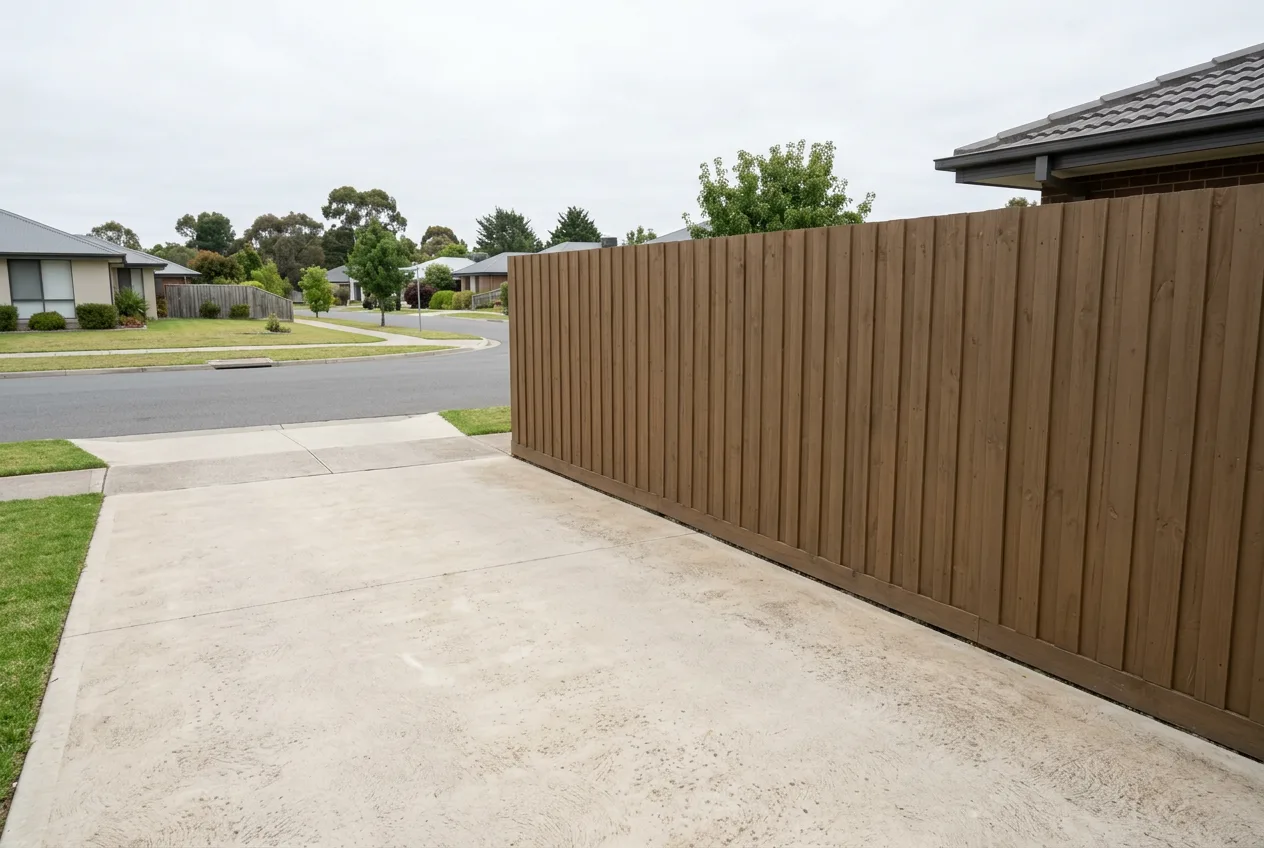
Vision clearance is the one rule that overrides your height allowance entirely. Inside a triangle measured back from an intersection, nothing may stand above roughly knee height — fence, wall, hedge or sign. The height is close to standard: Palo Alto, Plano, Salt Lake City and Sunnyvale all use 30 inches. The triangle is not standard at all, and it is the half most people get wrong. Fairfax County, VA measures “30 feet from the property lines extended” on a square corner, adds a foot for every ten degrees the corner is sharper than 90°, and allows fences up to 42 inches inside it — a longer triangle and a taller fence than the 30-inch cities.
And the triangle that catches the most people is not the street corner. It is the driveway. A mid-block lot with no corner at all still has a vision triangle where its own drive meets the footpath — commonly on the order of 20 ft along the property line by 12 ft along the edge of the drive — and a solid fence run right up to the apron puts a pedestrian on the footpath out of sight of a car reversing out. If you are planning a privacy fence on a lot with a driveway, that last stretch beside the drive is where it has to step down, whatever the rest of it is allowed to do. The same triangle governs what you may plant there, which is covered in full — with three cities’ codes quoted side by side — in driveway landscaping ideas.
How to verify your own limit in one call:
- Ask the planning or zoning counter — not the building counter — for the maximum fence height in the front setback of your zoning district. These are different departments answering different questions.
- Ask for the figure for a solid fence and for an open one separately. Several codes allow an open rail or wrought-iron fence higher than a solid one in the same position, and Los Angeles has a Fence Height District overlay that permits 6 ft of open ironwork with nothing solid above 3 ½ ft.
- Ask how height is measured on sloping ground, and whether a retaining wall underneath counts toward it. Seattle caps a wall-plus-fence combination at 9 ft 6 in; Austin allows an extra foot where the grade changes by a foot.
- Ask for the vision clearance dimensions for both your street corner, if you have one, and your driveway.
- Only then ask whether a permit is needed. It is the last question, not the first.
HOA Architectural Review Requirements
If you live in a community with a homeowners association, architectural review is typically required before fence installation. HOAs regulate:
- Fence style: Many HOAs allow only specific fence types (e.g., white picket or aluminum ornamental only).
- Height limits: Often stricter than municipal code (e.g., 3 feet maximum in front yard).
- Color and finish: White, natural wood, or black are commonly approved; bright colors are typically prohibited.
- Material restrictions: Some HOAs prohibit chain link, vinyl, or certain wood stains.
HOA submission process: Submit design plans, material samples, and installation timeline to the architectural review committee. Approval timelines range from 2 weeks to 2 months. Do not purchase materials before receiving written approval.
Proportional Design Rules
Even when zoning and HOA rules permit a fence, proportional design rules determine whether it looks right:
- Fence height should not exceed foundation height: A 4-foot fence on a home with 2-foot foundation exposure reads as top-heavy. Match fence height to foundation or slightly lower.
- Gate width should match path width: A 3-foot gate on a 5-foot path creates visual bottleneck. Gate should be 80-100% of path width.
- Fence color should coordinate with trim or door color: Match the fence to one existing color in your home's palette—never introduce a new color via fencing alone.
- Fence style should match home era and style: Victorian homes call for ornamental iron or Gothic picket; mid-century homes call for horizontal board or cable rail; craftsman homes call for wood post-and-rail or low stone wall.
For more context on front yard design proportions and curb appeal principles, see front yard curb appeal ideas and modern front yard landscaping ideas.
Landscaping Along Fences: Plant Pairings by Fence Type
A fence without foundation planting reads as harsh and unfinished. The right plants soften fence lines, add seasonal color, and increase curb appeal. Plant selection depends on fence height, style, and sun exposure.
General planting rules: Maintain 12-18 inch clearance between plants and fence for airflow. Choose plants with mature height at 60-75% of fence height to avoid obscuring the fence entirely.
Plant Pairings by Fence Type
Privacy Fences (6ft+)
Goal: Soften solid fence line, add texture at base without competing with height.
Evergreen layer (year-round structure):
- • Boxwood (Buxus) — 2-3 ft, compact evergreen, shears well
- • Dwarf yaupon holly (Ilex vomitoria 'Nana') — 3-4 ft, fine texture
- • Compact nandina (Nandina domestica 'Firepower') — 2 ft, red winter foliage
Flowering perennial layer (seasonal color):
- • Salvia (Salvia nemorosa) — 18-24 in, purple spikes, long bloom
- • Catmint (Nepeta) — 18 in, lavender-blue, attracts pollinators
- • Daylilies (Hemerocallis) — 24-30 in, wide color range, low maintenance
Picket Fences (3-4ft)
Goal: Frame fence with cottage garden aesthetic, allow pickets to remain visible.
Front row (low perennials, 12-18 in):
- • Catmint (Nepeta) — spills over edge, softens base
- • Lavender (Lavandula) — fragrant, gray-green foliage
- • Sedum (Sedum spectabile) — succulent foliage, fall blooms
Back row (tall perennials, 24-30 in):
- • Roses (shrub or floribunda) — classic cottage pairing
- • Black-eyed Susan (Rudbeckia) — bright yellow, summer-fall bloom
- • Russian sage (Perovskia) — airy texture, purple blooms
Ornamental Metal Fences (2-4ft)
Goal: Preserve visibility of ornamental fence while adding color at base.
Low perennials (12-24 in):
- • Coreopsis — cheerful yellow, long bloom season
- • Dianthus — compact, fragrant, pink/white blooms
- • Heuchera (coral bells) — colorful foliage, shade-tolerant
Ornamental grasses (18-30 in):
- • Blue fescue (Festuca glauca) — compact blue mounds
- • Fountain grass (Pennisetum) — soft plumes, movement
- • Mexican feather grass (Nassella tenuissima) — fine texture, golden fall color
Split Rail or Wire Fences (3-4ft)
Goal: Casual, naturalistic planting that doesn't obscure open fence aesthetic.
Native perennials and grasses:
- • Purple coneflower (Echinacea purpurea) — prairie native, pollinator magnet
- • Little bluestem grass (Schizachyrium scoparium) — native grass, bronze fall color
- • Blanket flower (Gaillardia) — red-yellow blooms, drought-tolerant
- • Butterfly weed (Asclepias tuberosa) — orange blooms, monarch host plant
The planting layout pattern: Alternate groupings of 3-5 plants of the same species in drifts along the fence line. Avoid single specimens spaced evenly—this creates a lineup, not a garden. Layer heights with lowest plants at front, tallest at back (for fences viewed from the street side).
For plant selection tools and more detailed pairing recommendations, see AI plant recommendations. For broader privacy landscaping strategies that integrate fencing with planting, see backyard privacy ideas.
Gate Design: The Detail Most People Get Wrong
The gate is the focal point of the front fence—it receives more visual attention than any other panel because it marks the entry point. Three rules apply universally, regardless of which fence family you chose.
Rule 1: The gate must be slightly taller or wider than the fence run.
A gate identical in height to the fence panels disappears visually. Adding 2–4 inches in height, or widening the gate posts, signals entry. Arched tops on gates against flat-top fence panels are the classic resolution.
Rule 2: Hardware finish must match the fence color, not contrast with it.
Brass hardware on a black fence reads as an error. Powder-coated black hardware on a black fence is invisible, as intended. Gate hardware should be a functional element that serves the design, not a competing design feature.
Rule 3: Align the gate opening with the front path, not the fence midpoint.
The gate opening must line up with the front door approach path. A gate offset from the path creates an awkward angle and signals poor planning. If you are replacing a fence without changing the path, measure the path alignment before ordering the gate panel. The gate should be 80–100% of the path width—a 3-foot gate on a 5-foot path creates a visual bottleneck.
Frequently Asked Questions
What is the best fence height for a front yard?
What is the cheapest front yard fence option?
Do I need HOA approval for a front yard fence?
What fence material lasts longest?
Should I plant along my front yard fence?
What is the standard setback for front yard fences?
Can I visualize fence styles in my yard before building?
What color should I paint my front yard fence?
Visualize Before You Build
See Every Fence Style in Your Actual Front Yard
Upload a photo. Generate photorealistic renders showing 30+ fence styles, materials, and plant pairings in your front yard context. Compare options side-by-side before committing.


