Mailbox landscaping ideas all work from one layout: a low bed of salt-tolerant plants, mostly under 18 inches and none over about three feet, set around a plain wooden post, with the box door and the approach to it kept clear. That layout is not a style choice. Three rules sit under every mailbox bed. The Postal Service wants the carrier to reach the box without leaving the vehicle. The post is meant to give way if a car hits it. And the soil beside a road takes salt and plowed snow. Get those right and nearly any planting scheme works; get them wrong and the bed ends up obstructing delivery or the plow.
Every figure below was read from its source this week and is linked, so you can check the one that governs your street.
The rules that decide the design
The Postal Service’s own mailbox installation page sets the numbers a bed has to be built around:
- Height: the bottom of the box, or its point of mail entry, sits 41 to 45 inches above the road surface.
- Distance from the curb: 6 to 8 inches back from the curb. With no raised curb, USPS says to contact your local postmaster.
- Your number: the house or apartment number goes on the box, so a bed should never grow over it.
- The post: the Federal Highway Administration’s recommendation, as USPS reproduces it, is a 4 by 4 inch wooden post or a 2 inch diameter steel or aluminum pipe, buried no more than 24 inches. USPS says to avoid “unyielding and potentially dangerous supports, like heavy metal pipes, concrete posts, and farm equipment (e.g., milk cans filled with concrete)”.
The second document is the Postal Bulletin notice on mailbox improvement and placement (issue 22441, 2016), and it is the one that matters for planting. It says customers must place mailboxes so a carrier can serve them without leaving the vehicle, and that “customers must remove obstructions, including vehicles, trash cans, and snow, that impede safe and efficient delivery.” It adds that carriers must have access to the box without leaving the vehicle unless authorized to dismount. A plant that makes a carrier lean, stretch or step out works against that wording, which is why the street side of the post stays clear in every layout below.
Two more lines from the same notice shape the winter design. In areas where snow removal is a problem, USPS suggests a semi-arch or extended-arm support, which “allows snowplows to sweep near or under mailboxes without damaging supports.” And it asks owners to keep boxes and posts painted and rust-free.
The rules differ by road, so check before you buy anything
USPS gives the box position; the road’s owner, a state or county, gives the rest, and they do not agree. Two published examples show the spread:
| USPS | Delaware DOT | Mesa County, Colorado | |
|---|---|---|---|
| Curbed street | 6–8 in back from the curb | Box face 6–8 in back from the curb face | Not stated on the page |
| Road with no curb | Ask your postmaster | 8–12 in behind the pavement edge, on low-volume roads with no shoulder | Box face at least 8 ft from the pavement edge on rural roads |
| Post | 4×4 wood or 2 in pipe, ≤ 24 in deep | 4×4 or 4.5 in round wood, or metal no stronger than 2 in pipe; ≤ 24 in deep; never encased in concrete or brick | One 4×4 or 4.5 in wood post or 2 in Schedule 40 pipe; not set in concrete; ≤ 2 ft deep |
| If it does not comply | n/a | 24 hours to 60 days to fix it, then removed at the owner’s expense | 24 hours to 30 days, then removed at the owner’s expense |
Sources: 2 Del. Admin. Code § 7.4 and Mesa County’s mailbox guidelines. Mesa County also says “structure ornamental monument type mailboxes” that do not meet its requirements “will not be allowed within Mesa County right of way.”
The gap between 12 inches and 8 feet for an uncurbed road is the reason USPS keeps telling people to call. It is also the reason a brick pillar with a planted ring around it, the shape many mailbox-garden searches are really after, is a gamble: the strip a mailbox stands on is often public right of way, and the agencies that own it write their rules around a post that yields.
One honest limit: we found no rule that names a ring of loose rocks around a post. The reasoning in every rule above is the same, though. A support is supposed to bend or fall away, and a boulder wall at its foot is a fixed object beside it. Treat that as our inference, not a citation, and ask the road’s owner.
Where the bed goes
The layout falls out of those rules. Think of the post as having four sides.
- Street side (the box door): clear. At most a ground-hugging band of thyme or phlox a few inches tall; no shrubs, no edging that stands up, nothing a carrier reaches across. If in doubt, leave it bare: this is the carrier’s reach and the plow’s path.
- Under and around the post’s base: bare ground or a flat collar of mulch or gravel kept level with the soil.
- House side, behind the post: the bed.
- Back edge of the bed: the tallest plants, kept well below the 41 inch line where the bottom of the box sits.
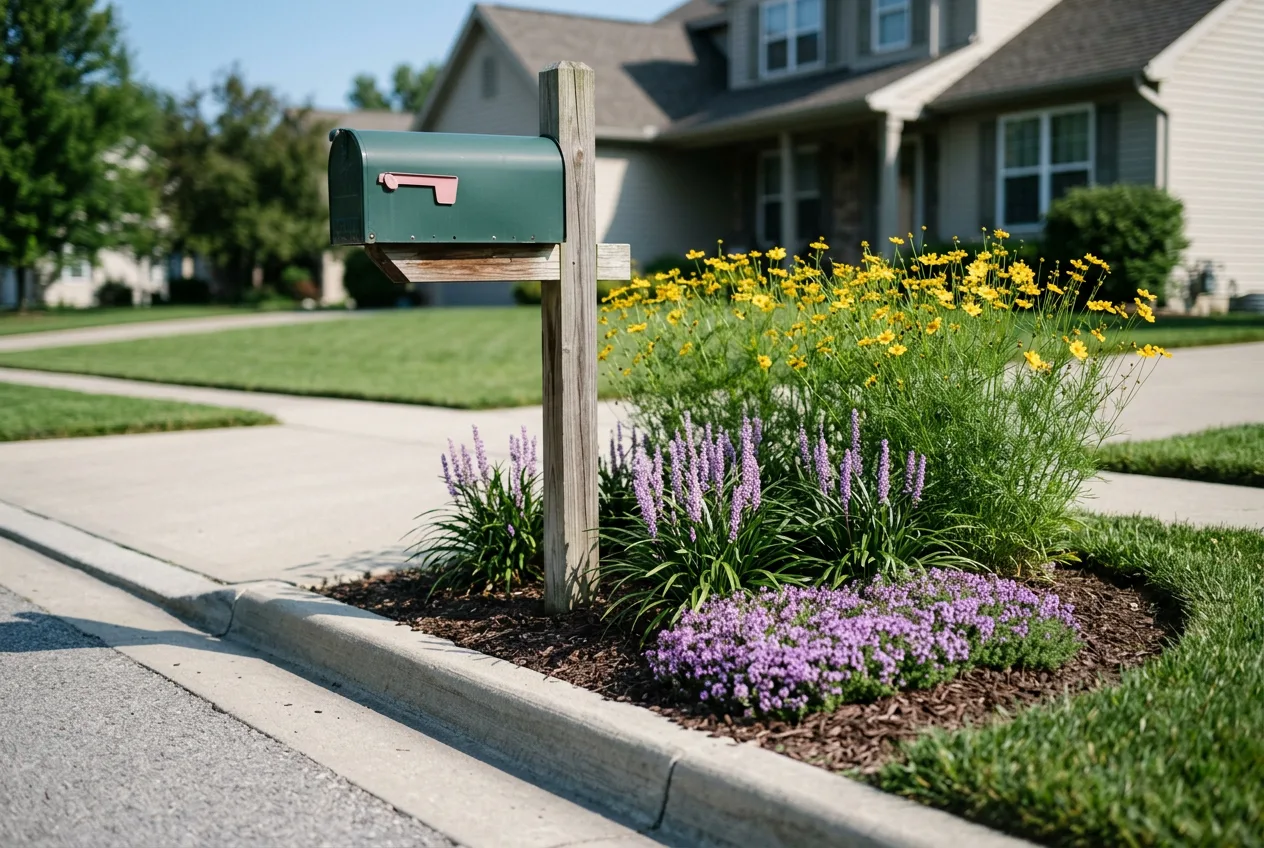
The arithmetic is simple. The box bottom is at 41 to 45 inches, so anything under about 3 feet stays below it. The lower the plants nearest the street, the clearer the carrier’s view of the post, the curb and the approach, which is why the tallest plant in this list goes at the back.
Six mailbox landscaping ideas that follow the rules
1. The low half-moon behind the post
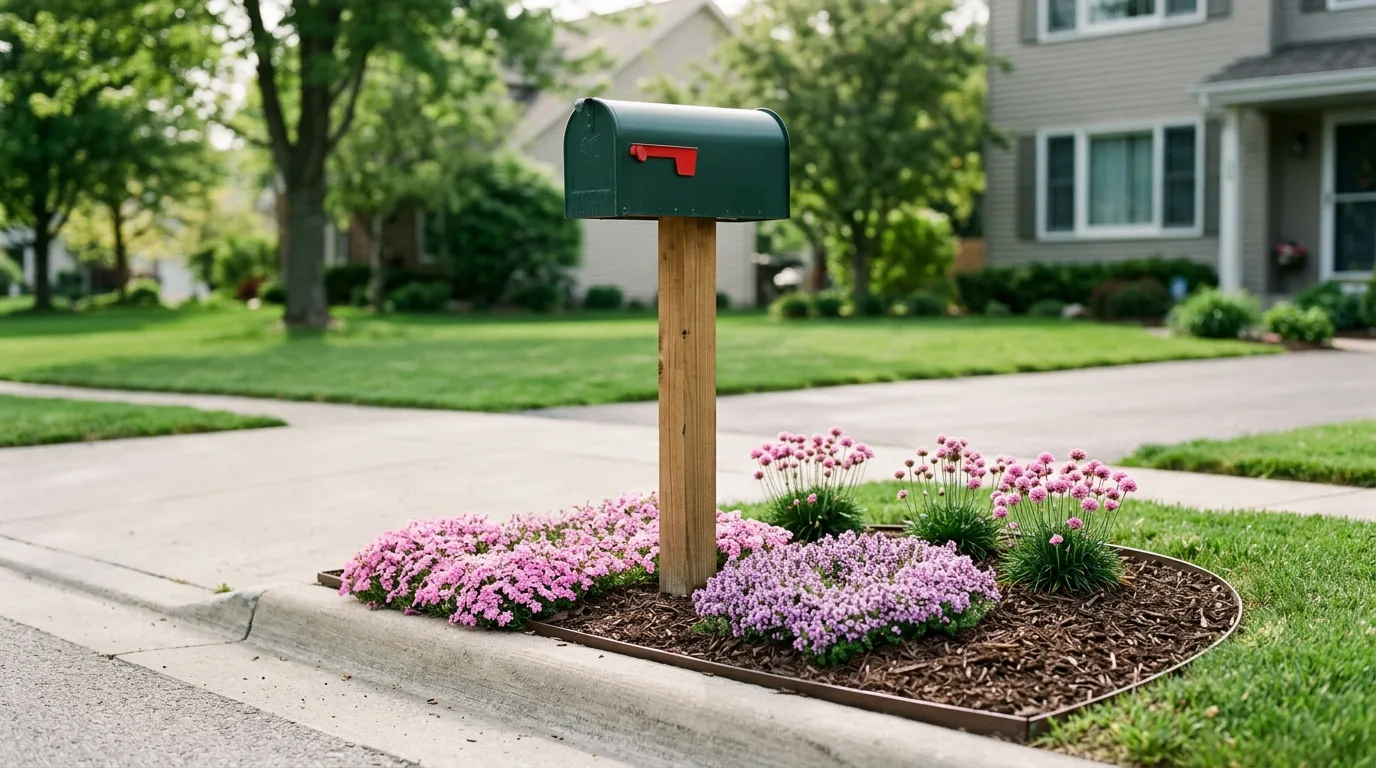
The layout in the photograph at the top: a half-circle bed edged flush with the lawn, planted in bands. Creeping thyme and moss phlox hug the ground nearest the curb, sea thrift or lilyturf fills the middle, and threadleaf coreopsis stands at the back. Every plant is in the table below. It is the cheapest idea here, and the easiest to cut back if a rule changes.
2. A flat gravel collar, not a rock ring
Rock is a standard mailbox-bed request (search suggestions include “with rocks” and “with stones”), and the way to do it is flat. A shallow layer of gravel level with the surrounding ground stops mud and weeds at the post’s base, and nothing in it is a fixed object for a vehicle or plow to hit. Our gravel landscaping guide covers edging, depth and the weed barrier question. Keep boulders back near the house, well off the street side.
3. The shade version
A mailbox under a street tree is common, and most sun-loving perennials sulk there. Lilyturf (Liriope muscari) is the one plant in this list whose NC State profile lists both heavy shade and salt among its resistances. NC State describes it as broadleaf evergreen and clumping. A band of lilyturf behind the post, with moss phlox at the sunnier front edge, gives a shaded bed that still reads as planted in winter.
4. The snow-country bed
Where plows come through, design the bed for the plow. Use the arm-type support USPS suggests so the ground under the box is clear, keep that strip bare, and set the bed back behind the post rather than beside the road edge. Plants nearest the street can end up under heaped, salty snow, so put the toughest and lowest there (thyme, phlox) and keep anything you care about in the back half.
5. Pots on the house side
Containers are the one idea that sidesteps most of the rules: nothing new is in the ground, and you can move them when the plow season starts. Set them behind the post, never on the street side, and keep them out of the snow-clearing strip.
6. Move the box to the house
If the roadside is too hostile, a wall-mounted mailbox puts the bed at your front door instead. USPS says replacing a curbside box with a wall-mounted one requires your local postmaster’s permission, that the box should sit near the main entrance so the carrier can see it, and that wall-mounted boxes can hold only items with postage, not newspapers. With permission, the whole salt, plow and right-of-way problem disappears and the planting becomes an ordinary entry bed. Our front-yard curb appeal guide has entry-bed ideas for that.
Plants that work at a mailbox
Five plants clear the tests: under 3 feet, no spines or thorns, and listed by NC State’s Plant Toolbox as resistant to salt. Zones and sizes are from each profile.
| Plant | Botanical name | Zones | Mature size | Where it goes |
|---|---|---|---|---|
| Creeping thyme | Thymus serpyllum | 4a–9b | 2–3 in tall, 3–10 in wide | Front edge, around the post’s base |
| Moss phlox | Phlox subulata | 3a–9b | 4–6 in tall, 2–3 ft wide | Front edge, spilling over a border |
| Sea thrift | Armeria maritima | 4a–8b | 6 in–2 ft tall, 6 in–1 ft wide | Middle of the bed |
| Lilyturf | Liriope muscari | 5a–10b | 1–1.5 ft tall and wide | Middle of the bed, shade |
| Threadleaf coreopsis | Coreopsis verticillata | 3a–9b | 2.5–3 ft tall, 1.4–2 ft wide | Back edge only |
If you are outside a plant’s zone range, ask your state extension service about the nearest alternative before buying a group.
Salt-tolerant, and still wrong for a mailbox
Salt tolerance is the filter most lists use, and it lets in plants a carrier should not brush against. All five of these appear on the Virginia Tech list of trees and shrubs that tolerate saline soils and salt spray, and all five are wrong beside a box:
| Plant | Problem at a mailbox | Size and zones (NC State) |
|---|---|---|
| Firethorn (Pyracantha coccinea) | Sharp spines on the stems | 6–18 ft × 8–18 ft, zones 6a–9b |
| Rugosa rose (Rosa rugosa) | Many prickles; suckers into thickets; invasive in New England and Virginia, per NC State | 4–6 ft × 4–6 ft, zones 2a–7b |
| Chinese holly (Ilex cornuta) | Stout leaf spines; listed as invasive by the NC Invasive Plant Council | 8–15 ft, zones 7a–9b |
| Adam’s needle yucca (Yucca filamentosa) | Spines on every leaf tip | 3–8 ft × 3–5 ft, zones 4a–10b |
| Oleander (Nerium oleander) | NC State rates its poison severity High: “highly toxic, may be fatal if eaten” | 5–19.5 ft, zones 8a–10b |
Firethorn and rugosa rose are on that salt-tolerance list for good reason, and a list built on salt alone will recommend them. A carrier’s hand and a child’s both reach a mailbox. Keep the sharp, the toxic and the huge away from it, and save them for the back of the lot.
A separate judgment call, ours rather than a rule: leave the post itself free of climbing vines. A vine will find the door, the flag and the number in one season.
Salt, plows and heat: what the roadside does to a bed
Virginia Tech’s extension publication is blunt: “Most landscape plants are sensitive to salt,” and salt accumulation in the soil “usually occurs within 30-50 feet of roads.” Three details change how you plant.
- New plants are the most exposed. The publication singles out newly planted plants and plants with tender new growth as particularly sensitive. Plant in spring and give the bed a whole growing season before its first salted winter.
- Foliage is more sensitive than roots. The publication notes plants are more sensitive to salts on the foliage than on stems, trunks or in the root zone, so splash from passing traffic matters as much as salt in the soil. A low, tough front edge takes the splash.
- Rainfall changes the problem. The publication says significant salt accumulation is uncommon where rainfall exceeds 20 inches a year, because rain washes salts out. In a drier climate salt is more likely to stay, and the publication also notes that repeated light watering without leaching or adequate drainage lets salt build up. Water the bed deeply and rarely rather than often and lightly.
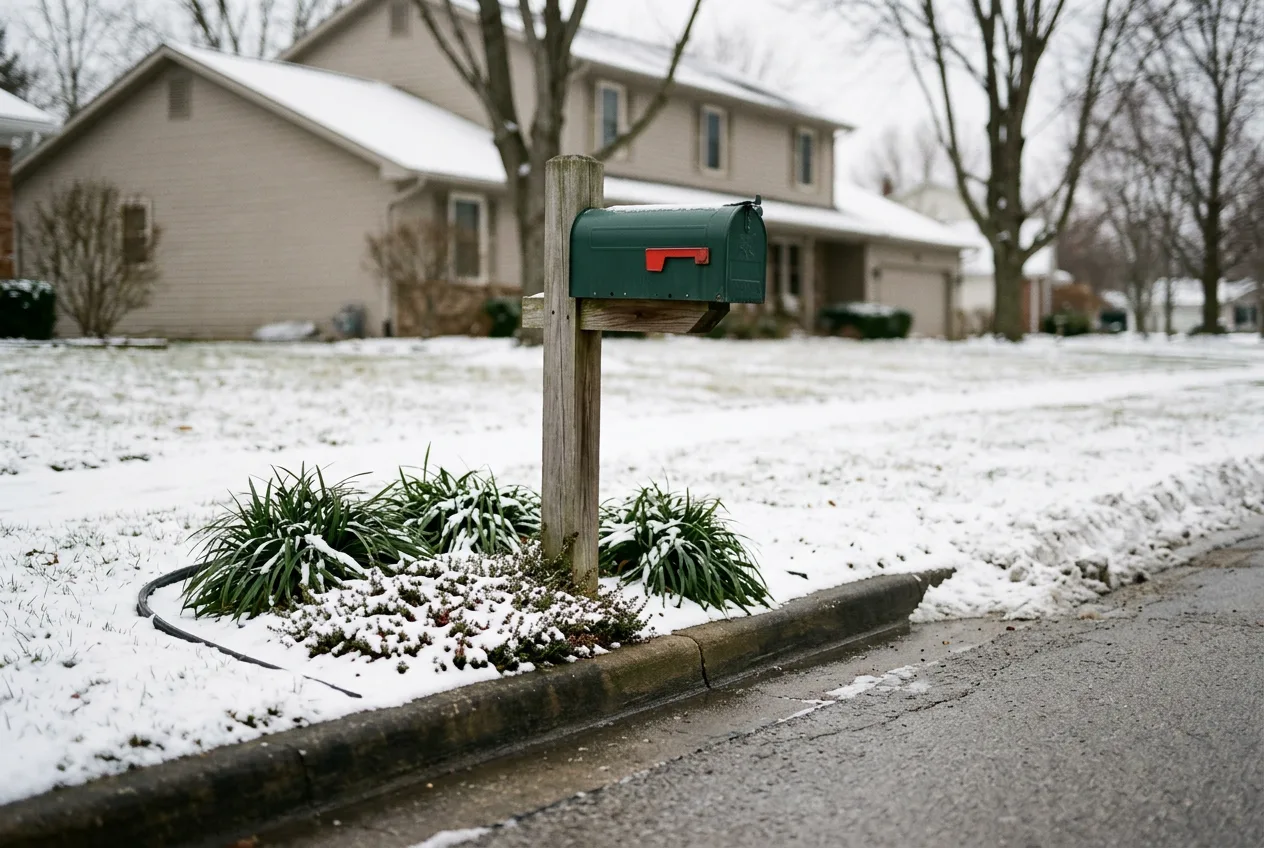
Snow clearing is the other half of the winter job. The Postal Bulletin puts snow in the same list as vehicles and trash cans, as an obstruction owners must remove, so the bare strip on the street side is also the strip you will shovel. A bed that spills into it will be shoveled onto.
Before you dig
Two calls before the post hole, neither optional.
- Call your local post office. USPS asks you to check before erecting or replacing a mailbox because road and curb conditions vary, and for a wall-mounted box it requires permission.
- Call 811. The national before-you-dig service says to contact it “a few business days before you begin any digging, including common projects like planting trees and shrubs or installing fences and mailboxes.” It is free, and it names mailbox installation explicitly. Our guide to planting trees near a property line covers the same call for trees, and if the frontage also holds a green utility box, our guide to landscaping around utility boxes gives the clearances utilities ask for around it.
A weekend plan
- Call the post office and the road’s owner for the post rules and the setback on your road.
- Call 811 and wait for the marks.
- Set a 4×4 wooden post, no more than 24 inches deep and without concrete, so the bottom of the box lands at 41 to 45 inches.
- Mark the half-moon behind the post and keep the street side to ground-hugging plants at most.
- Plant in spring from the table above, then edge flush with the lawn. For mulch depth and keeping it off stems, see our guide to mulch.
See it before you build it
A mailbox bed is small, but it sits at the front of your house and decides how the whole frontage reads. Upload a photo of your front yard to Hadaa and you can see a planting rendered into your own yard, with the plants checked against your hardiness zone, before you buy anything. It cannot know your county’s right-of-way rules, so do the post office and 811 calls first, and use the render to choose colours and proportions. For a bigger front-yard plan, our driveway landscaping guide covers borders and edging along the same frontage.
FAQ
How far should a mailbox be from the curb? USPS says 6 to 8 inches back from the curb, with the bottom of the box 41 to 45 inches above the road surface. If there is no raised curb, USPS says to contact your local postmaster. State and county rules on uncurbed roads differ: Delaware DOT sets 8 to 12 inches behind the pavement edge on low-volume roads without shoulders, while Mesa County, Colorado asks for the box face at least 8 feet from the pavement edge on rural roads.
Can I put rocks or a brick base around my mailbox? Check first. USPS, quoting the Federal Highway Administration, says to avoid unyielding supports such as concrete posts, Delaware’s rules say supports shall not be encased in concrete or brick, and Mesa County does not allow ornamental monument-type mailboxes that fail its requirements within its right of way. We found no rule that names a ring of loose rocks, but a heavy fixed object at the foot of a post that is meant to give way is the same problem. A flat gravel collar level with the ground is the safer version.
What can I plant around a mailbox? Low, salt-tolerant plants with no spines or thorns, kept under the 41 inch line where the bottom of the box sits: creeping thyme, moss phlox, sea thrift, lilyturf, and threadleaf coreopsis at the back. Keep the street side of the post clear.
Do I need to call 811 to install a mailbox post? Yes. The 811 service names mailboxes, fences and planting trees and shrubs as projects that need a call a few business days before you dig.
Can I move my mailbox to the house? Only with your local postmaster’s permission. USPS says a wall-mounted box should be near the main entrance so the carrier can see it, and it can hold only items with postage, not newspapers.
Will road salt kill the plants? Salt injures most landscape plants, newly planted ones most of all, and builds up in soil within about 30 to 50 feet of salted roads. Plant salt-tolerant species in spring, water deeply, and keep tender plants out of the front of the bed.