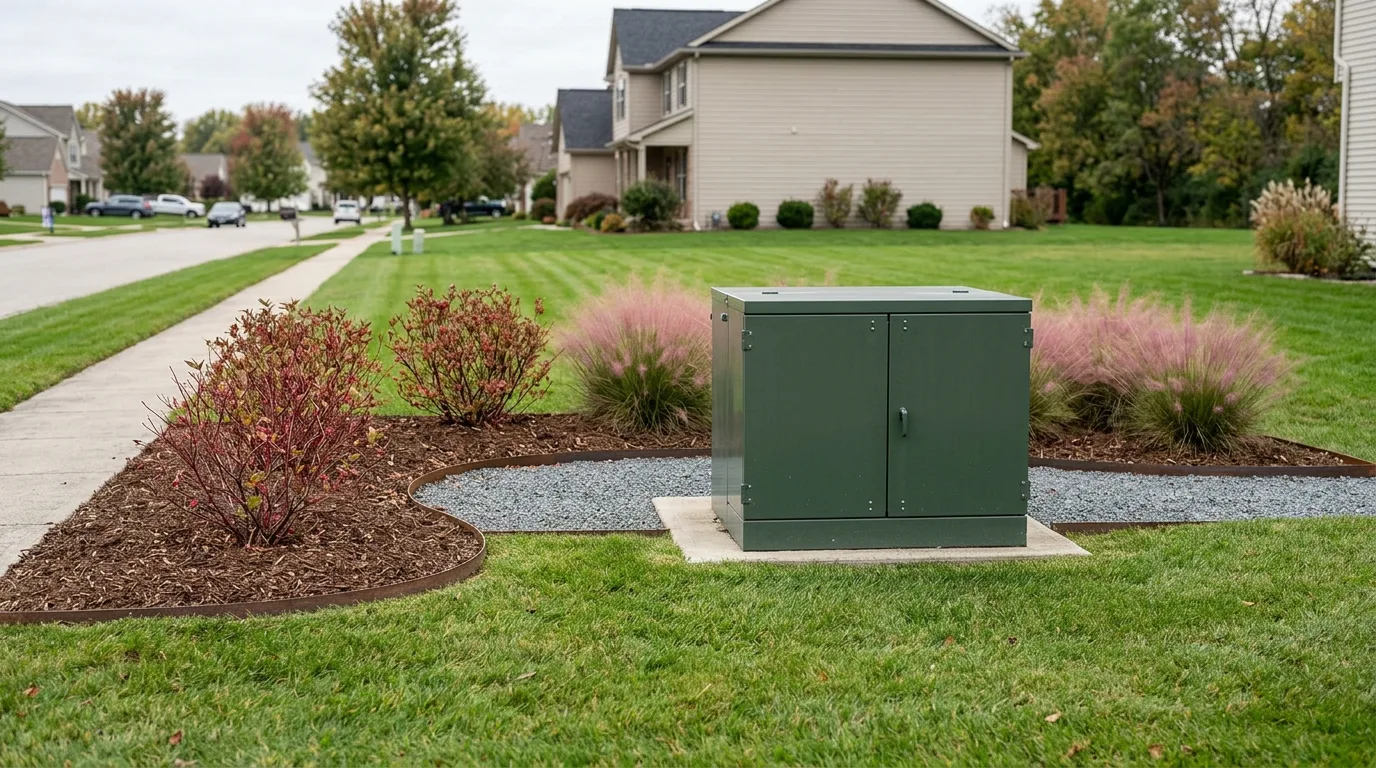
Landscaping around utility boxes is allowed, but the layout is decided before you pick a plant. Every electric utility we checked wants about 10 feet (3 metres) of open ground in front of the box’s doors and a clear strip on the other sides, which ranges from 1 foot to about 6½ feet depending on the utility. Plants have to stay outside that zone at their mature size. Vines, spiny plants, boulders and enclosures are out. So screen the sides and back of the box with compact shrubs set back from it, keep the door side as open lawn or fine gravel, and call your own utility for its numbers before you dig.
Popular “hide your utility box” guides start with ideas: climbing vines on a lattice or trellis, a repurposed cabinet or a wooden box built around it, a boulder or rock garden in front of it. The utilities’ own documents rule out every one of those. This guide starts from what the utilities publish. We read each document cited below this month, and each is linked so you can check it.
What is the green box in my yard?
The large green metal cabinet on a concrete pad is almost always a pad-mounted transformer. It takes high voltage from the underground distribution line and steps it down to the voltage your house uses. Vermont Electric Cooperative describes them as “generally green in color”, from about 3 ft wide × 3 ft deep × 2 ft high in a residential street to 7 × 7 × 6 ft on large sites. Orange & Rockland Utilities calls its residential unit “a three-foot-square green metal box”.
Smaller, shorter boxes and posts are usually pedestals. They hold connections rather than a transformer. They can belong to the electric utility (Public Service Company of Oklahoma applies the same landscaping rules to its pedestals as to its transformers) or to a phone, cable or fiber company. Look for a company name or warning label on the cabinet, and ask that company for its clearance. If you can’t tell who owns it, treat it like a transformer: the transformer rules are the strictest you’ll meet.
The clearance rules, utility by utility
The rule repeated by every utility below is the door side. Crews open the cabinet there, and some work it live. Omaha Public Power District explains that its crews use an eight-foot-long insulated “hot stick” to disconnect an energized unit, which is why they need the room. The rules for the other sides differ, so “the 10-foot rule” you’ll read elsewhere is only half the answer.
| Utility | Door side | Other sides | Also says |
|---|---|---|---|
| Omaha Public Power District (Nebraska) | 10 ft | 3 ft on two sides, at least 1 ft on the fourth | Fences are fine if they meet the clearances. A fence along the door side needs a gate that swings away from the transformer |
| Orange & Rockland (New York, New Jersey) | 10 ft | 3 ft on each of the other three sides | Landscaping must meet “utility easement accessibility standards” |
| Public Service Co. of Oklahoma | 10 ft | 3 ft | No vegetation or materials such as rocks or timbers within 10 ft of the door. No vines, no spiny-leaved plants, no structure that encloses the unit |
| Vermont Electric Cooperative | 10 ft | 4 ft, “clear of all objects (including landscaping)” | Crews will not do routine work until offending landscaping is removed |
| BC Hydro (British Columbia) | 3 m (10 ft) | 1 m (3 ft) | Shrubs should top out at 2–3 m. The same page also says “at least three meters clearance on all sides”, so ask which applies to you |
| EPCOR (Edmonton) | 3 m (10 ft) | 2 m (about 6½ ft); switching cubicles 3 m on all sides | Within 3 m: no boulders, trees or fences, gravel only 20 mm (¾ in) or smaller fractured rock, wood chips under 4 in. No concrete or asphalt within 1 m of the pad. Don’t dig within 2 m |
Two things follow from that table:
- Plan for the larger number until your utility gives you its own. A bed laid out for 3 ft sides fails a 4 ft or 2 m rule. A bed laid out for 2 m passes all of them.
- The rules are about mature size. PSO says it plainly: plant “far enough away so it reaches no closer than the minimum distance when it is full-grown.” A shrub that is 18 inches across in its nursery pot and 6 feet across in eight years breaks the rule in year four.
What happens if your plants are in the way
The box sits on an easement, and in many places the utility can clear what blocks it. Vermont Electric Cooperative’s guide says that in an emergency the utility “can remove the landscaping (not very gently) or leave and await notification that the offending vegetation has been removed”, and that during routine maintenance it “will not attempt to work on the transformer until the landscaping has been removed.” OPPD and PSO both say crews may have to remove plants or fences to get access. The cost of a crowded bed is more than lost shrubs. A longer outage on your street is part of it.
Keeping the space clear is usually your job. EPCOR says “homeowners have a responsibility to maintain space around electrical equipment on their property,” and BC Hydro says the vegetation around transformer boxes near your property is yours to maintain.
The layout: screen the view, not the box
Vermont Electric Cooperative notes that a transformer must be installed with its doors “facing away from buildings”. At a house, that usually means the doors face the street or the sidewalk. That is the side you most want to hide, and the one side you can’t plant. So the design turns around:
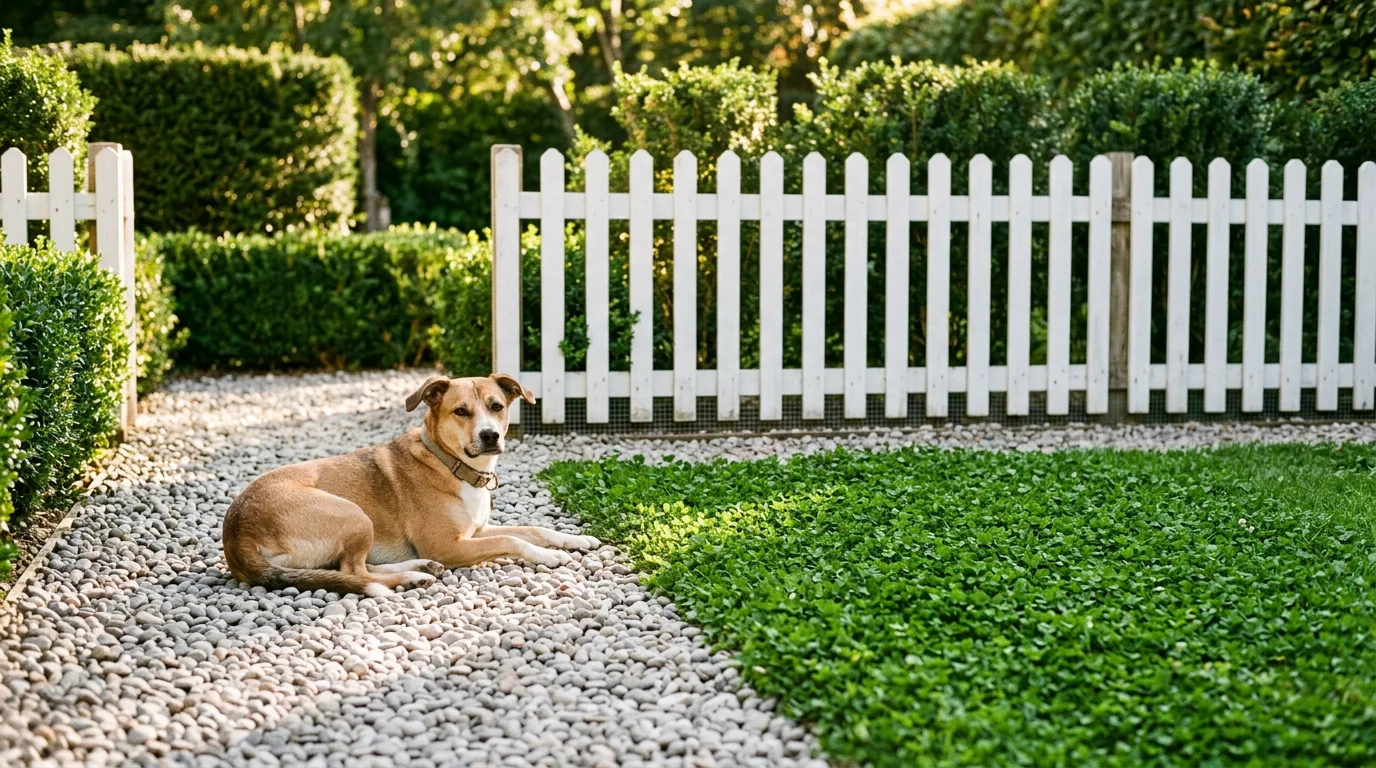
- Keep the door side open and walkable. Lawn is the simplest answer. If you want a hard surface, fine fractured gravel is what EPCOR accepts near its equipment; smooth river rock is not, because crews slip on it. Note that PSO’s leaflet bans vegetation or materials of any kind within 10 ft of the door, so ask your utility before you put even a gravel apron there.
- Screen the sides and back, set back by the clearance. From the house, the porch or the drive you usually see the box from the side or behind. A planting there, outside the clearance strip, hides most of it from the places you actually look from.
- Frame the door zone instead of filling it. Two matching shrubs or grass clumps at the outer corners of the 10-foot apron make the opening look intended, like a path ending at a gate, rather than a gap in the bed.
- Pull the eye somewhere else. A small tree or a bench well away from the box, or a planted hellstrip along the curb, gives the eye a better place to land. A box is more noticeable when it is the only object on a bare lawn.
Where each plant goes: clearance plus half the spread
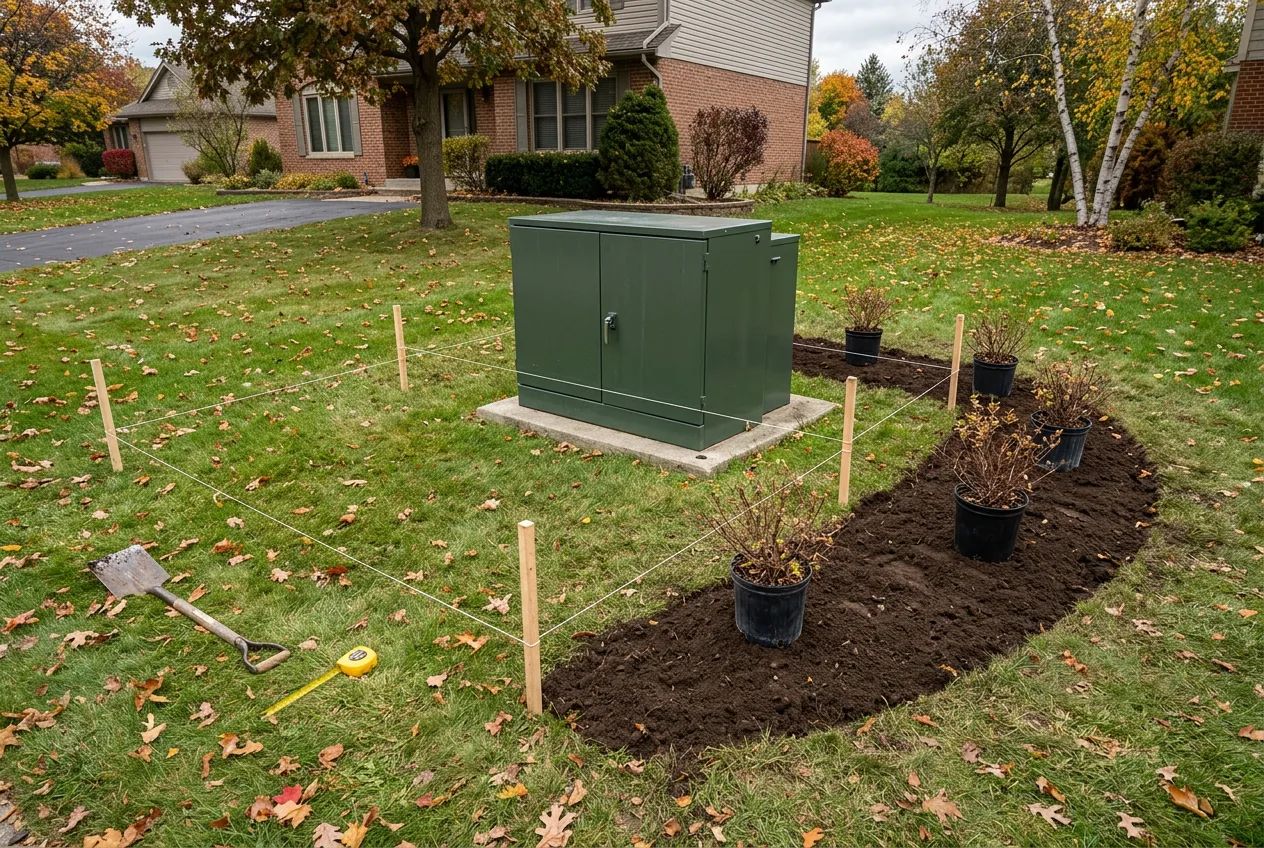
The placement rule fits in one line: plant centre = clearance + half the mature width.
- On a 3 ft side rule, a ‘Kelseyi’ red-twig dogwood that reaches 3 ft across goes in with its centre at 3 + 1.5 = 4.5 ft from the cabinet.
- Under EPCOR’s 2 m (6½ ft) rule, the same shrub goes at about 8 ft.
- A Korean lilac sold as ‘Palibin’ shows why you should plan to the top of the size range. The RHS lists it at 1–1.5 m high and wide, while NC State gives the species 6–10 ft across. At the larger figure, a 3 ft rule puts its centre 8 ft from the box.
Stake and string the clearance zone on the ground first, as in the picture above, then set the potted plants on their marks and walk round them before anything goes in the ground.
What to plant, and what never to plant
The utilities that publish plant lists ask for compact shrubs and grasses with no spines. OPPD’s list for Nebraska includes Kelsey redosier dogwood, dwarf Korean lilac, densiform yew and compact mugo pine. The cultivar on the label is what keeps the plant compact. The species of most of these grows far too big. NC State gives mugo pine as a species 20–25 ft tall and American cranberrybush 8–12 ft. Buy by the full name on the tag, never by the common name alone.
| Plant | Mature size | Hardiness zones | Why it works at a box |
|---|---|---|---|
| Red-twig dogwood, Cornus sericea ‘Kelseyi’ | 3 ft × 3 ft (NC State; the species is 5–9 ft) | 2–7 | Red winter stems, tolerates wet soil, easy to cut back |
| Pink muhly grass, Muhlenbergia capillaris | 2–3 ft × 2⅓–3 ft (NC State) | 5–9 | Soft, spineless, pink autumn plumes. Cut back in late winter |
| Dwarf Korean lilac, Syringa meyeri ‘Palibin’ | 1–1.5 m (RHS); plan for more | 3–7 (NC State, species) | Spring scent at the back of the bed, well away from the doors |
| Densiform yew, Taxus × media ‘Densiformis’ | 3–4 ft tall (NC State, semi-dwarf) | 4–7 | Evergreen, takes shade. Bark, leaves and seeds are highly poisonous to people and pets (NC State), so skip it where children or dogs play |
| Rosemary, Salvia rosmarinus | 4–5 ft × 3–4 ft (NC State) | 8–10 | Evergreen, drought tolerant, no spines, for warm dry yards |
| Texas sage, Leucophyllum frutescens ‘Compacta’ | about 4 ft (“four foot dwarf”, NC State; the species is 6–12 ft) | 8–11 | Desert-tough, silver leaves, no spines |
Check any plant against your own zone and soil before you buy. Our guide to front-yard and backyard shrubs covers more compact choices. If deer browse your street, the deer-resistant shrubs list narrows them further.
Never plant at a utility box:
- Vines and climbers, on a trellis or not. PSO bans them outright.
- Spiny or thorny plants: barberry, roses, pyracantha, holly with spined leaves, agave, yucca. PSO bans “plants with spiny leaves” near the equipment, so agave and yucca are out too, however well they suit a dry yard.
- Trees within EPCOR’s 3 m, or anywhere their roots could reach the cable run. EPCOR warns that roots can damage underground cables. Our guide on how close to plant a tree to a property line explains how to size a tree to its space.
- Boulders, timber edging, rock rings and river rock in the work area (PSO, EPCOR).
- Any enclosure: lattice boxes, painted cabinets, decorative covers. PSO’s leaflet shows a homeowner’s wooden enclosure and gives two objections: crews couldn’t find the transformer, and the enclosure “blocks airflow needed to cool the unit, which could lead to overheating and transformer failure.”
Fences, covers and other “hide it” ideas, checked against the rules
| Idea you’ll see suggested | What the utilities say |
|---|---|
| Lattice screen or trellis with vines | Vines banned near the unit (PSO). A freestanding screen is a structure inside the clearance unless it sits beyond it |
| Wooden box, repurposed cabinet or decorative cover around it | Banned: hides the unit from crews and blocks its cooling airflow (PSO) |
| Fence around the box | Allowed by OPPD if every clearance is met and a door-side gate swings away from the unit. EPCOR says no fences within 3 m |
| A boulder or rock garden in front of the box | No rocks or timbers within 10 ft of the door (PSO). No boulders, and only small fractured rock, within 3 m (EPCOR) |
| Potted plants around it | Pots are still objects in the clearance zone. Keep them outside it like any other plant |
| Tall ornamental grasses | Fine on the sides and back if their mature spread stays outside the strip. Pink muhly at 3 ft is a safe size |
Before you dig
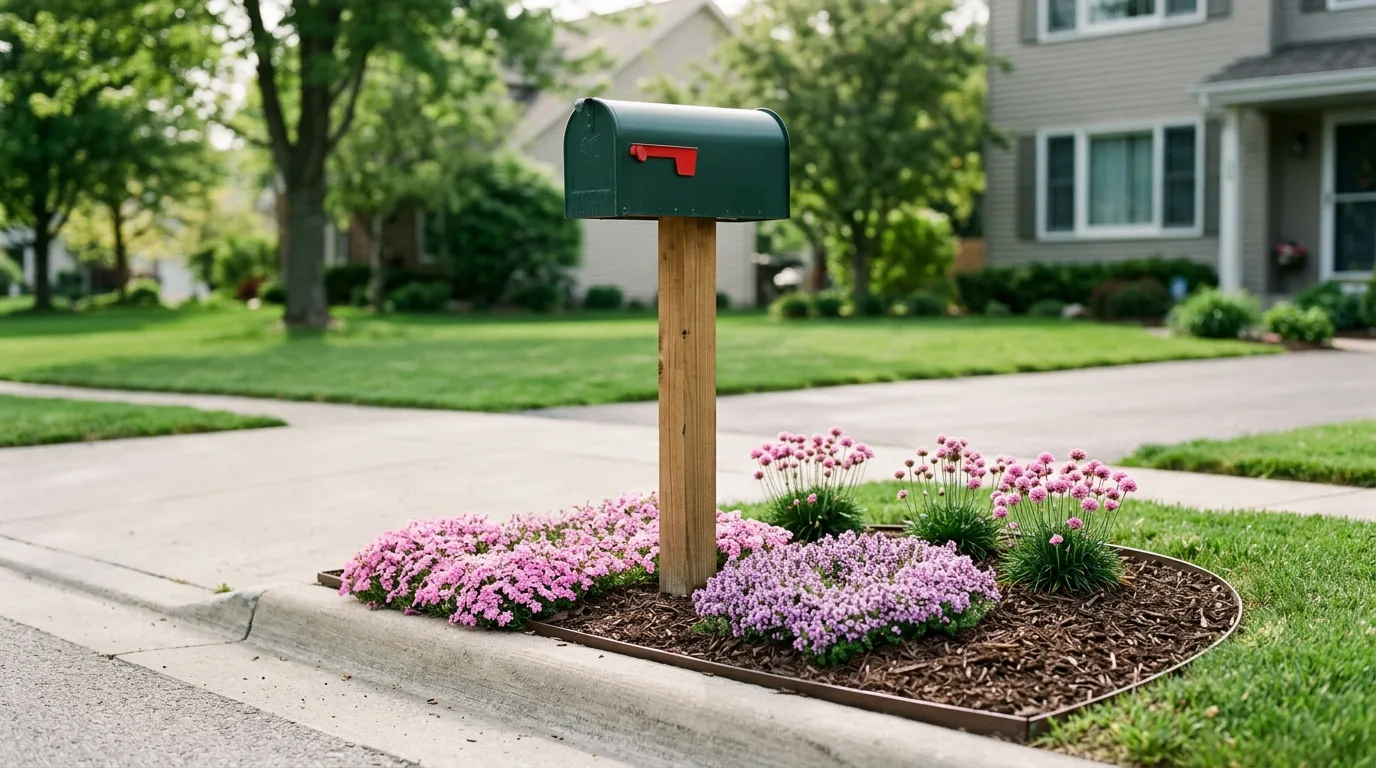
Underground cable runs from the box to the street and to the houses it serves, and other buried lines may run nearby. Call 811 a few business days before any digging and wait for the marks. EPCOR adds a rule of its own: don’t dig within 2 m of a transformer at all. Plant by hand outside the marks and keep mulch off the concrete pad. Our mulch guide covers how deep to lay it. The same call-first habit applies to every streetside project, from a mailbox bed to a new fence.
A weekend plan
- Find who owns the box (a label on the cabinet, or call your electric utility) and ask for its clearance on the door side and the other sides.
- Call 811 and wait for the marks.
- Stake and string the clearance zone, using the larger figure if you are unsure.
- Mark each plant at clearance plus half its mature width, using the size on the cultivar tag.
- Plant the sides and back. Leave the door side as lawn, or ask before laying gravel there.
- Every spring, walk round the box and cut back anything reaching into the strip.
See it before you plant it
A utility box usually sits at the front of the lot, so the screen around it changes how the whole frontage reads from the street. Upload a photo of your front yard, box included, to Hadaa. In the brief, say that the door side and the strip around the cabinet stay clear. You’ll see a planting rendered into your own yard, with every plant checked against your hardiness zone, before you buy a shrub. Hadaa can’t know your utility’s rules, so make the phone call first and use the render to judge how much screening the sides and back really need. For the rest of the frontage, our front-yard curb appeal ideas pick up from there.
FAQ
Can you landscape around utility boxes? Yes, outside the clearance zone. The utilities we checked want about 10 ft (3 m) open in front of the doors and 1 ft to 2 m clear on the other sides, measured to the plant’s mature size. Ask your own utility for its figures.
How far should plants be from a transformer box? At least 10 ft from the door side at every utility we checked. On the other sides it ranges from 1 ft on one side (OPPD) through 3 ft (Orange & Rockland, PSO, BC Hydro) and 4 ft (Vermont Electric Cooperative) to 2 m (EPCOR). Set each plant’s centre at the clearance plus half its mature width.
What are the green utility boxes in my yard? Usually pad-mounted transformers, which step down the voltage from the underground line for the houses around them. Smaller boxes and posts are pedestals, either electric connections or phone, cable or fiber equipment. A label on the cabinet normally names the owner.
Can I put a fence or cover around my utility box? Not a cover or enclosure: it hides the unit from crews and blocks the airflow that cools it (PSO). A fence is allowed by some utilities if it keeps every clearance and has a gate on the door side that swings away from the box (OPPD), and banned within 3 m by others (EPCOR).
Can I put rocks around a utility box? Not within 10 ft of the door at PSO, and no boulders within 3 m at EPCOR. Where gravel is allowed near the unit, EPCOR wants small fractured rock of ¾ in or less, not smooth river rock.
Will the utility remove my plants? It can. Vermont Electric Cooperative says crews may remove landscaping in an emergency and will not do routine work until it is cleared. OPPD and PSO say the same. Plants kept outside the clearance are left alone.