The best garden pond idea for your yard is decided by one question before any other: how much space and how much maintenance do you actually want to commit to? A whiskey-barrel container pond, a pondless waterfall, and a stocked koi pond all count as “a garden pond,” but they sit at three completely different points on the cost, upkeep, and skill scale — and most lists of pond ideas blur that distinction instead of helping you pick.
Below are 12 real designs grouped by how much space and budget they need, sourced installation costs from HomeAdvisor and Angi’s 2026 pricing data, and the three things that actually determine whether a pond is a joy or a chore for the next ten years: the liner you choose, the pump you size, and how you keep it from becoming a mosquito nursery.
What a garden pond actually costs
Before picking a style, it helps to see the real spread. HomeAdvisor’s 2026 pricing data puts the national average cost to build a backyard pond at $3,382, with most homeowners landing between $1,225 and $5,669. Angi’s 2026 figures are nearly identical — a $3,384 average across the same range — and both break the cost down the same way:
| Component | Typical cost |
|---|---|
| Excavation | $500–$5,000 |
| Liner (flexible, per sq. ft.) | $0.35–$0.70 (HDPE/EPDM) |
| Liner (preformed fiberglass, per sq. ft.) | $10–$80 |
| Pump and filtration | $200–$2,000 |
| Edging and landscaping | $300–$5,000 |
| Waterfall or fountain add-on | $900–$5,000 |
| Labor | $50–$200 per hour |
| Permits (where required) | $150–$500 |
| Annual maintenance | $400–$5,000 |
A dedicated koi pond runs well above a decorative garden pond — Angi puts professional koi pond installation at $3,000–$12,000, averaging around $7,500, because koi need more depth, stronger filtration, and a bigger pump than goldfish or a plant-only pond. A standalone pond liner installation, separate from the full build, averages around $1,000, in a $640–$3,980 range.
12 pond and water feature ideas, by size and effort
Smallest footprint: no digging required
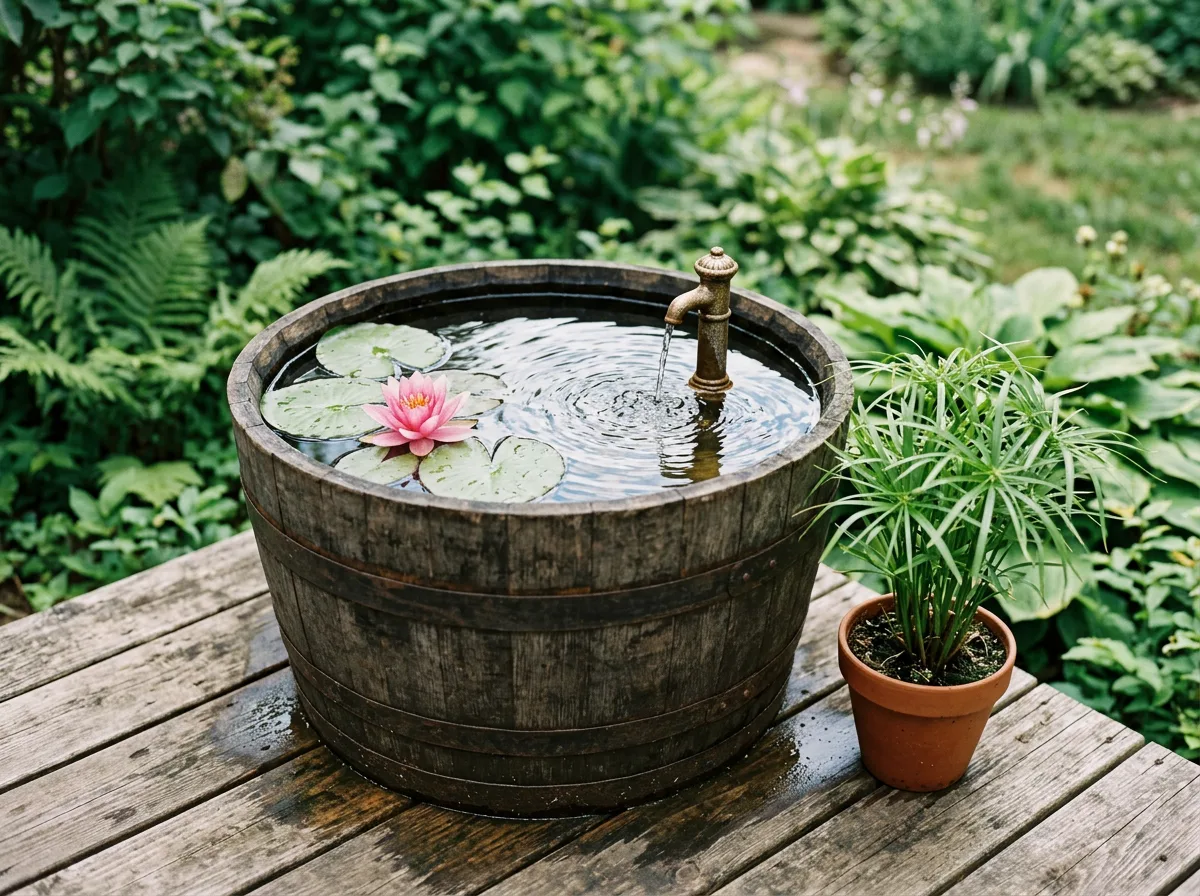
1. Container pond (whiskey barrel or stock tank). A half whiskey barrel or galvanized stock tank holds 50–150 gallons — enough for a water lily, a few marginal plants, and a small solar or battery pump. It sits on a patio or deck, needs no excavation, and can be assembled in an afternoon.
2. Bucket or sink pond. The smallest wildlife pond there is: an old sink, a galvanized bucket, or a large glazed pot, sunk or set on a stand, with a ramp of stones or a plank so insects and small animals can get in and out. Costs next to nothing beyond the container itself.
3. Two-pot bubbler fountain. Two ceramic pots, a submersible pump, and some gravel and tubing make a self-contained bubbling fountain with no open standing surface for mosquitoes to use. A genuinely one-afternoon DIY project.
Mid-size: some digging, real design choices
4. Pondless waterfall. Water recirculates through a buried reservoir and up over a rock face, with no open pool at the bottom — just a stream disappearing back underground. It gives the sound and movement of a waterfall with none of a pond’s drowning risk, algae load, or mosquito concern, which makes it the easiest water feature to retrofit into an existing bed. Expect to pay toward the $900–$4,500 waterfall-add-on range above, since there’s no separate liner-and-edging pond cost on top.
5. Raised pond. A masonry or timber-framed pond built 18–24 inches above grade, planted with water lilies, iris, and marginal plants. It’s visually prominent, easier to view and maintain without bending, and — because the wall itself acts as a barrier — generally the safer option where small children use the yard. Typically $2,000–$7,000 for a 6×4 ft raised pond with liner, planting, and pump.
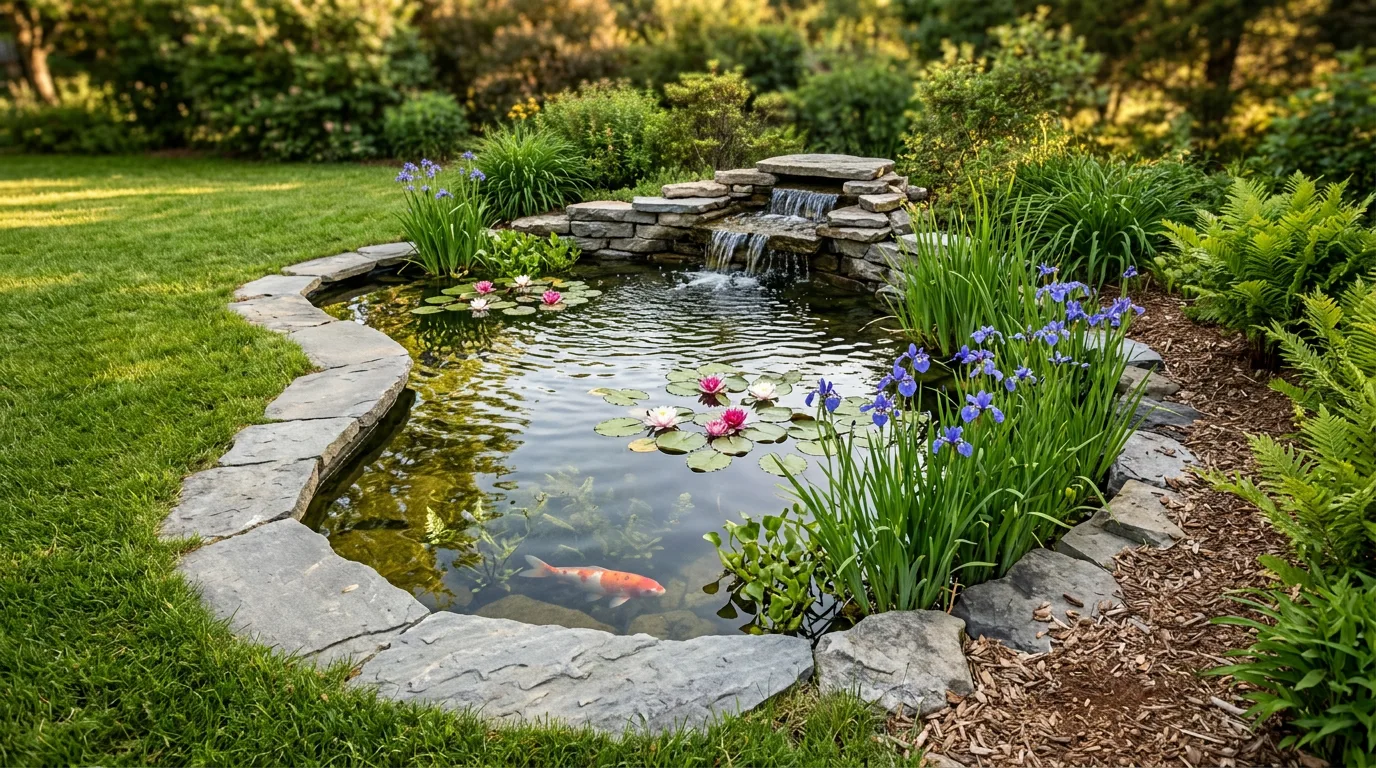
6. In-ground garden pond with marginal planting. The classic informal pond: a kidney- or oval-shaped excavation lined and edged with flat stone, planted at the margins with iris, pickerelweed, and sedges, with open water in the center for koi or goldfish. This is the shape most “garden pond ideas” image searches are showing you, and it’s the one where liner choice (below) matters most.
7. Stream or rill. A shallow, narrow channel of moving water connecting two points — a patio to a pond, or simply a straight run through a border — edged in stone. Because the water is constantly moving, it carries almost none of a still pond’s algae or mosquito risk, and it reads as more formal than an irregular pond when run in a straight line.
8. Wall-mounted or spill fountain. A wall fountain or a tall urn with water spilling into a hidden reservoir below grade. No open surface at all, minimal footprint, and — because there’s no exposed pool — it’s one of the few water features that genuinely works on a small patio or balcony without any safety concern.
Larger builds: real excavation, real stocking decisions
9. Koi pond. A dedicated fish pond needs real depth, not just real size. Winter dormancy is the limiting factor: koi need the water to stay unfrozen through winter, which in a USDA Zone 5 climate means a minimum depth of around 4 feet — roughly 2 feet below the local frost line — so the fish have a stable zone that never freezes. In a mild Zone 9–10 climate, 2–3 feet is often enough. Check your local frost-line depth before you dig, not after.
10. Natural swimming pond. Instead of chlorine, a separated planting zone of reeds, irises, and water lilies does the biological filtration. We cover the honest size requirement for this one in detail in our small yard pool ideas guide — the regeneration zone has to be at least 50% of the surface area to actually work, which rules it out below roughly 12m × 6m.
11. Multi-tier waterfall pond. Two or three linked pools stepping down a slope, each one a small catch basin before the water drops to the next. A good fit for a yard with real grade change, and the one design on this list where the terrain often does most of the design work for you.
12. Wildlife pond with a planted shelf. A sloped, shallow “beach” edge (planted, not stone) lets birds, frogs, and insects use the pond safely and lets any animal that falls in climb back out — the single most useful safety feature you can add to an open pond for free, since it costs nothing but grading.
Choosing a liner: the decision that outlasts everything else
The liner decides whether you redo this project in 10 years or in 30. Pond-liner lifespan data is consistent across sources: a flexible EPDM rubber liner has an average life expectancy of 30–40+ years, with a typical 45-mil product carrying a 20-year manufacturer warranty from brands like Firestone PondGard. A preformed liner — the rigid plastic or fiberglass shell sold pre-shaped — averages closer to 10 years; cheap polyethylene shells can crack within 5–10 years from UV exposure and ground movement, especially where winters freeze and thaw. Fiberglass preforms do better, often lasting 20–30 years, but still short of EPDM.
The trade-off is upfront cost versus install simplicity: a preform drops into a dug hole with no folding or seaming, which is why it’s the common choice for small, simple shapes. EPDM is the better long-term choice for anything irregular, large, or meant to be permanent — and if you’re not sure which category your project falls into, the per-square-foot cost difference in the table above ($0.35–$0.70 for flexible liner versus $10–$80 for preformed) is usually the deciding factor on its own.
Sizing the pump: the one number everyone gets wrong
Every pond needs enough flow to turn over its full volume on a schedule, and the baseline most sources agree on is turning over the entire pond at least once per hour for a planted garden pond, rising to 1.5–2x per hour for a koi pond and up to 2.5–3x per hour in summer heat when oxygen demand is highest.
The number printed on the pump box is not the number you’ll get: that rating is measured with zero feet of “head,” with nothing for the pump to push against. Once you account for the vertical lift to a waterfall and the friction of the tubing run, a pump can lose a third or more of its rated flow. The fix: size for 1.5x your calculated GPH requirement, so a 2,000-gallon pond needing 2,000 GPH of turnover should be shopping for a pump rated nearer 3,000 GPH on the box.
Keeping mosquitoes out without poisoning the pond
This is the question that stops more people from building a pond than cost does, and the CDC’s guidance on mosquito control at home is unambiguous about the underlying mechanism: mosquitoes lay eggs in still water, and the agency’s standard advice for ordinary containers is to empty or cover them weekly so eggs never get the days they need to hatch. A mosquito can complete its life cycle in water as shallow as a bottle cap.
A pond is different from a bucket because it can be kept moving rather than emptied. Mosquito larvae breathe through a surface-breaking siphon tube, and pest-control and pond-industry sources consistently report that surface agitation from a fountain, waterfall, or aerator disrupts that enough to prevent larvae from developing — which is the real reason every design above with moving water (the waterfall, the stream, the fountain) carries less mosquito risk than a dead-still container pond. For a still or lightly planted pond where you don’t want constant movement, the standard add-on is a mosquito dunk containing Bti (Bacillus thuringiensis israelensis), a naturally occurring bacterium that’s lethal to mosquito and black-fly larvae and considered safe around fish, pets, and people — the approach the EPA and most extension services recommend as part of an integrated program rather than a single fix. A handful of mosquitofish or even ordinary goldfish will also eat larvae on sight in a stocked pond.
Algae: the maintenance you can’t skip
Clear water needs at least two of three tools, because none of them works alone. Beneficial bacteria compete with algae for dissolved nutrients, starving it gradually. Barley straw releases humic compounds as it decomposes that suppress new growth — it doesn’t kill existing algae, and it needs to go in 4–6 weeks before algae season starts, roughly one bale per 1,000 square feet. UV clarifiers kill free-floating planktonic algae as water passes through a UV chamber, clearing green water within days — but they do nothing for string algae on rocks or liner, which has to be removed by hand or starved out with shade.
Safety and permits: check before you dig
Depth is what triggers legal requirements, not size. Guidance on residential ponds is consistent that ponds deeper than about 18–24 inches start crossing into the same territory as a swimming pool under local and state codes — in parts of Southern California, for example, a pond over 18 inches requires a permit and a 5-foot self-closing, self-latching fence, separate from any pool fence. The reasoning is the same reasoning behind pool-fencing laws generally: data on child drownings shows children ages 5–17 are more likely to drown in an unfenced natural body of water than in a fenced pool, and a backyard pond carries the same open-water appeal without the same obvious signage telling a child it’s off-limits. If young children use the yard, a planted, gently sloped “beach” edge (idea #12 above) and a bordering fence are both standard advice, not overkill — and a pondless waterfall or wall fountain avoids the question entirely by never holding open standing water.
Where a pond fits in the rest of the yard
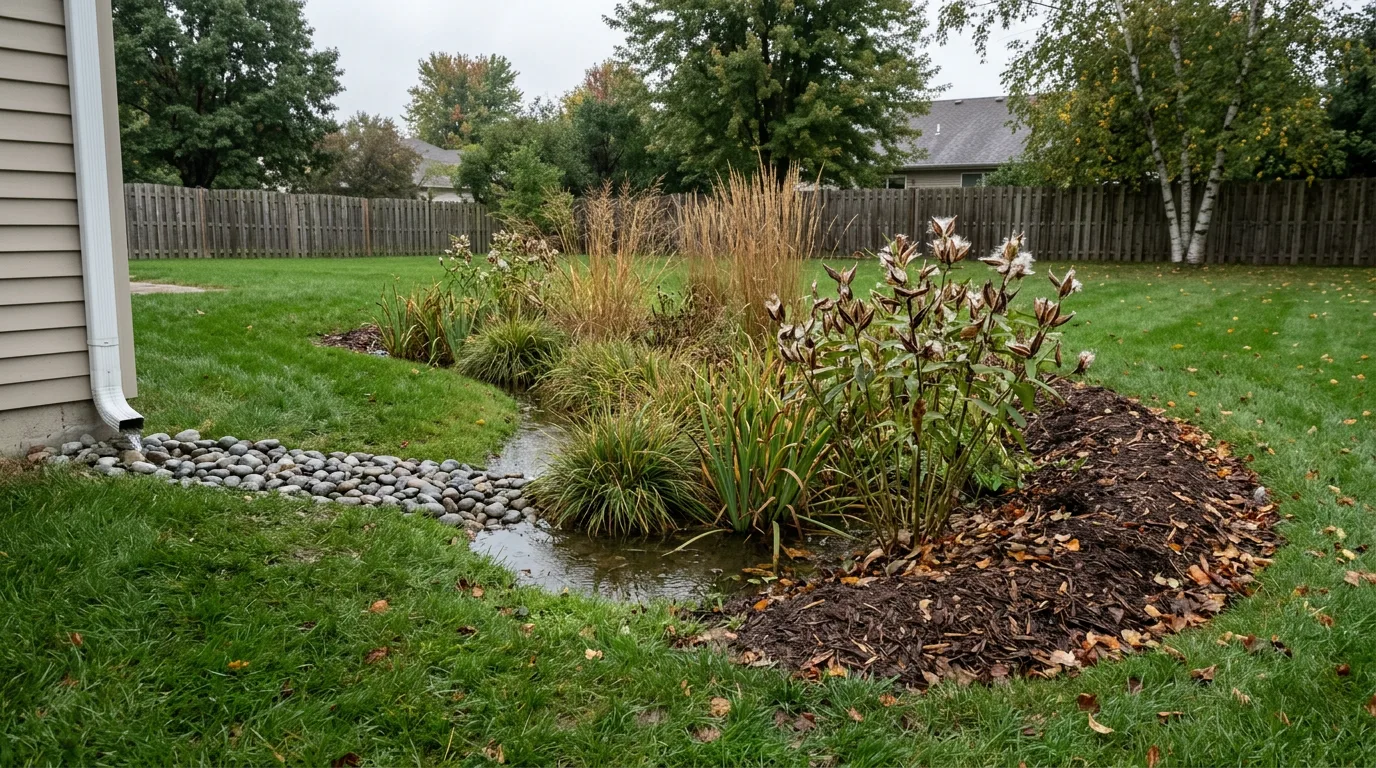
A pond rarely works in isolation — it sits in a planting scheme, and the two mistakes that undo an otherwise good design are siting and style. If your yard already has a poorly draining low spot, resist the temptation to put the pond there: standing surface water after rain is a sign of slow infiltration, not an invitation to dig, and it’s worth reading how to fix garden drainage first so you’re not fighting the grade while building the liner trench. And if you’re drawing up a full backyard makeover, decide the water feature’s style before the planting around it — a still reflecting basin reads completely differently in a Japanese garden, where tradition favors a quiet stone basin over a splashing fountain, than the same water does bordered by cottage-style planting.
FAQ
How much does a small garden pond cost? A small decorative garden pond — container pond, bucket pond, or a simple in-ground pond under roughly 50 square feet — typically falls in the $500–$3,000 range once you include a basic pump and liner, well below the $3,382 national average for a full-size build.
Do garden ponds attract mosquitoes? Still, unaerated water can, which is why every design on this list either keeps the water moving (waterfall, stream, fountain) or recommends a Bti mosquito dunk and/or fish for anything left still.
How deep does a koi pond need to be? At least 3 feet in mild climates, and roughly 4 feet — about 2 feet below the local frost line — in a USDA Zone 5 climate, so the water below that depth never freezes through winter.
What’s the easiest water feature to maintain? A pondless waterfall or a wall-mounted spill fountain: no open pool, no fish to overwinter, no planting zone to manage, and the recirculating water stays cleaner on its own because it never sits still.
EPDM or preformed liner for a first pond? Preformed is simpler to install and fine for a small, simple shape you’re testing out. EPDM costs less per square foot at scale, lasts three to four times longer, and is the better choice for anything irregular or meant to be permanent.
Once you’ve picked a shape and a size, the fastest way to know whether it actually works in your yard — proportion, sightlines from the house, how it reads against your existing planting — is to see it there before you dig. Hadaa turns a photo of your own yard into a photorealistic design in under 60 seconds, so you can check a koi pond against a container pond against a pondless waterfall on your actual garden instead of guessing from a gallery photo.