Most “dog-friendly backyard” lists are a bullet list of ground-cover options with no trade-offs attached — gravel, mulch, artificial turf, done. None of them tell you that one common mulch is genuinely toxic to dogs, that the grass most guides recommend is not the most urine-resistant one, or that a fence buried 6 inches deep is not a dog-proof fence, it is a 6-inch head start. Four decisions actually make a yard work for a dog: how much room it has to move, what the ground is actually made of, what the mulch is actually made of, and whether the fence line can be dug under. Here’s each one with real numbers.
Give the Dog Room to Actually Move
A dog-friendly yard is a space problem before it is a planting problem. Purdue’s Canine Welfare Science Center has measured exactly how much space changes a dog’s behavior, and the effect is large: in a kennel study, a dog housed in a 10.8 sq ft space traveled about 500 meters a day, while a dog given 75.3 sq ft in the same 12-hour window covered about 4,000 meters — roughly eight times the distance, even though both dogs were engaged in some form of activity for a similar share of the day (Purdue Extension VA-2-W, Hurt, Daigle & Croney). That’s a kennel figure, not a backyard one, but the underlying point transfers directly: a dog given room to move, moves. Purdue’s own conclusion is that dogs need “access to exercise spaces that are large enough to allow them to extend to full stride while running and playing” — not just a patch of lawn to stand on.
In practice that means keeping one open run of at least 20–25 ft uninterrupted by beds, furniture, or hardscape, rather than scattering the same square footage across several smaller zones. If the yard is too small for a straight run, an L-shaped or perimeter path around the planting beds gives a dog a loop to work instead — see our guide to small backyard ideas for how to lay that out without losing the rest of the yard to it.
The Ground-Cover Trade-Off Table
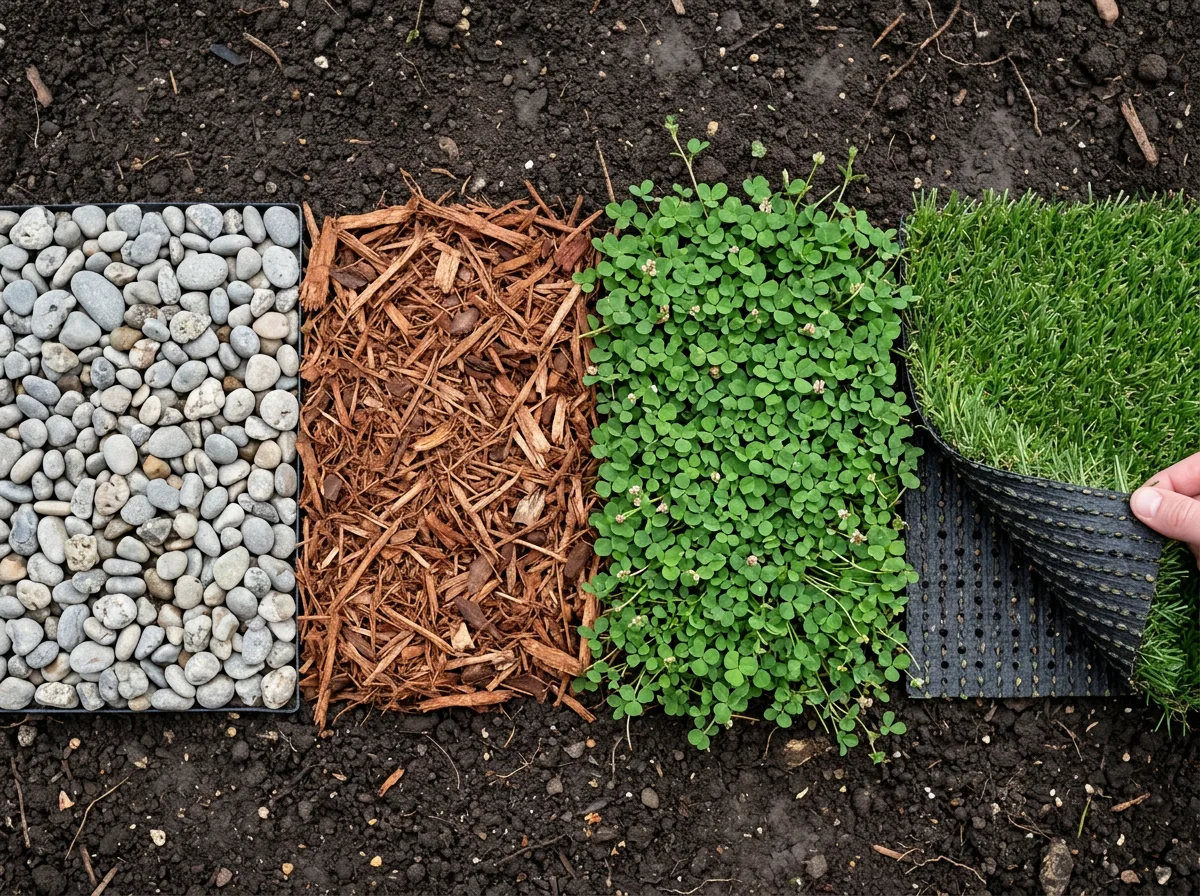
Every ranking page for this query lists ground-cover options as a plain bullet list — turf, mulch, gravel, done — with no sense of what each one actually trades off. The three things that matter for a dog are paw safety, resistance to urine and heat, and resistance to digging, and they rarely line up:
| Surface | Paw safety | Urine/heat resistance | Dig resistance | Notes |
|---|---|---|---|---|
| Bermudagrass or zoysiagrass | Good | Best of any turf — most tolerant of both traffic and urine damage | Low (dogs dig through any live turf) | Warm-season only; goes dormant/brown in cold climates |
| Tall fescue | Good | Best of the cool-season grasses | Low | Deeper roots than bluegrass, recovers faster from damage |
| Kentucky bluegrass | Good | Weakest of the common lawn grasses against urine | Low | Attractive, but burns fastest in a dog’s regular spot |
| Clover (white/micro) | Good | Recovers from urine patches better than turfgrass; fixes its own nitrogen | Low | Can get slick when wet; some dogs will dig at the roots |
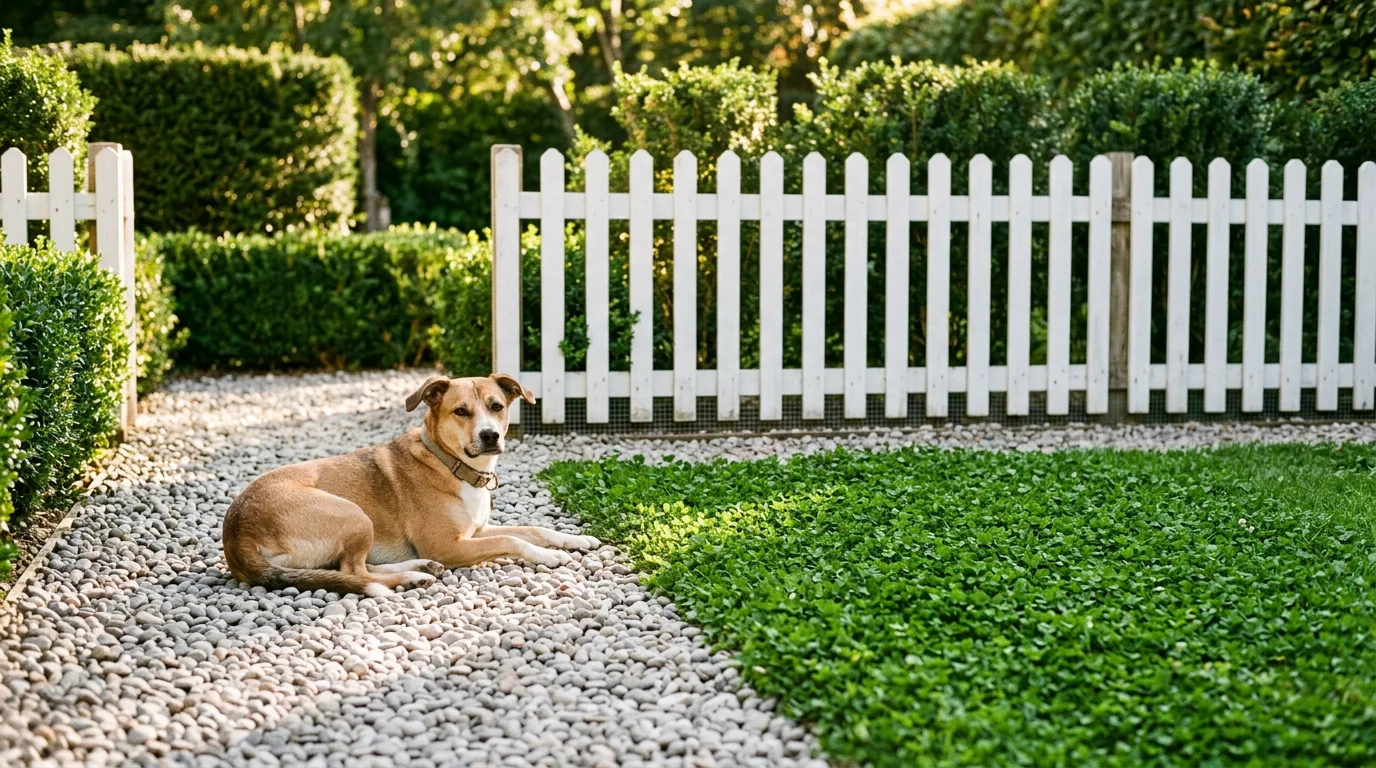
| Pea gravel (3/8 in, rounded) | Good if rounded, not crushed | Excellent — nothing to burn | Good — dogs generally won’t dig through consolidated gravel | Needs a weed barrier and edging to stay in place |
| Decomposed granite | Good | Excellent | Good | Compacts hard; least comfortable to lie on in full sun |
| Artificial turf | Good, but can run hot in direct sun | Excellent, with a permeable backing and regular rinsing | Good once installed over a compacted base | Needs a drainage/odor layer built in, not laid on bare soil |
| Cedar or pine bark mulch | Fine in small amounts | Good | Dogs will dig in loose mulch | Never cocoa mulch — see below |
The urine-resistance ranking surprises most people: the common advice is “nitrogen burns grass,” which is true but incomplete. NC State Extension’s research on dogs and turfgrass identifies lactic acid, not nitrogen or pH, as “the main culprit for turfgrass death,” because it disrupts the grass’s cell membranes directly. Nitrogen and salts cause a secondary, milder injury. That’s why bermudagrass and zoysiagrass — both more lactic-acid tolerant — hold up better than any cool-season lawn, and why among cool-season grasses tall fescue outperforms Kentucky bluegrass specifically, not just “any fescue blend.” If you’re in a warm-season climate and replacing a lawn specifically because of dog damage, that is the one substitution that matters most. For a fuller rundown of non-grass options, see our guide to ground cover plants instead of grass.
The Mulch Most Guides Don’t Warn You About
This is the fact almost every “dog-friendly backyard” page either gets wrong or leaves out entirely: cocoa bean mulch — sold for its appearance and chocolate-like smell — contains theobromine and caffeine, the same compounds that make chocolate toxic to dogs, and the smell that makes it attractive to buyers is the same smell that draws dogs to eat it. The ASPCA Animal Poison Control Center’s case series on cocoa mulch ingestion found vomiting in half of confirmed cases, tremors in a third, and fast heart rate, hyperactivity, or diarrhea in the rest. Don’t use it anywhere a dog has access, full stop — not “in moderation,” not “away from the main run.” Cedar and pine bark mulches don’t carry this risk and are the standard dog-safe substitute; our guide to using mulch covers application depth and placement for both ornamental beds and dog-adjacent areas.
Rubber mulch is sometimes marketed as a dog-friendly, long-lasting alternative. It won’t poison a dog the way cocoa mulch can, but it doesn’t break down, it heats up more than wood mulch in direct sun, and a dog that chews and swallows pieces of it can need surgery to remove them — treat it as a surface for play areas a dog is supervised on, not a bed liner a dog has unsupervised access to.
Dig-Proofing the Fence Line, by Dog Size
A fence that stops a human doesn’t stop a dog that digs, and the fix most buried-wire guides describe scales with how determined (and how big) the dog is:
- Small to medium dogs, light diggers: bury galvanized hardware cloth or welded wire mesh (1-inch spacing, not chicken wire — it tears) at least 12 inches deep along the fence line.
- Larger or persistent diggers: add an L-footer — the same buried mesh, bent 90 degrees to run another 12 inches outward from the base of the fence, underground. A dog that hits mesh going straight down gives up faster than one that only has to tunnel a few inches before the barrier ends; the horizontal leg of the L makes that tunnel much longer.
- Along a known digging spot (a corner, a gate, a gap under a gate): a paver or concrete footer set flush with the ground is more work to install but removes the digging option entirely, rather than just discouraging it.
6 inches of buried mesh is not a shortcut version of 12 — it is a 6-inch gap a motivated dog will find within a week. If the yard backs onto a fence line you’re planning as a privacy screen anyway, our guide to privacy fences and screens covers footing and post-spacing that double as the dig-proofing above.
Zoning the Rest of the Yard Around the Dog
Once the run, the ground surface, and the fence line are settled, the rest of the layout is the same zoning problem as designing for kids — a dedicated dog area, a human seating area, and planting beds that are physically separated rather than hoped to be respected. Raised beds, low (12–18 in) edging, or a defined gravel path do more to keep a dog out of a planting bed than any “keep off” instinct ever will; a bed a dog can step into at ground level, it will eventually step into. Our family backyard ideas guide walks through the same zone-by-use approach for a yard that has to work for kids and pets at once, which is most yards.
Seeing It Before You Build It
The mistake dog owners make most often is picking the ground cover and the fence line from a photo of someone else’s yard, then finding out it doesn’t fit theirs — a 20 ft run that’s actually 14 ft once the existing beds are accounted for, or a gravel run that looks different once it’s next to the house’s actual siding color. Upload photos of your yard to Hadaa and Garden Autopilot renders a chosen ground cover, fence line, and planting layout in your own space, so you can see the run length and the sightlines before anything is dug or poured.
FAQ
What’s the best low-maintenance ground cover for a dog-friendly backyard? For a warm-season climate, bermudagrass or zoysiagrass resist both traffic and urine damage better than any cool-season lawn. For cooler climates, tall fescue outperforms Kentucky bluegrass specifically. If you want to skip grass entirely, pea gravel or decomposed granite need the least ongoing repair.
Is mulch safe for dogs? Cedar and pine bark mulch are the standard safe choice. Cocoa bean mulch is not — it contains theobromine and caffeine, the same toxins in chocolate, and its smell actively attracts dogs to eat it.
How deep does a fence need to be buried to stop a dog from digging under it? At least 12 inches straight down for most dogs; for a determined digger, add a 12-inch horizontal L-footer at the base so the dog would have to tunnel sideways, not just down, to get under.