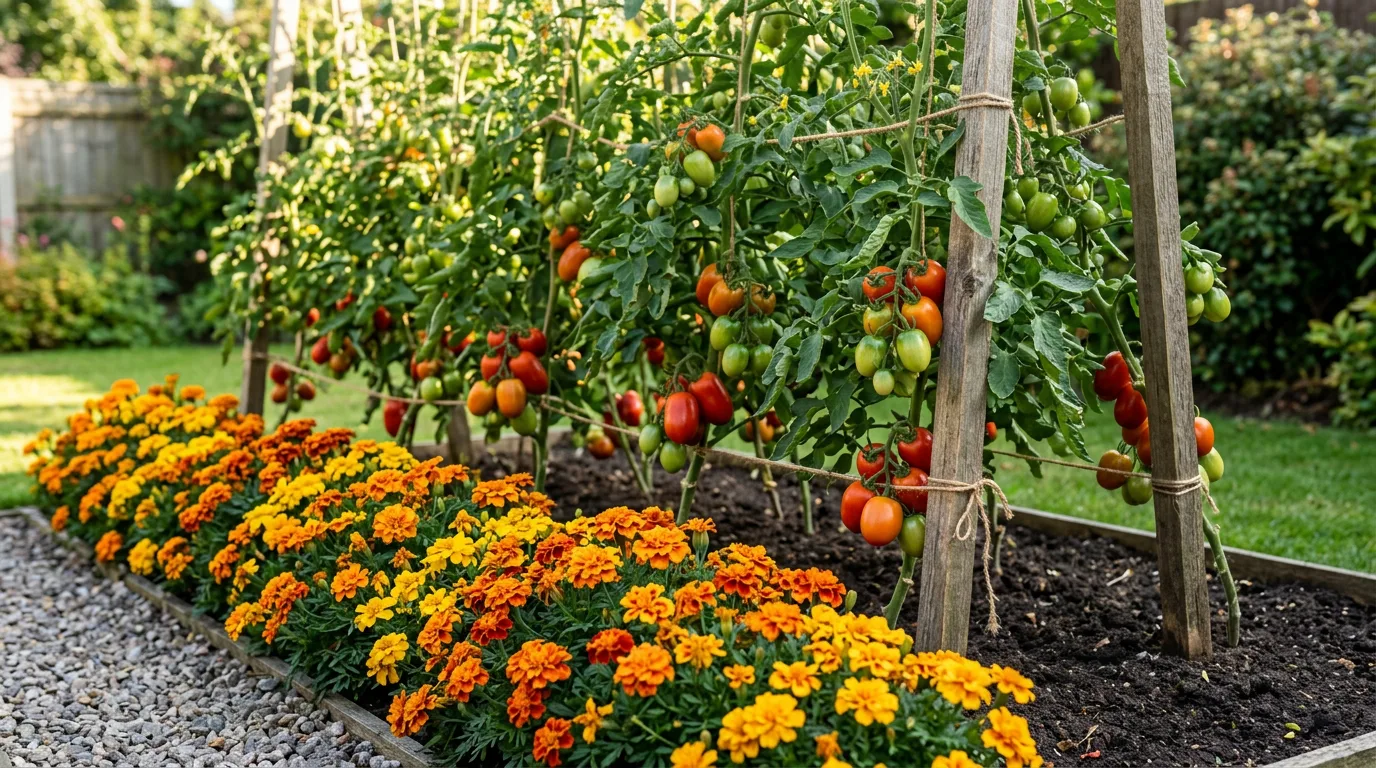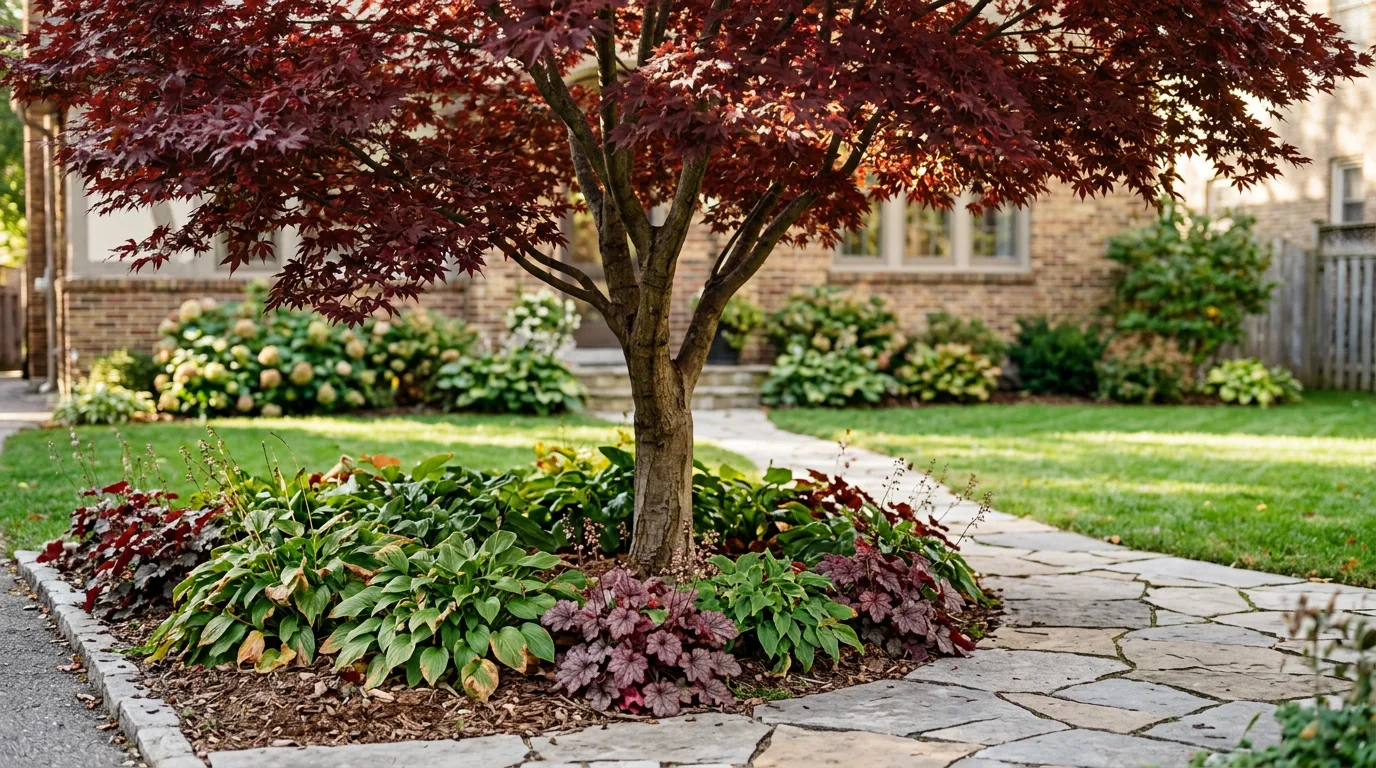
In most of the United States and Canada no statute sets a minimum distance between a tree and your boundary, so the legal answer is usually “as close as you like, until it becomes your neighbor’s problem.” The useful answer is a number you calculate: plant the trunk at least half the tree’s mature spread from the line, so the crown stays on your side when the tree is full grown. A tree that will spread 30 ft wide goes 15 ft in; one that will spread 8 ft goes 4 ft in.
Some countries do write a minimum into law. France, for example, requires 2 meters (about 6.6 ft) for any tree that will pass 2 meters in height, which is far closer than a shade tree can live with. That gap between what a law allows and what a tree needs is the whole subject of this guide.
The Rule: Half the Mature Spread
Laidback Gardener, a long-running gardening column, puts the rule plainly: if a tree’s crown will reach 20 ft across at maturity, plant it at least 10 ft, half its width, from your neighbor’s property so it stays entirely on your side. The reasoning is geometry. A tree’s crown is roughly centered on its trunk, so the trunk must sit at least one crown radius inside the line for no branch to cross it.
Not every popular guide says the same thing. House Digest gives a 30 ft canopy as an example and a setback of “at least 7 or 8 feet”. If that 30 ft is the crown’s width, a 7-8 ft setback puts the outer 7 ft or so of the crown over the line. House Digest’s own ranges (10 to 15 ft for medium trees, 15 to 20 ft or more for large shade trees) are closer to the half-spread rule and are a reasonable sanity check on whatever number you calculate.
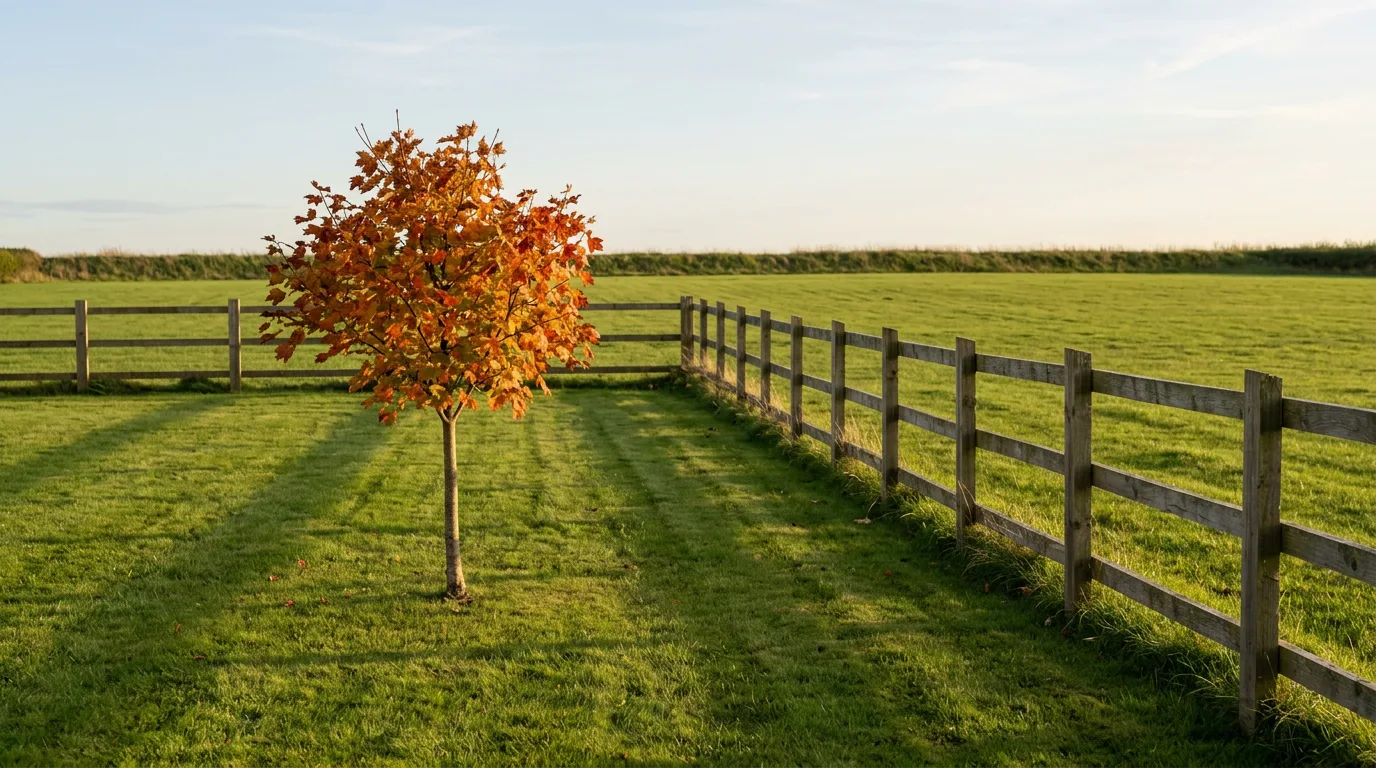
What Half the Mature Spread Means for Real Trees
The table uses the Missouri Botanical Garden’s mature spread for each species and halves the upper end of the range, because the top of the range is what a happy tree in good soil reaches. Cultivars can be much narrower, so on the tag or the nursery listing the spread figure is the one to use.
| Tree | Mature height | Mature spread | Setback from the line (half the upper spread) |
|---|---|---|---|
| Red maple (Acer rubrum) | 40-70 ft | 30-50 ft | 25 ft |
| White oak (Quercus alba) | 50-80 ft | 50-80 ft | 40 ft |
| River birch (Betula nigra) | 40-70 ft | 40-60 ft | 30 ft |
| American sycamore (Platanus occidentalis) | 75-100 ft | 75-100 ft | 50 ft |
| Eastern redbud (Cercis canadensis) | 20-30 ft | 25-35 ft | 17-18 ft |
| Flowering dogwood (Cornus florida) | 15-30 ft | 15-30 ft | 15 ft |
| Crape myrtle (Lagerstroemia indica) | 6-25 ft | 6-20 ft | 10 ft (3-10 ft by cultivar) |
Two things stand out once the numbers are in a row.
A big tree may not fit anywhere in a normal yard. A tree centered between two side boundaries needs a setback from each, so the yard has to be at least as wide as the tree’s spread. A white oak spreading up to 80 ft is a tree for an acre, not for a 60 ft-wide lot, whatever the setback arithmetic says about one side alone. If the numbers do not fit, the answer is a smaller species, not a smaller setback. Our guide to trees for residential yards sorts species by size.
The legal minimum and the right distance are far apart. France’s rule (2 m for a tall tree) would let you plant a red maple 6.6 ft from the line. The tree will want 25. The French government’s own guidance adds that plantations that meet the distance rule can still cause an “abnormal neighborhood disorder”, shade on the neighbor’s land being its example, and recommends a compromise by pruning. Meeting a minimum is not the same as being finished.
Roots Ignore the Line Either Way
Setting a tree back protects the canopy from crossing the line. It does very little for roots. Iowa State Extension describes a tree’s large woody roots as running horizontally 8 to 12 inches below the surface and extending 4 to 7 times the drip line. Illinois Extension says roots have been observed to spread up to four times as wide as the canopy, and that the large roots are typically in the upper 18 inches of soil. The two sources measure from different starting points (drip line versus canopy width), so treat “several times the crown” as the safe reading rather than quoting one multiplier.
What that means in practice: a mature tree 15 ft inside the line will still have roots under the neighbor’s lawn. What you can control is what the roots meet on your side first:
- Keep trees well away from a driveway, patio, sewer line, septic field and the house foundation. Roots lie close to the surface, so hard surfaces are the first thing they lift.
- Call 811 before digging the planting hole. 811 is the US “call before you dig” number, and it marks buried utility lines for free. The same call covers a mailbox post at the curb; our guide to mailbox landscaping ideas covers the other rules there.
- Avoid planting under overhead power lines; Québec’s government advises placing trees away from where branches or roots could damage electrical or telephone lines or underground cables and pipes.
What the Law Usually Says About Branches, Roots and Ownership
Rules vary by state, province and city, and nothing here is legal advice. These are the patterns that come up most often. A California attorney’s explainer, Stimmel, Stimmel & Roeser, states them clearly, and they are a good example of the common-law approach:
- A neighbor can generally trim overhanging branches and roots back to the line without asking you, but cannot enter your land, cut past the line or kill the tree.
- Most states require notice to the tree’s owner before significant cutting, according to the same source.
- A tree whose trunk straddles the line is jointly owned and should not be removed without both owners’ consent or a court order (California Civil Code 834).
- A tree whose trunk stands wholly on one owner’s land belongs to that owner, even if its roots grow into the neighbor’s land (Civil Code 833).
- Damage can make a tree a nuisance. The encroachment of vegetation that causes damage can be held to be a nuisance, and damages can lie against the owner of the tree’s land. Falling leaves, and shade or a blocked view, are not themselves treated as a nuisance in California.
Québec’s rule of thumb is the same shape: you are generally liable for your trees and any damage their branches and roots cause, unless the damage came from an unforeseeable event such as a violent windstorm, and the province advises planting at a distance so a grown tree is no nuisance.
France is the opposite extreme. A neighbor there can demand that a tree planted too close be uprooted or cut to the legal height, unless you have a written agreement, the tree predates the division of the land, or it has exceeded the allowed height for 30 years. The distance is measured to the middle of the trunk, and a plant against a wall may be planted right up to it, provided it stays under the top of that wall.
The practical conclusion: in the US you are not likely to be stopped from planting close to the line, but you are the one who carries the cost when the tree’s branches break a fence, its roots lift a neighbor’s patio or its shade kills their garden. The cheapest moment to avoid that is the day you choose the spot.
Hedges, Screens and Shrubs: Same Rule, Smaller Numbers
The half-spread rule works for shrubs and hedge plants too, applied to a single plant. A shrub that matures 6 ft wide goes 3 ft in. House Digest’s guide suggests 2 to 5 ft for shrubs and hedge trees and 3 to 6 ft for small ornamental trees; France’s default is 0.5 m (about 20 in) for plants that stay under 2 m.
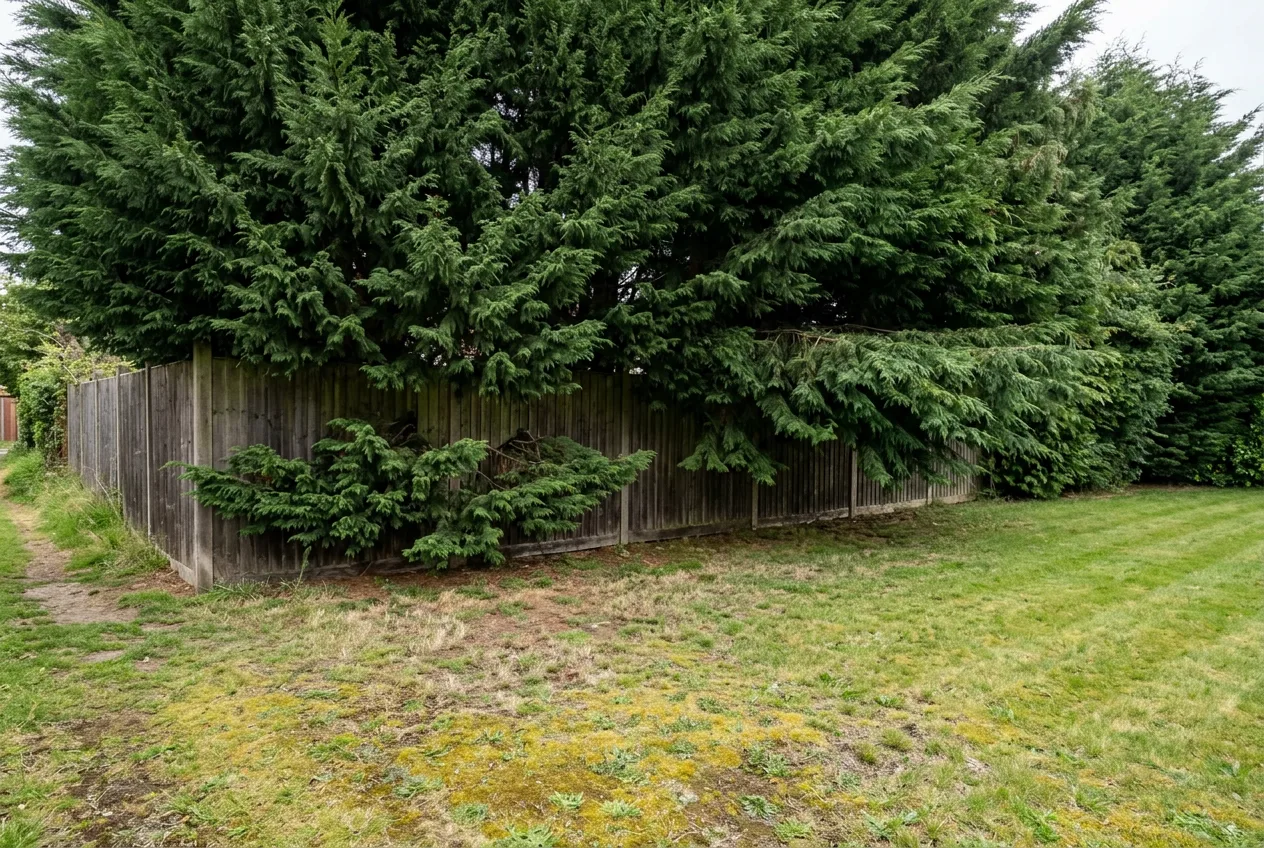
The problem with screening plants is that the reason people plant them on the line, to block the neighbor’s view, is the reason they overshoot it. A privacy planting set right against a fence leans through the fence as it fills out, which is how the planting in the photo below ended up over the neighbor’s lawn. Set a screen back far enough that you can still get to its far side to prune it. Our guides to privacy plants and hedges and privacy plants for small yards list narrower choices that need less room.
A Four-Step Way to Pick the Spot
- Find the mature spread. Use the nursery tag or a botanical garden’s plant database for the exact species or cultivar. Take the upper end of the range.
- Halve it. That is the minimum distance from the trunk’s center to your boundary. If the answer is bigger than the space you have, choose a smaller tree.
- Add a working margin. A few extra feet lets you prune, mow and rake on all sides of the tree without standing on the neighbor’s lawn. This one is a judgment call, not a rule.
- Check the constraints that override the formula. Look up your city or county rules and any HOA covenants, then call 811 and check overhead lines. Local codes can set their own distances, and a code beats a rule of thumb.
Finding the line itself is the step people skip. A fence or hedge is often not exactly on the boundary, so use your survey or plat, or hire a surveyor, before you measure a setback from it.
See the Full-Grown Tree Before You Plant It
A setback is easier to judge in your own yard than in a table. If you upload photos of your garden to Hadaa, you can try different trees in the spots you are considering and see how large the finished planting sits against the fence and the house. The planting recommendations are checked against your USDA zone, so a tree that will not survive your winters is flagged before you buy it. For the species you might plant, start with our guide to Japanese maples, which is built around mature width, and read the fall planting guide for timing.
FAQ
How far from a fence should you plant a tree? Half of its mature spread is the working rule, measured from the center of the trunk. A tree that will be 20 ft wide goes at least 10 ft from the fence. A fence is not always on the legal boundary, so measure from the boundary itself if you can.
Do you need your neighbor’s permission to plant a tree on the property line? Not for a tree wholly on your own land, but a trunk standing on the line is generally treated as jointly owned (in California, Civil Code 834), and removing it takes both owners’ consent. Plant inside the line to avoid the question.
Can a neighbor cut the branches or roots of my tree? In most places a neighbor can trim whatever crosses the line, but only up to the line, without entering your land and without killing the tree, and most states expect notice to you first. Local law varies, so check yours.
Who is responsible if my tree damages the neighbor’s property? Generally the tree’s owner. Québec’s government says the owner is liable for damage from branches and roots unless it was caused by an unforeseeable event, and a California explainer says damage from encroaching vegetation can be treated as a nuisance. A local attorney or your homeowner’s insurer can say how your state treats it.
Is there a legal minimum distance in the US? Usually not at the state level. Cities, counties and HOAs sometimes set their own, so check your local code before you buy the tree. Some other countries, such as France, set a national minimum of 2 meters for trees over 2 meters tall.