Shade garden design fails more often on a definition than on a plant list, because “part shade” means three different things depending on who wrote it down. Illinois Extension puts part shade at 2–4 hours of direct sun a day. K-State’s Johnson County Extension puts it at two hours, or shaded for at least half the day. And the plant tag you actually pick up at the garden centre — Proven Winners’ own definition — says 4 to 6 hours of direct sun, mostly before midday.
That is a factor-of-three spread on one phrase, and the tag is the sunniest of the three. A plant labelled “part shade” at retail wants roughly what Illinois Extension would call part sun. Buy by the tag, plant it in what an extension service means by part shade, and the plant is in half the light it was bred for.
So the first move in designing a shade garden is not choosing hostas. It is counting your own hours, writing the number down, and then reading every tag and every plant list against your number rather than theirs.
The four definitions, side by side
Three of these systems count hours. The fourth does not count anything — it describes what is casting the shadow, which turns out to matter as much as the hours do.
| Source | Full sun | Part sun | Part shade | Full / deep shade |
|---|---|---|---|---|
| Illinois Extension | 6–8 hrs | 4–6 hrs | 2–4 hrs | under 2 hrs |
| K-State, Johnson County | 6+ hrs | “light shade” 3–5 hrs | 2 hrs, or shaded half the day | under 1 hr, or dappled all day |
| Proven Winners (plant tags) | over 6 hrs | 4–6 hrs incl. afternoon | 4–6 hrs, mostly before midday | under 4 hrs |
| Colorado State PlantTalk | — | — | shade cast by evergreens or dense maples and lindens; under decks and stairwells | north or north-east of a building, wall or fence, in shade all day |
Two things fall out of that table that no plant list will tell you.
The tag and the textbook disagree by one whole step. Proven Winners’ “full shade” — under 4 hours — is Illinois Extension’s part shade. If a tag says full shade and you have 45 minutes of direct sun, you are two steps below what the grower tested.
K-State treats dappled light as full shade outright. Its full-shade category explicitly includes “dappled light through a tree canopy for most of the day”, which is a genuinely useful simplification: light filtered through leaves all day behaves like deep shade for most perennials, even though a light meter would disagree.
Where all three hour-based systems do agree is on timing: morning sun is the kind shade plants can take. K-State states the reason plainly — “morning sun, which is cooler and less intense, is easier on shade loving plants then the hot afternoon sun.” Two hours at 8 a.m. and two hours at 3 p.m. are not the same two hours.
Count your own hours first
The method is unglamorous and takes one clear day.
- Sketch the area roughly to scale — a bed outline on a sheet of paper is enough.
- Starting at sunrise, mark where direct sun falls and where shade falls. Use a different colour each hour, or photograph the same spot from the same position on the hour.
- If hourly is unrealistic, every two hours is enough to get the shape of the day.
- At the end, total the hours of direct sun each part of the bed received. Not brightness — direct sun.
Two cautions that change the answer:
- Do it in the growing season, not in winter. Illinois Extension’s full-sun definition is explicitly “direct summer sun”. A bed that gets five hours in March can get ninety minutes in July once the canopy above it leafs out, and the plants live in July.
- Measure in sections, not as one bed. A 4-metre border against a fence commonly spans two categories end to end. Designing it as a single light condition is what produces the bed that thrives at one end and sulks at the other.
Once you have a number, the rest of this is arithmetic. If you want to see the massing before you commit to it, Hadaa can render a planting plan from a photo of the bed so you can judge the layering against the actual light you measured — but the measurement has to come first, because no render knows how long your sun sits on that fence.
Dry shade or moist shade — the variable that decides survival
Hours tell you how much light. They tell you nothing about water, and under a mature tree water is usually the binding constraint rather than light.
Colorado State’s PlantTalk makes the distinction the standard way: “Most shade in Colorado gardens is dry shade, meaning that without watering, the soil is generally dry. However, if a shaded area receives runoff from rain or sprinklers, it may qualify as moist shade.”
The practical version, by cause:
| Shade with dry soil | Shade with moist soil |
|---|---|
| Under mature maples, willows, poplars — dense shallow roots | North side of a building, away from the eaves |
| Within about a metre of a wall under a roof overhang | Low ground that collects runoff |
| Under evergreens, where the canopy sheds rain outward | Beside a downspout outlet or a poorly draining low spot |
| North side of a solid wall or fence in a dry climate | Woodland soil with deep leaf litter |
A plant list that ignores this split is why the astilbe died. Astilbe wants dappled shade and consistently moist soil; put it in the dry rain-shadow strip along a north wall and the light is right and the plant is still finished by August.
The genuinely tough category is dry shade, and the plants that handle it do so by mechanism rather than by luck. Missouri Botanical Garden’s Plant Finder notes that Epimedium grandiflorum “tolerates drought and dry shade (rhizomes hold moisture) once established” — the rhizome is a water store, which is why barrenwort survives root competition that kills a fibrous-rooted perennial. The same reasoning picks out Pennsylvania sedge, bigroot geranium and wild ginger.
Designing under a mature tree: what the advice gets wrong
Here is where a lot of published shade-garden advice is actively dangerous to the tree.
The common recommendation, repeated across nursery blogs and design listicles, is to build a raised bed over the root zone — spread six to eight inches of soil and compost over the roots, sometimes over landscape fabric, and plant into that.
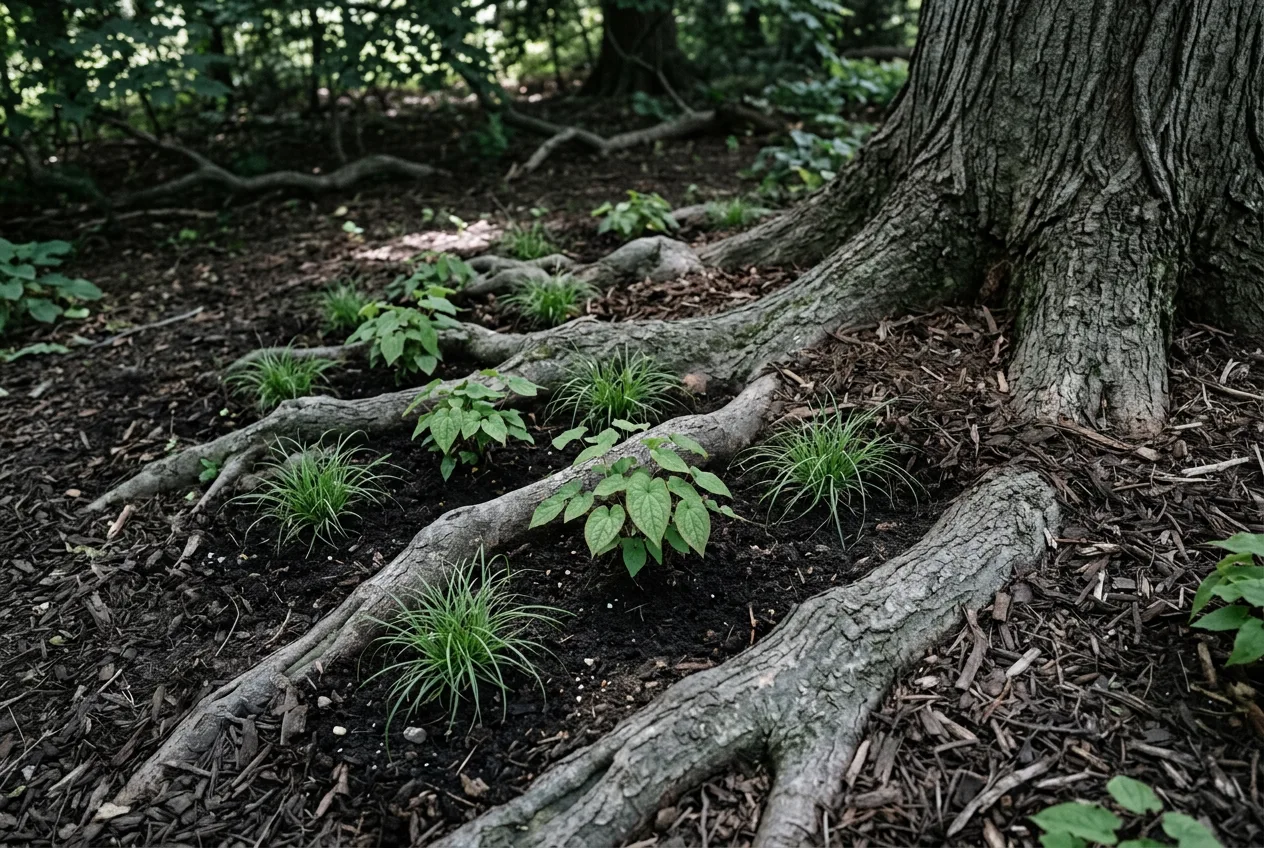
University of Wisconsin–Madison Horticulture Extension is unambiguous that this is the wrong move. On adding soil over tree roots: “Apply just enough to cover the roots by about a half inch.” On why: “Applying too much soil over the roots of a tree can suffocate them and cause tree damage or death.” And on planting the area, the method is hand work, not earthworks — “You can also plant the area with a groundcover or perennials in a mulched bed. Just be sure you don’t damage the tree’s roots when planting, and don’t use a rototiller in the area. Instead, hand dig small planting pockets in between the tree’s roots.”
Half an inch, not eight. That is a fortyfold difference between what the SERP recommends and what extension horticulture permits, and the cost of getting it wrong is slow enough to hide — a suffocated root system takes years to show in the canopy, by which time nothing connects the dead maple to the raised bed somebody built under it in 2026.
So the under-tree design rules are:
- Plant into pockets you dig by hand, between roots, never through them. If the spade will not go in, that spot is not a planting position — move 30 cm and try again.
- No rototiller, ever, and no trenching for edging across the root zone.
- Mulch instead of topsoil. A bark or wood-chip mulch layer does the moisture-conserving job the extra soil was supposed to do, without burying the roots. Keep it clear of the trunk so the root flare stays visible.
- Accept smaller plants. Buy 9 cm plugs rather than 2-litre pots; the hole is smaller, so there is less root to cut.
- Water the first two summers. New plants are competing with an established tree for every millimetre of rain, and the tree wins by default.
- Consider raising the canopy instead of amending the soil. Removing the lowest limbs lifts the shade line and brings morning sun under the tree without touching a root — see the timing rules before you cut, because for oaks and elms the safe window is a temperature, not a date.
Shade garden design by zone
The standard shade palette circulating on the web — hosta, astilbe, heuchera, Japanese forest grass, ostrich fern, epimedium — reads as though it works everywhere. It does not. Hardiness ranges from Missouri Botanical Garden’s Plant Finder show the list breaking apart at both ends:
| Plant | Hardiness | Where it drops out |
|---|---|---|
| Hosta sieboldiana | Zones 3–8 | Marginal in zone 9+ |
| Ostrich fern (Matteuccia struthiopteris) | Zones 3–7 | Out from zone 8 |
| Pennsylvania sedge (Carex pensylvanica) | Zones 3–8 | Marginal in zone 9+ |
| Astilbe × arendsii | Zones 4–8 | Out in zone 3 and zone 9 |
| Foamflower (Tiarella cordifolia) | Zones 4–9 | Out in zone 3 |
| Japanese forest grass (Hakonechloa macra) | Zones 5–9 | Out in zones 3–4 |
| Bishop’s hat (Epimedium grandiflorum) | Zones 5–8 | Out in zones 3–4 and 9 |
Read down the right-hand column and the zone picture is specific:
Zones 3–4. The two plants most shade-garden articles lean on for texture and groundcover — Japanese forest grass and epimedium — are both out. The cold-climate shade garden is built on hosta, ostrich fern and Pennsylvania sedge, all of which are comfortable to zone 3, with astilbe entering at zone 4. Structure comes from the ferns rather than from grasses.
Zones 5–7. Every plant in that table is in range. This is the band the standard advice was written for, which is why it reads as universal.
Zone 8. Ostrich fern drops out. It is a northern fern and the limit is heat, not cold, so a zone 8 shade garden substitutes evergreen ferns and sedges for the big deciduous fern mass.
Zone 9 and warmer. Hosta, epimedium and ostrich fern are all marginal or out, and the cold requirement is the reason — hosta in particular needs a genuine dormancy. Shade design here moves toward foliage from a different pool: foamflower holds to zone 9, and the structural layer comes from broadleaf evergreens rather than herbaceous perennials.
If you are not sure which band you are in, start with our USDA zone planting guide for zones 3–10 and check the range on every tag against it before buying.
Layering: the design half
With the light measured, the moisture established and the zone checked, the design itself is straightforward and mostly about foliage.
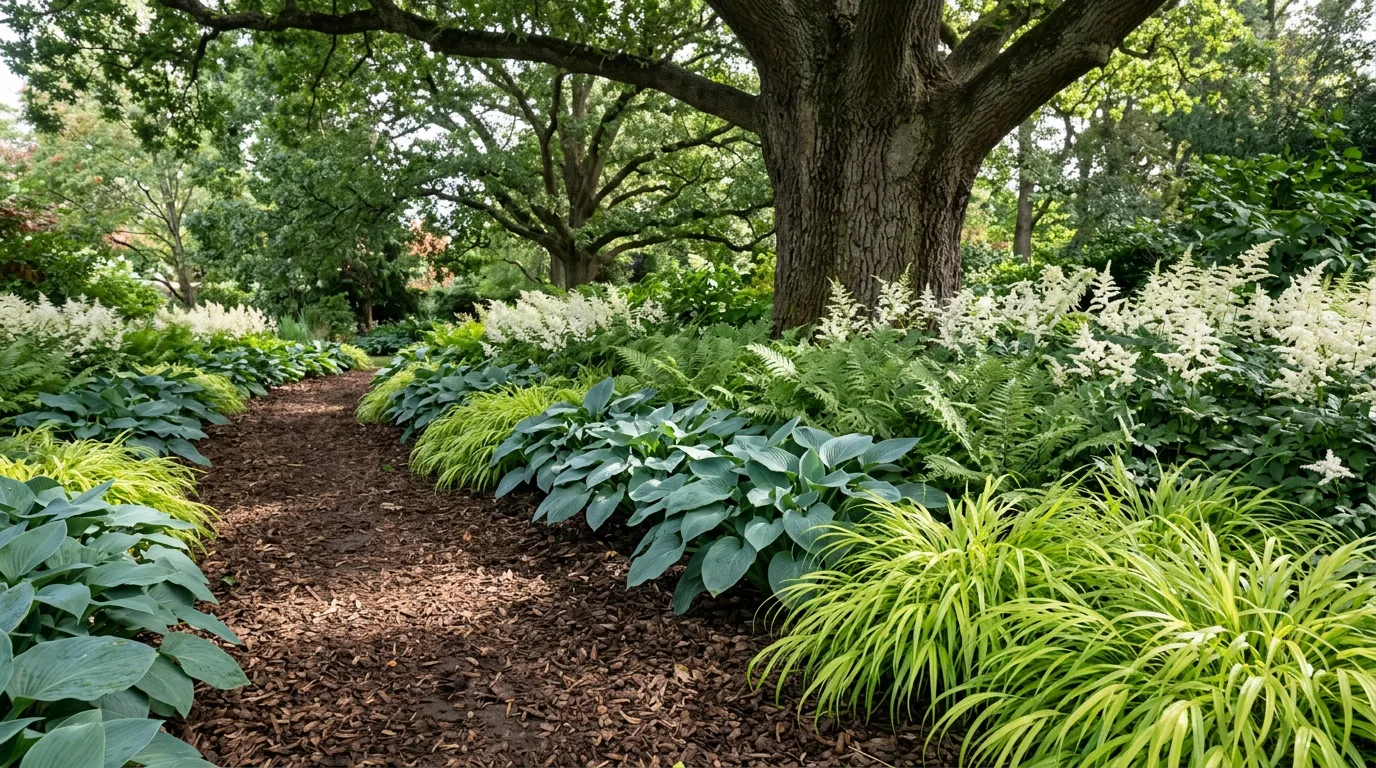
Three tiers, and the back one does the work. A shade border reads as designed when it has a canopy or tall shrub layer, a mid layer of ferns and large-leaved perennials, and a groundcover layer that reaches the path edge. Two tiers looks like a plant collection; three looks like woodland.
Contrast texture, not colour. Shade flowers are brief. Foliage is the whole year, so the composition has to work on leaf shape and size: a broad flat hosta leaf next to the fine arching blades of Japanese forest grass, a dissected fern frond against something glossy and solid. This is the single most reliable move in shade planting and it costs nothing.
Use pale foliage as the light source. Silver, cream, chartreuse and variegated leaves bounce the little light there is, and they read from a distance where a dark green mass disappears. One or two pale drifts placed where the eye lands first will do more than a dozen flowering plants.
Repeat, don’t scatter. In low light the eye needs rhythm to make sense of a bed. Three groups of five beat fifteen singletons, and the repetition reads as intention.
Finish the ground. Bare soil under trees is where weeds and erosion start. Either mulch it or plant it; a groundcover instead of grass is usually the better answer under a canopy, since turf in deep shade is a losing battle anyway — which is also the honest starting point for designing a garden without a lawn at all.
Where nothing will grow, stop trying. Deep dry shade within half a metre of a north wall under an overhang is a hard place. A container of shade annuals, a bench, a water feature or a gravel surface is a better design answer than the fourth failed planting — and containers let you give the plant its own soil and water while the shade stays as it is.
Frequently asked questions
What counts as full shade? It depends on the source, which is the problem. Illinois Extension says under 2 hours of direct sun; K-State says under 1 hour, or dappled light through a canopy most of the day; a Proven Winners plant tag says under 4 hours. Measure your own hours and treat the tag as the sunniest of the three readings.
Is part sun the same as part shade? Not on a plant tag. Proven Winners gives both as 4–6 hours of direct sun, with the difference being when — part sun includes afternoon sun, part shade should be mostly before midday. For a shade bed the distinction matters more than the hour count, because afternoon sun is the kind that scorches.
Will grass grow in shade? Not well under a dense canopy, and the failure is usually permanent rather than a seeding problem. Below roughly 3–4 hours of direct sun, a groundcover, mulch or a hard surface is a more honest answer than another bag of shade-mix seed.
Can I plant under a maple? Yes, but by hand and into pockets. UW–Madison Extension’s limit on added soil over tree roots is half an inch, and it specifically warns against rototilling the area, so the raised-bed-over-roots approach that circulates widely is the thing to avoid. Small plugs, dry-shade species, and water for the first two summers.
Why do shade plants I buy keep dying? The two usual causes are the definition gap — a tag’s “part shade” is 4–6 hours and your bed has one — and dry shade mistaken for moist shade. Check the hours, then check whether the soil dries out between rains, before changing the plant.
Do shade gardens need less water? Often more, not less, in the first two years. Shade under a tree is usually dry shade: the canopy intercepts rain and the roots take what reaches the ground. Shade beside a building away from the eaves is the case where watering genuinely drops.