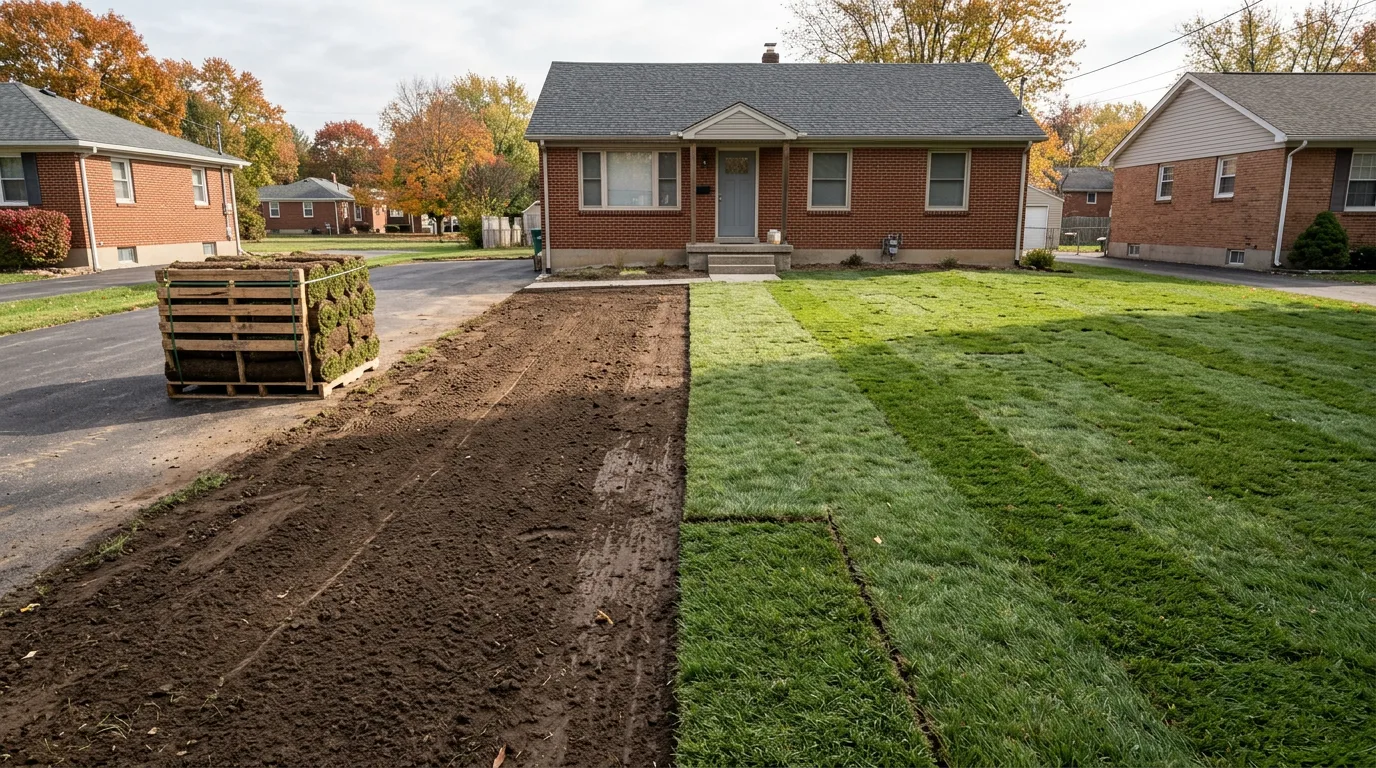
Sod costs a great deal more than seed and gives you a finished lawn in an afternoon. That trade-off is real, and it is the third question, not the first. Two things settle this before money comes into it: whether the grass you want can be grown from seed at all — for hybrid bermudagrass and St. Augustinegrass, NC State’s own table says no — and whether the seeding window is still open, because Penn State Extension is blunt that “seed will not germinate when soil temperatures become too cold in late fall,” while sodding “can be done at almost any time of the year except when soils are frozen.”
Work through those two, and in a large share of real yards the decision is already made for you. Here is each one with the figures behind it, then the costs, the watering, and the slope rule that catches people out.
First question: can your grass be seeded at all?
The “sod vs seed” debate is written as though every lawn grass offers both. It does not. NC State’s Carolina Lawns carries a column headed “Can Be Seeded?” for each principal lawn grass, and the answer is not always yes. The publication states it plainly: “some warm-season grasses must be planted either by sod or other vegetative means because seeds either are not available or do not result in uniform stands.”
| Grass | Can be seeded? | Rate of establishment (NC State) |
|---|---|---|
| Tall fescue | Yes | Fast |
| Kentucky bluegrass (and its mixes) | Yes | Moderate to fast |
| Bermudagrass, common | Yes | Fast |
| Bermudagrass, hybrid (e.g. Tifway 419) | No | Fast |
| St. Augustinegrass | No | Fast to moderate |
| Bahiagrass | Yes | Moderate |
| Centipedegrass | Yes | Slow |
| Zoysiagrass | Yes, some cultivars | Very slow |
Source: NC State Extension, Carolina Lawns, Tables 1b and 1c (piedmont and coastal plain).
Three practical consequences follow.
If you want a fine-textured bermuda lawn, there is no seed option. NC State: “Most finely textured, high-quality turf-type bermudagrasses are planted using sod, sprigs, or plugs. Common bermudagrass, which is the most coarsely textured, can be seeded.” Common bermuda seeds at 1 to 2 pounds per 1,000 sq ft — but it is a visibly different, coarser lawn than the hybrid you saw and liked.
If you want St. Augustine, there is no seed option either. It is sod, plugs or nothing.
“Yes” is not the same as “sensible.” Centipedegrass can be seeded, and NC State notes it “is slow to establish and may take two to three years when seeded.” Two to three years of a thin, weed-prone lawn is a cost, even if the bag was cheap. Zoysia is rated very slow from any method. For both, the seed saving buys you years of waiting.
Second question: does sod narrow your choice instead?
The constraint runs both ways, and this half is almost never mentioned. Sod is a living mat that has to hold together when it is cut, rolled, lifted and laid. Penn State: “Turfgrasses used for sod production typically produce rhizomes or stolons, which knit turf together and provide lateral strength. Kentucky bluegrass is the most common cool-season turfgrass species used for sod in Pennsylvania. Occasionally, tall fescue and fine fescues are used, but some Kentucky bluegrass is usually included with these species to give the sod more lateral strength.”
So if you have carefully chosen a 100% turf-type tall fescue for its drought and heat tolerance, buying sod will probably get you tall fescue with bluegrass in it — a blend with different water needs than the one you picked. Bunch-type grasses with no runners are difficult to supply as sod at all. Seed, by contrast, lets you specify the exact mixture and cultivars, which is why Penn State’s own mixture table is written in percentages by weight.
The clean summary of the first two questions: seed gives you the widest choice of species; sod gives you the widest choice of timing. Whichever one your project is short of is usually the one that decides.
Third question: is the window open?
Penn State, for cool-season grasses: “optimum times for turf seeding are mid/late spring and late summer/early fall. Seed will not germinate when soil temperatures become too cold in late fall, and summer seedings are subject to heat, drought, and disease problems.” Warm-season grasses run on the opposite clock — NC State: “Warm-season grasses are best planted in late spring and early summer.”
Sod has no equivalent lockout. Penn State: sodding “can be done at almost any time of the year except when soils are frozen,” with spring, late summer and fall the optimum.
That asymmetry is the whole of why sod wins so many real jobs. A lawn torn up by a build in November, a bare yard going on the market in January, a strip destroyed by a trench in July: those are not seeding conditions, and no price comparison changes it. If you are reading this outside your grass’s window and cannot wait for the next one, you are not choosing between sod and seed — you are choosing between sod and bare ground.
If you are near the edge of the window rather than past it, Penn State notes the one adjustment professionals make: “High seeding rates are sometimes used if seeding takes place past the optimum period of late summer/early fall as cold temperatures decrease seed germination.” More seed, not a different method.
What each one actually costs
Penn State states the direction without ambiguity: “Sodding is usually the most expensive method of establishing cool-season turfgrasses. However, it is the quickest way to achieve a mature lawn.”
For a current material-cost anchor, sod farms post their prices. The Grass Outlet, a Texas producer, lists these per 450 sq ft pallet as of October 2026 — grass only, before delivery and before any labour:
| Sod | Per 450 sq ft pallet | Per sq ft |
|---|---|---|
| Raleigh St. Augustine | $205 | $0.46 |
| Celebration bermuda | $225 | $0.50 |
| Tifway 419 bermuda | $220 | $0.49 |
| Palmetto St. Augustine | $240 | $0.53 |
| Palisades zoysia | $315 | $0.70 |
| Density buffalo | $315 | $0.70 |
Prices and delivery fees vary by region and by farm; treat these as the shape of the material bill, not a national rate. Installation, soil preparation and grading sit on top — our landscaping cost guide covers the installed ranges for both methods alongside the rest of a yard budget.
Seed is better priced by quantity than by dollar, because the right amount depends entirely on species. Penn State’s rates, in pounds per 1,000 sq ft:
| Seed | lb per 1,000 sq ft |
|---|---|
| Turf-type tall fescue | 6–8 |
| Kentucky bluegrass | 2–3 |
| Perennial ryegrass | 4–5 |
| Fine fescues | 4–5 |
| Kentucky bluegrass + perennial ryegrass mix | 2–3 |
| Common bermudagrass (NC State) | 1–2 |
Work out your area, multiply, then price that weight locally. A 2,000 sq ft tall-fescue lawn needs 12–16 lb of seed; the same area in bluegrass needs 4–6 lb. The gap between seed and sod is wide enough that the exact bag price rarely changes the decision.
The seed price that is not the price on the bag
Here is the arithmetic Penn State publishes and consumer guides leave out. A seed label carries a purity percentage and a germination percentage. Multiply them and you get pure live seed (PLS) — the fraction of the bag that is actually viable seed of the species you wanted:
- Purity 92% × germination 80% ÷ 100 = 74% PLS. Divide 100 by 74 and you need 1.35 lb for every 1 lb the mixture calls for.
Penn State’s worked example of the trap is worth reproducing: a lot sold at a “reduced” price of $0.95 per lb with 85% purity and 60% germination is 51% PLS, so you need 2 lb for every 1 lb specified — an effective $1.90 per lb. The cheap bag costs double. Always read purity and germination before comparing prices per pound, or the sum you are using to decide can be out by a factor of two.
The watering is the real risk, on both sides
Penn State is unsparing: “Lack of water is the most common cause of sod deterioration, so make sure that the water moves through the sod and wets the soil underneath. Continue to water daily (if needed) until the sod is well rooted into the soil. This may take up to 4 weeks, depending on the site and weather conditions.”
Seed is no softer. “Whether the lawn is established from seed or from sod, it will probably need regular, sometimes daily, irrigation. The soil should be moist at all times, but not excessively wet.”
So the honest version of “sod gives you an instant lawn” is: sod gives you an instant appearance, and up to a month of daily watering before it is a lawn that will survive on its own. If you cannot water daily for a month — no irrigation, a water restriction, a holiday booked, a rental between tenants — sod is the option that fails — and it fails having been, in Penn State’s words, “the most expensive method” in the first place. That is the single most common way this decision goes wrong.
Slopes change the answer
On any noticeable slope, both methods need a step the flat-ground version does not.
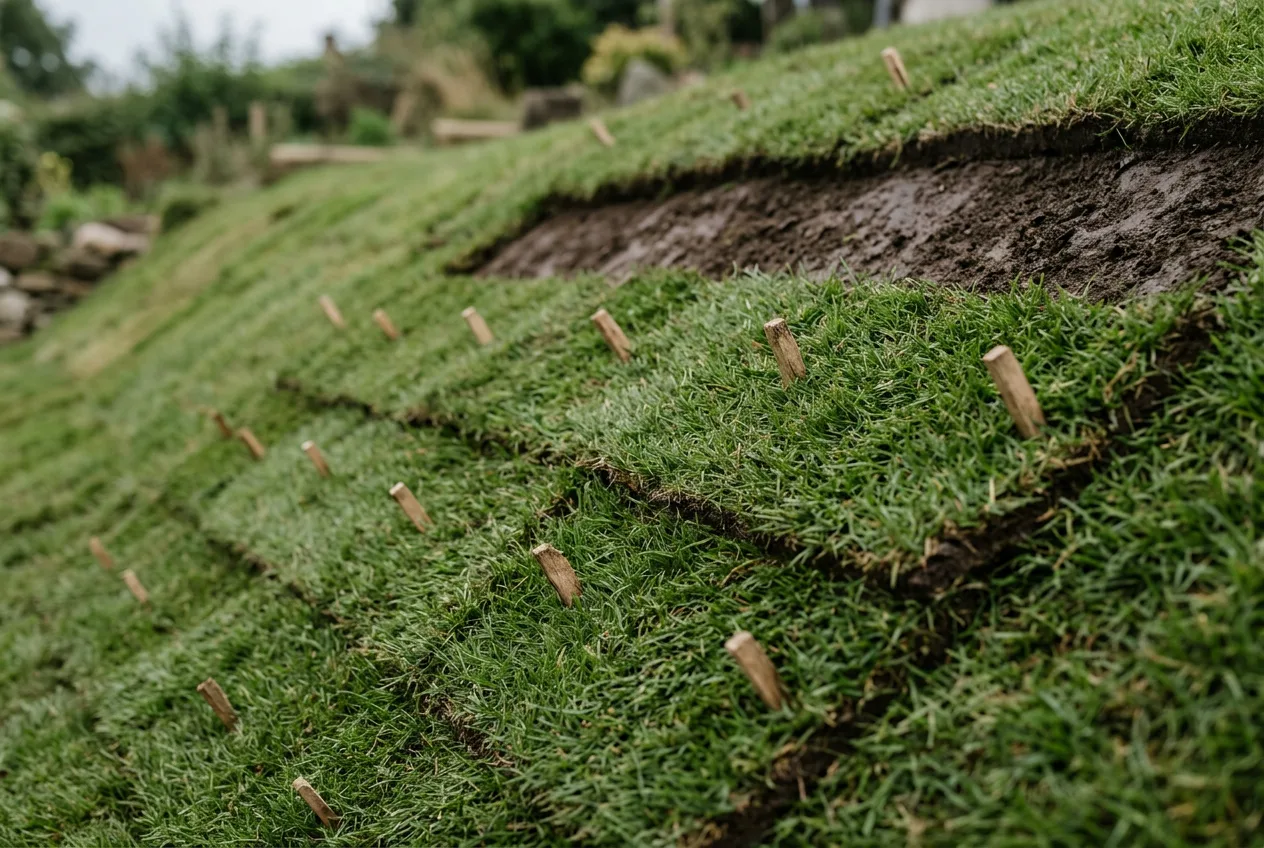
Sod gets pinned. Penn State: “When laying sod on sloped areas, put stakes into each strip of sod as it is laid. Staking of sod prevents slipping or movement down slope. Be sure to remove the stakes when the sod is well rooted.” Lay the strips across the slope, not down it, and butt them tight — “the sod will dry out quickly if any spaces are left between strips.”
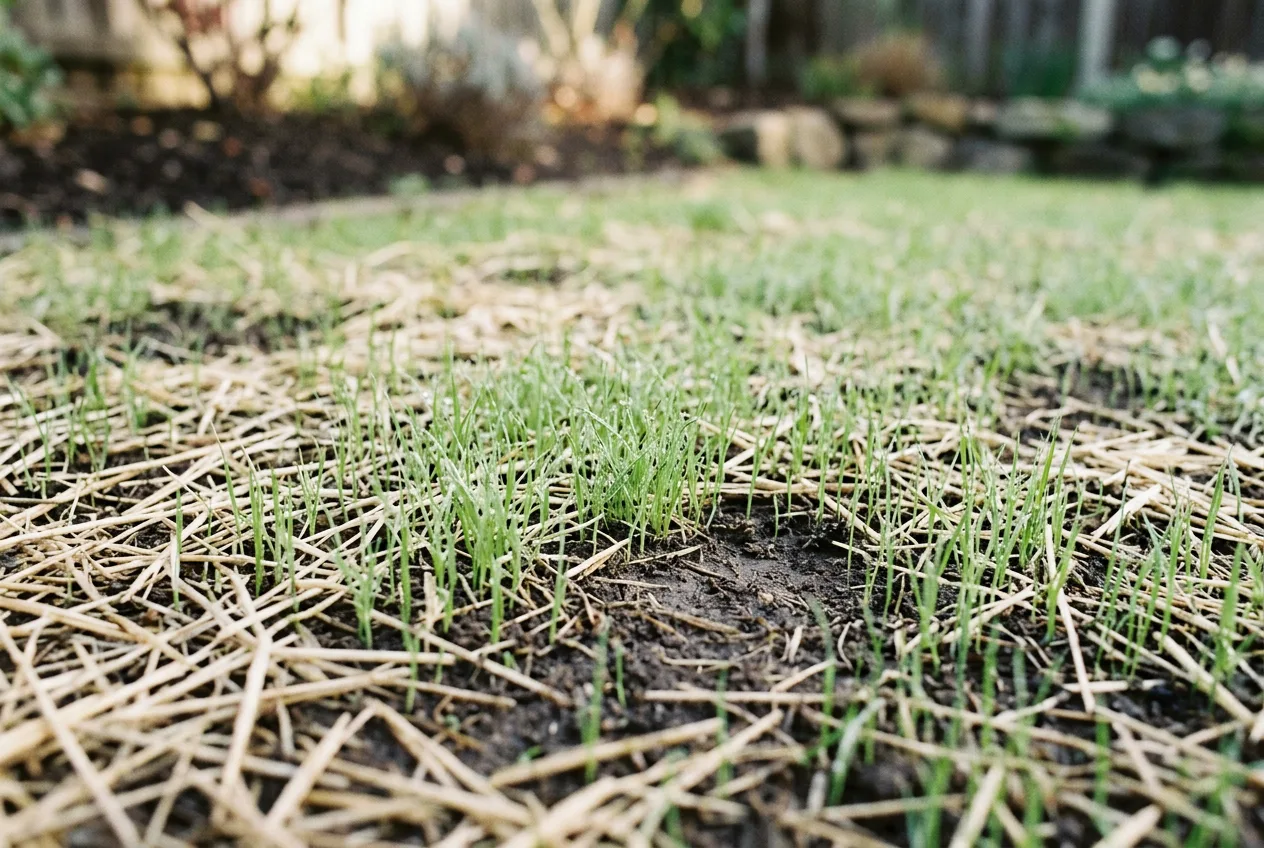
Seed gets mulched, or hydroseeded. Mulch “is particularly important on sloped areas where there is a higher chance of erosion,” and hydroseeding “is most efficient for seeding large areas or steep slopes.” Straw is the usual mulch and the cheapest — with one cost: “expect some weed introduction with straw mulch.”
On a steep bank that you also need to hold while it establishes, sod’s instant cover is doing erosion-control work that seed cannot do for weeks. If the slope itself is the problem rather than the grass, our guide to landscaping a hillside covers the terracing and planting options that often beat turf outright.
Two traps worth knowing before you order
Do not spray before you sod. Penn State: “Do not apply herbicides to newly laid sod or to the soil prior to sodding. Herbicides interfere with root development and often result in establishment failure.” The instinct to kill weeds first, then lay turf over clean ground, is how sod jobs die. The same caution applies to seed: use a product with no residual that interferes with germination.
Sod has a shelf life measured in hours. “Sod should be used immediately upon delivery because it deteriorates rapidly (within 24 to 48 hours) in warm weather.” Book the delivery for the morning you are laying it, not the weekend before. And lay it on soil that is “dry to slightly moist” — “never lay sod on wet soil.”
The decision, in one pass
Run these in order and stop at the first that applies:
- Do you want hybrid bermuda or St. Augustine? Sod (or plugs/sprigs). There is no seed route.
- Is the seeding window shut for your grass type, and can you not wait? Sod.
- Is it a steep slope you need held immediately? Sod.
- Can you water daily for up to four weeks? If not, seed in the right window — or wait for it.
- Do you want a specific mixture or cultivar — a 100% tall fescue, a fine-fescue shade blend? Seed.
- Is it a large area and the budget is the binding constraint? Seed, inside the window, mulched.
- Centipede or zoysia on a small, visible lawn? Sod, because seeded establishment is measured in years.
And one option the question itself hides: a smaller lawn. Sod at roughly $0.50 per square foot of material plus installation makes lawn area the most expensive decision on the plan, so shrinking the turf and putting the saving into beds, paving or gravel is frequently the better buy — the trade-offs are in our guide to landscaping without grass, and the long-run arithmetic against synthetic turf is in artificial turf vs real grass over ten years.
Both bills scale directly with area, which is why it pays to settle the lawn’s final shape before ordering anything. Upload a photo to Hadaa and you get a plan of your own yard with the lawn, beds and paving drawn to scale — so you are pricing the lawn you are actually going to build rather than the one you have now.
Frequently asked questions
Is sod or seed cheaper? Seed, substantially, on materials — but compare like with like. Price the PLS-adjusted weight of seed you actually need (purity × germination), and remember that a failed seeding inside the wrong window costs the whole job twice. Penn State’s position is simply that sodding “is usually the most expensive method.”
Is sod better than seed? Only on timing, instant cover and slope stability. Seed is better on cost, on choice of species and cultivar, and on root development into the existing soil. Neither is better in the abstract, which is why the species-and-window questions come first.
Can I seed in the fall? Late summer and early fall is the optimum window for cool-season grasses, so yes — but with a deadline. Once soil temperatures drop too far, Penn State says seed simply will not germinate. Near the edge of the window, raise the seeding rate.
What about hydroseeding? It is seeding, with the mulch and fertiliser mixed in and sprayed on. Penn State describes it as “most efficient for seeding large areas or steep slopes,” with the caveat that the seed sits on the surface and “may not be in close contact with the soil,” which can dry seedlings out. It changes the delivery, not the window.
Sod or seed for patching a small area? For a patch you can water easily, seed from the same mixture as the surrounding lawn blends in better. Penn State’s overseeding rate for perennial ryegrass is 4–6 lb per 1,000 sq ft. For patches in a lawn that is generally tired rather than locally damaged, the whole-lawn approach in our guide to lawn recovery after summer — aeration, then overseeding — is the better fix.
Sod or seed with dogs? Sod, if you can keep them off it for the rooting period. Penn State: “Keep traffic off the area until the sod is well rooted,” which can be four weeks. A seeded lawn needs that protection for considerably longer, which in a dog’s yard is usually the deciding factor.
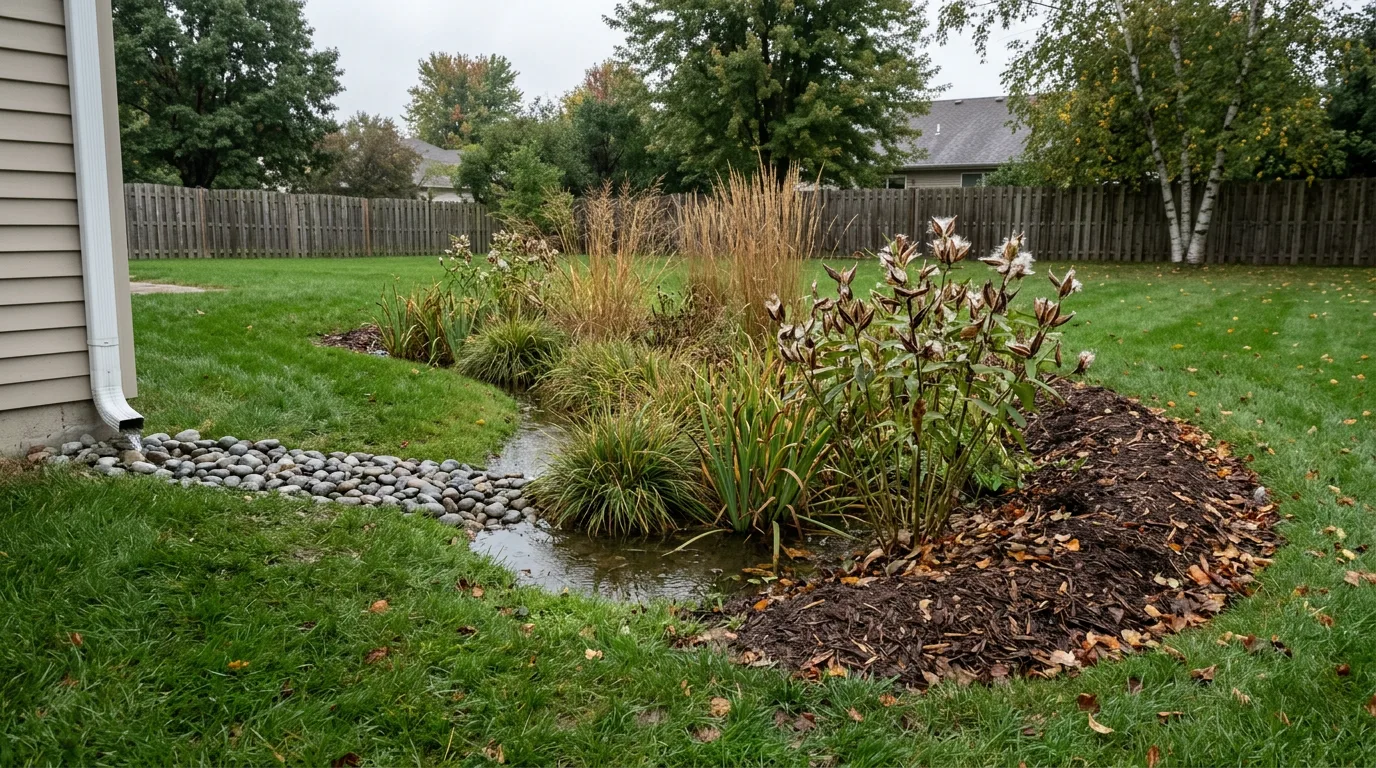
Will sod grow on poor soil because it arrives with its own? No. Soil preparation for sodding is “identical to those for establishing turf from seed,” and sod “can deteriorate if proper site preparation and follow-up maintenance practices are not followed.” If drainage is the underlying problem, fix that first — our guide to garden drainage covers the usual causes.