
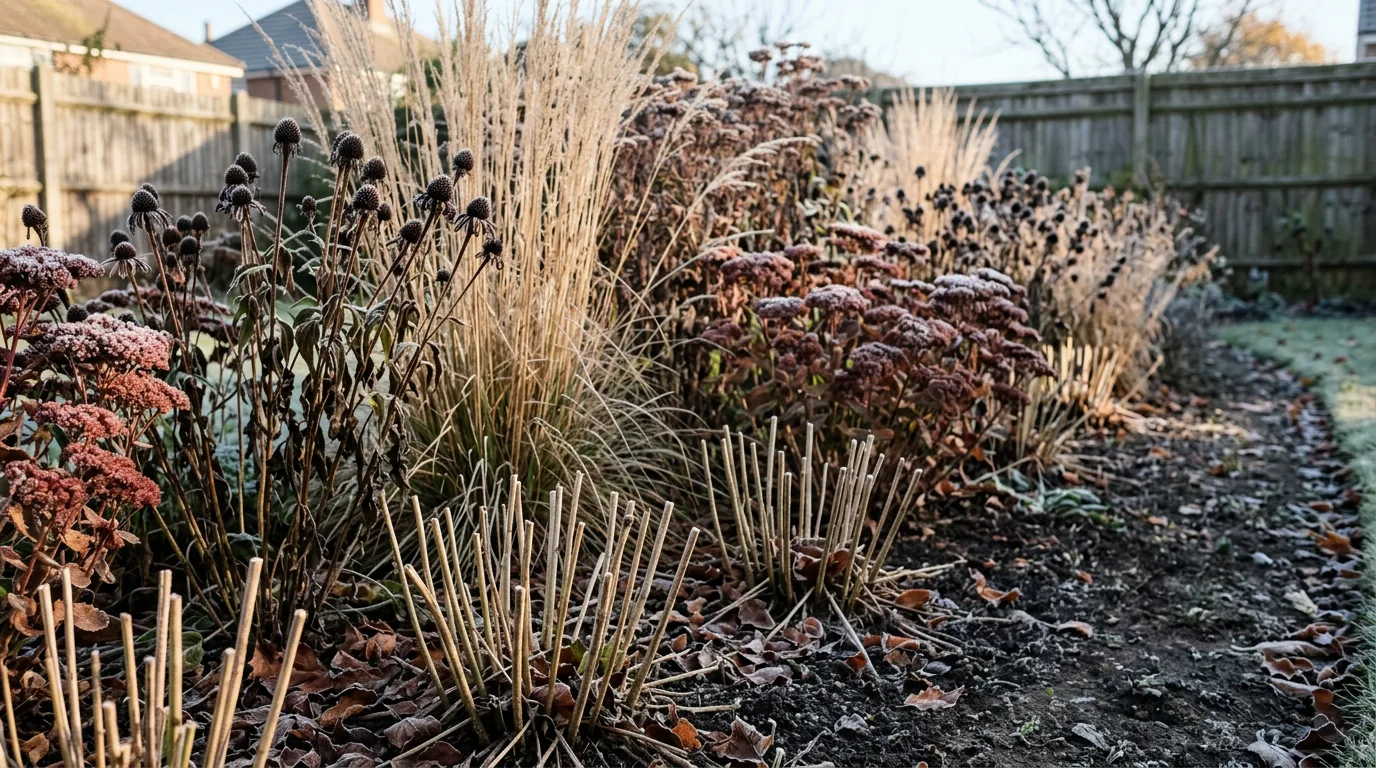
One rule settles almost every decision in a fall garden cleanup: cut out what carries disease, and leave the rest standing. Tidiness is not a reason to cut a bed back. Disease is. Everything else — the coneflower seedheads, the ornamental grasses, the hollow stems, most of the fallen leaves — is better left where it is until spring, and leaving it is the part that actually helps next year’s garden.
That sounds simple until you look up the details, because the people who study this do not agree on the numbers. Four university extension services publish four different stem heights and three different times of year to cut them. Below is what each one actually says, why they disagree, the one piece of research that reconciles them, and the disease list that decides what has to come out regardless.
The disagreement nobody tabulates
Every “leave the leaves” article tells you to leave your perennial stems standing for pollinators. Almost none of them tells you how tall, or when to cut them — and when you go to the sources, the advice splits:
| Source | Stem height to leave | When to cut |
|---|---|---|
| NC State Extension | No height given | “Trim stems in their first winter (after first frost but before last frost)” |
| UNH Extension | “about fifteen inches above the ground” | In the spring |
| Illinois Extension | “cut stems back to a height of 12-18 inches” | Not “until temperatures are consistently above 50 degrees overnight” |
| University of Maryland Extension | “prune them down to 8-24’’ if they are too tall to leave” | Leave standing in fall; cut after blooming finishes |
Read those side by side and the range is 8 to 24 inches, across a window running from after the first frost to late spring. If you have ever felt that the advice on this is vague, that is because it is — the guidance is genuinely unsettled, and most blog posts resolve it by picking one number and presenting it as fact.
The research that reconciles it
There is one finding that makes sense of the spread, and it comes from the NC State pollinator programme: the stems standing in your garden this winter are empty.
In their words, “stems are not occupied in their first winter,” and “in the spring, bees are moving into last year’s dead stems and starting new nests.”
That single mechanism changes the whole calculation:
- Cutting stems this autumn does not evict anything, because nothing has moved in yet.
- What matters is that the cut stubble is still there next spring, when the bees arrive looking for it. NC State’s instruction is “Once you trim a stem, you should leave it alone and bees will use it until it disintegrates.”
- So the real mistake is not cutting in autumn. It is cutting again in spring, which removes the nests that were made in the stubble you left.
That reframes the whole debate. The extensions recommending spring cutting are protecting stems that have already been occupied for a season; NC State is proposing you cut once, early, and then leave the stubble alone for years. Both work. What does not work is cutting every autumn and tidying every spring, which is what a conventional two-pass cleanup does — and which removes the habitat in both directions.
A practical reading: cut once, after the first frost, to a mixed height somewhere in the 8–24 inch range the sources bracket, and then leave that stubble undisturbed. If you would rather follow the spring-cutting advice, the Illinois threshold is the one to hold to — nothing comes out until overnight temperatures are consistently above 50°F.
What has to come out regardless
This is the part the pollinator guidance is not about, and it overrides everything above. Pathogens overwinter in dead plant material and re-infect the same plants next year.
Iowa State University Extension puts it plainly: “If infected plant debris is left to linger through the winter, gardens become an overwintering site for disease-causing pathogens like fungal spores.”
The specific culprits they and other extensions name:
| Remove | Why |
|---|---|
| Rose leaves and canes with black spot | Rose black spot overwinters in fallen leaves and stems |
| Tomato, pepper and eggplant debris | Early blight and Septoria leaf spot overwinter in debris; early blight also survives in soil and on seed |
| Bee balm and phlox with powdery mildew | Powdery mildews overwinter in debris |
| Iris foliage where borer has been a problem | Iowa State names iris borer among the reasons to remove foliage |
| Raspberry canes with anthracnose | Named by Iowa State as debris to remove |
| Squash and cucumber vines | Squash bugs overwinter as adults under plant residue |
| Dropped fruit under fruit trees | Iowa State lists fallen fruit as material to clear |
| Hosta foliage | See below |
Hostas are the clearest example of the exception swallowing the rule. The same Illinois Extension that tells you to delay spring cleanup for bees tells you to cut hostas in autumn: “Once fall color subsides, cut back your hosta foliage and petioles.” The reason is foliar nematodes — “microscopic roundworms that live and feed on the hosta leaves” — plus slugs, since cutting the foliage back “reduces future slug populations.” They add one more detail worth knowing: if you mulch newly transplanted hostas, do it after the ground has frozen, and “remember to remove the mulch the following spring so the crown does not rot.”
Do not compost the diseased half
This is where a lot of careful cleanups undo themselves. Iowa State is explicit: “Do not add this material to home compost piles, as most do not get warm enough to kill disease-causing pathogens.”
The threshold they give elsewhere is at least 140°F, which will kill most pathogens — and their assessment is that “Most home compost piles do not reach this temperature, but most municipal composting facilities do.” So diseased material goes in municipal collection or the bin, not your own heap. Composting it at home moves the problem rather than solving it.
The leaves: one test, not a rule
Fallen leaves are the other half of a fall cleanup, and the useful guidance here is a test rather than a quantity.
Iowa State’s standard for mowing leaves into a lawn is that “The leaves must be chopped into pieces small enough to fall down between the blades of grass.” That is the test. If the shredded pieces sit on top of the turf, they are too big or there are too many, and they will smother it.
Two conditions make that work: “Mowing is best done when the layer of leaves is thin and dry, so it’s recommended to mow often throughout the fall.” Mowing once, in November, over a thick wet layer, is the version of this that fails.
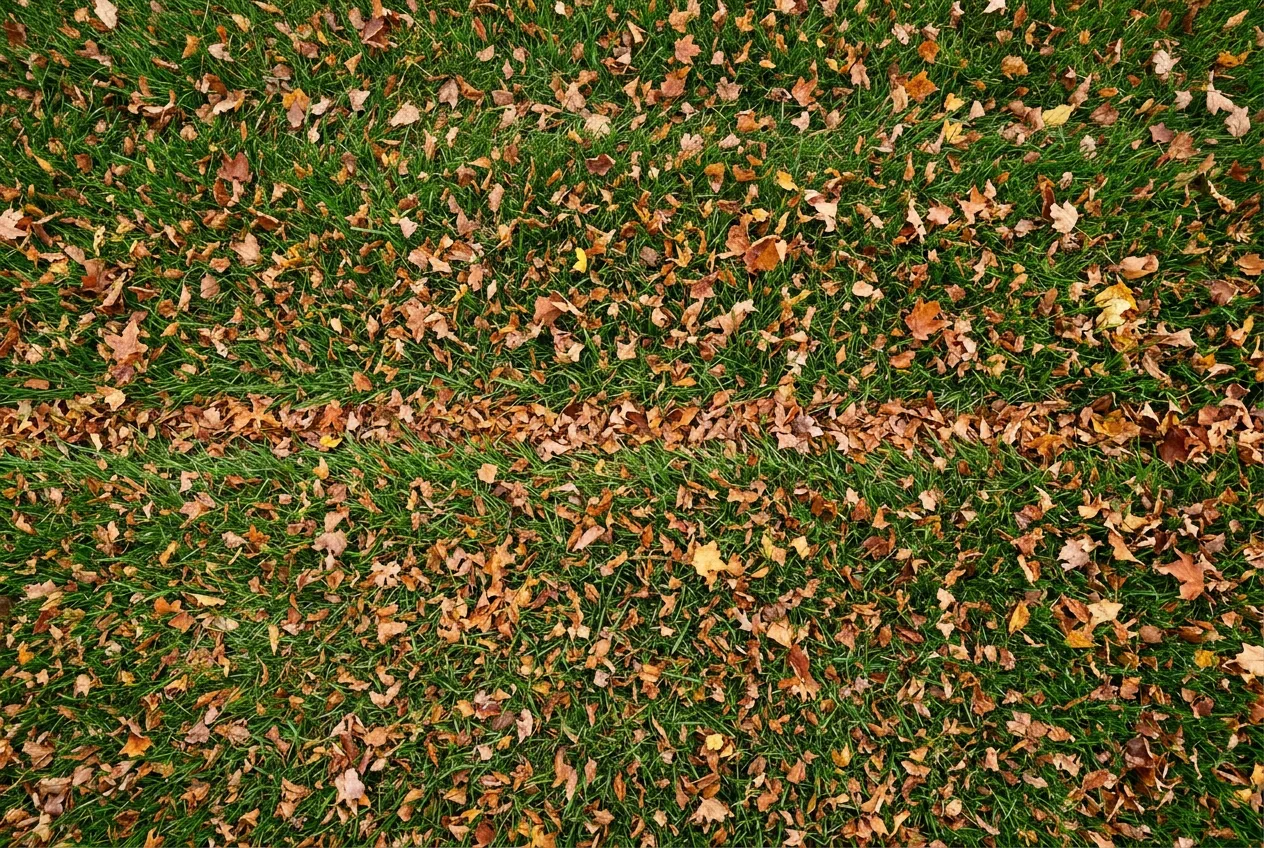
In beds, the limit is different. Leaves make good mulch, but Iowa State warns to “Be sure not to layer leaves too thick as they can smother the crowns of perennials if too deep.” UNH Extension’s line on lawns is the same principle stated generously: “A thin layer of leaves can benefit your lawn, so you don’t have to remove them all.”
One timing note if you are clearing leaves out of beds in spring rather than autumn: ground-nesting bees are still in there. A University of Maryland horticulturist’s guidance is to “at least wait until mid-May if you want to move leaves.”
What to leave standing
Iowa State’s own list of what earns its keep through winter: “Leaving the leaves, stems, dried flowers, and seed heads of many perennials, such as coneflowers and ornamental grasses, provides more interest through the winter months, as well as protection from extreme winter temperatures.”
Two reasons, and the second one is the one people forget. Standing stems and a leaf layer are insulation. Cutting a bed to the ground in November removes the cover that keeps crowns at a steadier temperature through freeze-thaw cycles.
Everything on this page is the herbaceous half of the job. The woody half — shrubs, hedges and the trees above them — runs on different rules, because a winter cut costs a spring-flowering shrub its flowers and can open an oak to disease; when to prune shrubs covers that side.
What they flag as the exception to leaving seedheads: perennials that self-sow aggressively. Iowa State names blackberry lily, garlic chives and golden Alexander as ones to deadhead rather than leave, unless you want the seedlings.
The bed-by-bed checklist
| Area | Cut now | Leave |
|---|---|---|
| Perennial border, healthy | Nothing, or cut once to 8–24 inch mixed-height stubble and then leave it alone | Coneflower and grass seedheads, leaf layer |
| Perennial border, mildew or leaf spot present | The affected plants, to the ground, into municipal waste | Everything else |
| Hostas | All foliage and petioles once fall colour goes | — |
| Vegetable beds | All debris after the first frost; all tomato, pepper and eggplant material | — |
| Roses | Any leaves and canes with black spot; clear fallen leaves beneath | Healthy canes until spring pruning |
| Lawn | Nothing | Leaves, mown fine enough to fall between the grass blades |
| Under fruit trees | All dropped fruit | — |
| Aggressive self-seeders | Seedheads | Stems |
Design your way out of half of this
The honest observation after writing that table: how much autumn work a garden creates is mostly decided when it is planted, not in October.
Beds built around plants that look good dead — switchgrass, little bluestem, coneflower, sedum, baptisia — need almost no autumn attention and give you a winter garden. Beds built around plants that reliably get mildew or leaf spot in your conditions need stripping out every single year. It is the same principle behind low-maintenance year-round garden design: the maintenance is a property of the plant list.
If you are reworking a bed this autumn anyway, autumn is the right time to plant — soil is still warm and roots establish before the ground freezes. Our fall planting guide covers the soil-temperature thresholds that decide what still has time to go in, and deer-resistant shrubs is worth reading first if you are choosing structure plants, because the two most-planted evergreen screens are both rated among the worst for deer. Bulbs are the one job on the list that runs later than the rest — they want the soil on the way down rather than still warm, so when to plant bulbs is a separate calendar and the window stays open until the ground is about to set.
For the beds themselves, you can see a planting change before you commit to it — Hadaa turns a photo of your garden into a zone-checked design, which is a cheaper way to test “what would this bed look like if I replaced the phlox” than buying the plants.
FAQ
When should I clean up my garden in the fall? For anything diseased, as soon as you see it, and for vegetable beds, after the first frost. For healthy perennials there is no deadline — the credible options are one cut after the first frost or nothing until overnight temperatures are consistently above 50°F in spring.
Should I cut perennials back in fall or spring? Either, but not both. Cutting in autumn to a stubble you then leave alone gives bees nesting sites next spring; leaving stems whole until spring protects the previous season’s nests. Doing a full cut in autumn and a tidy-up in spring removes the habitat both times.
How do I clean up hostas in the fall? Cut the foliage and petioles back once fall colour subsides. This is one of the clear cut-it cases, because foliar nematodes and slugs overwinter in the foliage.
Do I have to rake my leaves? Not off the lawn, if you can mow them fine enough to fall between the grass blades, and not out of beds, where a thin layer is mulch. Rake them off only where the layer is thick enough to smother turf or perennial crowns.
Can I compost diseased plants? Not in a home pile. Iowa State’s threshold is at least 140°F to kill most pathogens, which most home heaps do not reach and most municipal facilities do. Send it to municipal collection or the bin.
Is it bad to leave the garden completely untouched? Only where disease or a pest like foliar nematode is present. In a healthy bed, leaving it alone is the better option — and the insulation and seedheads are a benefit, not just an absence of work.
Sources: NC State Extension pollinator programme · UNH Extension · Illinois Extension on delaying spring cleanup and on hostas · University of Maryland Extension · Iowa State University Extension on managing fallen leaves and on disease prevention · Utah State University pest advisories. Checked 30 September 2026.


