
Landscaping without grass means replacing some or all of a lawn with planting, permeable surfaces or groundcover that does not need mowing or regular irrigation. The usual options are drought-tolerant planting beds, gravel or decomposed granite, permeable paving, spreading groundcovers, moss in shade, and synthetic turf. The part almost nobody mentions: the rebate money that pays for these conversions comes with design conditions, and the cheapest-looking options are frequently the ones that disqualify you. Southern California’s turf replacement programme, the largest in the United States, pays $2.00 per square foot — and will not accept synthetic turf at all.
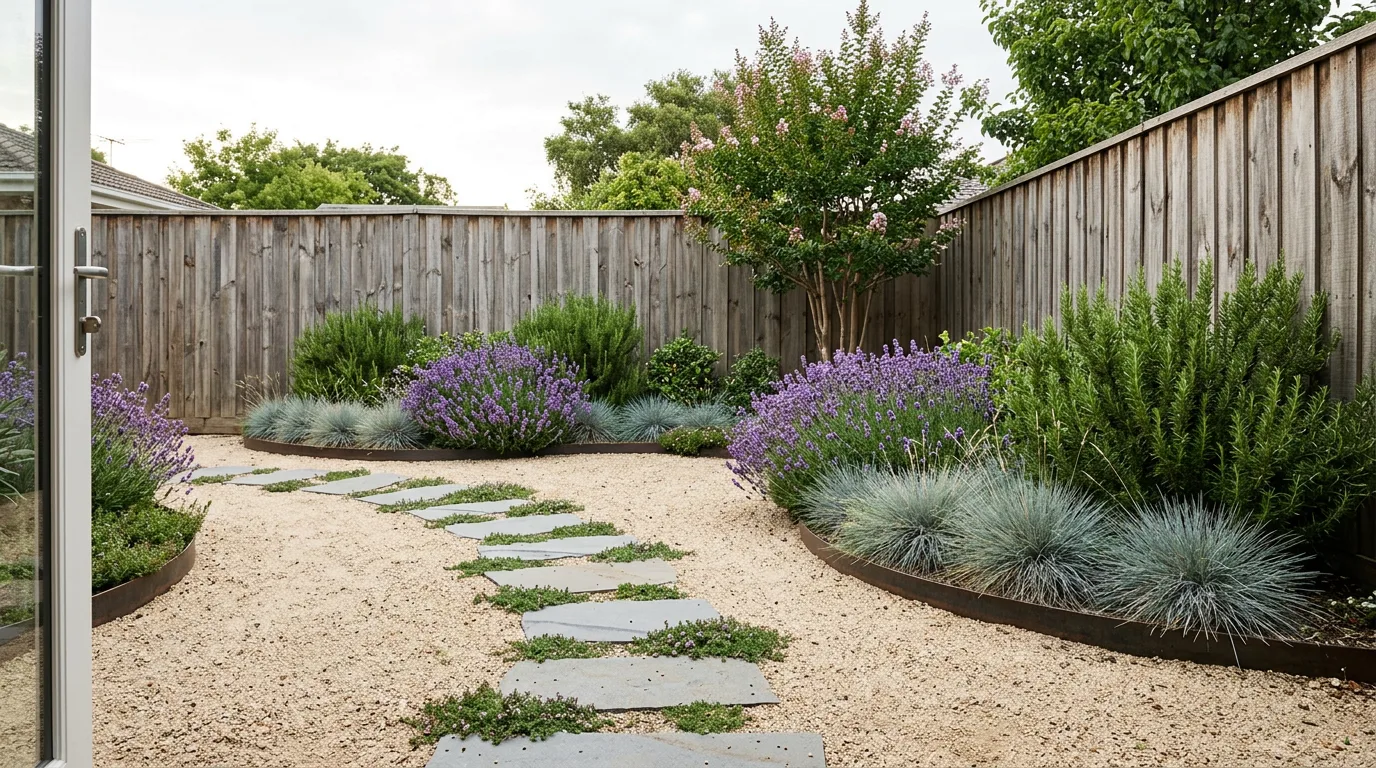
So the order of operations most people use — pick a look, then price it, then look for a rebate — is backwards. Check what your water provider will pay for first, because that decides which looks are even on the table. This guide covers the rules, the quantities you need to get real quotes, and how to choose by your site rather than by the photograph.
The rules that decide the design
Turf replacement rebates are not “here is money for removing grass.” They are payments for a specific outcome: a planted, permeable landscape that holds rainwater on site. Southern California’s SoCal Water$mart residential programme — the Metropolitan Water District’s base programme, covering roughly 19 million people — states its requirements plainly. Every project must include:
| Requirement | What it means for your plan |
|---|---|
| $2.00 per square foot, up to 5,000 sq ft per year | A 1,000 sq ft conversion is $2,000 back; the annual cap is worth $10,000 |
| 3 plants per 100 square feet of transformed area | A planted landscape, not a gravel field. 1,000 sq ft needs 30 plants |
| A stormwater retention feature | The ground has to hold rain — a swale, basin or depression, most often a rain garden sized to the soil |
| No hardscape in the transformed area except permeable hardscape | Poured concrete and sealed paving are out; open-jointed paving and gravel are in |
| Overhead spray sprinklers replaced or modified | The old irrigation has to change, not just get switched off |
| Synthetic turf is not an approved conversion option | Artificial grass earns nothing here |
Two of those are worth reading twice.
The plant density requirement is the whole design brief. Three plants per 100 square feet is not a decorative minimum — it rules out the single most popular image in this category, the tidy expanse of gravel with three boulders. If you want the rebate, gravel is the mulch between plants, not the finished surface.
Synthetic turf earns nothing. Every “landscaping without grass” list you will read puts artificial grass near the top. In the largest turf-conversion programme in the country it is explicitly excluded, because the programme is buying stormwater infiltration and habitat, and a plastic carpet on a compacted base delivers neither.
Rates and rules differ by provider and they change. Irvine Ranch Water District publishes $3 per square foot for its own customers. Many local agencies stack a supplemental amount on top of the Metropolitan base rate, and SoCal Water$mart notes that “rebate amounts are subject to change at any time and are based on availability at the time of application approval.” Check your own provider’s current terms, and apply before you remove anything — almost every programme requires pre-approval and a before photograph.
What each option actually involves
| Option | What it is | Rebate-eligible (typical) | Best for | The catch |
|---|---|---|---|---|
| Drought-tolerant beds | Massed perennials, shrubs and ornamental grasses over mulch | Yes — this is the intended outcome | Most of a front or back garden | Needs 1–3 years to fill in |
| Groundcover | Low spreading plants walked on lightly | Yes | Replacing lawn you barely use | Not a play surface |
| Moss | Shade groundcover, no mowing | Yes | Damp shade where nothing else works | Needs shade and moisture, not drought |
| Gravel / decomposed granite | Loose aggregate over a weed barrier | Only as mulch between the required plants | Paths, seating areas, joints | A bare gravel field usually fails the plant rule |
| Permeable paving | Open-jointed pavers, gravel-set flags | Permitted as permeable hardscape | Patios, routes, dining areas | Costs more than loose gravel; needs a proper base |
| Poured concrete | Slab or sealed paving | No — impervious | Nothing, in a conversion area | Sheds water instead of holding it; disqualifies the area |
| Synthetic turf | Plastic carpet on aggregate base | No, in SoCal Water$mart | Small dog runs, deep shade, roof terraces | Gets hot, has a replacement cycle, earns no rebate |
Why “just gravel it” is the expensive cheap option
Gravel looks like the budget answer and often is not, for three reasons that have nothing to do with the price of stone.
It forfeits the rebate on the area it covers if the planting density is not met. On 1,000 square feet in a $2.00 programme that is $2,000 you chose not to collect.
It does not stay clean. Loose aggregate collects leaf litter, that litter becomes soil, and soil grows weeds — on top of the membrane, where the membrane cannot help. A gravel area is a maintenance commitment; it is simply a different one from mowing.
It sheds heat. A pale aggregate surface in full sun re-radiates it into the house and makes the space unusable in the afternoon, which is the opposite of what most people want from a garden.
Gravel is genuinely good at what it is good at: joints between pavers, paths, the strip along a fence, and as a mulch around drought-tolerant planting. Our gravel landscaping ideas guide covers where it earns its place.
Synthetic turf, honestly
There are cases for it: a small dog run, a shaded strip where nothing grows, a roof terrace with a load limit. Outside those, the arithmetic is worse than it first appears, because artificial grass has a replacement cycle that real planting does not — we worked the full ten-year comparison in artificial turf vs real grass.
For this article the relevant point is narrower. If a rebate is part of how you are funding the project, synthetic turf is not just unrewarded, it can consume the area that would have earned the money. Price it as a full-cost, no-subsidy choice and see whether it still wins.
Choose by your site, not by the photograph
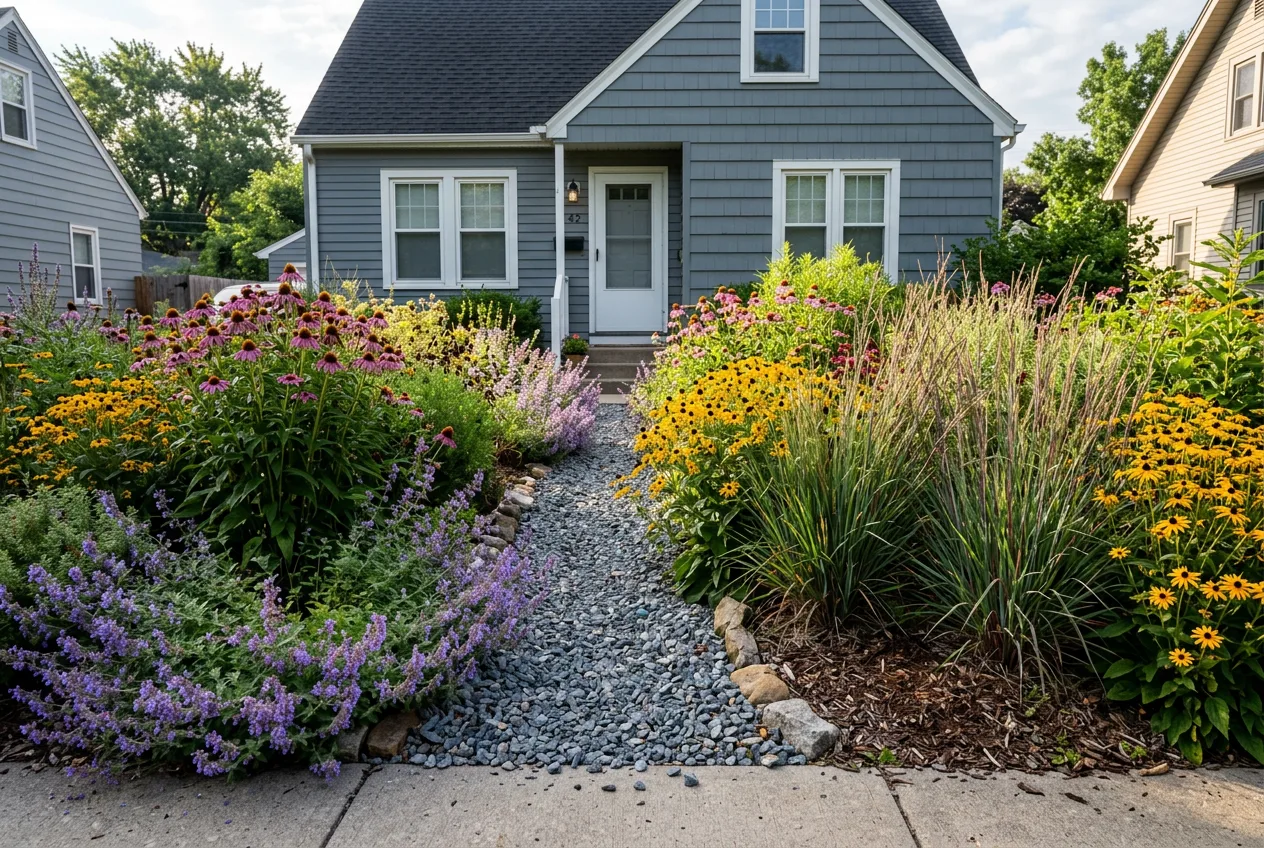
The photographs that sell this idea are almost all of sunny, flat, mild-climate front gardens. If it is the front garden specifically you are replacing, and you want the looks before the arithmetic, no-grass front yard ideas walks the styles — gravel, groundcover, meadow, mixed hardscape, succulent — with a worked example of each. This page is the decision and the numbers behind it. Six site facts matter more than the style:
How much sun does it get? Full sun opens the whole drought-tolerant palette. Deep shade closes most of it, and the honest answers there are moss, shade groundcover, ferns and a permeable surface. A “low-water” bed in deep shade fails slowly and confusingly.
Do children play on it? Nothing in this list takes hard running-and-falling use the way a lawn does. Keep a smaller lawn for the play area and convert the rest — a partial conversion is still rebate-eligible and usually the better design.
Do you have dogs? Dog urine burns most groundcover and kills moss; gravel gets into paws and dogs dig in loose mulch. The workable answers are a durable permeable surface on the routes dogs actually run, with planting protected behind an edge.
Does it slope? Loose gravel migrates downhill and mulch washes off. A slope wants planting with roots, terracing, or both.
How hot does it get? This decides how much pale hard surface you can stand near the house.
What are your water rules? Restrictions change the maths entirely, and a rebate can move a scheme from unaffordable to obvious.
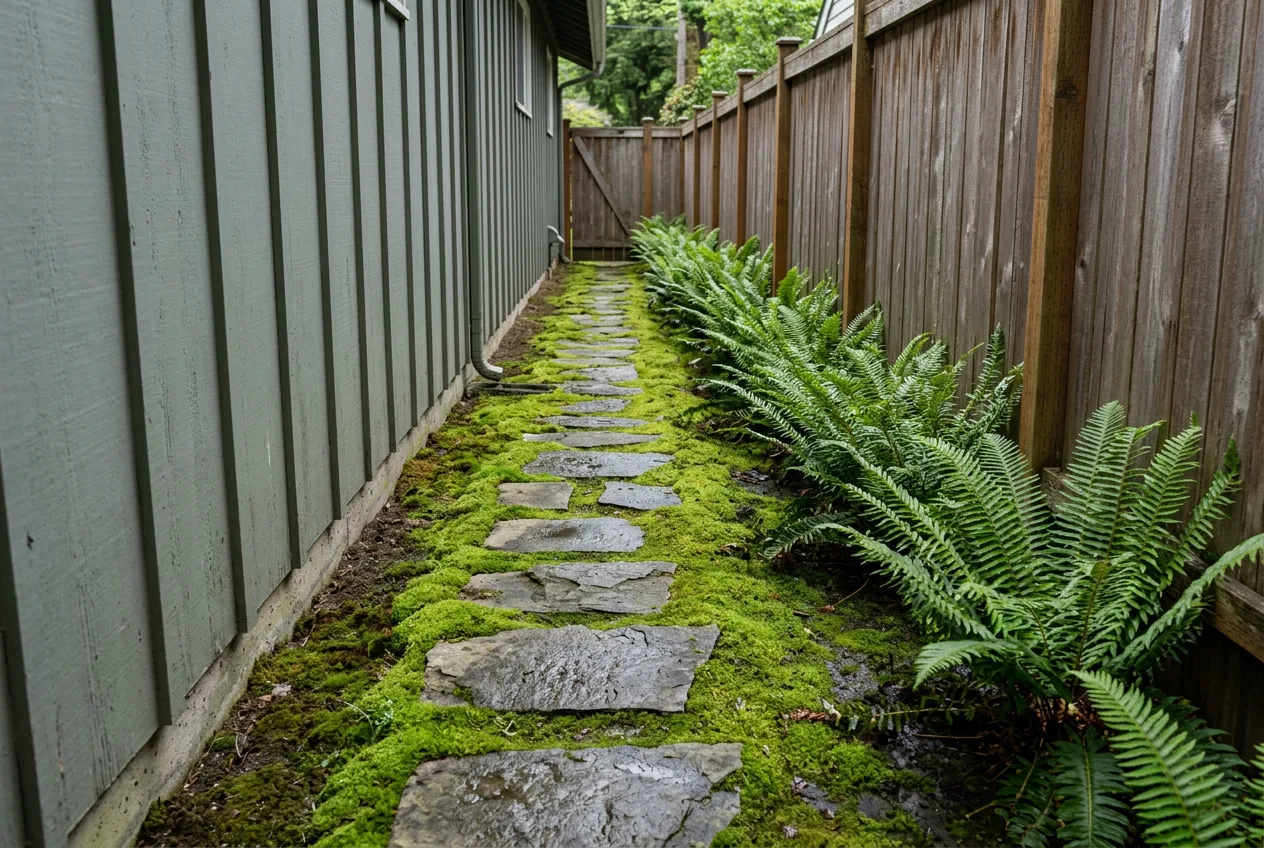
Whatever you choose, the species have to survive where you actually live. Check any plant against your own hardiness zone, rainfall and sun exposure before you buy thirty of it — our drought-tolerant plants by region guide and native plants for pollinators are the starting points, and ground cover plants instead of grass covers the walkable options. In a genuinely arid climate, read desert landscape design first: the plant list is different and the mistakes are more expensive.
The water case, in real numbers
The reason these programmes exist is that outdoor water use is the largest discretionary block in a household’s consumption. According to the EPA’s WaterSense programme:
- Outdoor use is more than 30% of total household water use on average, and as much as 60% in arid regions.
- As much as 50% of the water used outdoors is lost to wind, evaporation and runoff from inefficient irrigation.
- A household with an automatic irrigation system that is not properly maintained and operated can waste up to 25,000 gallons a year.
Nationally, EPA puts residential outdoor water use at nearly 8 billion gallons a day, mainly landscape irrigation, and notes that the average American household uses more water outdoors than for showering and washing clothes combined.
That last comparison is the useful one for a decision at home. The water a lawn drinks is not a rounding error against the rest of the house; it is bigger than two of the things you think of as your main water use.
The four numbers you need before you ask for quotes
Contractors quote conversions per square foot, and the quotes are not comparable unless you have specified the same thing. Measure the area you are converting and work out these four. The arithmetic is simple and it is the same arithmetic the supplier will do:
| Converted area | Gravel or mulch at 3″ depth | Plants at 3 per 100 sq ft | Rebate at $2.00/sq ft |
|---|---|---|---|
| 500 sq ft | 4.6 cubic yards | 15 | $1,000 |
| 1,000 sq ft | 9.3 cubic yards | 30 | $2,000 |
| 2,000 sq ft | 18.5 cubic yards | 60 | $4,000 |
| 5,000 sq ft (annual cap) | 46.3 cubic yards | 150 | $10,000 |
To work your own: cubic yards = area in square feet × depth in feet ÷ 27, so 3 inches is × 0.25 ÷ 27. Plant count at the SoCal Water$mart density is area ÷ 100 × 3.
Then ask each quote to separate four line items: removal and disposal of the existing turf, soil preparation, the plants (species and container size, not “planting”), and the surface with its depth and base build-up. A quote that bundles those into one per-square-foot figure is hiding which of them it has skimped on, and the one that gets skimped is almost always soil preparation — which is the one that decides whether your thirty plants are alive in three years. For broader budgeting, backyard makeover costs sets the context, and patio cost by material covers the paved portion.
See it on your own garden before you commit
The hardest part of removing a lawn is that you cannot picture the result, and a lawn is the one element every photograph of your garden already contains. This is worth solving before you spend, because the common regret is not the cost — it is converting the whole plot and discovering you wanted to keep a patch.
Upload photos of your yard to Hadaa and Garden Autopilot renders it as a lawn-free garden in your own climate, with plants checked against your hardiness zone rather than chosen for the picture. Try the version that keeps a small lawn beside the version that removes all of it, and see which one you actually want — before the turf goes in a skip.
Frequently asked questions
What is landscaping without grass called? Several things, and they are not synonyms. Xeriscaping is design for minimal irrigation, usually in an arid climate. Lawn conversion or turf replacement is the process of removing existing grass, and it is the term rebate programmes use. Lawn-free or no-lawn landscaping is the general description. Hardscaping means the built, non-living parts only.
Is landscaping without grass cheaper? Not to install — a planted, mulched conversion usually costs more up front than laying sod. It is cheaper to run, because there is no mowing and far less irrigation, and a rebate can offset a large part of the installation. Treat it as a cost moved from the running budget to the capital budget.
Do I need to remove the grass or can I cover it? Programmes typically require the turf to be killed or removed, verified with before-and-after photographs, and many accept sheet mulching as the removal method. Check the terms before you choose, because “cover it and hope” will usually void the rebate.
What works with dogs? Durable permeable surfacing on the routes they run, with planting behind an edge they do not cross. Avoid moss and delicate groundcovers, and expect to top up loose material where they dig.
How do I do this over a large area? In phases, and not at a uniform density. Plant the areas you see and use from the house properly, and treat the far reaches as rough ground — meadow, coarse groundcover, or mulched trees and shrubs that need no attention. Note that annual rebate caps like the 5,000 sq ft one push a very large conversion across two application years anyway.
Will it hurt resale value? A well-executed, clearly maintained lawn-free garden reads as a feature; a half-finished one reads as neglect. The risk is not the absence of grass, it is the appearance of abandonment — which is a reason to plant densely rather than sparsely, and to finish one area completely before starting the next. Our low-maintenance year-round garden guide covers keeping it looking deliberate in every season.


