
Low-Maintenance Landscaping: Upfront Costs vs. Long-Term Savings
Francis Karuri
Landscape & AI Correspondent
Low-maintenance landscaping costs more to install and far less to own. This guide quantifies the financial case — water bill savings, reduced maintenance hours, rebate capture, and long-term ROI — so you can evaluate the investment on numbers rather than assumptions.
Short answer
What does “no upkeep” landscaping cost?
Installation runs $6–$15 per square foot, or roughly $8,000–$25,000 for a standard yard — and the upkeep never reaches zero. Budget $200–$600 a year afterwards, against the $2,000–$5,000 a year a conventional lawn-and-border yard costs to own. That is the real trade: a one-off capital cost in exchange for an 80–90% cut in the annual bill, not an escape from it.
New Mexico State University’s Extension guide to xeriscape is blunt about the second half of that sentence: “Maintenance cannot be forgotten, even in a xeriscape.” It lists what survives every design decision you can make — “pruning, removing trash that has blown into the landscape, occasional weeding and pest management, checking that the irrigation system is functioning properly, and adjusting automatic irrigation systems as the seasons change” — and notes that “irrigation is necessary in a xeric landscape, at least during the first few years while the plants’ root systems are developing.” (NMSU Extension Guide H707)
So price a low-upkeep garden as install + a small permanent residual. The sections below put numbers on both, including the rebate that can cover a third of the install and the three conditions that most often disqualify it.
The financial case for low-maintenance landscaping
The standard objection to low-maintenance landscaping is cost: replacing a lawn or redesigning established planting requires a meaningful investment. The response is a different financial question — not "how much does it cost?" but "what does it save over 10 years?"
A typical US homeowner spends $2,000–$5,000 per year on landscaping maintenance when professional service, water, fertiliser, and pesticides are tallied honestly. Over 10 years, that is $20,000–$50,000. A well-designed low-maintenance landscape eliminates 70–90% of that spend after the upfront installation.
| Cost category | Standard landscape / yr | Low-maintenance / yr | Annual saving |
|---|---|---|---|
| Lawn mowing service | $800–$1,500 | $0–$200 | $600–$1,300 |
| Irrigation / water | $300–$800 | $50–$150 (establishment) | $250–$650 |
| Fertilising | $200–$500 | $0–$50 | $200–$450 |
| Weed control | $200–$600 | $50–$150 (mulch refresh) | $150–$450 |
| Seasonal replanting / annuals | $300–$800 | $0 | $300–$800 |
| Aeration / overseeding | $150–$400 | $0 | $150–$400 |
| Total annual saving | — | — | $1,650–$4,050/yr |
Break-even calculation
A $15,000 low-maintenance redesign saving $2,500/year breaks even in 6 years — and delivers pure saving for the remaining life of the planting. Most perennial and native plant schemes have a 20–30+ year lifespan with minimal renewal cost. The return accelerates in climates where water pricing rises with drought frequency.
10-Year Cost Comparison: Traditional vs Low-Maintenance
The annual table above shows the yearly gap. Compounded over a decade, that gap is what decides the investment. The table below models the full 10-year cost of ownership for a standard 1,500 sq ft US residential yard — including the upfront installation the low-maintenance option requires — so the two paths can be compared on total cost, not just the sticker price of year one.
| Cost category (10-year total) | Traditional lawn | Low-maintenance | 10-year saving |
|---|---|---|---|
| Lawn care / mowing | $8,000–$15,000 | $0–$2,000 | $6,000–$13,000 |
| Water / irrigation | $3,000–$8,000 | $500–$1,500 | $2,500–$6,500 |
| Fertiliser & weed control | $4,000–$11,000 | $500–$2,000 | $3,500–$9,000 |
| Seasonal replanting / annuals | $3,000–$8,000 | $0 | $3,000–$8,000 |
| Plant / turf replacements | $1,500–$3,000 | $500–$1,500 | $1,000–$1,500 |
| Upfront installation | $0 (existing) | $8,000–$20,000 | −$8,000 to −$20,000 |
| Net 10-year position | $19,500–$45,000 | $9,500–$27,000 | $8,000–$26,000 saved |
Figures are cumulative, undiscounted 2026 US pricing for a standard 1,500 sq ft yard; local rates and any rebate capture shift the ranges. The pattern holds across almost every scenario: even after absorbing the full installation cost, a low-maintenance yard finishes the decade thousands of dollars ahead — and that advantage keeps compounding, because native and perennial schemes typically run 20–30+ years before major renewal.
The single biggest lever within the table is lawn area. Removing turf cuts mowing, water, fertiliser, and weed control simultaneously, which is why a no-grass front yard is often the fastest route to the lower column.
Water savings: the biggest lever in dry climates
Outdoor irrigation typically accounts for 30–60% of residential water use. In dry-summer climates (California, Arizona, Colorado, Nevada), a standard lawn can consume 30,000–50,000 gallons per year. Converting to drought-tolerant native planting reduces outdoor water use by 50–70% and often more once plants are established.
Water saving by region (1,500 sq ft yard, 10-year estimate)
- California (Southern): Average outdoor water saving of $400–$900/year after conversion. With tier-2 and drought-surcharge pricing, savings can reach $1,200–$1,800/year during drought periods. 10-year water saving: $4,000–$15,000.
- Arizona / Nevada: Similar to Southern California. High base water costs and frequent drought restrictions make the financial case compelling. Many municipalities mandate water-wise landscaping for new construction.
- Texas, Colorado: Water costs vary significantly by municipality. Savings of $200–$600/year are typical. Rebate programmes are increasingly available through local utilities.
- Northeast, Pacific Northwest: Lower irrigation dependency reduces the financial return from drought-tolerant planting. The maintenance labour saving remains significant, but water savings are smaller. Prioritise reducing mowing area as the highest-ROI change in these climates.
Maintenance savings: the value of your time
Professional garden maintenance costs $50–$100 per hour. DIY maintenance is "free" only if you assign no value to your time — an assumption worth questioning when the average US homeowner spends 4–6 hours per week on yard maintenance during growing season.
At a modest personal time value of $25/hour, 5 hours per week over a 26-week season equals $3,250 in implicit annual cost. A low-maintenance landscape reduces active maintenance to 15–20 hours per year — a time saving of 110+ hours annually, worth $2,750 at the same rate.
Eliminating annuals
Replacing annual beds with established perennials removes the entire cycle of seasonal replanting — typically 10–15 hours per year of planting, watering, and removal. Annual seed and plant costs ($200–$600/year) are also eliminated. Perennials return without intervention; many self-seed and expand over time.
Reducing lawn area
Every 500 sq ft of lawn replaced with planting beds saves approximately 20–25 mowing passes per year, or 8–12 hours of mowing time. In a professionally maintained yard, that is $400–$600 annually. In a DIY yard, it is 8–12 hours returned to you every growing season.
Mulching to suppress weeds
A 3–4 inch layer of organic mulch (wood chip, bark) applied once in spring suppresses 70–85% of annual weed germination. The mulch breaks down and improves soil structure over time, reducing irrigation need further. Cost: $200–$500 for a standard residential yard annually. Return: 20–40 hours of weeding time eliminated.
“No upkeep” landscaping: what the residual actually costs
Almost everything written about low-maintenance landscaping prices the install and stops. The question people actually type is whether upkeep can reach zero, and the honest answer is that it cannot — which is worth knowing before you choose materials, because the two popular routes to “zero” both carry costs that no quote itemises.
Extension horticulturists are unusually direct on this point. New Mexico State University’s xeriscape guide states that “maintenance cannot be forgotten, even in a xeriscape” and that “any garden will require some maintenance.” So the useful figure is not an install cost but a permanent annual residual: what you still spend once the garden is established.
| What never goes away | Why it persists | Typical annual cost |
|---|---|---|
| Mulch depth | Organic mulch decomposes; below about 3 inches it stops suppressing weeds | $150–$400 |
| Pruning and shaping | Woody plants keep growing; density is what keeps weeds out, so it has to be managed | $0–$300 |
| Irrigation checks | NMSU lists “checking that the irrigation system is functioning properly, and adjusting automatic irrigation systems as the seasons change” | $50–$150 |
| Occasional weeding and pest management | Reduced by dense planting, never eliminated by it | $0–$200 |
| Establishment watering (years 1–3 only) | “Irrigation is necessary in a xeric landscape, at least during the first few years while the plants’ root systems are developing” | $100–$300 |
Route 1: gravel instead of planting
The cheapest apparent route to zero, and the one with the least-discussed penalty. NMSU warns that “rock mulch becomes very hot in our climate and can injure or limit the growth of some plants” — so a gravel field around planting can cost you the planting. Gravel also still needs depth: Colorado State Extension puts wood chips and pea gravel alike at 3–4 inches, and weed fabric beneath only works where the covering is at least that thick. Gravel does not decompose, which is its genuine advantage; weed seed blowing into it is the recurring job instead.
Route 2: synthetic turf
Genuinely low-upkeep, and the route that loses you the rebate. The SoCal Water$mart programme states that “synthetic turf is not an approved conversion option for this program”, so a 2,000 sq ft conversion forfeits the $4,000 a planted conversion would have earned — which has to be added to the install price before the two options can be compared at all. Our 10-year comparison of artificial turf against real grass works that arithmetic through.
The mistake that quietly costs the most
Topping up mulch without checking the depth first. UMass Extension’s guidance is that you should check the depth before replenishing each season, and that some old mulch may need removing before new is added — because laying fresh mulch over old year after year amounts to applying far too deep a layer all at once. Mulch that is too deep weakens trees and shrubs and stops water and air reaching the soil, which turns an annual $200 job into replacement planting. The residual above assumes depth is measured, not guessed.
Rebates and incentives: reduce your upfront cost
Utility and municipal rebate programmes for water-wise landscaping are widely available in drought-affected regions and are frequently under-claimed. Always research available rebates before starting any low-maintenance landscaping project — they can materially reduce installation cost.
- California: the Metropolitan Water District’s SoCal Water$mart turf replacement programme pays a flat $2.00 per square foot, and the ceiling is an area limit rather than a dollar one: up to 5,000 sq ft of converted yard per year, so $10,000 at the base rate. A 2,000 sq ft lawn removal is therefore $4,000 before any local top-up, plus $100 per tree planted to a maximum of five trees. Your own water agency may add to the base rate — LADWP, for one, runs a higher local programme — so the $1–$3 range quoted on most listicles is really “$2.00 plus whatever your agency adds”. (SoCal Water$mart programme terms)
- Arizona / Nevada: Salt River Project, SNWA, and local municipalities offer similar per-square-foot rebates. Some include bonus rebates for specific drought-tolerant species or certified water-wise contractors. Check with your specific utility for current rates.
- Texas and Colorado: SAWS (San Antonio), Aurora Water, and others offer rebates for grass removal and water-efficient irrigation upgrades. In Texas the more valuable protection is not a rebate at all but a statute: Property Code §202.007 says a property owners’ association “may not include or enforce a provision… that prohibits or restricts a property owner from… using drought-resistant landscaping or water-conserving natural turf”, along with rain barrels, drip irrigation and composting — and any covenant that does is void. Read the exceptions before you buy materials, though: the same section expressly does not stop an association “from regulating the installation or use of gravel, rocks, or cacti”. (Tex. Prop. Code §202.007)
- National: EPA WaterSense products (irrigation controllers, valves) qualify for utility rebates in many markets. The IRA (Inflation Reduction Act) does not directly cover landscaping, but some state-level energy and water efficiency programmes include related incentives.
What actually disqualifies a claim
Always apply before starting work. SoCal Water$mart runs a two-part application: you must apply to reserve rebate funds before the project starts, and you then have 180 days to finish. Removing the lawn first disqualifies the claim outright.
The conditions that catch people out are the design ones, not the paperwork. On the SoCal Water$mart terms the converted area must carry three plants per 100 square feet, may contain no hardscape except permeable hardscape, must include a stormwater retention feature such as rainwater capture or filtration, and overhead spray sprinklers must be converted to drip, hand-watering or another efficient alternative. Each qualifying tree counts as three plants toward the plant total.
And the big one: synthetic turf does not qualify. The programme states plainly that “synthetic turf is not an approved conversion option for this program”. If you are weighing artificial grass as the lowest-upkeep option, price it without the rebate — which changes the comparison substantially. Rebate rates are also subject to change and depend on funding available when your application is approved, so confirm the current rate with your own agency rather than with any guide, this one included.
Plant selection: the foundation of low-maintenance success
The highest-ROI decision in any low-maintenance landscape project is plant selection. The wrong plants require ongoing irrigation, fertilisation, and pest management regardless of how low-maintenance the design intent was. The right plants — regionally appropriate natives and adapted perennials — become self-sustaining after establishment.
Principle 1: Match plant to place, not aesthetic preference
A Mediterranean lavender in a humid Southeast climate will struggle, require supplemental treatment, and die early regardless of how well it suits the design brief. A plant that is native to or naturally adapted to your climate zone performs with zero additional inputs. Zone-matched planting is not a constraint — it is the mechanism that makes low-maintenance possible.
Principle 2: Prioritise woody plants over herbaceous
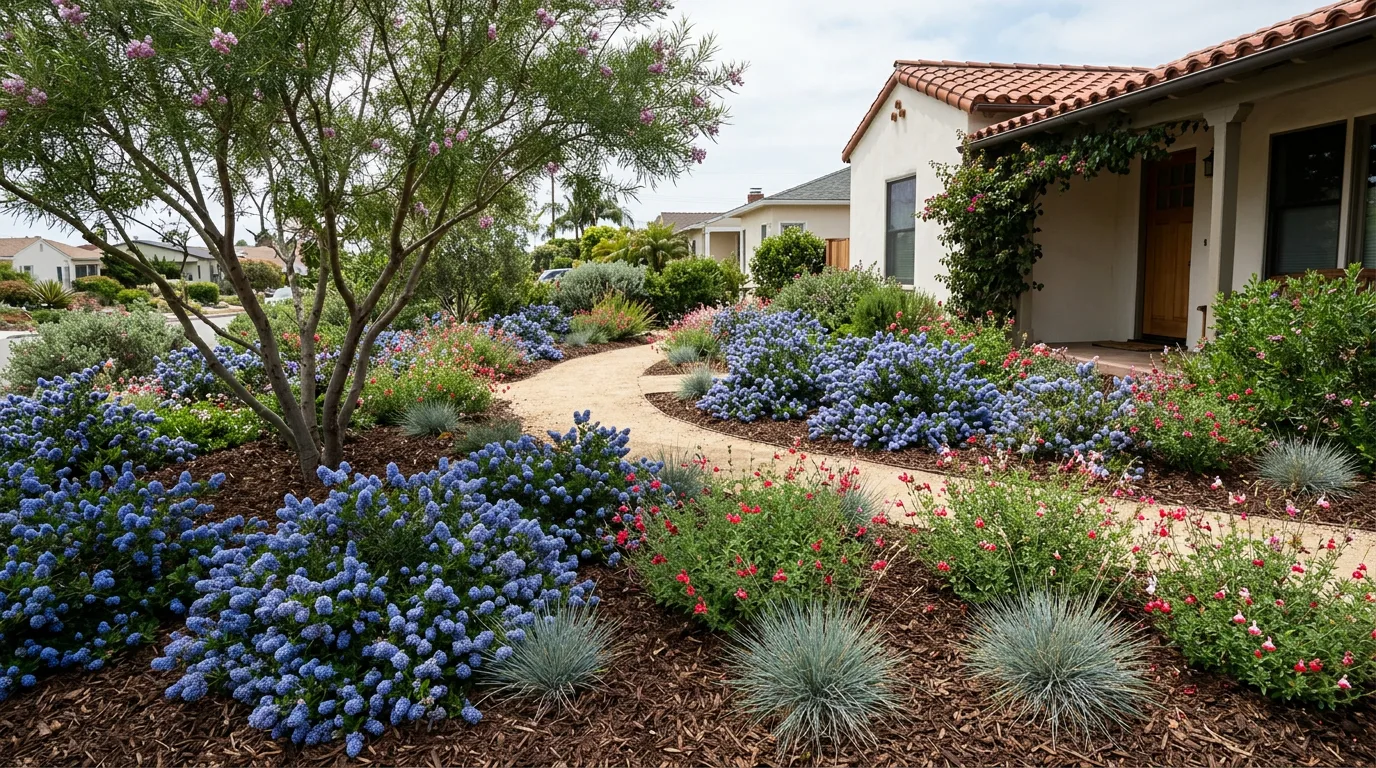
Shrubs and small trees require a larger upfront investment than perennials but provide structure, privacy, and visual mass with minimal annual maintenance once established. A well-placed Ceanothus, Salvia greggii, or ornamental grass eliminates the seasonal replanting cycle permanently. Perennial-dominant schemes are lower-maintenance than annual-dominant but still require occasional division and deadheading; woody plant-dominant schemes approach true low-maintenance status.
Principle 3: Design for density
Sparse planting creates weeding maintenance as the gaps between plants provide germination opportunities for weeds. A dense, ground-covering planting plan — where plants are spaced to close canopy at maturity — eliminates most weeding. This requires correct plant spacing based on mature size, which is a common source of error in self-designed gardens.
The phased approach: manage cost without losing momentum
A full low-maintenance landscape conversion does not need to happen all at once. A phased approach spreads cost over 2–4 years while delivering maintenance savings from phase one onward. The key is sequencing phases by return on investment — tackling the highest-saving areas first.
Recommended phasing sequence
Phase 1: Remove high-water-use lawn ($4,000–$8,000)
Target the largest irrigated lawn area first — this delivers the fastest water and mowing savings. Replace with mulched native planting or drought-tolerant ground cover. Apply for utility rebates before this phase begins.
Phase 2: Convert annual beds to perennials ($2,000–$5,000)
Replace all seasonal annual planting with established native perennials and woody shrubs. This removes the replanting labour cycle entirely. Mulch between plants at 3–4 inches depth to suppress weeds through establishment.
Phase 3: Upgrade irrigation to drip or smart control ($1,500–$4,000)
Drip irrigation delivers water directly to root zones, eliminating the evaporation waste of overhead sprinklers (30–50% of overhead irrigation is lost to evaporation). Smart controllers with soil moisture sensing reduce irrigation run time by 30–50% versus timer-only systems.
Phase 4: Add structural features ($3,000–$8,000)
Hardscape paths, stepping stone routes, and defined bed edging reduce ongoing maintenance by eliminating edge trimming and preventing grass invasion into planted areas. These features also improve the design's longevity and visual clarity as plants mature.
Plan before you plant: see the end state before work begins
The most expensive mistake in a phased landscape conversion is discovering in phase 3 that phase 1 was in the wrong place. Low-maintenance landscape design requires a clear vision of the intended end state before any single plant is installed — so that each phase builds toward the same outcome.
Hadaa's AI landscape design tool generates photorealistic renders of drought-tolerant planting schemes, reduced-lawn configurations, and native planting designs in your specific yard — from a single photo upload. You can visualise the intended outcome across all four phases before committing to a contractor or a plant order.
This is particularly useful when evaluating low-maintenance alternatives that look sparse in plant lists but dense and visually rich at maturity. Renders showing the planting at 3-year maturity help justify the investment to yourself and to any co-decision-makers, and help you brief contractors with precision.
Frequently Asked Questions
How much does low-maintenance landscaping cost upfront?
How much can I save on water by switching to drought-tolerant landscaping?
What plants require the least maintenance in a garden?
Do I need to irrigate drought-tolerant plants?
Are there rebates available for low-maintenance landscaping?
How long does it take for drought-tolerant landscaping to establish?
What is the cheapest way to make a yard low maintenance?
Can AI landscape design help me plan a low-maintenance yard?
Does low-maintenance landscaping actually save money over 10 years?
What has the highest maintenance cost in a traditional yard?
Plan your low-maintenance redesign
See your drought-tolerant landscape before you plant a single thing.
Upload a photo of your yard and generate photorealistic renders showing low-maintenance planting alternatives — native ground covers, reduced-lawn designs, and mulched planting schemes in your actual outdoor space.


