
Low-Maintenance Plants for Your Yard: Designer-Approved Picks That Actually Survive
The best low-maintenance plants are the ones whose Latin name you checked. Not the toughest species, not the most drought-tolerant — the ones you actually bought. Every list on the web, this one included until today, recommends plants by common name, and the common names collide: “Texas sage” is two different shrubs that differ by two hardiness zones and nine feet of mature height, and “boxwood” covers cultivars Virginia Tech rates from resistant to very susceptible to the disease that kills them. Below are the picks — ornamental grasses, drought-tolerant shrubs, evergreen ground covers and perennials — each with the species name, the extension-sourced zone range, and the mature size, plus the two-plants-one-name traps that make a correct list produce the wrong garden.
Francis Karuri
Landscape & AI Correspondent
Quick Answer
- Best ornamental grass (all zones): Feather Reed Grass — tall, narrow, year-round structure, minimal pruning.
- Best drought-tolerant shrub: autumn sage (Salvia greggii, zones 6a–9b) or, in zone 8 and warmer, cenizo (Leucophyllum frutescens, zones 8a–11b) — both handle heat and drought without complaint. Buy by the Latin name: both are sold as “Texas sage” and they differ by two zones and six feet.
- Best evergreen ground cover: Carex or Sedge — lush year-round, mounds beautifully, suppresses weeds.
- The real rule: Low-maintenance plants must match your USDA zone and site conditions. One zone over and your perfect plant dies.
- Visualize before planting: Use Hadaa's AI landscape design tool to see exactly how any plant looks in your yard before digging.
What Is Low-Maintenance Landscaping, Really?
The term “low-maintenance” gets thrown around a lot, usually to justify planting a monoculture of bark mulch and calling it done. Real low-maintenance landscaping is more nuanced.
A low-maintenance plant is one that thrives in your specific site conditions — your sun exposure, soil type, rainfall pattern, and USDA hardiness zone — without constant intervention. It won't need weekly watering, monthly fertilizing, or obsessive pruning. But it will need an initial investment: good site prep, proper planting depth, and a first-season establishment period where you water consistently.
After that? A mature low-maintenance landscape largely tends itself. You still rake leaves, deadhead spent flowers if you want repeat blooms, and divide perennials every few years. But the daily work — the obsessive watering, the pest sprays, the fertilizer applications — that goes away.
Low-Maintenance Plant Picks by Category
A resilient low-maintenance planting needs one reliable performer from each structural layer — a grass for vertical movement, an evergreen shrub for year-round bones, a groundcover to close the soil against weeds, and a perennial for seasonal colour. The species below are proven, zone-verified picks. Confirm your USDA hardiness zone falls inside each range before you buy.
| Category | Species | Zones | Why it's low-maintenance |
|---|---|---|---|
| Ornamental grass | Feather Reed Grass ('Karl Foerster') | 4–9 | One spring cutback; upright all winter |
| Ornamental grass | Little Bluestem | 3–10 | Drought-proof native; no feeding or division |
| Evergreen shrub | Boxwood ('Winter Gem') | 5–9 | Dense evergreen form; blight-resistant; shears once a year at most |
| Evergreen shrub | Inkberry Holly (Ilex glabra) | 4–9 | Native evergreen; tolerates wet soil and neglect |
| Groundcover | Creeping Sedum | 3–10 | Thrives on rainfall alone; suppresses weeds |
| Groundcover | Carex / Sedge | 4–9 | Evergreen mounds in shade; no cutback needed |
| Perennial | Autumn Joy Sedum | 3–10 | Four seasons of interest; one spring cutback |
| Perennial | Catmint (Nepeta) | 3–8 | Long bloom, deer-proof; shear once for a rebloom |
Build the layers, not a shopping list
Pick one grass, one evergreen shrub, one groundcover, and one perennial that all share your zone and sun conditions, then repeat them in drifts rather than dotting single specimens around. That layered, repeated structure is what makes a planting look intentional and — because dense planting shades out weeds — genuinely low-maintenance as it matures. For the grass layer specifically, our ornamental grasses guide goes species by species; for keeping something in interest in every month, see year-round garden plants.
Ornamental Grasses: The Foundation of Low-Maintenance Design
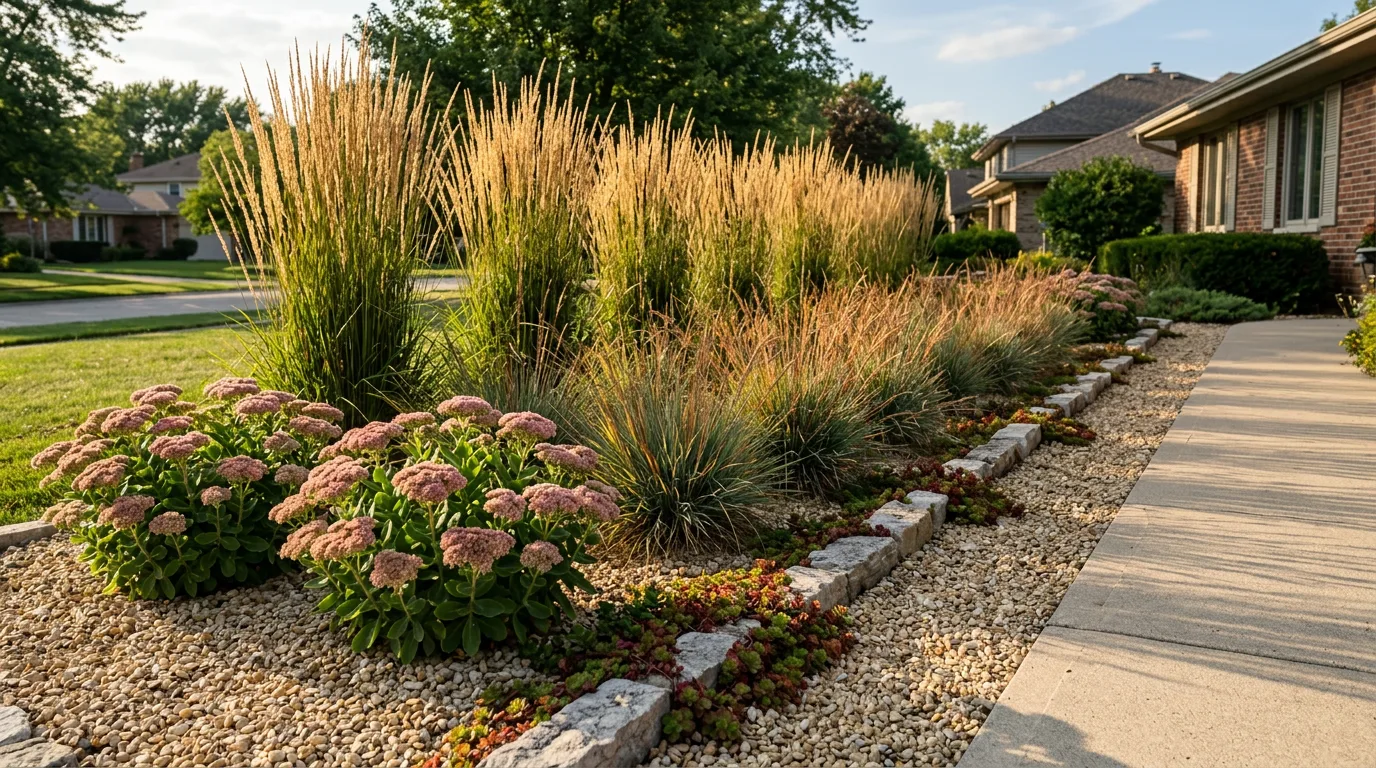
Ornamental grasses are the backbone of contemporary low-maintenance landscape design. They deliver year-round structure, require minimal pruning, and most tolerate drought, poor soil, and neglect. Their feathery texture and seasonal colour shifts make them visually interesting without demanding attention.
Feather Reed Grass (Calamagrostis × acutiflora 'Karl Foerster')
The gold standard for low-maintenance vertical architecture. Feather Reed stands ramrod straight from spring through winter, delivering visual weight to the back of beds. Feathery plumes emerge in mid-summer, golden-tan initially then bleaching to silver-white for months. One spring cutback — that's it. No deadheading, no division needed for years.
The award-winning 'Karl Foerster' cultivar is the most reliable version. Plant in groups of three or five for maximum visual impact, or use as an individual specimen in smaller yards.
Best For
Zones 4–9. Full sun locations. Privacy screens or tall borders. Anywhere you want winter structure without annual maintenance.
Prairie Dropseed (Sporobolus heterolepis)
A North American native that honestly outperforms almost every other grass in the low-maintenance category. Extremely tough, accepting poor soil, drought, and neglect. Plants establish quickly and get tougher every year. The fine, feathery foliage stays relatively neat even without pruning, though a spring cutback keeps it looking sharp.
The real reward? Fall colour that shifts from green to russet-orange to deep burgundy. And in late summer, impossibly delicate seed heads emerge, scenting the air like fresh popcorn. This is a grass that actually improves your landscape design without asking for anything back.
Best For
Zones 3–9. Dry, full-sun locations. Pollinator gardens and meadowy designs. Anyone in the Prairie or Mountain regions.
Little Bluestem (Schizachyrium scoparium)
The landscape chameleon. Starts blue-green in spring and summer, then transitions through orange to deep burgundy-red by autumn — a colour show that rivals any flowering perennial. Once established, it asks almost nothing: no supplemental water in most climates, no fertilizer, no division. Plant it and move on.
Little Bluestem works equally well in contemporary minimalist designs and casual cottage gardens. Its compact form fits smaller spaces, while its seasonal changes add visual depth throughout the year.
Best For
Zones 3–10. Dry, sunny locations. Cottage, meadow, or modern gardens. Anyone wanting dynamic seasonal colour without high maintenance.
Drought-Tolerant Shrubs: The Middle Layer
Shrubs create the structural backbone between ground covers and taller trees. Low-maintenance shrubs are compact, tolerate poor soil, and rarely need pruning. They create visual weight without demanding constant care.
If you are buying boxwood, buy by cultivar. Boxwood blight is in most of the eastern United States and no boxwood is immune to it, so the cultivar is the whole decision. Virginia Tech's Boxwood Blight Task Force lists ten selections as resistant or tolerant in research trials — Buxus microphylla 'Winter Gem', 'Wintergreen', 'Golden Dream', 'Northern Emerald' and 'Wedding Ring', B. microphylla var. japonica 'Green Beauty', B. sinica var. insularis 'Nana', 'Franklin's Gem' and 'Wee Willie', and B. harlandii 'Richard' — and ten as very susceptible, led by the dwarf English box B. sempervirens 'Suffruticosa' that most formal planting plans still specify. Cultivars on neither list, including the widely sold 'Green Velvet' and 'Little Gem', have simply not been trialled. Cornell's NYS IPM programme keeps a list of non-boxwood alternatives if you would rather sidestep the problem; inkberry holly (Ilex glabra) is the usual answer in the Northeast.
| Shrub | Zones | Height | Water Need | Key Feature |
|---|---|---|---|---|
| Autumn sage — Salvia greggii | 6a–9b | 2–3 ft | Very low | Hummingbird flowers spring to frost |
| Cenizo — Leucophyllum frutescens | 8a–11b | 6–12 ft | Very low | Flowers in flushes after humid weather |
| Boxwood — Buxus microphylla 'Winter Gem' | 5–9 | 3–4 ft | Low | Evergreen; on Virginia Tech's blight-resistant list |
| Autumn Joy Sedum | 3–10 | 18–24 in | Very low | Fall colour, winter structure |
| Caryopteris (Bluebeard) | 5–9 | 2–3 ft | Low | Blue flowers late summer |
| Ceanothus (California lilac) | 8–10 | 4–8 ft | Very low | Blue spring flowers |
| Dwarf Arctic Willow | 2–7 | 2–3 ft | Low | Compact, silvery foliage |
Autumn sage (Salvia greggii) — The Hummingbird Magnet
A 2–3 ft subshrub that flowers from spring until frost without coaxing — tubular red, pink, white or coral blooms depending on cultivar, and established plants get through a dry summer on rainfall alone. NC State Extension's plant record puts it at zones 6a–9b, 2–3 ft tall and wide, blooming spring, summer and fall, which is two zones hardier than most low-maintenance lists give it. If you garden in zone 6 or 7 and skipped it because a list said zone 8, it is back on your shortlist.
Extremely tough, tolerant of poor soil, and irresistible to hummingbirds and bees — it is a member of the mint family, Lamiaceae, so the foliage is aromatic when brushed. Minimal pruning; a light shear after the main bloom flush keeps it compact.
Buying note: this plant is sold as “Texas sage”, “autumn sage” and “cherry sage”. So is a completely different shrub. Check which one you are being handed before you plan a bed around it.
Two plants, one name: the “Texas sage” problem
Almost every low-maintenance plant list — including an earlier version of this one — names “Texas sage” as a drought shrub and then describes two different plants at once. The name belongs to both, and they are not in the same family, let alone interchangeable in a bed:
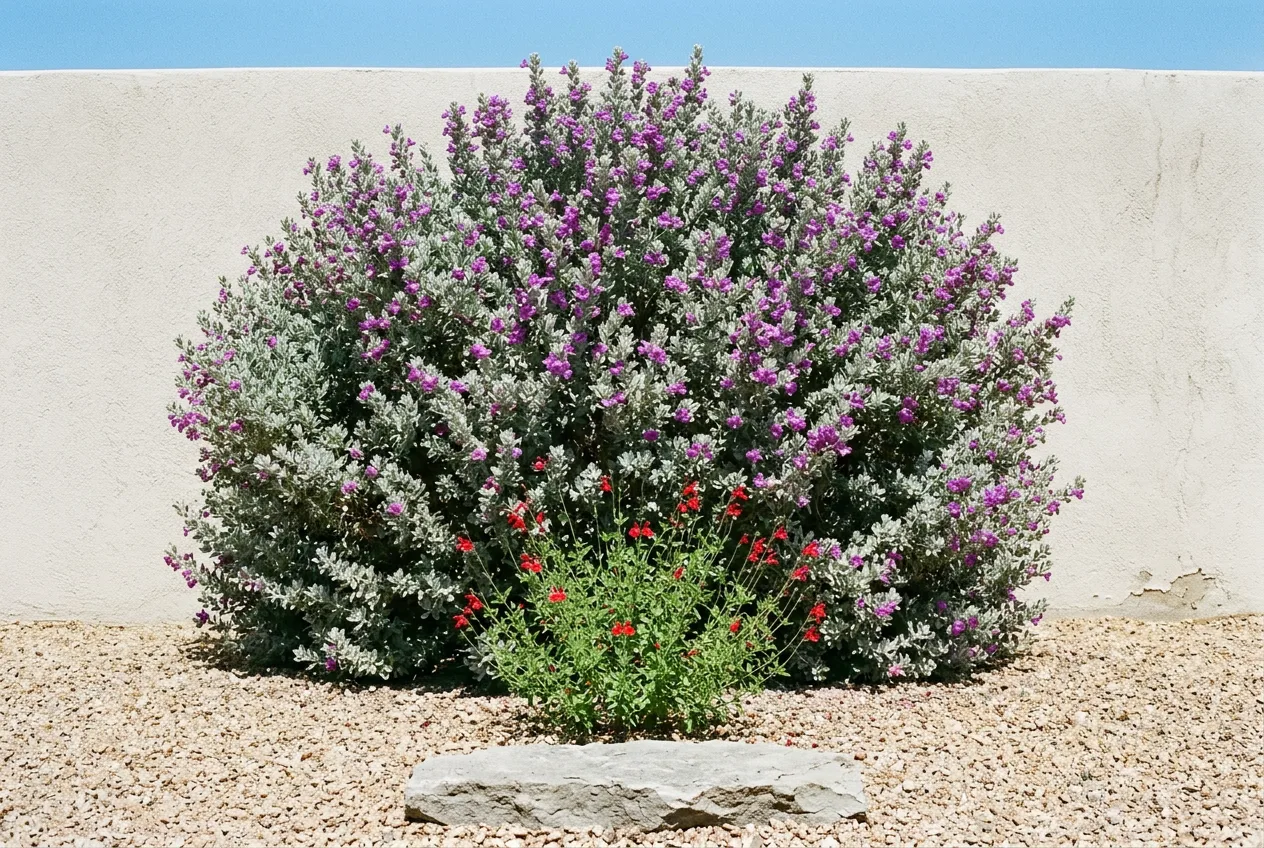
Both of these are sold as “Texas sage”. Cenizo is at the back; autumn sage is the knee-high plant in front of it.
| Autumn sage | Cenizo / barometer bush | |
|---|---|---|
| Latin name | Salvia greggii | Leucophyllum frutescens |
| Family | Lamiaceae (mint) | Scrophulariaceae (figwort) |
| USDA zones | 6a–9b | 8a–11b |
| Mature size | 2–3 ft tall and wide | 6–12 ft tall and wide |
| Flowering | Continuous, spring to frost | In flushes, after a rise in humidity or rain |
| Foliage | Small green aromatic leaves | Silver-grey, felted |
| Also sold as | Texas sage, cherry sage | Texas sage, purple sage, Texas ranger, silverleaf |
Both figures come from the same source, so they are directly comparable: NC State Extension's plant toolbox gives autumn sage zones 6a–9b at 2–3 ft and cenizo zones 8a–11b at 6–12 ft, noting of cenizo that “the blossom episodes seem to occur whenever a change in humidity detects the oncoming presence of rainfall” — which is why it is also called the barometer bush. Texas Tech's woody plant sheet lists the compact nursery selections at 3–5 ft in zones 7–9, so the size you get depends on the cultivar as well as the species.
What it costs you to get this wrong. Plan a 3 ft shrub and plant the species cenizo and it will reach for 6–12 ft, swallowing whatever is behind it. Plan a continuously flowering edging plant and plant cenizo and you get flowers in unpredictable bursts after humid spells, not all season. And if you are in zone 6 or 7, the version of this plant that is actually hardy for you is the Salvia — the one most lists put out of reach.
Neither plant is region-neutral, either: our drought-tolerant plant guide by region sorts the same shortlist by where you actually garden, and the USDA zone planting guide explains what a zone number does and does not promise.
The rule that fixes it: buy by the Latin name on the tag, not the common name on the sign. The same trap catches “dusty miller”, “snow on the mountain” and any of the dozen things sold as “sedum”. A nursery that cannot tell you the species is a nursery that cannot tell you the mature size.
Autumn Joy Sedum (Hylotelephium 'Autumn Joy') — The Four-Season Performer
The four-season champion. Spring emergence is lush green. By mid-summer, flat flower heads bloom in dusty pink. Autumn transforms the entire plant to deep burgundy-red. Winter? The dried seed heads remain architecturally interesting through snow. One spring cutback to 4 inches, that's all.
Virtually indestructible, tolerating neglect and poor soil that would kill finicky perennials. Attracts late-season pollinators. Works equally well in borders, containers, or front-yard focal points.
Evergreen Ground Covers: Weed Suppression + Beauty
The ground layer is where many landscapes fail — weeds take hold, bare soil shows, maintenance explodes. Strategic planting with evergreen ground covers solves all three problems simultaneously. When densely planted, they suppress weeds better than any mulch or herbicide.
Carex & Sedges — The Shade Heroes
Carex divulsa (Berkeley Sedge) and related species are the unsung heroes of shade landscaping. Sedges are technically not grasses, but occupy a similar ecological niche. They form dense, lush mounds of evergreen foliage that suppress weeds simply by existing — no special effort required.
When planted in drifts 12–18 inches apart, Carex creates an undulating carpet that looks intentional and polished. Unlike vining ground covers that sprawl unpredictably, sedges maintain clean mounding form indefinitely. Zero pruning, minimal watering after establishment, no seasonal cutback.
Pair with shade perennials like hellebores, epimedium, or hostas for layered texture.
Creeping Sedums — The Sun & Drought Specialists
Species like Sedum spurium (Tricolor), Sedum acre (Goldmoss), and Sedum rupestre (Copper Stonecrop) carpet bare soil while tolerating conditions where almost nothing else grows. Extremely low-growing, they're ideal for pathway edges, between pavers, or as living mulch around taller plants.
Many shift colour with the seasons — greens becoming bronzes and reds in cool weather. Drought tolerance is genuinely extreme; once established, they thrive on rainfall alone in most climates. A light trim or rake in spring removes any winter debris, but that's optional.
Five Core Principles of Low-Maintenance Design
1. Match Plants to Site, Not Site to Plants
The biggest maintenance killer is fighting your conditions. If you have shade, don't plant sun lovers and expect them to thrive on supplemental water. Choose shade-tolerant plants (sedges, hellebores, epimedium) that actually prefer your conditions. Same rule applies to soil type, moisture, and wind exposure. Low-maintenance means accepting your site and designing within those parameters, not against them.
2. Plant Densely from the Start
Sparse planting looks modern for about one season. By year two, weeds colonise every bare patch between plants. Dense planting — spacing plants closer together than you think comfortable — suppresses weeds through sheer plant mass. This mimics natural plant communities where unplanted areas are rare. Dense planting actually becomes less maintenance over time as plants mature and fill in.
3. Build Vertical Layers
Low-maintenance landscapes avoid monoculture. Use tall plants (Feather Reed, Little Bluestem), mid-layer shrubs (Autumn Joy sedum, autumn sage), and ground covers (Carex, creeping sedums) to create a stratified canopy. This layering is more visually interesting, better for wildlife, and means weeds have fewer gaps to exploit. Each layer plays a role; together they create a self-sustaining system.
4. Use Mulch Strategically
Mulch is one tool among many, not the whole strategy. A 2–3 inch layer of organic mulch (bark chips, compost) blocks weeds and retains moisture initially. But over time, mulch breaks down, weeds reclaim space, and your maintenance starts over. Dense planting is a better long-term strategy. Use mulch around newly planted areas to help establishment; replace it with self-sustaining ground cover as plants mature.
5. Limit Lawn Area
Lawns are the most maintenance-intensive part of any landscape — mowing, watering, fertilizing, weed control. If you want low-maintenance yards, reduce lawn to functional areas only (play space, seating zone). Replace decorative lawn with perennial borders, ground covers, or ornamental grasses. This single change reduces maintenance time by 70%+ on most residential properties.
Low-Maintenance Plants by Region
The same plant performs differently depending on climate. This list is organized by USDA zone range and regional climate. Find your zone at planthardiness.ars.usda.gov.
Northeast & Upper Midwest
- Prairie Dropseed — native, tough, popcorn scent
- Little Bluestem — prairie native, brilliant fall colour
- Feather Reed Grass — tall structure, winter interest
- Autumn Joy Sedum — 4-season performance, deer proof
- Caryopteris (Bluebeard) — blue flowers late summer, cut-back perennial
Mid-Atlantic & Ohio Valley
- Little Bluestem — native, extremely hardy
- Carex (sedges) — shade heroines, dense ground cover
- Autumn Joy Sedum — year-round interest
- Dwarf Arctic Willow — compact, silvery foliage
- Creeping Sedums — poor-soil specialists
Southwest, Texas, California
- Autumn sage, Salvia greggii — hummingbird flowers spring to frost, zones 6a–9b
- Deergrass (Muhlenbergia rigens) — West Coast native, year-round green
- Lantana — butterflies, blooms all summer with minimal water
- Desert Marigold (Baileya) — heat and drought expert
- Creeping Sedums — poor-soil specialists, extreme drought tolerance
Planting Low-Maintenance Plants: Getting Started Right
The First Year Matters
Low-maintenance plants are low-maintenance once established. The first year is an investment: proper site prep, good planting depth, and consistent watering during the establishment period (typically 6–8 weeks for perennials, up to one season for shrubs and grasses).
Planting depth is critical. Plant at the same depth the plant was growing in its nursery pot — not deeper, not shallower. Too deep and the roots suffocate; too shallow and they dry out. This single detail determines whether a low-maintenance plant stays that way or becomes a maintenance nightmare.
Watering Schedule During Establishment
First 2–3 weeks: water daily if rainfall is lacking.
Weeks 4–8: water 2–3 times per week, less if rain fills the gap.
After 8 weeks: begin weaning plants off supplemental water (unless your region is experiencing drought).
This establishment period allows roots to expand into surrounding soil. After that, even "very drought-tolerant" plants can survive on rainfall in most climates.
PRO TIP
Use Hadaa's AI landscape design tool to preview your low-maintenance planting design before committing. Upload a photo of your yard, use Smart Fix to type 'add drifts of Little Bluestem along the left fence' or 'plant Autumn Joy Sedum in groups of five', and see photorealistic renders showing exactly how those plants will look in your space. This eliminates guesswork and ensures you're buying the right plants in the right quantities.
Year-Round Maintenance Calendar
Spring (March–April)
Cut back ornamental grasses and sedums to 3–4 inches. Divide perennials as they break dormancy. Apply 2 inches of mulch around newly planted areas. No fertilizer needed for most low-maintenance plants.
Summer (May–August)
Water establishment plantings if rainfall is lacking. Deadhead any spent flowers to encourage more blooms (optional — leaving them provides seed for birds). Watch for weeds in mulched areas and pull by hand before they establish.
Fall (September–November)
Let ornamental grasses stand through winter for structure and wildlife habitat. Cut back dead perennials only if you want a cleaner winter look (leaving them provides shelter for beneficial insects). Do not prune shrubs or grasses in fall — they need that growth to harden off for winter.
Winter (December–February)
Let the landscape rest. This is the reward period for choosing low-maintenance plants — they look beautiful in winter with minimal effort. If you want winter interest, dried seed heads, evergreen foliage, and bark texture provide plenty of visual appeal.
Frequently Asked Questions
What makes a plant low-maintenance?
Are native plants always low-maintenance?
How do I know which plants will survive my climate zone?
Can I mix ornamental grasses with other plants?
What's the difference between evergreens and deciduous low-maintenance plants?
How much water do drought-tolerant plants need after planting?
Can I see what low-maintenance plants look like in my actual yard before planting?
Do I need to fertilize low-maintenance plants?
What low-maintenance plant should I pick from each category?
How many different plants do I need for a low-maintenance yard?
See your low-maintenance garden
Preview Ornamental Grasses & Drought Plants in Your Yard
Upload a photo of your yard and use Hadaa's Smart Fix to see exactly what Feather Reed, Little Bluestem, Autumn Joy, or any other low-maintenance plant will look like before you plant. Get photorealistic renders in 60 seconds. $9 per project — no subscription.


