
Plants for Hillside Gardens: 18 Slope-Ready Species
A steep slope looks like a landscaping problem. It is also an opportunity. The right plants transform an eroding, unusable bank into a layered, low-maintenance garden that holds soil, handles drought, and looks intentional from street level. This guide covers 18 species selected specifically for slope performance — grouped by form, with a zone and water-needs table at the end.
Quick Answer
- Best overall groundcover: Creeping Juniper — fast, evergreen, spreads without mowing.
- Best ornamental grass: Switchgrass — native, deep-rooted, four-season interest.
- Best shrub: Native Staghorn Sumac — aggressive spreader that colonises bare slopes.
- Critical threshold: Slopes steeper than 2:1 need erosion fabric or a retaining wall before planting.
- Invasive species to flag: Crown Vetch, Pampas Grass, Butterfly Bush, Japanese Spiraea and Miscanthus sinensis — effective but check your state's list. No M. sinensis cultivar has been shown reliably sterile; see the correction under Miscanthus below.
Why Slope Planting Is Different
Flat-ground planting guides assume water pools and percolates vertically. On a slope, water moves. At a gradient of roughly 5% (1 in 20), surface runoff begins. By 15% (1 in 7), sheetflow strips topsoil at measurable rates. Above 33% (1:3), bare soil loses several tons per acre per year in moderate rainfall climates — a number that compounds with every storm.
Timing matters more here than on the flat, because a slope planted late has no root mass when the winter rain arrives. Autumn is the window, and the trigger is soil temperature rather than the date. Where the runoff has somewhere flat to go at the foot of the bank, a rain garden absorbs what the planting sheds.
The physics are simple. Raindrops detach soil particles (splash erosion). Runoff carries those particles downhill (sheet erosion). Where water concentrates — at drainage paths, fence lines, the base of walls — it cuts channels (rill erosion). Once rills form, they concentrate more water, cut deeper, and the cycle accelerates. Standard turf grass interrupts this cycle on gentle slopes but fails once the grade exceeds about 25%, because mowing becomes unsafe, roots are shallow, and bare soil appears between blades.
The solution is not just ground coverage. It is root mass. Plants with deep, branching fibrous roots create a three-dimensional matrix that binds soil particles together and absorbs water before it becomes runoff. Leaf canopy intercepts raindrop energy. Litter and mulch slow surface flow. A well-planted slope is essentially a sponge with structure.
Steepness thresholds that matter in practice:
- Up to 3:1 (18°): Standard planting without erosion fabric. Most groundcovers work. Mowing is feasible.
- 2:1 (27°): Use biodegradable erosion netting during plant establishment. Shrubs and spreading groundcovers preferred. No lawn.
- 1:1 (45°): Retaining walls or terracing required first. Plant pockets within the structure.
- Steeper than 1:1: Engineering solution before any planting. See our guide to retaining wall ideas for the hardscape side.
Water-pooling at the slope base is a separate problem. Where a slope flattens into a lawn or patio, runoff concentrates. Choose plants at the toe of the slope that tolerate periodic wet feet — a criterion that eliminates many drought-tolerant species and explains why planting the bottom third of a slope often requires different species than the top two-thirds. For the full context on slope landscaping costs and approaches, our hillside landscaping ideas guide covers the broader picture.
How Deep-Rooting Plants Hold Soil
A slope can fail in two completely different ways, and the plant that fixes one barely touches the other. Surface erosion is rain detaching soil grains and runoff carrying them off the face. Shallow mass movement — slumping — is a block of saturated soil sliding off on a failure plane a foot or two down. Most hillside planting lists grade plants on one axis, as if a single “erosion rating” covered both. It does not.
The USDA Natural Resources Conservation Service draws the line explicitly in its own engineering handbook: “Herbaceous vegetation, especially grasses and forbs, offers long-term protection against surface (water and wind) erosion on slopes. It provides only minor protection against shallow mass movement.” Woody plants are the other half: “More deeply rooted woody vegetation provides greater protection against shallow mass movement by: mechanically reinforcing the soil with roots; depleting soil-water through transpiration and interception; buttressing and soil arching action from embedded stems” (NRCS, National Engineering Handbook Part 650, Chapter 18: Soil Bioengineering for Upland Slope Protection and Erosion Reduction, 2nd ed. 2021).
Two things follow, and they are the opposite of the usual advice. First, the mechanism by which roots dry a slope out is transpiration, not hydraulic lift — hydraulic lift is the reverse process, in which roots move water from moist deep soil up into dry surface soil overnight, and it does nothing for stability. Second, a 6-inch mat of groundcover is the best thing you can own against splash and sheet erosion and close to irrelevant against slumping, because the failure plane sits below it. Research on root reinforcement finds that landslide shear planes tend to occur near the limit of rooting depth, where there are few roots left to cross them.
The practical implication: read your slope's symptom before you choose plants. Rills, fans of silt at the bottom of the bank, exposed plant crowns and a thinning surface are surface erosion — plant the spreading mats, at 18-inch centres, and they will fill in within two seasons. Crescent-shaped cracks near the top of the bank, a bulge or step part-way down, tilted fence posts or trees leaning out of the slope are mass movement — that needs woody roots through the failure plane, and if the signs are active it needs an engineer before it needs a plant list.
| Plant Type | Typical Root Depth | Spread Pattern | Surface erosion | Slumping |
|---|---|---|---|---|
| Spreading groundcovers | 6–18 in | Dense horizontal mat | Excellent | Minor |
| Ornamental grasses | 12–36 in | Clump + rhizomes | Excellent | Minor |
| Shrubs | 18–48 in | Woody framework | Good | Best available |
| Tap-rooted perennials | 12–24 in (single) | Clump, no spread | Good (in mass) | Minor |
| Turf grass | 2–6 in | Shallow mat | Adequate <18° | None |
Groundcovers
Low-growing, spreading species that form continuous cover quickly. Best used on the upper two-thirds of a slope where drought stress is highest.
1. Creeping Juniper (Juniperus horizontalis)
Spreads 6–8 feet wide, roots at branch nodes, and tolerates drought, poor soil, and full sun. Evergreen needles provide year-round cover. One of the most reliable slope groundcovers in zones 3–9. Extremely low maintenance once established — no mowing, no deadheading.
2. Crown Vetch (Coronilla varia)
Extremely fast-establishing, nitrogen-fixing, and produces pink flowers through summer. Root systems reach 24 inches and spread aggressively by rhizome. Highly effective for large bare slopes in zones 3–9.
Check local invasive status — Crown Vetch is listed as invasive or noxious in many US states and should not be used near natural areas.
3. Cotoneaster (Cotoneaster horizontalis and relatives)
Spreading deciduous or semi-evergreen shrub that forms a layered, herringbone mat 2–3 feet tall. Red berries attract birds in autumn. Tolerates clay, slopes, and partial shade. Zones 4–7. Growth habit naturally follows contours, making it visually suited to sloping ground.
4. Bearberry (Arctostaphylos uva-ursi)
Native North American groundcover, 6–12 inches tall, spreading to 4 feet or more. Exceptionally deep-rooted for its size, tolerates sandy or rocky poor soils, salt exposure, and harsh winters (zones 2–6). Small white flowers in spring, red berries through autumn, glossy evergreen leaves.
5. Ice Plant (Delosperma spp.)
Dense succulent groundcover with vivid magenta or yellow flowers. Extremely drought-tolerant once established. Forms a tight mat that resists both erosion and foot traffic. Best in zones 9–11 (West Coast, Southwest). In colder zones, treat as an annual or choose cold-hardy hybrids down to zone 5.
6. Pachysandra (Pachysandra terminalis)
The workhorse groundcover for shaded slopes. Spreads by underground stems, forming a uniform 8–10 inch carpet that outcompetes weeds once established. Zones 4–8. Consistent moisture needed during establishment; drought-tolerant afterwards. Use the native Pachysandra procumbens if planting near woodland edges for better ecological value.
Ornamental Grasses
Grasses move in wind, provide four-season structure, and have root systems deeper than their above-ground height. Mass plantings on slopes create strong horizontal rhythm that reads well from below.
7. Blue Oat Grass (Helictotrichon sempervirens)
Striking steel-blue, evergreen clumps 2–3 feet tall. Drought tolerant in zones 4–8. Dense fibrous roots hold their soil column well. Looks best planted in repeating clusters of 3–5 down a slope face.
8. Miscanthus (Miscanthus sinensis)
Large, architectural clumps 4–8 feet tall with silky plumes in late summer. Root systems reach 30–36 inches. Zones 5–9. Annual cutting to the ground in late winter keeps it tidy.
Correction, and read this before you buy: this guide previously told you to pick a “non-seeding or sterile” cultivar such as 'Morning Light' or 'Gracillimus'. That is not supported by the only trial that counted the seed. Miscanthus sinensis is listed invasive in more than twenty states, so the cultivar choice is the whole safety question — and when the Chicago Botanic Garden X-rayed the inflorescences of its Miscanthus trial, viable seed per plant ran “from as few as 497 ('Dixieland') to as many as 349,327 ('Kleine Silberspinne')”, and only 'Hinjo', 'Silberpfeil', var. condensatus 'Cabaret' and M. × giganteus produced no viable seed at all. Neither 'Morning Light' nor 'Gracillimus' is on that list; 'Hinjo' came closest to truly sterile and still set seed in University of Minnesota trials (Richard Hawke, Chicago Botanic Garden). NC State Extension does still list 'Morning Light' as not producing viable seed, which is exactly the kind of disagreement worth knowing about before you plant a regulated grass on a bank you cannot weed.
If you want the look without the argument: Calamagrostis × acutiflora 'Karl Foerster' is recorded as sterile and non-self-seeding by NC State Extension, holds the same upright winter structure, and is a sterile hybrid rather than a cultivar of a listed species.
9. Pampas Grass (Cortaderia selloana)
Dramatic 6–10 foot clumps with large white or pink plumes. Very deep, strong root systems. Zones 7–11.
Check local invasive status — Pampas Grass is invasive in California, parts of the Pacific Coast, and several other states. Where restricted, Miscanthus or native grasses are better alternatives.
10. Switchgrass (Panicum virgatum)
Native prairie grass, zones 4–9. Its fibrous roots can grow more than 10 feet deep (USDA NRCS, which calls it “perhaps our most” valuable grass for erosion control), which is one of the few herbaceous root systems deep enough to reach past a shallow failure plane rather than only armour the surface. Airy seed heads catch light from autumn through winter. Tolerates clay, poor drainage at the toe of slopes, and periods of drought. One of the best all-round native choices.
11. Muhly Grass (Muhlenbergia capillaris)
Spectacular pink-purple cloud of fine seed heads in September and October. Clump-forming, 3 feet tall, zones 6–10. Works well on dry, sunny upper slopes combined with Sedum or Black-Eyed Susan. Native to the southeastern US, so excellent ecological value in that region.
Shrubs
Woody structure provides the most durable long-term slope stabilisation. A mix of shrubs and groundcovers addresses both surface erosion (groundcovers) and deeper slumping (woody roots).
12. Forsythia (Forsythia × intermedia)
One of the most reliably slope-colonising shrubs. Arching branches root where they contact soil (layering), progressively spreading across a slope without any intervention. Zones 5–8. Bright yellow flowers are the earliest spring colour. Cut back hard every few years to prevent becoming top-heavy.
13. Native Sumac — Staghorn (Rhus typhina)
Spreads by root suckers to form a dense thicket, making it ideal for large bare slopes where rapid colonisation is the goal. Zones 3–8. Brilliant red autumn colour. Cut-leaf cultivars like 'Tiger Eyes' are more refined for smaller spaces. Tolerates poor, dry, compacted soil.
14. Butterfly Bush (Buddleja davidii)
Long-blooming, fragrant panicles that attract butterflies through summer and autumn. Deep taproot once established, tolerates dry, rocky slopes. Zones 5–9.
Check local invasive status — Butterfly Bush seeds freely into disturbed habitat and is regulated in some Pacific Northwest states. Choose sterile cultivars ('Lo & Behold', 'Buzz' series) wherever available.
15. Weigela (Weigela florida)
Dense, arching shrub 4–6 feet, zones 4–8. Produces masses of pink or red tubular flowers in late spring. Does not spread aggressively, so it is better suited to designed slope plantings than naturalistic erosion-control projects. Tolerates clay and compacted soils. Pairs well with Spirea below it on a slope.
16. Spirea (Spiraea japonica)
Low, mounding shrub 2–4 feet tall with flat-topped flower clusters in pink or white. Compact root system, but dense enough for stable slopes. Zones 3–8. 'Goldflame' and 'Goldmound' cultivars add foliage colour interest alongside the flowers.
Check your state's list first. Japanese spiraea is in the Invasive Plant Atlas of the United States and is listed as invasive across much of the East and Mid-Atlantic — Virginia's Department of Conservation and Recreation ranks it a medium-risk invasive, and it is recorded escaping in Georgia, the Carolinas, Tennessee and Kentucky, including the Great Smoky Mountains. It spreads both by seed and by suckering, which is the trait that makes it useful on a bank and dangerous next to woodland. Fine in the Midwest and West; substitute a native shrub if your slope backs onto open ground east of the Appalachians.
Perennials
Used in mass plantings between shrubs and groundcovers, perennials add seasonal colour. Individually their erosion control is moderate; in drifts of 9–15 plants their root mass becomes significant.
17. Black-Eyed Susan (Rudbeckia hirta)
Native meadow perennial, zones 3–9. Golden-yellow flowers from June to October. Self-seeds gently to fill gaps on a slope. Fibrous root system, tolerates clay, drought, and poor fertility. Combined with grasses, it creates a naturalistic slope planting that requires no irrigation after year one.
18. Daylily (Hemerocallis cultivars)
Dense, spreading clumps that slowly expand year on year. Root system is thick and fibrous, very effective at holding soil on moderate slopes. Zones 3–9. Common orange ditch daylily (H. fulva) naturalises aggressively and is often listed invasive — choose named cultivars for controlled growth.
19. Sedum (Sedum spectabile / Hylotelephium)
Succulent perennial, zones 3–9. Extremely drought tolerant. Fleshy root systems anchor well in well-drained, shallow slope soils where other perennials fail. Late-season flowers (August–September) and persistent seed heads through winter. Particularly effective on south-facing dry slopes. For more drought-tolerant plant options, see our drought-tolerant plants regional guide.
Slope Design Tips
Species selection is half the work. Installation and maintenance practices on slopes are categorically different from flat-ground gardening. These four principles apply regardless of which plants you choose.
Terracing
On slopes between 2:1 and 1:1, informal terracing using timber, stone, or gabion baskets creates flat planting pockets where water pools rather than runs. You don't need a formal retaining wall — even a 6-inch rise with a flat 12-inch step reduces effective slope angle enough to allow irrigation to penetrate. Space terraces every 2–4 vertical feet depending on slope angle. Our guide to slope landscaping costs covers the cost implications of different terracing approaches.
Stepping Stones
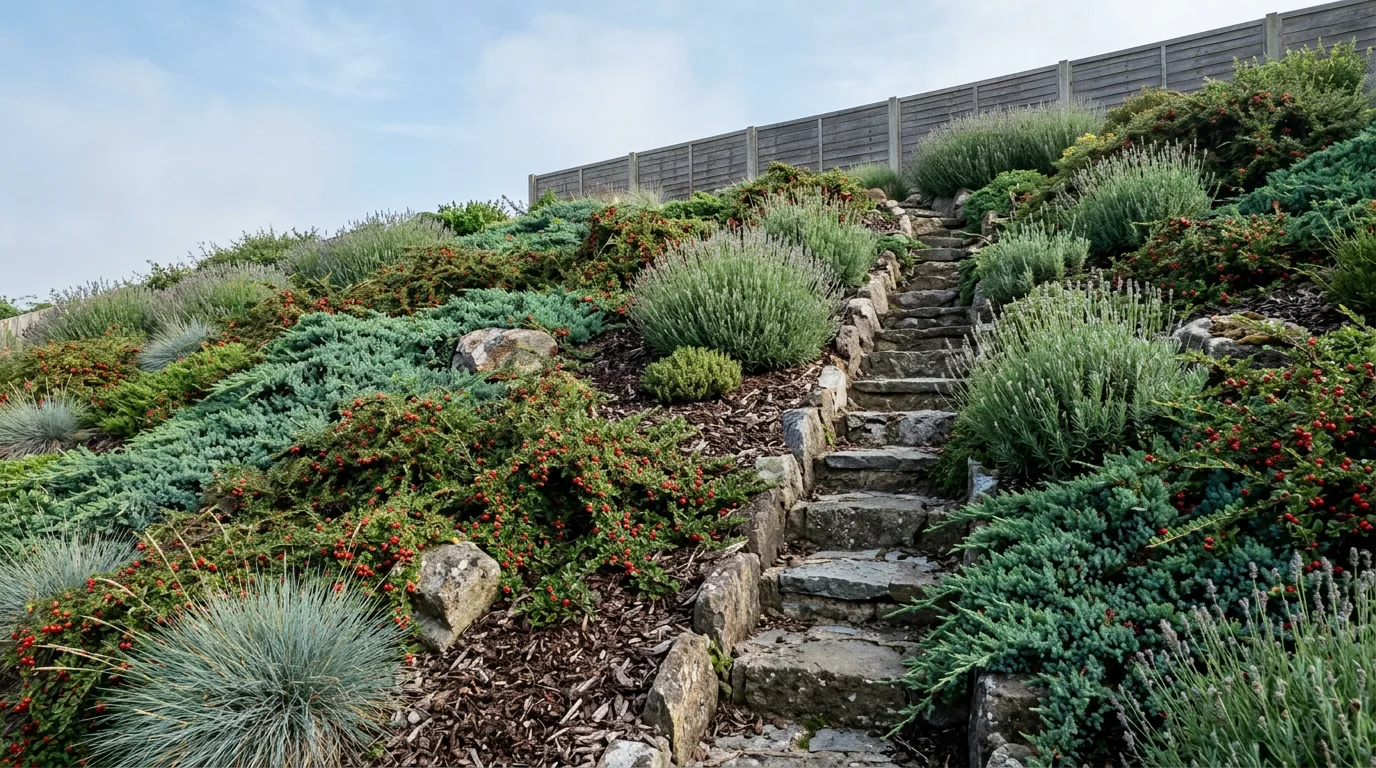
A maintenance path through a slope planting is essential — without one, you compact and damage plants by treading on them to weed, prune, or check irrigation. Set stepping stones slightly below the finished mulch surface so a string trimmer can pass over them. Space them at natural stride length (16–18 inches centre to centre). Irregular flat stones are less formal than pre-cast pavers and read more naturally in a planted slope context.
Mulching on Slopes
Shredded bark is the standard slope mulch — it interleaves with itself and doesn't slide. Apply 2–3 inches and lay biodegradable jute or coir netting over newly planted areas to hold it during the first season. Do not mulch directly against plant stems. Avoid wood chips (round surface, rolls), gravel (holds no moisture, accelerates runoff where it ends), and straw (blows, mats). Replenish mulch annually until groundcovers fully knit; after that, leaf litter does the job.
Irrigation on Slopes
Overhead sprinklers waste water on slopes — most of it runs off before penetrating. Drip irrigation laid along the contour line (horizontally across the slope) is 40–60% more efficient. Use low-flow emitters (0.5–1 GPH) that deliver water slowly enough for the soil to absorb it. For the first season, water twice weekly. After establishment, most drought-tolerant slope species need irrigation only during extended dry spells.
For a broader look at alternatives to grass on slopes, our guide to ground cover plants instead of grass covers options across all gradients and light conditions.
If your project involves significant regrading before planting, visit Hadaa to see how AI renders can help you visualise the finished grade before you break ground.
USDA Zone & Slope Compatibility Table
All 18 species across zone, slope tolerance, and water needs. Scroll horizontally on mobile.
| Plant | Category | USDA Zones | Slope Tolerance | Water Needs | Note |
|---|---|---|---|---|---|
| Creeping Juniper | Groundcover | 3–9 | High | Low | — |
| Crown Vetch | Groundcover | 3–9 | Very High | Low–Med | Check invasive status |
| Cotoneaster | Groundcover | 4–7 | High | Low–Med | — |
| Bearberry | Groundcover | 2–6 | Very High | Low | Native |
| Ice Plant | Groundcover | 5–11* | High | Very Low | *Z9–11 best |
| Pachysandra | Groundcover | 4–8 | Moderate | Medium | Shade |
| Blue Oat Grass | Grass | 4–8 | High | Low | — |
| Miscanthus | Grass | 5–9 | High | Low–Med | Use sterile cvs |
| Pampas Grass | Grass | 7–11 | Very High | Low | Check invasive status |
| Switchgrass | Grass | 4–9 | Very High | Low–Med | Native |
| Muhly Grass | Grass | 6–10 | High | Low | Native SE US |
| Forsythia | Shrub | 5–8 | High | Low–Med | Self-layers |
| Native Sumac | Shrub | 3–8 | Very High | Low | Native |
| Butterfly Bush | Shrub | 5–9 | High | Low | Check invasive status |
| Weigela | Shrub | 4–8 | Moderate | Medium | — |
| Spirea | Shrub | 3–8 | Moderate–High | Low–Med | — |
| Black-Eyed Susan | Perennial | 3–9 | Moderate | Low | Native |
| Daylily | Perennial | 3–9 | Moderate–High | Low–Med | Avoid H. fulva |
| Sedum | Perennial | 3–9 | High | Very Low | Dry slopes |
Invasive status varies by state. Always verify with your county extension office or your state's invasive species council before purchasing.
Visualise Your Slope Before You Plant
One of the practical problems with slope planting design is spatial: groundcovers that look modest at the nursery become dominant masses at scale, and shrubs that fill a flat border read completely differently when stacked up a hillside. Getting the plant palette wrong on a slope is expensive to correct because you have to work against gravity during the correction.
Hadaa's Sketch Engine lets you upload a photo of your slope and render it with your chosen planting scheme before you buy a single plant. The aerial Change Viewpoint feature generates a top-down plan view — useful for understanding how coverage will distribute across the slope face — and an eye-level view from the street, which is how most people actually experience a planted slope.
Both views render the same planting scheme, so you can see whether your groundcover-to-shrub ratio creates the visual weight you want, whether the colour distribution is balanced, and whether the species you've chosen from this list translate into the aesthetic you're aiming for. The tool works from a photo, a sketch, or a satellite image — no CAD skills required.
How It Works for Slopes
- Upload a photo of your slope — current condition, from any angle.
- Sketch or describe your intended planting — species, coverage zones, paths.
- Generate aerial and eye-level renders to see the finished planting from both perspectives.
- Iterate freely — swap species, adjust coverage, try a different colour palette — before committing budget.
Frequently Asked Questions
What plants are best for preventing erosion on a steep slope?
How steep is too steep to plant without hardscape?
Is Crown Vetch safe to plant on my slope?
Do I need to water hillside plants more or less than flat-ground plants?
What mulch works best on a slope without washing away?
What are the best plants to stop hillside erosion?
What ground cover works on a steep slope?
Related Reading
Design
AI Hillside & Slope Garden Design
Render your slope with a full planting scheme before you dig.
Ideas
Hillside Landscaping Ideas
The broader picture: terracing, paths, drainage, and layout.
Hardscape
Retaining Wall Ideas
For grades steeper than 1:1, where planting alone won't hold.
Costs
Slope Landscaping Costs
Budget for terracing, walls, and erosion control.
Plants
Drought-Tolerant Plants: Regional Guide
Low-water species by region — ideal for dry, sunny upper slopes.
Design Your Hillside
See Slope Planting Designs Before You Dig
Upload a photo of your slope and Hadaa renders it with erosion-control planting — aerial and eye-level views. Studio includes a personal onboarding call.


