
Gabion Wall Ideas: The Designer's Guide to Wire Basket Retaining Walls
Francis Karuri
Landscape & AI Correspondent
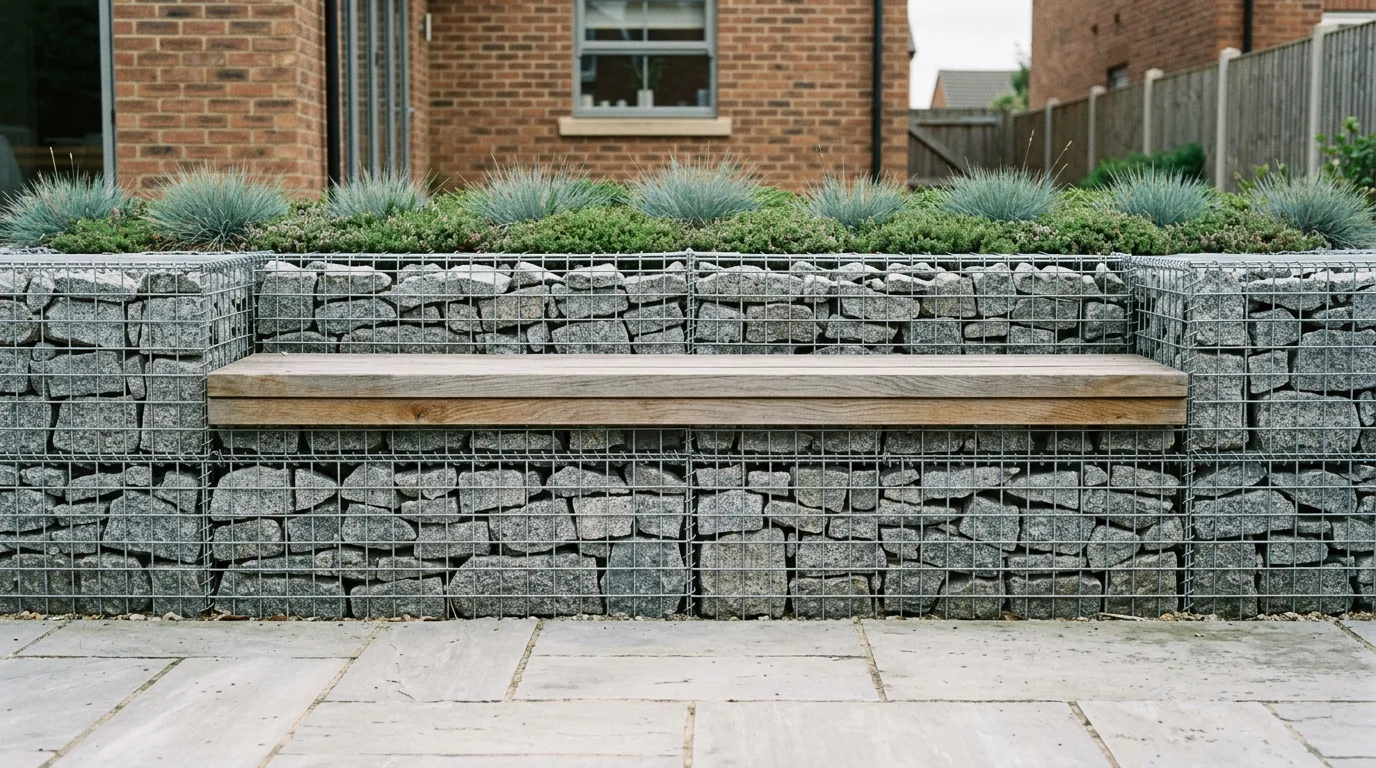
Gabion walls — wire mesh baskets packed with stone — have moved from civil engineering infrastructure to one of the most versatile and design-forward materials in contemporary residential landscaping. They drain naturally, require no mortar, age beautifully, and can be used as retaining walls, free-standing screens, raised beds, seating walls, and garden feature objects. This guide covers every design application from industrial contemporary to naturalistic rustic, the structural engineering principles behind them, the stone and wire specifications that determine longevity, and how to plan the installation before a single basket is ordered.
What Are Gabion Walls — and Why Are They Everywhere Right Now?
Gabion walls have been used in civil engineering for well over a century — lining riverbanks, stabilising road cuttings, and reinforcing coastal defences. The shift into residential landscaping gathered pace in the 2010s as contemporary garden design embraced raw, industrial materials, and homeowners with sloped lots discovered that gabion retaining walls are cheaper to install than poured concrete walls, dramatically faster to build, and far more visually interesting.
The core product is a wire mesh basket — typically welded steel mesh or hexagonal woven wire — available in standard modular dimensions (usually 1m × 1m × 0.5m or 2m × 1m × 0.5m). Baskets are filled with stone on site and stacked, with adjacent units connected by binding wire at their edges. The result is a gravity retaining structure that resists soil pressure through mass, not through tension or mortar.
Their current popularity in garden design is not accidental. Gabion walls satisfy the contemporary appetite for honest materials — you can see exactly what the wall is made of — while offering a textural richness that poured concrete cannot match. They also function well ecologically: the stone fill provides habitat for insects and small reptiles, the permeable structure supports drainage, and the voids can be planted with drought-tolerant species that root directly into the wall face.
Gabion wall advantages at a glance
- Natural drainage — permeable structure eliminates hydrostatic pressure behind the wall
- No mortar — dry construction installs faster and allows flexibility in freeze-thaw conditions
- Material honesty — visible stone fill gives an authentic, handcrafted appearance that concrete cannot replicate
- Ecological value — stone voids provide microhabitat; wall can be planted with sedum and thyme
- Long lifespan — galvanised wire and durable stone fill last 50–80 years with zero maintenance
Gabion Retaining Wall Design: Modern, Rustic & Industrial
Most people searching for gabion walls are really planning a gabion retaining wall design — a structure that holds back a slope, not just a decorative screen. The retaining application is where the design choices carry the most weight, because the wall has to look intentional while doing structural work. The three families below — modern, rustic, and industrial — each handle a gabion retaining wall design differently, and the right one depends on your home's architecture and how much you want the wall to read as engineering versus landscape.
Modern Gabion Retaining Wall Design
A modern gabion retaining wall design treats the stone face as an architectural panel rather than a pile of rubble. The defining moves: welded mesh baskets in dark powder-coated wire, tightly graded angular fill of a single colour (charcoal granite, basalt, or slate), and clean stepped or battered profiles that follow the slope in crisp, deliberate increments. Stone is hand-placed at the visible face so the panel reads as a dense, uniform texture — the "rubble" is hidden inside.
This style pairs naturally with contemporary homes, corten steel, board-formed concrete, and cedar. For a sloped lot, a modern gabion retaining wall design often stacks two or three baskets high with a planted terrace between runs, turning the structural necessity of slope retention into a layered, designed sequence. Keep the wire colour consistent with the home's window frames or roofline metalwork to tie the wall into the architecture.
The engineering behind a tall modern gabion retaining wall design is identical to any gravity retaining structure — correct sizing for the soil load and a free-draining backfill are non-negotiable. For the structural principles that apply across all retaining systems, see retaining wall ideas, and for slope-specific terracing strategy, hillside landscaping ideas.
Contemporary / Architectural
The dominant gabion aesthetic in new-build gardens. Welded mesh baskets in dark powdercoat wire, filled with tightly graded dark granite or slate. Stone is selected for consistency of colour and angular regularity so the wall face presents as a dense, textured panel rather than a casual heap. Works best with steel, concrete, and cedar — materials that share the same industrial honesty. Corten steel planter boxes and gabion walls make natural companions.
Best for
Modern homes with clean lines; garden rooms; pool surrounds; courtyard gardens where the wall is a feature element, not a background one.
Rustic / Naturalistic
Softer, less precise, and genuinely beautiful over time. Hexagonal woven wire (closer to traditional gabion engineering mesh) filled with locally sourced mixed stone — rounded and angular, multiple tones. The wall is planted at the face with sedum, thyme, and creeping herbs that root into the voids. Within two to three seasons it looks as if the wall has grown from the ground. Best suited to country gardens, cottage gardens, and rural properties where informality is an asset.
Best for
Rural and semi-rural settings; cottage gardens; sloped gardens where the wall is a structural necessity that benefits from softening.
Industrial / Urban
The most provocative version. Gabion baskets filled with reclaimed materials — broken concrete, brick rubble, glass bottles, industrial ceramics. Used in urban regeneration projects and avant-garde garden design to make a statement about waste and materiality. Practically, recycled concrete fill is free (demolition waste), performs well structurally, and weathers over time to develop a patina that looks increasingly designed rather than scavenged.
Best for
Urban back gardens; show gardens; walls where the design intention is explicitly about materiality and sustainability rather than naturalism.
Eight Ways to Use Gabion Baskets in a Garden
The modular nature of gabion baskets means one product serves almost every structural and feature application in the garden. The following eight uses cover the full range from large engineering structures to small decorative elements.
1. Retaining walls
The structural use case. Gravity-based soil retention for sloped yards. Requires correct sizing for soil load and drainage behind the wall.
2. Free-standing screen walls
Privacy screens and garden dividers without a retained soil load. Can be thinner (500mm) than retaining walls and allows more design freedom.
3. Raised garden beds
Gabion basket sides with topsoil fill. Outstanding drainage, thermal mass that warms early-season soil, and a look that suits kitchen gardens.
4. Seating walls
Low gabion walls (400–500mm) capped with hardwood, granite slab, or porcelain serve as permanent seating around patios and fire pit areas.
5. Steps and terracing
Gabion risers create chunky, architectural steps on sloped gardens. The stone fill must be tightly packed to prevent movement under foot traffic.
6. Garden feature objects
Single baskets as standalone focal points: a boulder-scale stone cube at a path junction, a lit plinth for a sculpture, a textured planter base.
7. Water features
Gabion cages encasing water reservoir tanks or as the face of a rill or cascade. Water weeping through stone fill creates a naturalistic visual effect.
8. Noise and wind baffles
The mass and irregular surface of gabion walls absorbs rather than reflects sound — useful as boundary walls adjacent to roads or neighbouring properties.
Stone & Wire Specification: What Determines How Long Your Wall Lasts
Gabion walls have a reputation for low maintenance because the stone is inherently durable — but the wire cage is what determines actual lifespan. Specifying the right wire for your climate and conditions is the most important decision in the entire project.
Wire types by environment:
Galvanised steel (80 g/m² zinc) — standard residential
The default specification. Suitable for most inland residential environments. Expected lifespan 50–80 years. The most cost-effective option for the majority of projects.
PVC-coated galvanised wire — coastal and high-rainfall
An outer PVC coating over a galvanised core provides dual corrosion protection. Recommended within 5km of the coast and in regions with high annual rainfall. Available in green, black, and anthracite — colour can be matched to the design palette.
Galfan-coated wire — premium specification
Galfan (zinc-aluminium alloy coating) offers 3–5x the corrosion resistance of standard galvanising and is specified for engineering-grade retaining walls and coastal environments. More expensive but a significant upgrade in durability for permanent structural applications.
Stainless steel — extreme environments
Grade 304 or 316 stainless steel wire is specified for marine environments, exposed coastal cliffs, and permanent public realm structures. Indefinite lifespan; 30–40% cost premium over PVC-coated. Rarely necessary for residential garden use unless within 100m of the sea.
Stone sizing: The fill stone must be larger than the mesh aperture. For standard 80×100mm welded mesh, use stone 100–200mm nominal size. Undersized stone passes through the mesh; oversized stone creates large voids that reduce the wall's stability and visual density. For premium contemporary walls, tightly graded 100–150mm angular stone of a single colour produces the cleanest result.
Stone hardness: Granite, basalt, and quartzite are the hardest and most durable fill stones. Limestone is softer and dissolves very slowly in acid rain — not a problem in alkaline regions, but worth considering in areas with highly acidic rainfall. Sandstone should not be used as structural fill; it is too soft and degrades over time.
Gabion Wall Detail: What the Engineering Standards Actually Require
Almost every gabion article online is a gallery. None of them tell you what a specified gabion wall has to do to pass inspection — and a garden wall built to a highway specification is a garden wall that outlives its owner. Two public documents govern gabions in the United States, and both are free to read.
The product standards. ASTM A974 covers welded-wire-fabric gabions and gabion mattresses; ASTM A975 covers double-twisted hexagonal mesh gabions and revet mattresses. Both cover metallic-coated (galvanised) wire and PVC-coated wire, and both cover the lacing wire, stiffeners and fasteners as well as the baskets. If a supplier cannot tell you which of the two their baskets are made to, that is the whole answer about the supplier.
The workmanship standard. TxDOT Item 459, “Gabions and Gabion Mattresses” (2024 Specifications) is a state highway specification, which makes it public, current and unusually specific. The numbers below are lifted from it. They are written for bridge abutments and channel linings, so they are conservative for a 900 mm garden wall — but they are the only published numbers a homeowner can hold a contractor to.
Fill stone size is set by cage height, not by mesh opening
The rule most blogs give — “use stone larger than the mesh aperture” — is a floor, not a specification. TxDOT sizes fill by the height of the cage, because a deep basket carries more load per stone and needs a coarser, more interlocked fill:
| Unit | Cage height | Min stone | Max stone |
|---|---|---|---|
| Gabion mattress | 6 in. (150 mm) | 3 in. (75 mm) | 5 in. (125 mm) |
| Gabion mattress | 9 in. (230 mm) | 3 in. (75 mm) | 5 in. (125 mm) |
| Gabion mattress | 12 in. (300 mm) | 4 in. (100 mm) | 8 in. (200 mm) |
| Gabion | 12 in. (300 mm) | 4 in. (100 mm) | 8 in. (200 mm) |
| Gabion | 18 in. (450 mm) | 4 in. (100 mm) | 8 in. (200 mm) |
| Gabion | 36 in. (900 mm) | 4 in. (100 mm) | 8 in. (200 mm) |
Source: TxDOT 2024 Standard Specifications, Item 459, Table 2. Metric equivalents are rounded.
The stone itself has to pass two tests
Item 459 rejects filler stone with a five-cycle magnesium sulfate soundness loss above 18%, and requires a minimum bulk specific gravity of 2.50. In plain terms: the stone must survive repeated wetting and freezing without shedding, and it must be dense enough that the wall's own weight does the retaining. Shale, caliche and other soft particles are excluded outright. This is the number to ask a stone yard for — granite, basalt and quartzite clear it comfortably; a soft local sandstone often does not, which is why sandstone fails as structural gabion fill even though it looks the part on day one.
Six build rules worth holding a contractor to
Fill in 12 in. courses, and keep neighbouring cells level
Fill baskets in a row in stages of no more than 12 in. (300 mm), and never let one cell run more than 1 ft. deeper than the cell beside it. Uneven filling is what pushes a mesh face out of plumb, and it cannot be corrected once the lid is closed.
Never drop stone more than 36 in.
Stone dropped from height dents the mesh and chips the zinc or PVC coating — the two things keeping the wall alive. Item 459 caps the drop at 36 in. (900 mm) and requires hand placement on all exposed faces.
Two internal connecting wires per stone layer, above 2 ft.
Any gabion unit more than 2 ft. (600 mm) high needs two uniformly spaced wires per layer tying the back face to the front face, looped around two mesh openings (or a welded joint) at each face and twisted off. This is the single most common omission in DIY gabion walls, and bulging faces are the result.
Overfill the last layer by 1–2 in.
Counter-intuitively, the top layer is deliberately overfilled — 1–2 in. (25–50 mm) for gabions, 1 in. for mattresses — to compensate for the stone settling later. Fill flush and you get a dished top course within a season.
Lace at 5 in. intervals, alternating single and double loops
Where lacing wire is used, Item 459 requires continuous stitching with alternating single and double loops at no more than 5 in. (125 mm) centres, with terminals securely fastened. Spiral binders are the quicker equivalent.
Don't fit PVC-coated baskets in the cold
PVC-coated wire may only be placed when both the air and the wire are more than 15°F (8°C) above the PVC's brittleness temperature. Fitting coated mesh on a frosty morning cracks the coating at every bend, and the crack is where the corrosion starts.
Connection strength: the number that separates a wall from a pile of baskets
A gabion wall is monolithic only if the baskets are joined to each other before filling. Item 459 sets a minimum panel-to-panel connection strength of 1,400 lb./ft. for galvanised gabions, 1,200 lb./ft. for PVC-coated gabions and 700 lb./ft. for gabion mattresses, and applies that figure to every connection including end panels, diaphragms and lids. If a supplier offers clips or alternative fasteners, this is the figure their certification has to meet. Twisted-wire baskets must be joined selvage-to-selvage or selvage-to-edge — never mesh-to-mesh — except where baskets are offset or stacked.
When a residential gabion wall needs a permit
The threshold most US jurisdictions inherit comes from the International Building Code, Section 105.2, Work exempt from permit: retaining walls not over 4 feet (1,219 mm) in height, measured from the bottom of the footing to the top of the wall, are exempt — unless the wall supports a surcharge, or impounds Class I, II or IIIA liquids.
Two details catch people out. The first is where the measurement starts: from the bottom of the footing, not from the ground you are standing on. A gabion wall showing 3 ft. 6 in. of face above a 12 in. excavated and compacted base is a 4 ft. 6 in. wall to the building department, and needs a permit. The second is surcharge — any additional load bearing on the retained soil: a slope continuing up behind the wall, a driveway, a patio, a pool, a shed, a neighbouring foundation. A surcharged wall is outside the exemption at any height, which is why "it's only three feet" is not the end of the conversation on a sloping site.
Jurisdictions amend this freely — some cities drop the threshold to 3 ft., some require a permit for any retaining wall in a setback — so confirm the figure with your own building department before you order baskets. Where a wall is engineered, expect the drawings to call up an ASTM A974 or A975 basket by style number, a filter fabric or granular filter behind the face, and the drainage detail that makes the whole thing work.
Construction: What Professional Installation Involves
Gabion wall installation is physically demanding but not technically complex for walls under 1 metre. Professional contractors are essential for retaining walls over 1 metre due to the soil load engineering required. Here is the standard construction sequence for a residential retaining wall:
Step 1 — Excavation and base preparation. Excavate to 150–300mm below the finished base level of the wall, depending on frost risk and soil conditions. Compact a 150mm layer of Type 1 granular fill (hardcore) and check it is level in both directions.
Step 2 — Geotextile membrane. Line the cut face behind the wall with a non-woven geotextile membrane before filling. This prevents soil migration through the wall while still allowing water to drain freely.
Step 3 — Basket assembly and placement. Assemble the base layer of baskets in position (flat-packed baskets fold up and are tied at the corners with connecting wire). Baskets in a row are tied together along their shared edges before filling begins.
Step 4 — Fill in layers. Fill each basket in 300mm layers, placing cross-tie wires at each layer to prevent the mesh faces from bulging outward under the stone weight. Compact lightly between layers. Overfill the final layer by 25–50mm rather than filling flush: the stone settles, and a flush-filled top course dishes within a season (TxDOT Item 459).
Step 5 — Lid closure. Fold the basket lid down and secure it along all four edges with connecting wire or spiral binders. Stack the next layer of baskets and repeat.
Step 6 — Backfill and drainage. Backfill behind the completed wall with compacted granular material. The geotextile membrane keeps soil separate from the drainage fill; water drains through the gabion wall face rather than pooling behind it.
Visualising the finished wall before construction starts — particularly the height, face profile, and relationship to planting — is straightforward using Hadaa's AI design tool. Upload a photo of your sloped yard and generate renders showing gabion retaining walls in different heights and stone fills against your actual garden backdrop.
Planting Integration: How to Soften a Gabion Wall Naturally
A gabion wall straight out of installation looks industrial. A gabion wall after two seasons of planted sedum, thyme, and creeping phlox looks as if it has always been part of the landscape. The planting strategy depends on the wall's design style and the level of softening intended.
Face planting — push plugs of sedum, thyme, or alyssum into the stone voids between the outer and inner layers during construction, before the baskets are topped up. They root into the soil-filled gaps and colonise the face over time. This works best with rustic and naturalistic gabion styles; contemporary walls may deliberately avoid face planting to preserve the clean stone panel aesthetic.
Base planting — planting at the foot of the wall face creates a visual transition between the hardscape and the softscape. Ornamental grasses (Karl Foerster, Blue Oat Grass), lavender, and trailing rosemary work well. Keep root systems at least 300mm from the wall base to prevent displacement of the stone fill over 10–20 years.
Top and behind the wall — the bank behind and above a retaining wall benefits from ground covers that hold soil: creeping juniper, vinca minor, native ferns, or ornamental grasses. These stabilise the retained bank, reduce erosion, and create a layered visual composition with the wall below.
Avoid bamboo, willow, and other aggressive root systems within 1 metre of a gabion wall — over time they can displace stone fill and compromise the structural integrity of the mesh.
Frequently Asked Questions
How long do gabion walls last?
What stone should I use to fill a gabion wall?
Do gabion walls need a foundation?
What is the difference between a gabion wall and a gabion basket?
Can I build a gabion wall myself?
Are gabion walls permeable?
What plants work well with gabion walls?
How much do gabion walls cost?
Visualise your sloped garden
See your gabion wall design before construction starts.
Upload a photo of your current slope to Hadaa and get photorealistic renders showing gabion retaining walls in different heights, stone fills, and planting schemes — in under two minutes.


