
Deck vs. Patio: Which Costs Less and Adds More Value to Your Home?
Winnie Astrid
Garden Design Editor
The deck-vs-patio debate sounds simple until you price it. A 400 sq ft poured-concrete patio can cost $5,000 while the same square footage in composite decking runs $18,000 — but the reverse is true on a sloped lot where ground prep costs make a patio the expensive option. This guide runs the real numbers on both, by material and terrain, so you can make a decision based on your actual yard rather than generic averages.
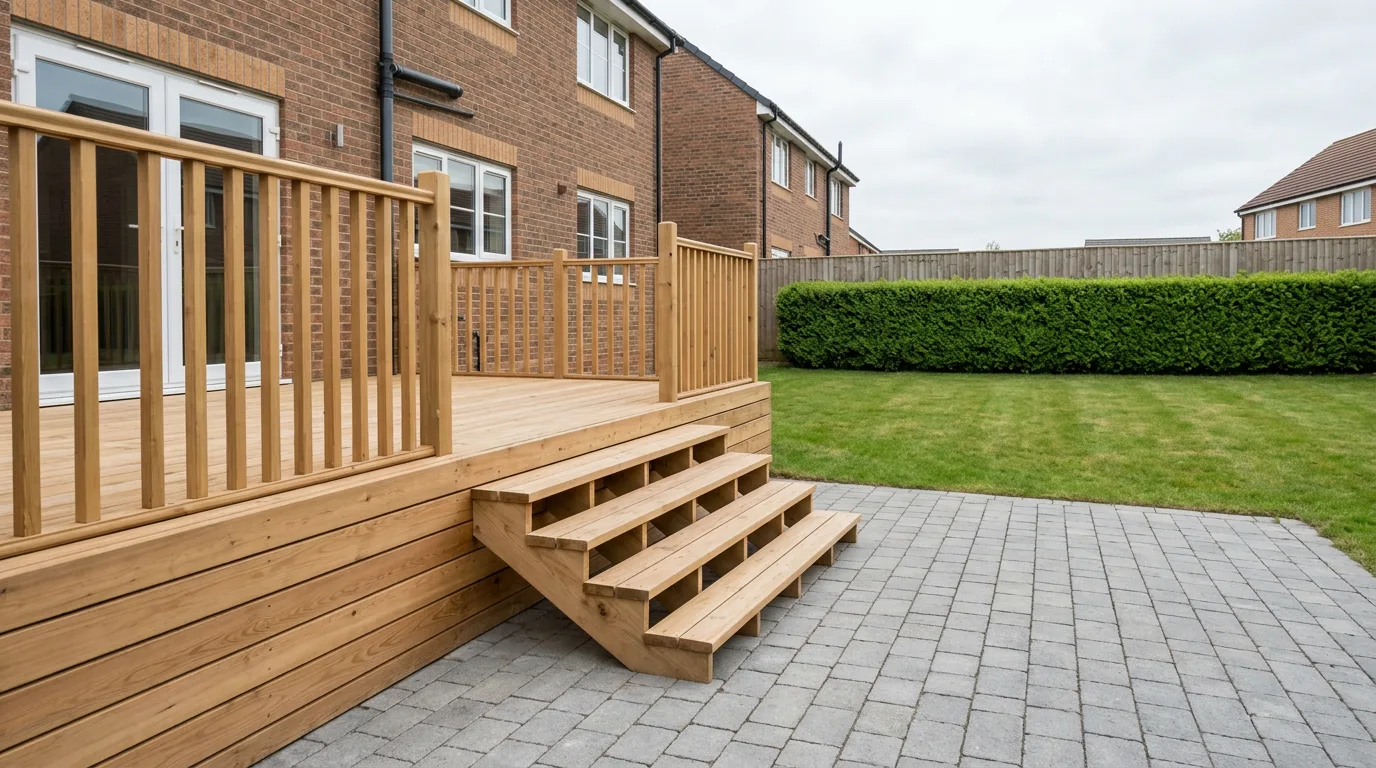
Cost comparison: deck vs. patio by material
The most useful comparison is cost per square foot — installed, with labour. Headline numbers for a 400 sq ft project:
| Surface type | Cost per sq ft | 400 sq ft total | Labour % |
|---|---|---|---|
| Gravel patio | $1–$4 | $400–$1,600 | 30% |
| Concrete patio | $8–$18 | $3,200–$7,200 | 50% |
| Stamped concrete | $12–$22 | $4,800–$8,800 | 55% |
| Paver patio | $15–$30 | $6,000–$12,000 | 60% |
| Natural stone patio | $25–$50 | $10,000–$20,000 | 55% |
| Pressure-treated wood deck | $15–$25 | $6,000–$10,000 | 60% |
| Cedar / redwood deck | $20–$35 | $8,000–$14,000 | 55% |
| Composite deck | $30–$60 | $12,000–$24,000 | 55% |
These are flat-site numbers. Add 15–30% for sloped-lot ground prep on patios, or 10–20% for elevated post-and-beam framing on decks above 4 feet. Permits typically add $500–$1,500 for decks; most ground-level patios don't require one.
The key insight: on flat ground, concrete or pavers almost always cost less than a deck at equivalent quality tiers. The exception is when you're comparing a basic pressure-treated deck against natural stone — they land at similar price points.
Deck materials: pressure-treated vs. composite vs. hardwood
Pressure-treated wood
The entry-level deck material. Chemically treated pine is rot and insect resistant, structurally sound, and universally available. It requires sealing or staining every 2–3 years to maintain appearance and prevent cracking. Freshly installed PT wood has a greenish cast that weathers to grey over 6–12 months unless stained.
Where PT decking falls short: its appearance is utilitarian. Without consistent staining, it looks tired within a few years. It's the right choice when budget is the primary constraint or when the deck will be covered or painted.
Verdict
Best for: tight budgets, decks that will be painted or covered, rental properties. Skip it if curb appeal and resale ROI are priorities.
Composite decking
Wood-plastic composite (WPC) boards require no staining, no sealing, and no sanding. Wash annually with a hose. They look consistently good for decades and most premium composites carry 25-year warranties. Colour selection now closely mimics natural hardwoods.
The premium cost is real — roughly 2–3x a PT deck upfront. But over 20 years, factor in zero maintenance labour and no material replacement: composite often costs less in total than PT once you account for the annual maintenance bill.
Verdict
Best for: primary entertaining space, high-visibility locations, homeowners who want set-and-forget maintenance. The highest resale ROI deck option.
Visualise your deck design with Hadaa →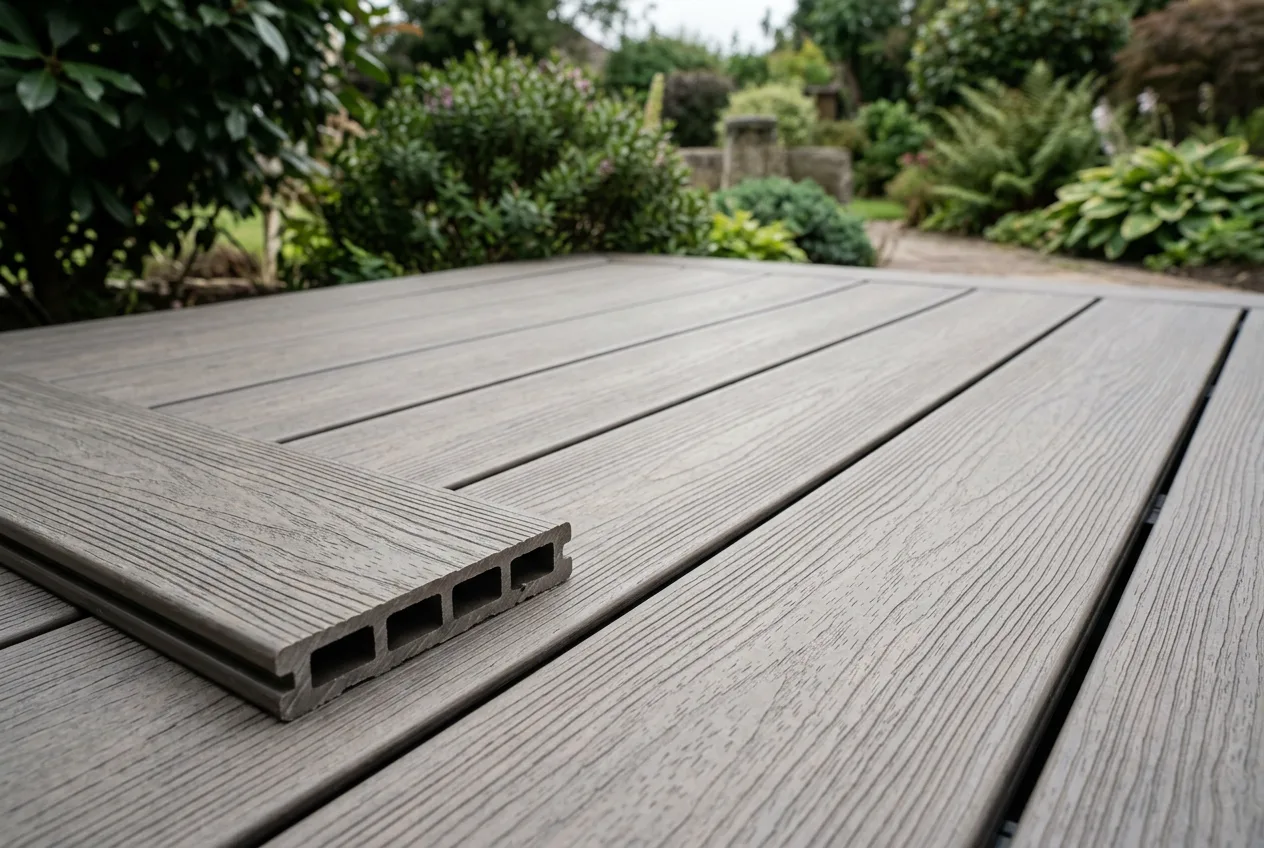
Patio materials: concrete vs. pavers vs. natural stone
Patios offer more material variety than decks. Each material has a distinct cost, aesthetic, and maintenance profile — and the right choice depends on your design vision as much as your budget.
Poured concrete — the practical default
At $8–$18/sqft, poured concrete is the most affordable hard surface for a patio. It's fast to install, durable, and can be broom-finished, exposed-aggregate, or stained. Drawbacks: cracks over time (especially in freeze-thaw climates), and individual cracks can't be repaired invisibly. Best in warm, stable climates.
Concrete pavers — the flexible upgrade
Pavers ($15–$30/sqft) cost more than plain concrete but offer a huge design advantage: individual pavers can be replaced if one cracks or stains. They're also permeable when dry-set on sand, which reduces runoff. Pattern options (herringbone, basket weave, running bond) add visual interest at no extra cost.
Natural stone — the premium finish
Bluestone, flagstone, and travertine ($25–$50/sqft) deliver a finish that ages beautifully and photographs exceptionally well. They're the highest-cost patio option but also command the strongest visual impact and resale response. Irregular flagstone requires more skilled labour; calibrated stone (consistent thickness) is faster to install.
ROI at resale: what the data actually shows
Most deck-versus-patio ROI tables on the web are built by splicing two different studies together, and the splice is where the numbers go wrong. Remodeling's Cost vs. Value Report covers a wood deck addition and a composite deck addition — and no patio at all; its exterior line items are siding, decks, windows, roofing, garage doors and stone veneer. The study that does price a patio and a deck side by side, under one methodology, is the 2023 Remodeling Impact Report: Outdoor Features from the National Association of REALTORS® and the National Association of Landscape Professionals.
Its method matters when you read the figures: landscape professionals estimated the cost of a named project spec, and REALTORS® estimated the value recovered at resale. Both are survey estimates of one defined project, not a national average of what anyone actually spent.
| Project (NAR/NALP 2023) | Cost estimate | Value recovered | Cost recovery |
|---|---|---|---|
| New patio — 18 × 16 ft concrete pavers, dry set | $10,500 | $10,000 | 95% |
| New wood deck — 14 × 18 ft cedar, ledger-attached | $16,900 | $15,000 | 89% |
| Outdoor kitchen | — | — | 100% |
| Overall landscape upgrade | — | — | 100% |
| Landscape lighting | — | — | 59% |
| Fire feature | — | — | 56% |
| In-ground pool addition | — | — | 56% |
The patio beats the deck, and this page used to say otherwise
On the one dataset that measures both, the patio recovers more of its cost than the deck — 95% against 89% — and it does so on a project costing $6,400 less. That is the opposite of the conclusion most ROI tables reach, including the one this page carried until October 2026, which put a composite deck top and patios last at 57–62%. Those patio percentages appear in neither study; the Cost vs. Value Report has no patio line item to take them from.
The honest version of the comparison is therefore narrower than the usual claim. Both projects return most of their cost. The deck returns a larger number of dollars ($15,000 against $10,000) because it is a bigger project, and the patio returns a larger share of what you put in. Neither is "the investment choice" — the spread between 89% and 95% is well inside the noise of a survey of estimates, and well inside the swing your own site conditions will produce.
What the report does separate clearly is enjoyment: the patio scores a Joy Score of 9.9 and the wood deck 9.8, both near the top of the eleven outdoor projects surveyed, and 85% of patio owners reported an increased sense of enjoyment at home. If resale is a tie, pick the one you will use.
One more thing the table hides: cost recovery scales with how routine the work is. The same report puts standard lawn care service at 217% recovery and landscape maintenance at 104% — both far above either hard surface — so if the goal is strictly the resale number rather than the space, the money goes further on maintenance than on construction.
Before committing to a material, use Hadaa's AI design tool to see how a deck or patio will look in your specific yard. Seeing it rendered in your actual space removes guesswork and helps you compare options visually before spending a dollar on construction.
The terrain factor: when a slope changes everything
Terrain is the variable most cost guides ignore. On a flat lot, patio materials are almost always cheaper per square foot than decking. On a sloped lot, a patio may require excavation, grading, retaining walls, and drainage — easily adding $3,000–$10,000 in site prep before a single paver goes down.
Grade rule of thumb: if your lot drops more than 6 inches across the planned project area, get a patio and deck quote from the same contractor and compare the full installed price including site prep. Don't compare raw material costs.
A deck on a sloped site simply sets posts at different depths — no earthmoving required. This is the primary reason decks dominate in hilly regions: the structure spans the terrain problem rather than solving it.
Deck framing on steep slopes does increase lumber and labour costs. A deck 4+ feet above grade also requires larger posts, cross-bracing, and (in most municipalities) an engineer-stamped permit. Expect to add 15–25% to flat-site deck pricing for elevated builds.
Decking vs patio: the same question with different words
If you searched decking vs patio rather than deck vs patio, you are almost certainly in the UK, Ireland, Australia or New Zealand, and the vocabulary shifts under you. Decking is the timber (or composite) platform — the boards and the frame — where American usage says "deck". Patio in British usage means the paved area at ground level, usually called paving or a paved terrace by trade; in American usage "patio" covers the same thing. So is decking cheaper than a patio and is a deck cheaper than a patio are one question, and everything above answers it.
One thing does genuinely differ, and no US-framed cost comparison mentions it: in England, decking has a height limit before it needs planning permission, and paving at grade does not.
The 30 cm rule (England)
Under permitted development, the Planning Portal states decking does not need an application provided that:
- "The decking is no more than 30cm above the ground";
- "Together with other extensions, outbuildings etc, the decking or platforms cover no more than 50 per cent of the garden area";
- "None of the decking or platform is on land forward of a wall forming the principal elevation."
Stricter limits apply in National Parks, Areas of Outstanding Natural Beauty, listed building curtilages and Article 2(3) land. Scotland, Wales and Northern Ireland run their own regimes — check locally rather than assuming the English figure.
Why it changes the costing: 30 cm is a low step. A deck built off a raised ground floor, over a sloping garden, or to meet a back door sill is frequently above it, and then the comparison picks up an application fee, a wait, and a non-trivial chance of refusal — none of which a paved terrace at grade incurs. On a sloping plot, the thing that makes decking cheap in the United States (posts at different depths instead of earthworks) is the same thing that pushes it through the English threshold.
The other practical divergence is climate rather than law. Softwood decking in a wet, mild maritime climate stays damp for longer and grows algae, which is a slip risk on boards and not on a textured paving slab — so the maintenance figures in the next section sit at the top of their range in the UK and Ireland rather than the middle. Grooved or anti-slip decking and an annual wash are the usual answers.
If you are weighing the two on a plot that slopes, read the terrain section above first: it is the variable that decides the answer in both vocabularies, and it does so more strongly than the material does.
20-year maintenance: the number most quotes leave out
Upfront cost comparisons miss the most important number: total cost of ownership over 15–20 years. Maintenance transforms the economics significantly for wood surfaces.
Estimated 20-year maintenance costs (400 sq ft)
- Pressure-treated wood deck: $3,000–$6,000 in sealing, staining, board replacement. Plus 1 full deck re-deck at year 18–20 on heavily used surfaces: $4,000–$8,000. Total 20-year maintenance: $7,000–$14,000.
- Composite deck: Annual wash, occasional spot clean. Total 20-year maintenance: $400–$800. No re-decking required within 20 years with a quality brand.
- Concrete patio: Joint sealing every 3–5 years; possible crack repair once. Total 20-year maintenance: $500–$1,500.
- Paver patio: Re-sanding joints every 3–4 years; weed treatment; occasional paver reset. Total 20-year maintenance: $600–$2,000.
When you add 20-year maintenance to upfront cost, a composite deck ($14,000 upfront + $600 maintenance = $14,600) often costs less over two decades than a pressure-treated deck ($7,000 upfront + $10,000 maintenance = $17,000). The patio retains its cost advantage, but the gap with composite decking shrinks substantially once maintenance is factored in.
Design before you build: see it in your yard first
One of the costliest mistakes in outdoor renovation is committing to a surface material based on photos in a brochure — and then discovering it doesn't read well in your specific space, against your house colour, or with your existing landscaping. Refunds on installed patios and decks don't exist.
Hadaa lets you upload a photo of your existing yard and generate photorealistic renders showing a deck, patio, or both — in any material, any colour, with or without surrounding planting. You can compare composite decking against a paver patio side by side in your actual space before committing to either.
Designers using Hadaa report that clients who see a visual representation of their outdoor space before receiving a quote are significantly more likely to approve the project — and significantly less likely to request changes after construction begins.
Frequently Asked Questions
Is a deck or patio cheaper to build?
Is decking cheaper than a patio in the UK?
Does a deck or patio add more home value?
How long does a wood deck last compared to a patio?
Which is better for a sloped yard — deck or patio?
Do I need a permit for a deck or patio?
What is the cheapest patio material?
Can I build a deck or patio myself to save money?
How do I decide between a deck and a patio?
Can I build a deck over an existing concrete patio?
Design before you build
See your deck or patio in your actual yard before spending a dollar.
Upload a photo of your outdoor space and get photorealistic renders comparing deck and patio materials — in your specific yard, with your existing house and garden context.


